
Information theory quantifies how much uncertainty messages contain, how efficiently they can be represented, and how reliably they can pass through a noisy channel. Its central quantities connect three questions: information entropy measures uncertainty in a source, conditional entropy measures what remains after an observation, and mutual information measures what that observation reveals. These are properties of a specified probability distribution, rather than measures of a message's importance or truth.
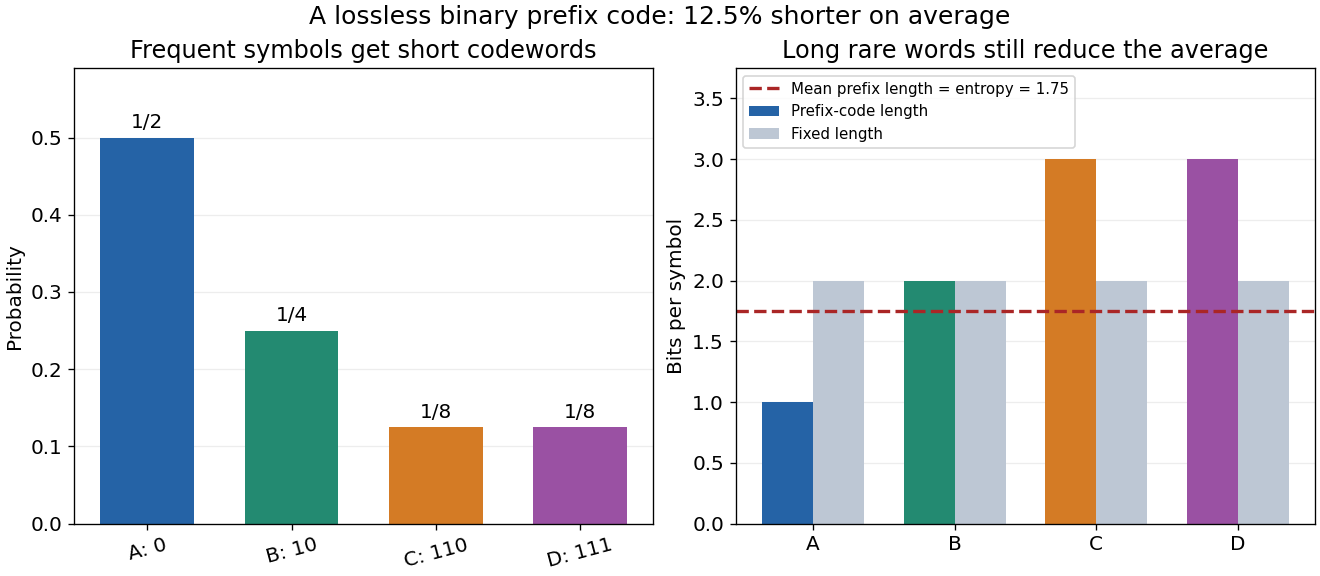
For a concrete source, suppose symbols have probabilities . A fixed-length binary representation needs two bits per symbol. Instead assign the prefix code , , , . Reading from left to right gives an unambiguous decoding because no codeword begins another. The expected value of the length isThis saves an average of of a bit per symbol, or of the fixed-length representation, with no loss of symbols. The lengths are exactly , so the average equals the source's Shannon entropy. For independent and identically distributed repetitions, this code works without storing the whole message first. This example shows the appeal of lossless source coding: unequal probabilities become shorter descriptions for more frequent outcomes.
Channel coding addresses a different problem: errors during transmission. A shorter representation removes predictable structure; an error-correcting representation adds carefully chosen structure that helps recover corrupted symbols. Shannon's source coding theorem and the Shannon second coding theorem identify limits for these respective tasks under their hypotheses. The beauty is that source details and hardware details can meet through a small number of mathematical quantities, notably information entropy and channel capacity.
Claude E. Shannon's A Mathematical Theory of Communication appeared in the Bell System Technical Journal in July and October 1948. Its introduction separates the engineering problem of reproducing messages from their semantic meaning; subsequent sections develop probabilistic source models, noiseless coding, and transmission with noise. It also acknowledges earlier work by Harry Nyquist and Ralph Hartley.[ref]

Information theory is a branch of applied mathematics and electrical engineering that deals with the quantification, storage, and communication of information. It was founded by Claude Shannon in his groundbreaking 1948 paper, "A Mathematical Theory of Communication." The field has since grown to encompass various aspects of information processing and transmission. Key concepts in information theory include: 1. **Information**: This is often quantified in terms of entropy, which measures the uncertainty or unpredictability of information content. Higher entropy indicates more information.


New to topics? Read the docs here!