Model a finite solenoid as a continuum of coaxial turns shaped as circles of radius , uniformly distributed over length with solenoid turn density . Put its centre at , so its ends are . With the same electric current orientation as in the long-solenoid approximation, its axial magnetic field isThis formula applies only on the axis, where symmetry cancels the transverse magnetic field. It does not describe points off the axis. It is exact for the continuum circular-turn model, which neglects winding thickness, discrete wire spacing, and helical advance. [ref].
The derivation is an especially direct use of the superposition principle. The on-axis magnetic field of a circular current loop at source position is . There are turns in an axial slice, soSubstitute and use the antiderivative to obtain the displayed expression. If the centre is instead at , replace every in that expression by .
At the centre and at either end, respectively,For aspect ratios , the centre ratios are approximately . The end ratio tends to as becomes large, even though the centre ratio tends to . Thus a long coil can have an excellent central magnetic field while the ends still differ strongly from that value. Convergence to the long-solenoid approximation is not uniform across the end region.
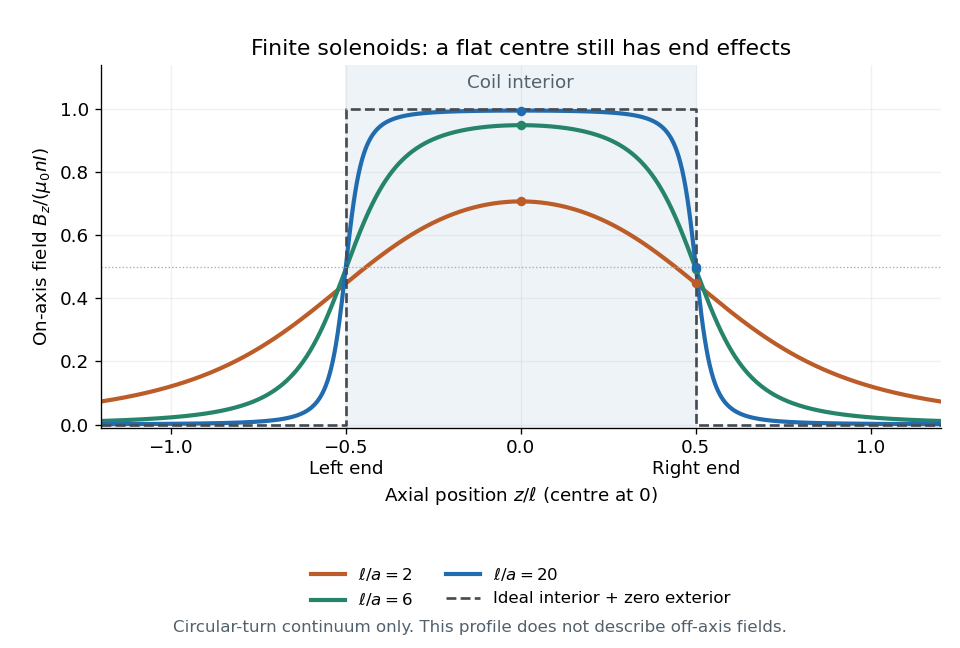

For a concrete geometry, give the earlier coil radius , so . Its central magnetic field is approximately , its end value is , and at its axial magnetic field is still . The last point is outside the coil: finite length does not permit the zero-exterior conclusion of the infinite model. Off the axis, the magnetic field lines bend around to form the return field. A central axial value alone also does not determine the total magnetic flux through every turn of a short coil.
Articles by others on the same topic
There are currently no matching articles.