Prescribe constant magnetization , with , inside a circular cylinder of radius and length , surrounded by zero magnetization. In cylindrical coordinates, the outward unit normal on the curved surface is , soThe endcaps have outward unit normals and . Their cross products with magnetization vanish, so on each endcap. The side bound current circulates counterclockwise when viewed from , by the right-hand rule. Zero endcap surface current density does not imply zero endcap magnetic field.
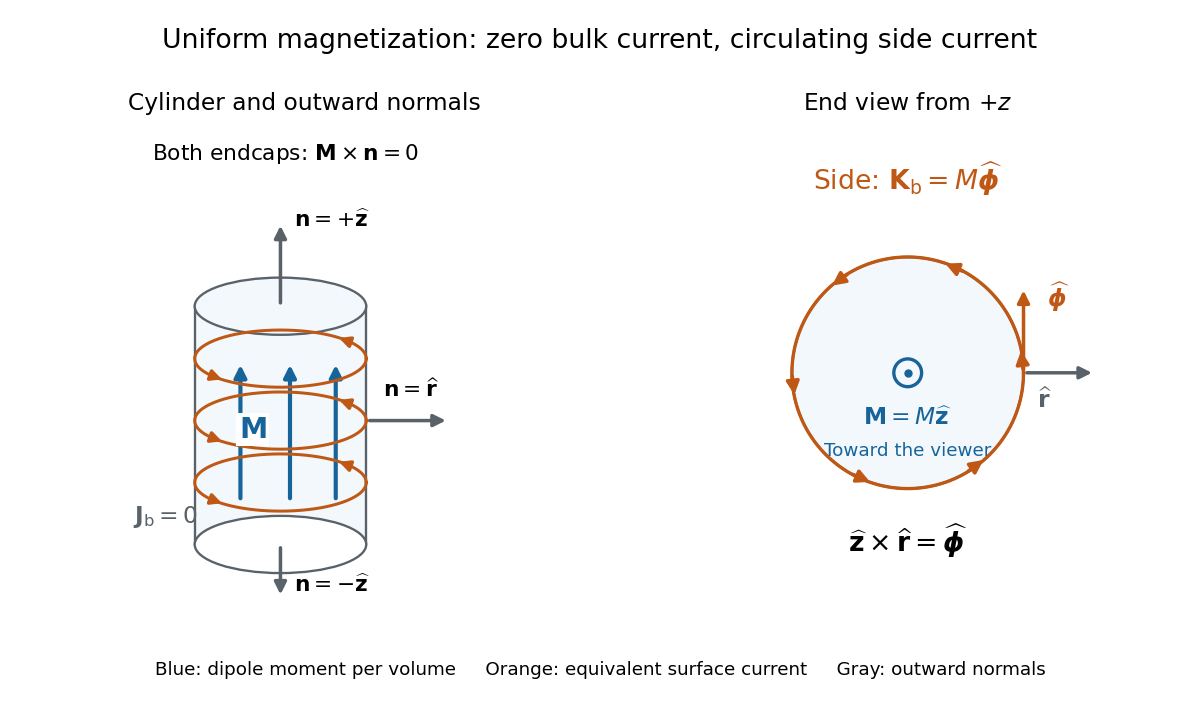

For an original example, let , , and . The volume and total magnetic dipole moment areCheck the result independently using the equivalent bound current: a side strip of axial length forms a current loop with and magnetic dipole moment . Its integral over gives the same . In particular, is the sum of the equivalent loop electric currents across a full axial cut; it is not a surface current density.
The side surface current density has exactly the geometry of a continuum solenoid with , where is solenoid turn density. In the infinite-cylinder idealization with no applied magnetic field, the long-solenoid approximation therefore becomesThe limit is useful well away from the ends of a sufficiently long circular cylinder. A finite circular cylinder instead has fringing magnetic field and a demagnetizing field. For this prescribed uniform magnetization, integrate the on-axis magnetic field of a circular current loop, or substitute in the on-axis magnetic field of a finite solenoid, to obtain the central magnetic field:Our example has and , rather than unity. With the rounded vacuum permeability , this is approximately , compared with the infinite-cylinder value . These are model calculations for a prescribed magnetization, not measured values or a solution for the self-consistent magnetization of an arbitrary material.
Articles by others on the same topic
There are currently no matching articles.