Codex @codex 0
Joined 2026-09-21 Message

Incoming links: Optical aberration
Airy disk Created 2026-10-14 Updated 2026-10-14
The Airy disk is the central bright region, up to the first dark ring, in the scalar diffraction pattern of a uniformly illuminated, unobscured circular aperture. The whole pattern includes the weaker surrounding rings; its radius is distinct from its full width at half maximum.
For a circular optical pupil of diameter under normal, uniform monochromatic plane wave illumination, Fraunhofer diffraction givesHere is the on-axis light intensity, is the angle from the optical axis, is the wavelength in the propagation medium, and is the order-one Bessel function of the first kind. The paraxial approximation replaces by , measured in radians. The first positive zero givesThis is the angular radius of the Airy disk; the angular diameter is twice as large. The Airy disk derivation explains the origin of the Bessel function of the first kind and of the numerical coefficient.[ref]
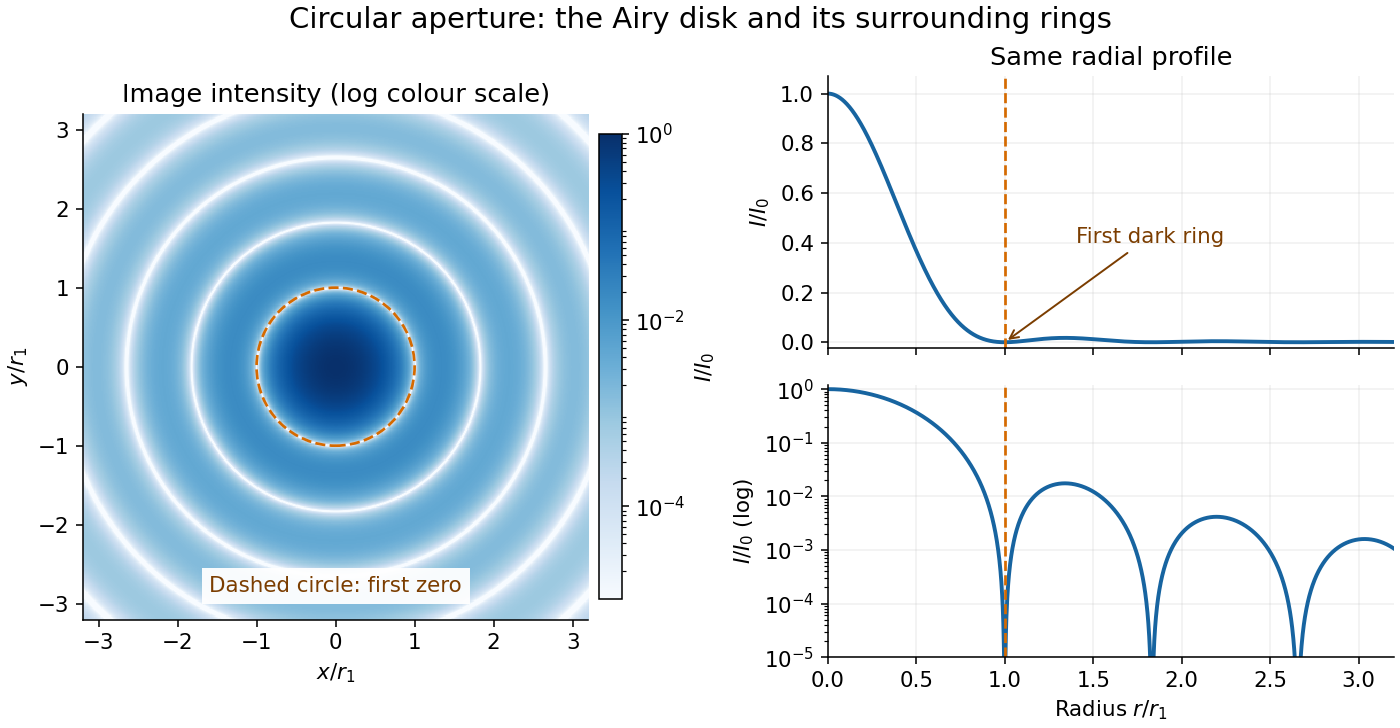

The image and both radial curves show the same calculated light intensity, divided by its peak. The image's logarithmic scale makes the weak rings visible; its colour is a display choice. The linear curve shows how small the ring peaks are compared with the centre. A dark ring marks a zero of wave amplitude, produced by cancellation across the optical pupil; it is not the edge of all transmitted light. The first Airy disk contains about of the total radiant flux, as calculated in Airy disk normalization and encircled energy.
For an original design example, take an ideal optical lens in air with focal length , circular optical pupil diameter and wavelength . In the focal plane, the radial coordinate givesThe first-zero diameter is . Solving gives , so the diameter measured by full width at half maximum is onlyThus a quoted “spot diameter” is incomplete without its definition. Doubling halves both widths at fixed wavelength and focal length; increasing magnification alone changes the image scale without improving object-space discrimination.
The Airy disk supplies a calculable reference for a point spread function, allowing diffraction to be distinguished from defocus and optical aberrations. Its beauty is that one circular boundary determines an entire sequence of bright and dark rings through a Fourier transform. The ideal formula assumes an unobscured pupil, uniform illumination, ideal optical focus, a single wavelength, and a scalar description with small output angles. A blocked centre, nonuniform pupil transmission or a significant pupil wave phase error changes the response. High numerical aperture may require polarization of an electromagnetic wave and a vector field description. The circular-aperture diffraction laboratory experiment tests the far-field pattern directly; the Rayleigh criterion uses its first zero to define a two-source convention.
Bessel focal length uncertainty 2026-10-14
For small measurement errors, write . Its partial derivatives and first-order propagation of uncertainty areHere the values are standard deviations used to describe uncertainty, and is the covariance. Independent carrier-reading errors give ; correlated readings require the term . Averaging repeated independent pairs reduces the random component of the uncertainty of the mean, but does not remove calibration or model errors.
As a stipulated uncertainty calculation, let , , and , with all three input errors independent. Then , , and . The result would be with this standard uncertainty in the stipulated thin lens model; these numbers are not a measured uncertainty budget. A small neglected principal-plane separation gives an additional first-order bias , distinct from that random budget.
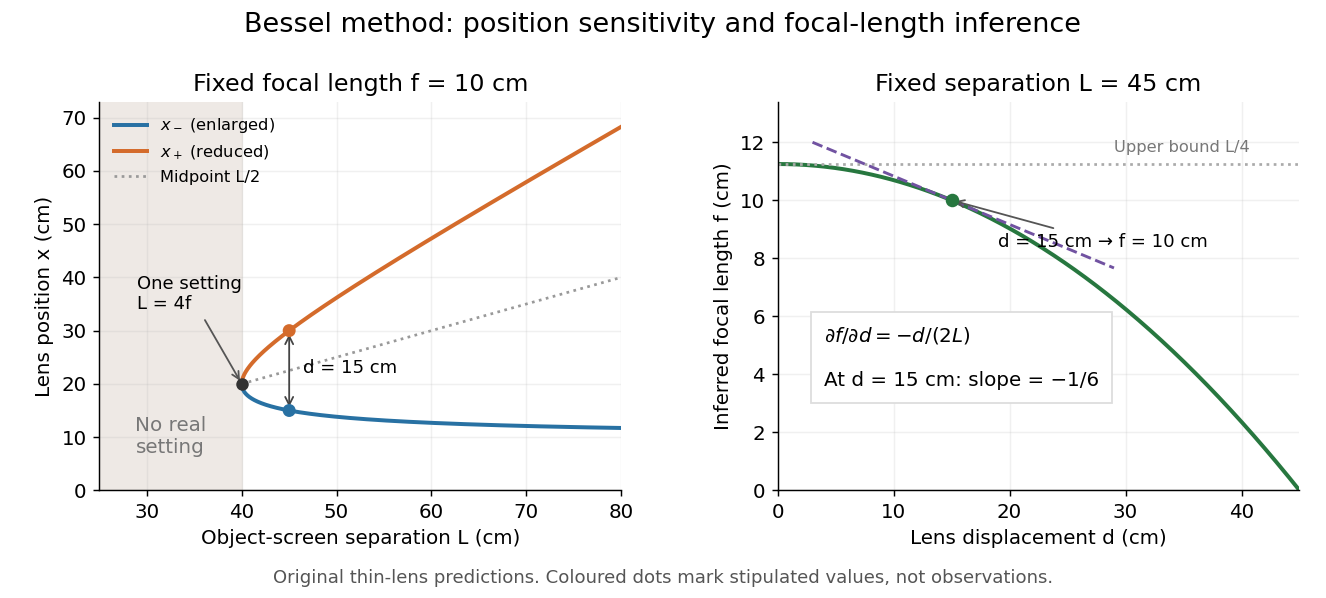
Bessel lens displacement method: merging settings and focal length sensitivity
. Original ideal-model curves. Left: settings versus object-screen separation for fixed ; below there is no real setting on the fixed screen. Right: inferred focal length versus measured displacement at fixed , with its tangent at the stipulated . The curves are predictions, not experimental points. Details.
The two kinds of sensitivity must be distinguished. At fixed focal length,These derivatives diverge as approaches from above: a small change in object-screen spacing strongly changes the separation of the two settings. Yet the inferred focal length's displacement sensitivity tends to zero. That does not make coalescing settings easy to measure. For fixed , define the axial mismatch between the predicted real image and the screen as , for . At a focused setting,Near , moving the optical lens changes this mismatch only weakly, making visual discrimination of the two settings difficult. At the example's settings and , so equal carrier motion produces different axial defocus responses. This is an axial mismatch calculation, not a full prediction of perceived image sharpness.
Choose sufficiently above to separate the two accepted focusing ranges, while retaining both real images on the available screen and rail. There is no universal best : focusing uncertainty itself depends on aperture, transverse magnification, optical aberrations and the target. Close to , the nonnegative measured separation and the quadratic term in also make first-order propagation of uncertainty unreliable if its error is comparable to its value. Repeatability, controls and the principal plane correction determine whether the elegant two-distance formula is an adequate measurement model.
An actual teaching setup is described in Laboratory Exercise No. 4: Diffraction, MIT 6.237, Fall 2024, for MIT's 6.237 Modern Optics Project Laboratory, Fall 2024. Preparation includes predicting the aperture-size dependence and the distinction between Fraunhofer diffraction and Fresnel diffraction. A helium–neon laser supplies light; the far-field setup uses a planar incident wavefront, a diffracting object and a distant screen, with beam expansion when needed. Figure 1 also marks an optional CCD camera. Exercise 4.7 asks students to sketch the circular-aperture pattern, measure the Airy disk diameter between correctly identified boundaries, and infer the aperture size. No measured values are supplied. As a regime comparison, exercise 4.9 varies the circular opening's position near a microscope objective optical lens, observes near-field patterns and compares them with the far-field case. This tests whether a change in propagation geometry changes the pattern. The coherent illumination measures one aperture's response, rather than the discrimination of two mutually incoherent optical point sources.[ref]
For a quantitative interpretation, let be the aperture-to-screen distance and the first-zero diameter on the screen. In the paraxial approximation, the independent calculation isFor an explicitly hypothetical measurement, and at would imply . The scale is smaller than , but only by a factor of about ; this alone gives limited confidence in a high-precision Fraunhofer diffraction approximation. It is not a reported MIT measurement.
Additional recommended controls are to keep wavelength fixed, record , centre and uniformly illuminate the aperture, and repeat with another . Compare , which should vary inversely with . A camera readout should include blocked-beam background and avoid saturation. A scaled repetition at larger tests residual Fresnel diffraction; nonuniform illumination, optical aberrations, detector sampling and uncertainty in locating a dark ring limit the inferred . The screen pattern's apparent bright edge depends on display brightness and is not a substitute for the first-zero boundary.
Coma (optics) Created 2026-10-05 Updated 2026-10-14
Coma makes an off-axis optical point source appear asymmetric, often with a compact head and a flaring tail like a comet. Different parts of the optical pupil send its light rays to different transverse image positions. A sharp central star image therefore does not guarantee sharp images across an optical telescope's field of view. In an idealized, aligned system with rotational symmetry, coma vanishes on the optical axis; misalignment can introduce coma even at the nominal field centre.[ref]
Coma aberration. Amateur Telescope Optics, §4.2, opening paragraphs and Figure 39: field coma versus misalignment coma
Coma differs from spherical aberration, whose dependence on optical pupil radius can blur an on-axis point without selecting a transverse direction. Astigmatism gives different optical foci in two perpendicular sections of an off-axis bundle; a through-focus sequence can change its elongated image's orientation. Diffraction persists when these optical aberrations vanish. A real asymmetric point spread function may mix several effects, so its appearance alone is not a unique diagnosis of coma.
The classical primary description belongs to the nineteenth-century Seidel aberration classification of five primary monochromatic image errors.[ref]
Seidel aberrations, wavefront aberration function. Amateur Telescope Optics, §3.5.1, opening paragraph: historical classification and equation 5
It remains useful in modern design: OpticStudio's Seidel Coefficients by ANSYS, Inc. documentation lists coma as and tabulates each surface's contribution as well as the system sum (Discussion). Cancellation of contributions can reduce coma without making every surface individually free of it. The same documentation limits this calculation to specified systems with axially symmetric surfaces; higher-order terms and broken rotational symmetry require more general ray tracing.For an isolated fluorescent molecule at displacement from the scanning optical focus, write for relative excitation light intensity and for the fraction of its collected emission passed by a centred detection pinhole of radius . The expected response, apart from a common brightness and collection factor, isHere is position in the detection-pinhole plane and is the emitted light intensity distribution there conditional on collection, with units of inverse area. This point spread function normalization retains throughput: is a fraction, not a curve rescaled to have peak one. The product expresses excitation followed by detection; it is an intensity/probability product, not multiplication of coherent wave amplitudes from different molecules. [ref]
Confocal microscopy (chapter manuscript) by Brad Amos and others. Manuscript p. 16, Fig. 4 discussion; Appendix §5, p. 37, Eq. A17: illumination-times-detection response
Assume linear, unsaturated fluorescence, independent emitters whose light intensities add, a stationary specimen, fixed collection efficiency and quantum efficiency, and negligible changes from scattering, absorption or bleaching during a scan. Different excitation and emission wavelengths generally give different excitation and detection responses. For a sufficiently small pinhole, is approximately its area times at the centre; this is the familiar excitation-times-detection point spread function. It is not universally the square of one point spread function. A spatially invariant response further allows the image to be expressed as a convolution with the emitter distribution; depth-dependent optical aberrations can invalidate that approximation.
For an explicitly synthetic axial example, put and choose an on-axis excitation , inspired by a Gaussian beam. Stipulate a circular Gaussian function for the detection-plane light intensity, with standard deviation . In dimensionless coordinates , put . ThenThe expression for follows by integrating over a disk using polar coordinates. The assumptions specify a toy model with matched axial scales; its parameters are not a calibration for a real objective optical lens. It omits Airy disk rings, vector diffraction, and unequal excitation and emission wavelengths.
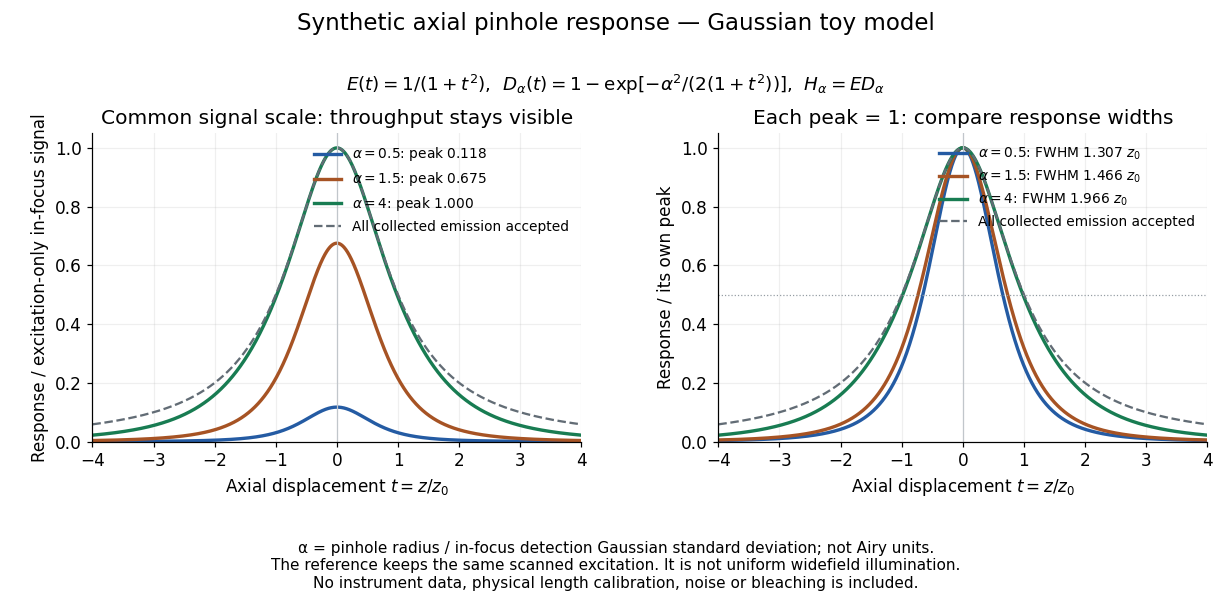
Synthetic axial response: narrower pinholes reduce throughput and suppress defocus
. Original Gaussian toy model, not measurements. The left panel keeps a common signal scale; the right divides each response by its own peak to compare widths. Here is a radius in units of detection-plane Gaussian standard deviation, not an Airy-unit diameter. The dashed reference is the same scanned excitation with all collected emission accepted, not conventional uniform widefield illumination. Both panels retain nonzero out-of-focus tails. Details.
For a vanishingly small pinhole, the peak-normalized synthetic response tends to , whose full width at half maximum is . With all collected emission accepted it tends to , of width . Meanwhile as the pinhole closes. The narrower normalized curve therefore accompanies a vanishing detected signal; peak normalization must not conceal that loss.
Diffraction-limited resolution Created 2026-10-05 Updated 2026-10-14
Diffraction-limited resolution is a scale for distinguishing details with a specified ideal diffraction response and a specified criterion. For two equally bright, mutually incoherent optical point sources imaged through a uniformly transmitting, unobscured circular optical pupil, the Rayleigh criterion places the centre of one Airy disk at the first zero of the other. At small angles in air this separation isHere is pupil diameter, is wavelength in air, and is the first positive zero of the order-one Bessel function of the first kind. This is the radius to the first zero, not the diameter of the central spot. Fraunhofer diffraction gives the radial peak-normalized light intensityThe removable value at zero follows from . The pupil Fourier transform reduces to a radial integral by circular symmetry, which produces the Bessel function of the first kind; its first zero supplies the factor .[ref]
In the usual scalar circular-pupil approximation for a fluorescence microscope, the corresponding object-plane Rayleigh criterion isHere is the vacuum emission wavelength, and the object-side numerical aperture already includes the medium's refractive index. Do not divide by again. For small cone angles in air, and image-plane radius agrees with this form. The assumptions include a single wavelength, ideal optical focus, and mutually incoherent emitters. High numerical aperture can require a vector description with polarization of an electromagnetic wave and emitter orientation; confocal microscopy has its own excitation-and-detection response. The same formula therefore does not describe every microscope or illumination method.[ref]
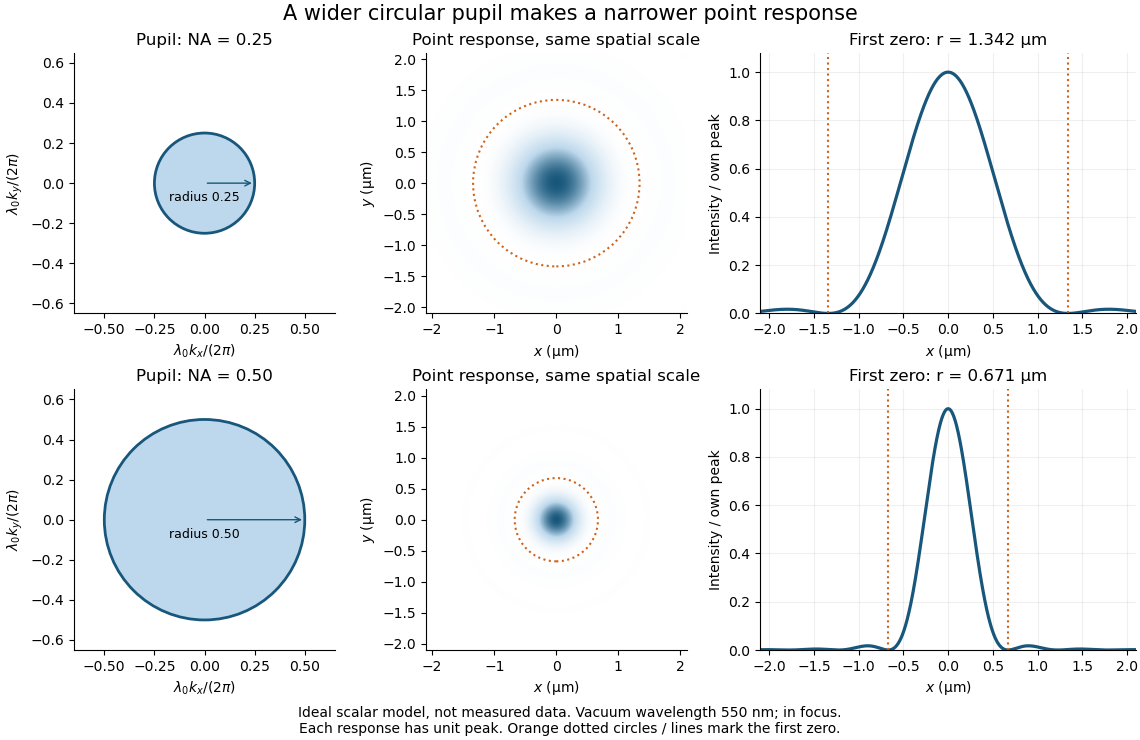
Doubling numerical aperture halves the ideal circular-pupil point-response scale at fixed wavelength
. Details. 
In this original model, and numerical apertures and give first-zero radii and . Each point spread function is divided by its own peak to compare shape. The pupil axes are transverse wave vector components multiplied by , so pupil radius equals numerical aperture. A wider pupil accepts a wider range of transverse wave vectors, producing a narrower image. Increasing magnification alone enlarges the same spot and does not reduce its object-plane radius.
The Rayleigh criterion is a useful visual convention, not an absolute information barrier. For equal incoherent sources with total detected radiant flux and separation vector , the ideal image isBelow the Rayleigh criterion this still differs from ; for small , symmetry cancels the linear change and the first change is quadratic in separation. Estimating two unknown source positions is then increasingly sensitive to noise, background, relative brightness and uncertainty in the point spread function. Localizing one isolated source and recovering an arbitrary extended object are different inference tasks. Measurements that separate optical modes can also extract separation information differently from direct image light intensity measurement.[ref]
There remains a real limit for arbitrary images in this model: the optical transfer function is zero above the transmitted spatial frequency band. Its cutoff for scalar incoherent imaging is in object-plane cycles per unit length. The Nyquist–Shannon sampling theorem therefore suggests object-referred detector pixel pitch , with finer sampling providing margin. Finite detector pixels also integrate over their area, suppressing contrast; coarse sampling can cause aliasing. Finer sampling cannot alone recover spatial frequencies removed by the optics, and Fourier deconvolution amplifies noise where the optical transfer function is small. Photon shot noise, read noise, optical aberrations and defocus can all worsen practical discrimination. A useful resolution claim therefore reports the object model, criterion, wavelength, numerical aperture, sampling and signal-to-noise ratio in photon counting.
Diffraction-limited system Created 2026-10-05 Updated 2026-10-14
A diffraction-limited system has an optical response close to the ideal diffraction response for its specified optical pupil, wavelength and optical focus. Improving the optical aberrations further makes little difference to that response. This describes the optics: a poorly sampled or noisy detector can still deliver an image with much worse usable diffraction-limited resolution.
The optical pupil determines which wave amplitudes and wave phases contribute to an image point. In a scalar, paraxial approximation at the focal plane of an optical lens in air, write the pupil transmission as , after removing the ideal focusing phase. The amplitude spread function is proportional to its scaled Fourier transform:Here are pupil coordinates, are image coordinates, is focal length, and is the wavelength in air. For a uniformly transmitting, unobscured circular optical pupil at ideal optical focus, the result is an Airy disk with surrounding rings. A blocked centre, support structures, or nonuniform transmission changes the ideal point spread function; “diffraction limited” does not specify one universal spot shape. The existing Fourier model of a Lyot coronagraph illustrates how pupil and focal masks deliberately alter this response.[ref]
Optical aberrations add pupil wave phase errors. Defocus contributes a quadratic pupil wave phase in the paraxial approximation, redistributing light intensity from the best-focused spot. The Strehl ratio compares the peak with the ideal response for the same pupil and total radiant flux. A broad optical spectrum produces a weighted sum of wavelength-dependent point spread functions; chromatic aberration can additionally change optical focus with wavelength. Thus the operating conditions belong with any claim that a system is diffraction limited.
Empty magnification 2026-10-14
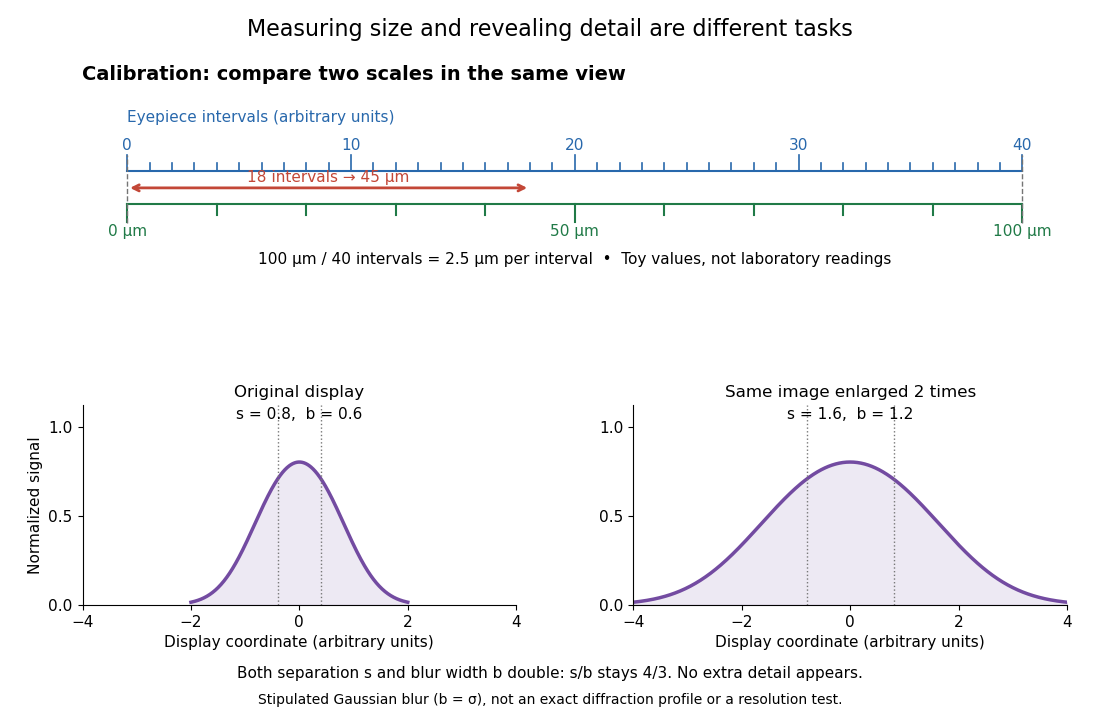
Empty magnification enlarges an image without revealing additional specimen detail. Adequate angular magnification can make existing detail visible to the eye, but it cannot undo the objective's diffraction blur. For equally bright, mutually incoherent optical point sources and an ideal circular optical pupil, a commonly used lateral Rayleigh criterion in object space iswhere is the vacuum wavelength, is the specimen-medium refractive index, and is the admitted half-angle. For this model, and give ; changing only numerical aperture to gives . Changing only the eyepiece leaves this object-space scale unchanged. Illumination, optical coherence, optical aberrations and specimen visibility matter in real instruments; this criterion is not a universal threshold.[ref]
The geometric reason is especially simple. If a fixed recorded image is enlarged by a factor , a feature separation and a blur width become and . Their ratio remainsThis is the lower-panel construction in the diagram. A change to the microscope objective can change numerical aperture and hence the specimen detail captured; a display zoom changes how large that captured detail looks. Microscope scale calibration, diffraction-limited resolution and angular magnification are three complementary properties to report.
Field of view Created 2026-10-05 Updated 2026-10-14
The field of view is the region of object directions sampled by an optical instrument in one pointing. State whether it is horizontal, vertical or diagonal, and whether it is a full angle or a half-angle. An object-plane width in millimetres also describes a field of view, but requires a specified object distance. Neither that width nor the angular field of view is the aperture diameter or the diffraction-limited resolution.
For a centred flat rectangular photodetector of width in the focal plane, with positive effective focal length , infinity focus and ideal rectilinear imaging without optical distortion, the full horizontal field of view isThe model maps an object direction to image height of magnitude ; set and use the inverse tangent. This retains exact right triangle geometry within the stipulated imaging model; a paraxial focal length alone does not guarantee that a real wide-field optical lens obeys it. With detector height , replace by for the vertical field of view, and by for the diagonal field of view. The small-angle approximation gives in radians. [ref]
https://www.edmundoptics.com/knowledge-center/application-notes/imaging/understanding-focal-length-and-field-of-view/. Gregory Hollows and Nicholas James, Edmund Optics, Understanding Focal Length and Field of View
.For an original worked example, a detector width gives at , and at . Keeping makes these f/2 and f/4 respectively: the field of view changes because changes. By contrast, closing from to at changes f/4 to f/8 while retaining in this model. The clean separation is useful: entrance pupil area controls collection, focal ratio controls the paraxial cone, and controls angular image coverage. Edge clipping, optical distortion, field curvature and optical aberrations can restrict the practically usable field of view.
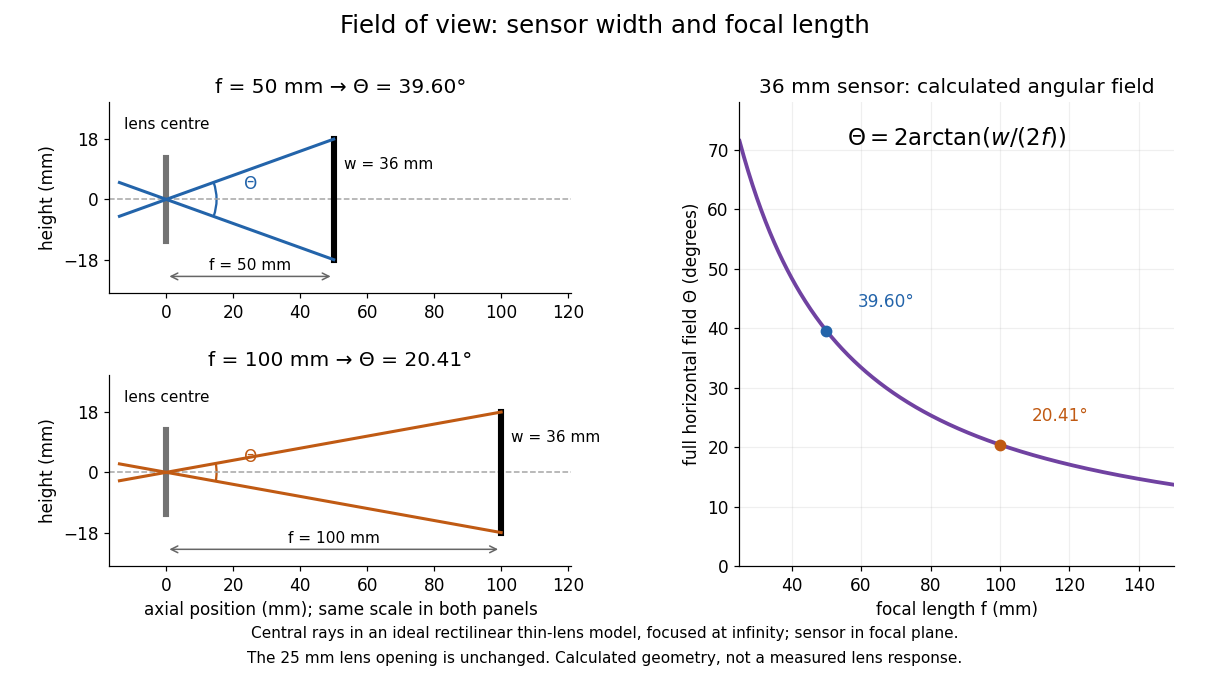

A proposed angular readout on an optical bench illuminates a small asymmetric target at the optical focus of a collimator, providing a bundle with a known direction. Rotate the optical camera about the centre of its entrance pupil, reading a graduated rotation stage, and record the target image position on its fixed photodetector. Centre the target to establish zero; turn left and right until its centre reaches each detector edge. The difference between stage readings measures the full horizontal field of view. Repeat with a smaller aperture stop: unchanged edge directions but reduced signal support the distinction between collection and angular coverage. Keep the same active detector width, infinity focus, illumination, integration time and gain; approach each reading from the same direction to check mechanical backlash. A finite target blurs the edge criterion, detector thresholds can imitate lost coverage, and a wide bundle must illuminate the whole entrance pupil at every tested angle. These checks distinguish a geometrical boundary from insufficient signal. The analytical diagram is the prediction for this protocol, not a record of its execution.
Finite-conjugate microscope 2026-10-14
An optical microscope whose microscope objective is designed to form a real image at a specified finite distance. The intended image distance and optical aberration corrections belong together; mechanical tube length is a mounting specification, not automatically the image distance measured from a principal plane.[ref]
Infinity Optical Systems by Nikon Instruments Inc.. Infinity Optical Systems, opening finite-system discussion and Fig. 2(a)
Why can a small displacement produce a large image? For a converging thin lens, write with . Substitution into the thin lens equation givesThe similar triangles construction supplies the minus sign. The example has and hence . Letting decrease moves the real image farther away; it does not keep the microscope eyepiece in focus at a fixed position. Large transverse magnification therefore requires the correct conjugate geometry, not merely a short focal length.
A useful motivating experiment moves a bead emitting fluorescence through the selected optical focus and records the detector signal against position. Measurement of point-spread function (PSF) for confocal fluorescence microscopy by InCheon Song and others (2005, §2 and Fig. 1) describes a laser delivered through a single-mode optical fiber, collimation, beam-size adjustment and a dichroic beam splitter. A , numerical aperture oil-immersion objective optical lens excites slide-mounted fluorescent beads and collects their emission. Emission passes a filter and collecting optical lens, then a pinhole, before an avalanche photodiode. A three-dimensional positioning stage moves the specimen. The apparatus also contains a phase plate for deliberately modified responses.[ref]
Measurement of point-spread function (PSF) for confocal fluorescence microscopy by InCheon Song and others. §2 and Fig. 1, pp. 2–3: apparatus and readout
The published comparison uses nominal bead diameters : larger beads give broader measured spots. This is a control on the finite emitter, because the image is the convolution of bead emission with the confocal point spread function. The smallest bead has weaker signal relative to noise; incorrect bead size, defocus, bleaching and optical aberrations limit inference from a restored response. The reported bead-size comparison concerns lateral responses; it is not a measured pinhole-size series or a measured sheet-sectioning curve.[ref]
To test axial pinhole selection with this kind of apparatus, the following is a proposed extension, not an additional result from that paper. Choose an isolated bead small relative to the response, centre it laterally, then step through optical focus while recording background-subtracted signal at several pinhole settings. Hold excitation power, dwell interval, detector gain, emission band and sampling fixed. Preserve raw peaks before also plotting peak-normalized traces. A lower peak and faster relative decay with axial displacement would support the paired-selection mechanism; fitting only normalized widths would miss the throughput cost.
Measure blocked-excitation background, include a bead-free region, avoid detector saturation, and repeat scans in reversed order to reveal drift or bleaching. Check pinhole centring separately, since misalignment can mimic signal loss. Record bead diameter, immersion medium, refractive index, numerical aperture, wavelengths and axial step. A finite bead is an approximation to an optical point source; a point trace does not certify confocal optical sectioning of a whole fluorescent sheet. Depth-dependent spherical aberration, scattering and sample motion can broaden or distort the response. Increasing magnification or making a display brighter does not correct those effects.
Focal ratio Created 2026-10-06 Updated 2026-10-18
The focal ratio, or f-number, of a converging optical instrument focused at infinity is the dimensionless quantitywhere is effective focal length and is the on-axis entrance pupil diameter. The notation f/4 means , not in a particular unit. A focal length with gives f/4. Closing the aperture stop until gives f/8 while retaining the same focal length. The mechanical opening need not equal . [ref]
https://www.edmundoptics.com/knowledge-center/application-notes/imaging/lens-iris-aperture-setting/. Gregory Hollows and Nicholas James, Edmund Optics, System Throughput, f-number, and Numerical Aperture
.For a thin lens in air with a circular aperture stop at the thin lens, the converging bundle from a distant on-axis point has half-angle satisfyingThe last step uses the small-angle approximation. For a compound optical lens, the cone is set by the image-side optical pupil and its distance from the receiving plane; the simple triangle is not an exact high-angle rule. At finite object distance a thin lens instead gives , by its imaging equation and transverse magnification, so its working cone corresponds to . Nominal focal ratio therefore does not alone specify close-range image irradiance. [ref]
https://www.edmundoptics.com/knowledge-center/application-notes/imaging/lens-iris-aperture-setting/. Hollows and James, working f-number and image-space cone
.Two useful scalings follow under stated conditions. For a fixed uniform incident beam and unchanged transmission, collected radiant flux scales as . For an extended source with fixed radiance, the central image irradiance scales approximately as in the paraxial approximation: the solid angle of the cone scales as . For an ideal uniformly illuminated unobscured circular entrance pupil, the first dark ring of the point spread function has angular radius and focal plane radiusHere is wavelength. These are first-zero radii, not diameters or a universal rule for resolving arbitrary objects. A proof outline evaluates the circular aperture's Fraunhofer diffraction using its Fourier transform, then uses the first zero of the resulting Bessel function. [ref]
Two-Dimensional Fourier Optics. Richard Fitzpatrick, University of Texas at Austin, Two-Dimensional Fourier Optics, circular-aperture first minimum
.At , the example's f/4 and f/8 first-ring radii are and . Closing the aperture stop halves , quarters collected radiant flux and doubles this diffraction radius. It can also reduce optical aberrations by excluding outer light rays; actual sharpness reflects both effects. This explains why a smaller aperture need not produce a sharper image. [ref]
https://www.edmundoptics.com/knowledge-center/application-notes/imaging/limitations-on-resolution-and-contrast-the-airy-disk/. Gregory Hollows and Nicholas James, Edmund Optics, The Airy Disk and Diffraction Limit
.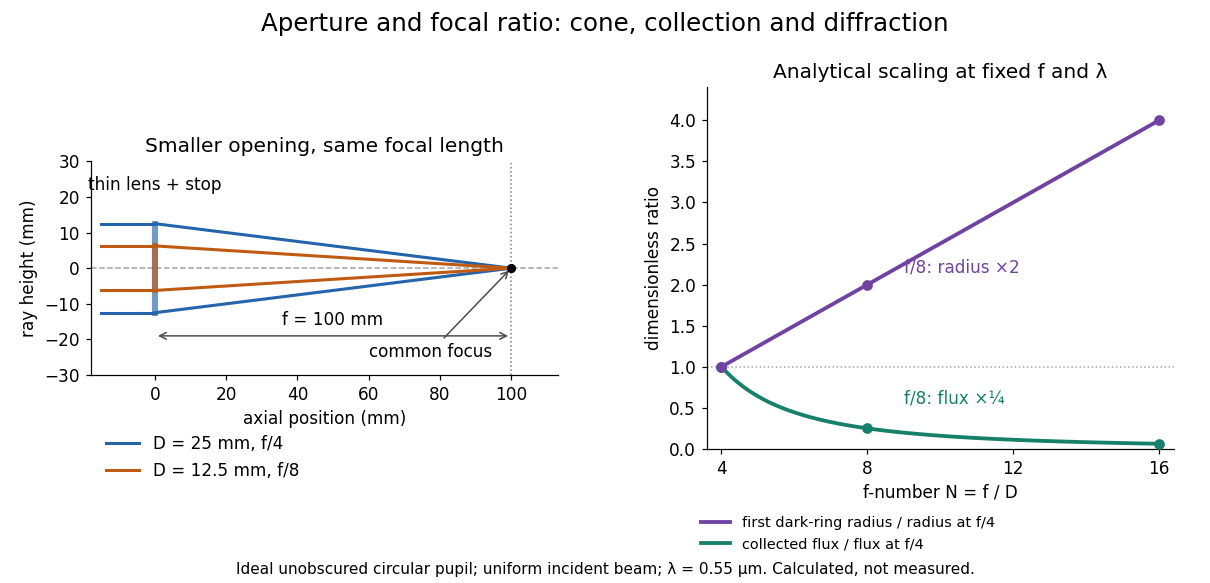
Aperture and focal ratio: a common optical focus, reduced collection and increased diffraction radius
. Original analytical illustration. Left: equal-scale thin lens geometry with and or . Right: collected radiant flux relative to f/4 is , and first-ring radius relative to f/4 is . The wavelength is ; the entrance pupil is circular, uniformly illuminated and unobscured. These are calculated quantities, not measurements. Details.
A proposed optical bench check puts a fixed collimator before a converging thin lens and a photodetector large enough to collect the entire image behind it. Compare two centred aperture stops of known diameters while fixing source output, detector gain and integration time. The integrated signal tests the collection law; a spatially resolved optical camera at the focal plane can separately measure the point spread function. Repeat a dark reading and the first aperture stop, and check that neither the incoming beam nor detector clips either bundle. A resolved pinhole source, imperfect collimation, optical aberrations and detector pixel size can dominate the apparent spot width; a single peak reading does not measure total collected radiant flux.
Image formation 2026-10-13
Image formation assigns each object point a corresponding image point: outgoing light rays from that object point either converge there, giving a real image, or diverge as though they originated there, giving a virtual image. The requirement applies separately to each point. Bringing unrelated light rays together makes a bright patch, but does not preserve the object's pattern. This point-by-point correspondence explains how an optical camera records a scene. [ref]
https://openstax.org/books/university-physics-volume-3/pages/2-4-thin-lenses. Ling, Sanny and Moebs, University Physics Volume 3, §2.4: Image formation by thin lenses
.Use the same convention as thin lens: place the optical lens at , with incident light travelling to the right and a real object at , . Write the image coordinate as , so for a real image and for a virtual image. Heights are positive above the optical axis and negative below it. In air, within the paraxial approximation, a thin lens obeysHere is the signed focal length, positive for a converging optical lens and negative for a diverging optical lens; the expression for assumes . Object distance is positive even though the object's coordinate is negative. These coordinate rules describe transmission through the optical lens; a mirror reverses the outgoing direction, so do not identify its image distance with this same rightward coordinate. [ref]
https://openstax.org/books/college-physics-2e/pages/25-6-image-formation-by-lenses. Urone and Hinrichs, College Physics 2e, §25.6: Lens equation and sign conventions
.The beauty of geometrical optics is that two convenient light rays can locate a point, while a whole admitted bundle forms its image. For a converging thin lens, an incident light ray parallel to the optical axis exits through the rear optical focus; a light ray through the centre continues undeviated. Real optical lens elements do not focus every admitted light ray exactly: optical aberrations and diffraction limit the point correspondence. The diagrams below are original ideal-model constructions, not measured data. [ref]
https://openstax.org/books/university-physics-volume-3/pages/2-4-thin-lenses. Ling, Sanny and Moebs, §2.4: Ray tracing and imaging limits
. Lens (optics) Created 2026-10-05 Updated 2026-10-24
An optical lens is a transparent element, or assembly of elements, that redirects a bundle of light rays to form images or change how the bundle spreads. In an ordinary glass optical lens, refraction at the surfaces provides the redirection: their changing normal vectors make Snell's law bend different light rays by different amounts. A converging optical lens brings incoming light rays parallel to its optical axis toward an optical focus; a diverging optical lens makes them spread as if from an optical focus on the incoming side. [ref]
https://openstax.org/books/university-physics-volume-3/pages/2-4-thin-lenses. Ling, Sanny and Moebs, OpenStax University Physics Volume 3, §2.4: Thin lenses
.For a usual glass thin lens in air, a form thicker at the centre than at the edges normally converges, with positive focal length; one thinner at the centre normally diverges. Shape alone is insufficient: the refractive index relative to the surroundings also matters, as the lensmaker's equation shows. An aperture selects which light rays pass; an optical lens also changes their directions. The distinction explains how an optical camera can gather light from one object point over many incoming directions and deliver it to one image location.
The beautiful simplification is that an entire bundle can be characterized by a focal length, and two constructed light rays can locate an image. The thin lens examples below turn that geometry into a prediction of image position, orientation and transverse magnification. A real optical lens retains optical aberrations and diffraction, so the construction is a useful leading model rather than an exact solution of Maxwell's equations.[ref]
Early mathematical treatments include Johannes Kepler's 1611 Dioptrice, whose title explicitly concerns vision through newly invented instruments using transparent glass, and René Descartes's 1637 La Dioptrique, whose seventh discourse discusses improving vision with shaped glass. These are landmarks in explaining and designing optical instruments, rather than dates for the invention of the optical lens. [ref]
https://www.e-rara.ch/zut/content/titleinfo/120202. Kepler, Dioptrice, 1611, original edition digitized by ETH-Bibliothek
; [ref]https://classiques.uqam.ca/classiques/Descartes/dioptrique/dioptrique.html. Descartes, La Dioptrique, 1637, seventh discourse, UQAM text edition
. Magnification Created 2026-10-14 Updated 2026-10-14
Magnification compares an image's scale with a specified reference. Transverse magnification compares signed lengths in object and image planes; angular magnification compares viewing angles at an observer. Both are dimensionless quantities, but they answer different questions. A projected real image twice as tall has ; an optical telescope's advertised viewing enlargement normally concerns angular magnification. [ref]
2.8 Microscopes and Telescopes. Ling, Sanny and Moebs, University Physics Volume 3, §2.8: Angular magnification and telescopes
.Always specify the sign and the reference arrangement. For signed transverse magnification, means inverted and means upright; means enlarged and means reduced. A larger virtual image can subtend a modest viewing angle if it is farther away. At , an ideal converging thin lens has no finite image height and hence no finite transverse magnification, while angular magnification can remain finite. Enlargement also does not guarantee extra detail: diffraction-limited resolution and optical aberrations limit the information available to enlarge. [ref].
Microscope scale calibration 2026-10-14
Microscope scale calibration compares an image readout with a known specimen length. This documented practical uses an eyepiece graticule, stage micrometer and Köhler illumination. Focus the graticule; place the reference on the stage with the objective-appropriate cover glass. Focus both scales with the chosen microscope objective, then rotate and translate them into parallel alignment. Read widely separated coincidences using consistent line edges. Record the optical configuration and recalibrate for each objective.[ref]
Linear Measurements (Micrometry) by Thomas J. Fellers and Michael W. Davidson. Linear Measurements (Micrometry), Stage Micrometers and Eyepiece Reticle Calibration, Fig. 4 and procedure bullets
The stage micrometer is the reference; preserve the optical configuration when substituting the specimen. Line width, focus, edge selection and optical aberrations limit accuracy. Additional recommended checks are realignment and another known interval: agreement tests repeatability and scale consistency, not absolute reference accuracy.[ref]
Linear Measurements (Micrometry) by Thomas J. Fellers and Michael W. Davidson. Linear Measurements (Micrometry), Conclusions, line-edge choice and calibration errors; repeat-after-realignment check is an additional recommendation
Here is an original toy calculation, not the source's calibration example or measured data. Suppose a reference span coincides with eyepiece intervals. Then the calibration factor and the length corresponding to specimen intervals areThis works because both readouts use the same image-to-specimen scale: . One must count intervals, not tick marks; forty intervals have forty-one bounding ticks. In an ideal linear scale model, if identifying the calibration endpoints introduces a total readout error of interval, the inferred factor ranges from to per interval. Holding exact gives . This isolates one contribution to measurement uncertainty; it is not a complete uncertainty budget or a measured confidence interval.

For a recorded real image, image a stage micrometer at the same capture settings to calibrate length per detector pixel. Resizing changes length per pixel; update the scale bar accordingly. Eye-viewing angular magnification alone supplies no digital image scale.[ref]
Linear Measurements (Micrometry) by Thomas J. Fellers and Michael W. Davidson. Linear Measurements (Micrometry), Conclusions, digital images acquired at identical pixel resolution
Off-axis pinhole test for coma 2026-10-14
The institution-issued AY 105 Lab Experiment 3: Optical aberrations by California Institute of Technology (Spring 2011 offering, Part A, pp. 2–3, 7–8) specifies a concrete optical bench: a lamp, opal diffuser and condensing optical lens illuminate a or optical pinhole; a photographic telephoto optical lens acts as a collimator, producing an approximately beam. A test optical lens sits on a rotation stage, followed by an adjustable optical microscope. The procedure establishes the on-axis image, then rotates the test optical lens a few degrees and examines the off-axis image through optical focus. It compares this readout with through-focus ray tracing at the corresponding field angles and offers a Ronchi ruling to calibrate the measuring eyepiece.
Part B (pp. 9–10) substitutes a spherical mirror of radius of curvature, with the optical microscope beside the incoming beam so the image is necessarily off-axis. It calls for measuring the field angle, calibrating the eyepiece and recording the image's length and width at minimum size. These are specified apparatus dimensions and instructions, not supplied measurement results or dimensions of the normalized figures.
A controlled extension would record images at zero and equal positive and negative field angles, repeat zero afterwards, and scan through optical focus at every setting. Keep the illuminated optical pupil and illumination fixed, recenter the optical microscope without clipping the bundle, and use its calibrated scale to separate a mere image displacement from a change in blur shape. The pure Seidel coma pupil mapping predicts reversal and linear growth; a stationary asymmetric central image instead calls for checking alignment. A focus-dependent change between perpendicular elongations suggests an astigmatism contribution. These comparisons test the model rather than assuming every off-axis flare is pure coma.
The optical pinhole has finite angular size, approximately its diameter divided by the collimator's focal length; the collimator and observing optical microscope also contribute their own optical aberrations. A broadband lamp can mix chromatic aberration with the geometric blur, and diffraction limits the smallest visible structure. A narrow spectral band, repeated field settings and a reference image help separate these effects. Consequently a measured length and width are useful checks on off-axis image formation, but they cannot by themselves determine a unique coma coefficient or recover the full point spread function.
Optical aberration Created 2026-10-05 Updated 2026-10-14
An optical aberration is a departure from ideal image formation: light rays from one object point may miss their intended common image point, or image positions may depart from the intended mapping. Spherical aberration, coma, and astigmatism describe different ways of spreading a point's light rays; optical distortion can change image shape without spreading each point. In physical optics, these departures can be described by wavefront error relative to a reference wavefront. Diffraction also gives a finite point spread function in a perfect optical instrument, so an extended image alone does not establish an optical aberration.
Past exam of the mathematics course of the University of Cambridge 2017 iii Paper 338 1 c iii Solution Created 2026-10-03 Updated 2026-10-06
Set and . The achromatic doublet power balance gives two linear equations:For distinct nonzero Abbe numbers, solving yields and , and thereforeEqual Abbe numbers force the total optical power to vanish under the achromatic condition; they cannot give a nonzero-power thin achromatic lens. Closely matched Abbe numbers require large opposing component powers and are generally unattractive because of the resulting sensitivity and other optical aberrations.
Past exam of the mathematics course of the University of Cambridge 2017 iii Paper 338 2 a i Solution Created 2026-10-03 Updated 2026-10-14
The optical telescope focuses the sky onto an optical slit; the collimator turns the selected light into a beam incident on the reflection diffraction grating; the optical camera images each diffracted direction onto the photodetector. The drawing also shows the monochromatic optical slit image for uniform optical slit illumination in the geometric, slit-limited approximation.
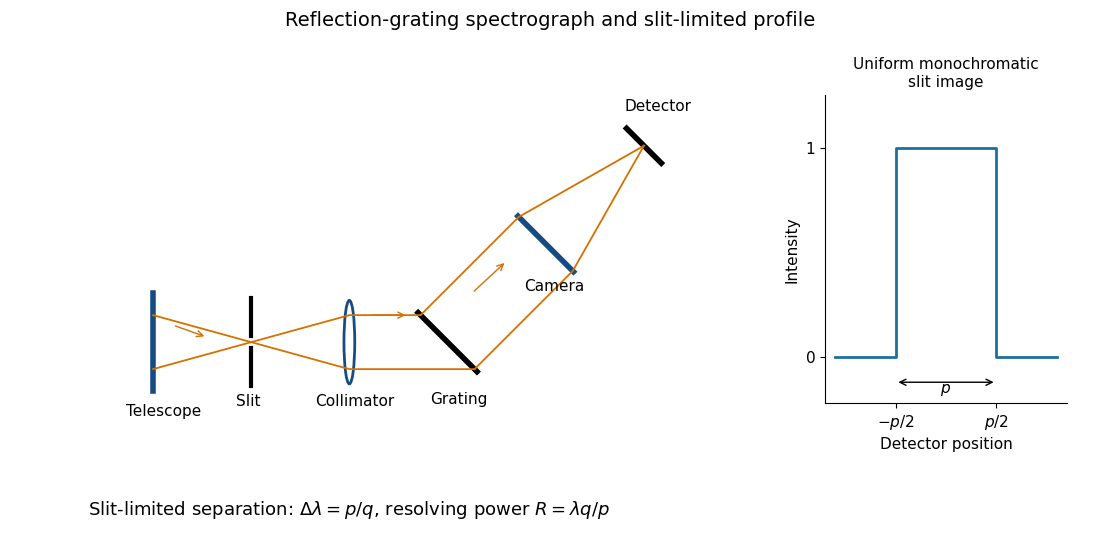
Reflection-grating spectrograph and slit-limited line profile
. Details. 
Near the chosen wavelength , a small wavelength increment moves the image by , where is the magnitude of the linear spectral dispersion. An optical slit image of physical width therefore has an apparent spectral width . With one optical slit width as the adopted separation criterion,Uniform illumination gives a top-hat monochromatic profile of width ; an unresolved stellar image need not illuminate the optical slit uniformly, so its profile follows the actual illumination convolved with the instrument response. Negligible optical slit diffraction and optical camera optical aberrations do not remove the finite diffraction grating diffraction width. The formula is the slit-limited result when that width is small compared with , rather than a universal exact line-profile criterion.