An optical aberration is a departure from ideal image formation: light rays from one object point may miss their intended common image point, or image positions may depart from the intended mapping. Spherical aberration, coma, and astigmatism describe different ways of spreading a point's light rays; optical distortion can change image shape without spreading each point. In physical optics, these departures can be described by wavefront error relative to a reference wavefront. Diffraction also gives a finite point spread function in a perfect optical instrument, so an extended image alone does not establish an optical aberration.
The five Seidel aberrations of a rotationally symmetric optical system are spherical aberration, coma, astigmatism, field curvature, and optical distortion.
Spherical aberration makes rays at different pupil radii focus at different axial positions. Its primary pupil dependence is quartic; the balanced Zernike spherical mode also contains quadratic and constant terms to remove defocus and piston.
Coma makes an off-axis optical point source appear asymmetric, often with a compact head and a flaring tail like a comet. Different parts of the optical pupil send its light rays to different transverse image positions. A sharp central star image therefore does not guarantee sharp images across an optical telescope's field of view. In an idealized, aligned system with rotational symmetry, coma vanishes on the optical axis; misalignment can introduce coma even at the nominal field centre.[ref]
Coma aberration. Amateur Telescope Optics, §4.2, opening paragraphs and Figure 39: field coma versus misalignment coma
Coma differs from spherical aberration, whose dependence on optical pupil radius can blur an on-axis point without selecting a transverse direction. Astigmatism gives different optical foci in two perpendicular sections of an off-axis bundle; a through-focus sequence can change its elongated image's orientation. Diffraction persists when these optical aberrations vanish. A real asymmetric point spread function may mix several effects, so its appearance alone is not a unique diagnosis of coma.
The classical primary description belongs to the nineteenth-century Seidel aberration classification of five primary monochromatic image errors.[ref]
Seidel aberrations, wavefront aberration function. Amateur Telescope Optics, §3.5.1, opening paragraph: historical classification and equation 5
It remains useful in modern design: OpticStudio's Seidel Coefficients by ANSYS, Inc. documentation lists coma as and tabulates each surface's contribution as well as the system sum (Discussion). Cancellation of contributions can reduce coma without making every surface individually free of it. The same documentation limits this calculation to specified systems with axially symmetric surfaces; higher-order terms and broken rotational symmetry require more general ray tracing.Consider an original, explicitly normalized model of primary coma, rather than a prescription for a particular optical lens. Let be Cartesian coordinates in a circular optical pupil divided by its radius , with . Let be a signed small field angle divided by an arbitrary positive reference angle. With polar coordinates , , prescribe the wavefront errorHere is an arbitrary positive optical path difference scale, not a measured error. The cubic optical pupil dependence and linear field dependence are the classical Seidel form.[ref]
Coma aberration. Amateur Telescope Optics, §4.2, classical coma formula after equation 15 and equation 13: pupil-cubic and field-linear dependence
In the paraxial approximation, light ray direction errors follow the transverse gradient of wavefront error. For a reference sphere a distance from the exit optical pupil in a uniform image medium of refractive index , the corresponding image-error scale is . Choose image-error coordinate signs so the normalized displacement is ; reversing the convention reverses the plotted orientation. Image coordinates below are errors relative to the ideal image of this particular object point, rather than positions of different objects:The partial derivatives explain the asymmetry: opposite optical pupil points and land together, rather than on opposite sides of the ideal image. For , every is nonnegative, while can have either sign. The figures stipulate this single wavefront error, omit other optical aberrations and diffraction, and assign no instrument dimensions.
For a ring of fixed optical pupil radius , the double-angle formulas for trigonometric functions giveThus each ring maps into a circle of radius whose centre is displaced by . Doubling quadruples both sizes; for , the edge ring has centre and radius , while the half-radius ring has centre and radius . Superposing these displaced circles produces the comet-like envelope.
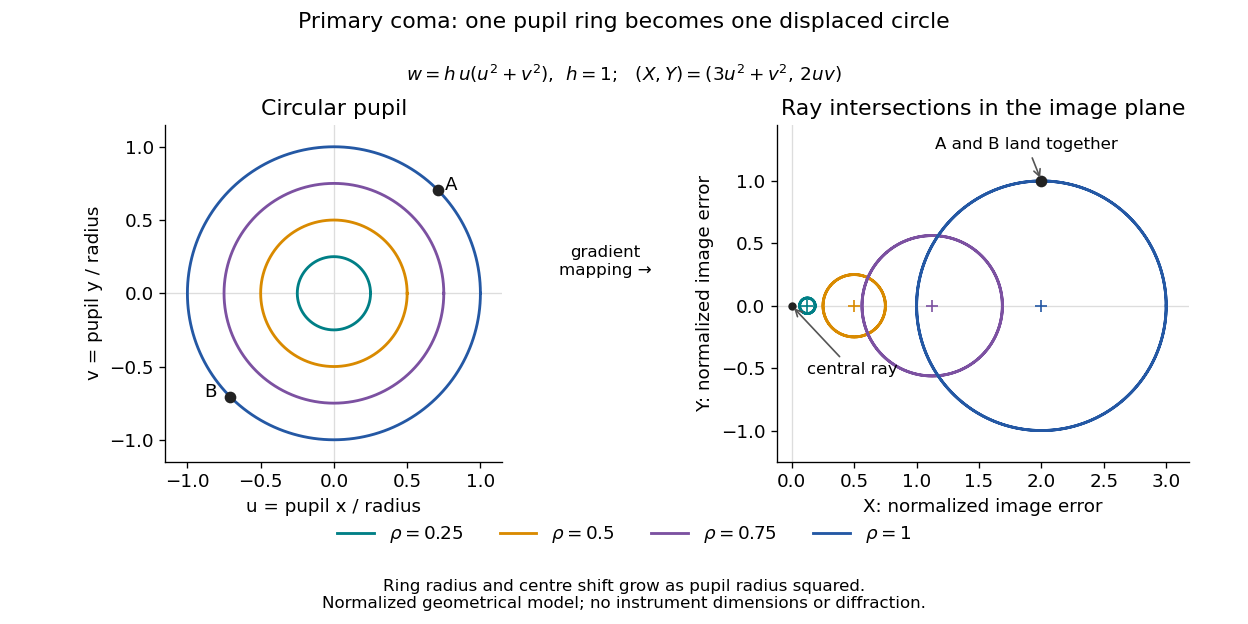
For uniform irradiance over the circular optical pupil, equal area samples give an equal-weight geometrical image. Its centroid is because and . Moving the coordinate origin to that centroid translates the image; it does not remove its asymmetric shape. Adding a linear term to likewise translates all light rays equally. These origin choices must be distinguished from changing the optical aberration itself.
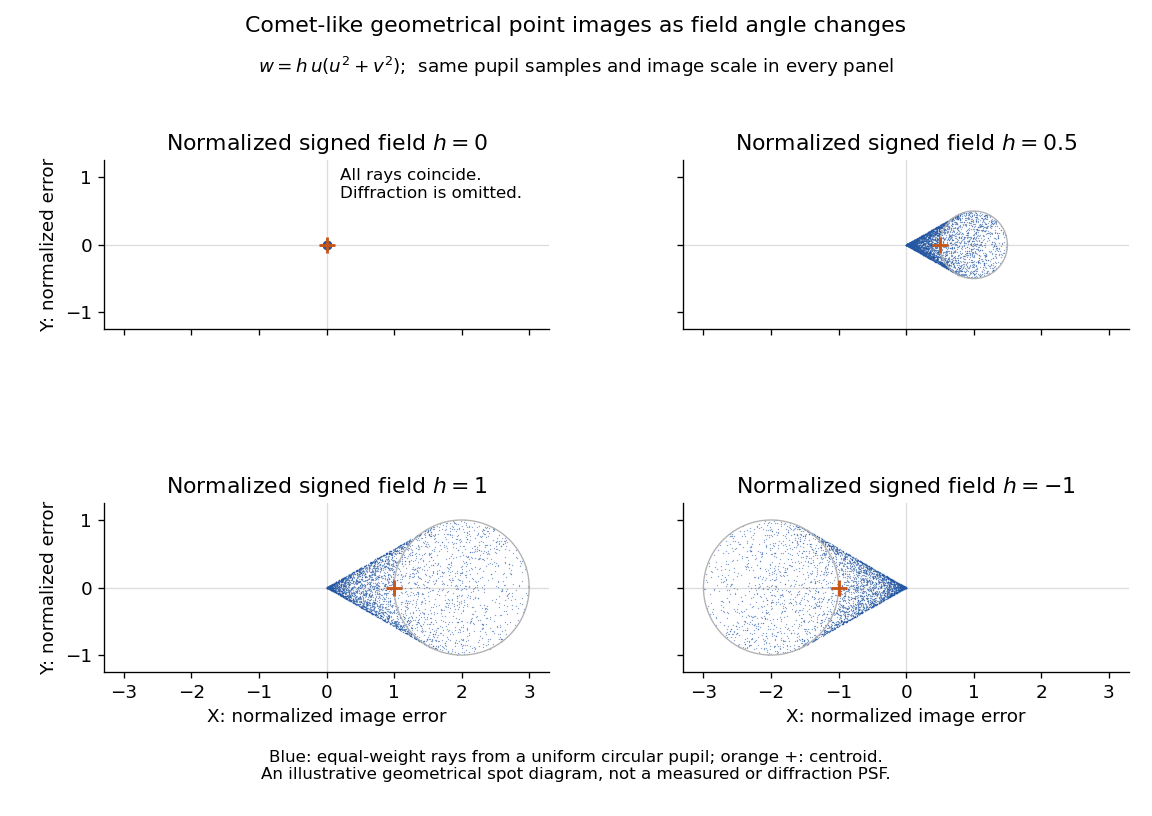
The model's full transverse extent is along and along . Halving the field angle halves the blur, and reversing it reverses the pattern about the ideal image. This isolates why coma matters for an optical camera's usable field of view: collecting more light does not ensure that off-axis points remain compact. Near diffraction-limited resolution, a physical optics calculation of the point spread function is needed instead of interpreting the geometrical tip as an infinitely sharp image.[ref]
Coma aberration. Amateur Telescope Optics, §4.2, Figure 41: geometrical spots versus diffraction images
The institution-issued AY 105 Lab Experiment 3: Optical aberrations by California Institute of Technology (Spring 2011 offering, Part A, pp. 2–3, 7–8) specifies a concrete optical bench: a lamp, opal diffuser and condensing optical lens illuminate a or optical pinhole; a photographic telephoto optical lens acts as a collimator, producing an approximately beam. A test optical lens sits on a rotation stage, followed by an adjustable optical microscope. The procedure establishes the on-axis image, then rotates the test optical lens a few degrees and examines the off-axis image through optical focus. It compares this readout with through-focus ray tracing at the corresponding field angles and offers a Ronchi ruling to calibrate the measuring eyepiece.
Part B (pp. 9–10) substitutes a spherical mirror of radius of curvature, with the optical microscope beside the incoming beam so the image is necessarily off-axis. It calls for measuring the field angle, calibrating the eyepiece and recording the image's length and width at minimum size. These are specified apparatus dimensions and instructions, not supplied measurement results or dimensions of the normalized figures.
A controlled extension would record images at zero and equal positive and negative field angles, repeat zero afterwards, and scan through optical focus at every setting. Keep the illuminated optical pupil and illumination fixed, recenter the optical microscope without clipping the bundle, and use its calibrated scale to separate a mere image displacement from a change in blur shape. The pure Seidel coma pupil mapping predicts reversal and linear growth; a stationary asymmetric central image instead calls for checking alignment. A focus-dependent change between perpendicular elongations suggests an astigmatism contribution. These comparisons test the model rather than assuming every off-axis flare is pure coma.
The optical pinhole has finite angular size, approximately its diameter divided by the collimator's focal length; the collimator and observing optical microscope also contribute their own optical aberrations. A broadband lamp can mix chromatic aberration with the geometric blur, and diffraction limits the smallest visible structure. A narrow spectral band, repeated field settings and a reference image help separate these effects. Consequently a measured length and width are useful checks on off-axis image formation, but they cannot by themselves determine a unique coma coefficient or recover the full point spread function.
An optical camera can focus a white object sharply in one colour while leaving coloured fringes around its edges in another. Chromatic aberration is the dependence of image position or image scale on wavelength, caused by optical dispersion in the optical lens materials. Axial chromatic aberration separates the optical foci along the optical axis; lateral chromatic aberration changes the transverse magnification with wavelength. Moving the receiving plane can favour one colour without bringing all colours into focus. [ref]
https://farside.ph.utexas.edu/teaching/302l/lectures/node142.html. Richard Fitzpatrick, University of Texas at Austin, Chromatic aberration
; [ref]https://imaging.nikon.com/sport-optics/guide/fieldscopes/choosing/choosing_03/. Nikon, Comparison of ED glass and ordinary lens
.For ordinary optical glass in the visible range, the blue refractive index exceeds the red refractive index. For a fixed positive thin lens in air, the lensmaker's equation then givesHere is wavelength, is refractive index, is optical power, is focal length, and are the signed surface radius of curvature values in the lensmaker's equation. The blue light rays therefore bend more strongly and meet sooner. This ordering is a statement about ordinary visible optical dispersion, not a universal rule for every material and every spectral range. [ref]
https://farside.ph.utexas.edu/teaching/302l/lectures/node142.html. Fitzpatrick, Chromatic aberration, colour-dependent focusing
.For a worked example, take a single positive thin lens with reference optical power and Abbe number , hence reference focal length . Its F–C optical power difference is , by the achromatic doublet power balance relation below. This difference alone does not locate the reference optical power within the F–C interval. To draw a transparent example, introduce a synthetic colour coordinate , a dimensionless quantity, with red , reference , and blue , and choose the toy optical dispersion modelThe diagram's red and blue endpoints represent the C and F endpoints of this toy model. Its reference point is placed symmetrically in optical power by construction; is not a measured wavelength scale, and the model is not measured optical glass data. The endpoint focal lengths areThus the axial chromatic aberration in this example separates the endpoint optical foci by about . A single receiving plane cannot coincide with both optical foci.
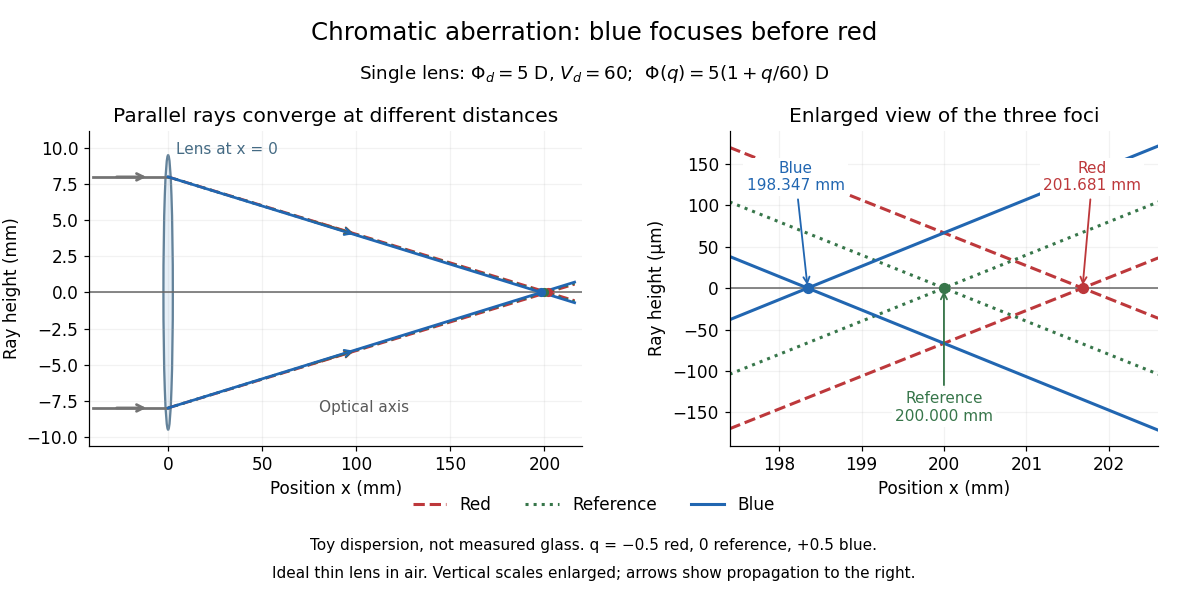
Chromatic aberration: the blue optical focus precedes the red optical focus in a toy single thin lens
. Parallel incoming light rays meet an ideal positive thin lens at . The right panel enlarges the neighbourhood of the three optical foci; the reference focal length is . The synthetic model uses , , and . This is toy optical dispersion, not measured optical glass; the vertical scales are enlarged. Details.The useful design idea is to cancel changes of optical power while retaining a positive total optical power. An achromatic lens does this with materials having different Abbe numbers. It greatly reduces chromatic aberration, but correcting two chosen wavelengths still leaves the possibility of a secondary spectrum.
Axial chromatic aberration, also called longitudinal chromatic aberration, is colour-dependent focus position along the optical axis. For incident light rays parallel to the optical axis, it appears as a changing focal length. The chromatic aberration diagram isolates this effect using an ideal thin lens at each colour.
Lateral chromatic aberration, also called transverse chromatic aberration, is colour-dependent image scale: an object away from the optical axis can have different image heights at different wavelengths. Its changing transverse magnification produces displaced coloured edges. The on-axis parallel bundle in the chromatic aberration diagram illustrates axial chromatic aberration, and does not measure lateral chromatic aberration. [ref]
https://imaging.nikon.com/sport-optics/guide/fieldscopes/choosing/choosing_03/. Nikon, wavelength-dependent focal point and magnification
.An achromatic lens combines optical lens elements with different optical dispersion so that two specified wavelengths have the same focal length in the paraxial approximation. This brings their parallel incoming light rays to a common optical focus, helping an optical camera form a sharper image under mixed-colour illumination. A common implementation is an achromatic doublet: a positive crown glass element paired with a negative flint glass element. [ref]
https://farside.ph.utexas.edu/teaching/302l/lectures/node142.html. Fitzpatrick, Chromatic aberration, compound lenses
.The achromatic doublet does not require either material to have zero optical dispersion. Instead, the positive element gains positive optical power toward blue, while the negative element becomes more negative. Suitable Abbe numbers and signed optical powers let these changes cancel even though their reference optical powers do not cancel. For example, the achromatic doublet power balance calculation below combines with to obtain , or focal length , with zero primary F–C optical power difference. The smaller Abbe number of the negative element makes its weaker reference optical power sufficient to oppose the positive element's colour change.
An achromatic lens is corrected at two chosen wavelengths, not necessarily at every wavelength between them. The remaining focal length variation is the secondary spectrum. Correcting axial chromatic aberration also does not automatically remove lateral chromatic aberration throughout an imaging system, spherical aberration, or diffraction. Actual designs therefore need ray tracing with the intended wavelengths, element thicknesses, separations and apertures. [ref]
https://imaging.nikon.com/sport-optics/guide/fieldscopes/choosing/choosing_03/. Nikon, ED glass and secondary spectrum
; [ref]AY 105 Lab Experiment 3: Optical aberrations by California Institute of Technology. Caltech AY 105, Optical aberrations, 2011, Part A: doublet ray tracing and through-focus comparison
.An achromatic doublet is an achromatic lens with two optical lens elements. In the contact thin lens model, their optical powers add and their primary colour changes cancel according to achromatic doublet power balance. The conventional positive achromatic doublet uses a converging crown glass element and a weaker diverging flint glass element; these names describe a common choice, not a universal ordering of every modern optical glass composition.
Achromatic doublet power balance chooses two signed optical powers to meet two goals: obtain the required focal length and cancel the primary F–C colour difference. Model two thin lens elements in contact in air, using the paraxial approximation. Let label the crown glass and flint glass elements, and let denote each element's optical power at the reference d line. The Abbe number for each material isThe subscripts label standard spectral lines: blue F near , red C near , and reference d near . These are three specified wavelengths, not colour bands. A larger Abbe number means less relative optical dispersion between F and C. [ref].
For a fixed thin lens shape in air, write the lensmaker's equation as , with signed shape factor . Subtracting its C value from its F value gives the primary optical power differenceThe negative element has negative : its blue optical power is more negative, not less negative. The contact rule for optical power therefore givesThis zero is equality of the total F and C optical powers, hence equality of their focal lengths when the total optical power is nonzero. The relation follows directly from the lensmaker's equation and the Abbe number; it is exact within the fixed-shape contact thin lens model. [ref]
https://phys.libretexts.org/Bookshelves/Optics/Geometric_Optics_(Tatum)/02:_Lens_and_Mirror_Calculations/2.10:_Designing_an_Achromatic_Doublet. Jeremy Tatum, University of Victoria, Geometric Optics §2.10, equations 2.10.8–2.10.11, authored text hosted by LibreTexts
. Tatum uses a yellow D-line reference; here the Abbe number convention uses the d line consistently.For a toy design, choose , , and . ThenThe positive element contributes to the F–C difference and the negative element contributes . This retains the same reference focal length as the single , thin lens in chromatic aberration, while cancelling its primary colour split. The values are illustrative design parameters, not a catalogue optical glass pair.
Use the same synthetic colour coordinate and toy optical dispersion as in chromatic aberration. The two element optical powers and their sum becomeAt the red endpoint, the element optical powers are and ; at the blue endpoint, they are and . Both sums are . In this first-order toy model alone, the sum is constant for every and the focal length remains throughout. Real material optical dispersion is not captured by these two straight slopes, so the flat line is not a claim that a real achromatic doublet focuses all colours perfectly.
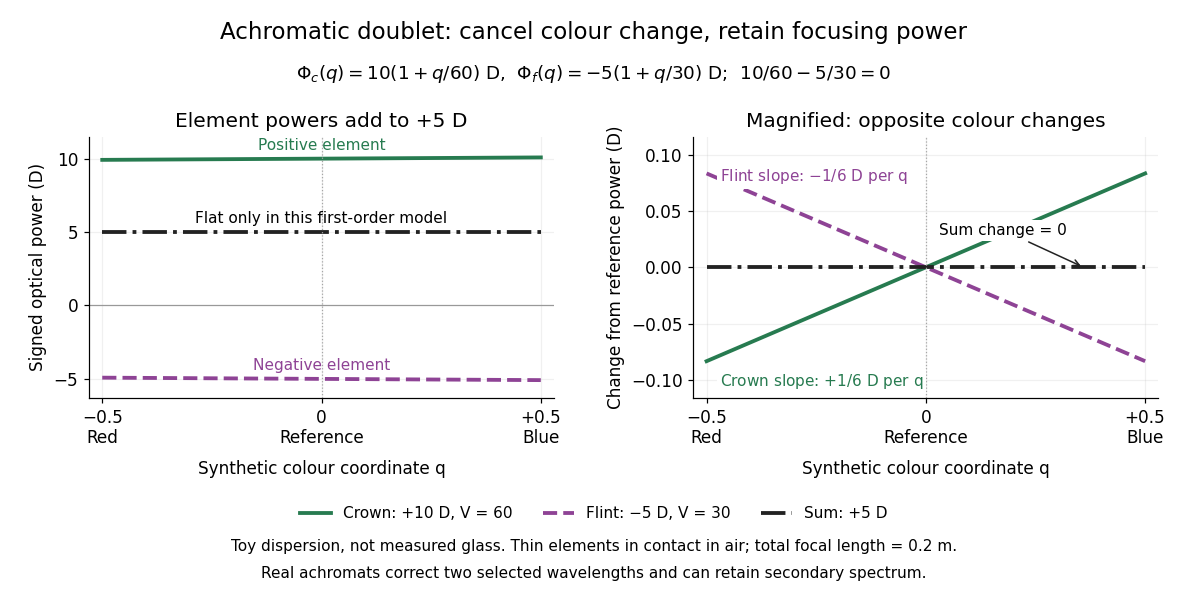
For specified nonzero reference optical power and distinct Abbe numbers, solving the two balance equations givesThus and require positive crown glass optical power and negative flint glass optical power. If the two finite Abbe numbers were equal, cancellation would force zero total optical power. If they are close, the required element optical powers become large compared with the total: cancelling primary colour can demand much stronger individual elements.
The contact assumption matters. For two thin lens elements separated by distance in air, the equivalent optical power is , evaluated at each wavelength; its colour change need not satisfy the contact balance. Finite thickness, departures from the paraxial approximation, and the secondary spectrum also limit the simple prediction.[ref]
Lecture Notes on Geometrical Optics. §J: Composite lenses
The secondary spectrum is residual chromatic aberration after an achromatic lens brings two selected wavelengths to the same optical focus. For example, equal red and blue focal lengths can coexist with a different green focal length. The Abbe number fixes one F–C relative difference, not the complete shape of optical dispersion between or beyond those wavelengths. The perfectly flat sum in the achromatic doublet power balance diagram deliberately omits this residual effect. [ref]
https://imaging.nikon.com/sport-optics/guide/fieldscopes/choosing/choosing_03/. Nikon, ED glass and secondary spectrum
. Articles by others on the same topic



Optical aberration refers to the imperfections in the imaging properties of optical systems, such as lenses and mirrors, that prevent them from focusing all incoming light to a single point. These aberrations result in distortions or blurriness in the images produced by these optical devices. There are several types of optical aberrations, each affecting image quality in different ways.