Optical tweezers hold and move a small particle using the force exerted by a tightly focused beam of light, usually from a laser. They can position transparent beads in a liquid and manipulate suitable biological cells. Attaching a molecule to a trapped bead turns the bead into a handle: a measured bead displacement, together with a calibrated spring constant, reveals the force exerted on the attachment. This makes microscopic manipulation and measurement possible without a mechanical tool touching the bead. Living biological cells were manipulated with infrared beams by Ashkin, Dziedzic and Yamane in 1987; Svoboda and Block used trapped beads to measure forces from individual molecules in 1994. [ref]
https://doi.org/10.1038/330769a0. Ashkin, Dziedzic and Yamane, Optical trapping and manipulation of single cells using infrared laser beams, 1987
[ref]https://www.andrew.cmu.edu/course/42-620/handouts/svoboda_cell_94.pdf. Svoboda and Block, Force and Velocity Measured for Single Kinesin Molecules, 1994
.Why can light pull a bead towards a focus? Light carries momentum. A transparent bead with a higher refractive index than the surrounding liquid bends transmitted light rays by refraction, changing their momentum; conservation of momentum requires an opposite transfer to the bead. In the geometrical optics picture, unequal illumination of a displaced bead produces a net restoring force towards the brighter region. For a particle much smaller than the wavelength, a physical optics description replaces that ray picture. The detailed force depends on particle size, refractive index, beam shape and wavelength; the qualitative attraction does not supply a universal formula for every particle.
The optical gradient force draws a suitable transparent bead towards high illumination, while the optical scattering force generally pushes along beam propagation. A stable three-dimensional optical trap needs a balance with a restoring force in each direction: transverse confinement alone does not ensure axial confinement. Strong focusing can make the backward axial gradient contribution large enough to balance the forward scattering contribution, with the equilibrium displaced from the focus. Higher refractive index alone is insufficient; absorbing particles, different index contrasts and different beam geometries can behave differently. [ref]
Observation of a single-beam gradient force optical trap for dielectric particles by Arthur Ashkin and others. Ashkin, Dziedzic, Bjorkholm and Chu, Observation of a single-beam gradient force optical trap for dielectric particles, 1986, pp. 288–289
.Historically, Ashkin's 1970 experiments accelerated and trapped particles using radiation pressure. The 1986 paper by Ashkin, Dziedzic, Bjorkholm and Chu demonstrated the single-beam gradient optical trap for transparent particles. These are distinct steps: the earlier work established optical manipulation, and the later work supplied the tightly focused single-beam arrangement. [ref]
Acceleration and Trapping of Particles by Radiation Pressure by Arthur Ashkin. Ashkin, Acceleration and Trapping of Particles by Radiation Pressure, 1970
[ref]Observation of a single-beam gradient force optical trap for dielectric particles by Arthur Ashkin and others. Ashkin, Dziedzic, Bjorkholm and Chu, 1986
.Near a stable equilibrium, a harmonic optical trap behaves like a spring; thermal calibration of an optical trap uses its Brownian motion to determine the effective spring constant. The later passage through a translating optical trap sections instead consider a moving localized potential energy, which need not remain harmonic throughout a passage.
A calibrated coordinate in a harmonic trap has equilibrium variance . This determines stiffness only after removing detector noise and accounting for drift, exposure averaging and finite bandwidth. Position variance does not supply a force calibration if the coordinate scale is unknown.
Arthur Ashkin's 1970 first experiment suspended transparent latex spheres in water inside a glass cell. A horizontal argon laser beam, focused to a radius, illuminated individual beads viewed through a microscope. An off-centre bead moved toward the beam axis and downstream until reaching the cell wall; blocking the beam released it into Brownian motion. Transparent particles and liquid reduced competing thermal effects. This observed sequence separates transverse attraction from downstream radiation pressure: wall-assisted confinement is not free three-dimensional confinement by one beam.[ref]
Acceleration and Trapping of Particles by Radiation Pressure by Arthur Ashkin. A. Ashkin, Acceleration and Trapping of Particles by Radiation Pressure, 1970, p. 156 and Fig. 1(a)
The beam-blocking comparison is particularly informative: persistence against a wall while illuminated and release when illumination stops test an optical cause. To infer a force from the downstream velocity, one additionally needs a linear drag model and the bead's distance from the wall; the observed motion alone does not calibrate an unrestricted harmonic optical trap.
In 1986, Arthur Ashkin, Joseph Martin Dziedzic, John Ernst Bjorkholm and Steven Chu used spatially filtered argon laser light, a water-immersion objective of numerical aperture , and a water-filled glass cell. An auxiliary beam loaded large glass beads; dispersed small particles entered by Brownian motion. A side microscope and scattering of light detector provided readout. Their Fig. 1 shows a bead below the focus with about . On p. 290, silica size was inferred by scattering against a latex standard; translating the cell imposed fluid drag. These observations support single-beam confinement, while inferred size depends on the scattering model.[ref]
Observation of a single-beam gradient force optical trap for dielectric particles by Arthur Ashkin and others. A. Ashkin, J. M. Dziedzic, J. E. Bjorkholm and Steven Chu, Observation of a single-beam gradient force optical trap for dielectric particles, 1986, pp. 288–290, Figs. 1–2 and final experimental paragraphs
A loading beam can help bring a bead into the capture region without supplying its subsequent confinement. Distinguish loading, holding and sensing when interpreting an apparatus drawing. The following optical trap position readout is a proposed calibration arrangement; its detector layout is not a reconstruction of this historical experiment.
An optical gradient force arises from spatial variation in illumination. In a usual optical trap for a suitable transparent particle with higher refractive index than its surroundings, it draws the particle towards high light intensity. It supplies a restoring force near a stable trap, but three-dimensional confinement also depends on the optical scattering force. The direction and size depend on the particle and field; attraction to the brightest point is not universal. [ref]
Observation of a single-beam gradient force optical trap for dielectric particles by Arthur Ashkin and others. Ashkin and colleagues, single-beam gradient optical trap, 1986
.The geometrical optics account of an optical trap adds the momentum flux changes of refracted and reflected light rays. It applies when the bead is large compared with the surrounding medium's wavelength. When the bead is much smaller, an induced electric dipole gives a different approximation. For a homogeneous dielectric sphere of radius , define , with the peak complex electric field and its SI polarizability. In a transparent, nonmagnetic, nondispersive host,where are particle and host refractive indices, is cycle-averaged light intensity, is the vacuum permittivity and is the speed of light. The quasistatic electric dipole approximation requires , with the vacuum wavelength, and a field nearly uniform across the bead.
For real quasistatic , building an induced electric dipole gives instantaneous potential energy . Averaging over one optical cycle givesThus gives positive polarizability and attraction toward larger light intensity; reverses this contribution. The factor uses a peak field: substituting a root mean square field without changing that factor would halve the force incorrectly. Dimensionally is energy, so its gradient is force.
This leading conservative term does not remove the optical scattering force. Even a nonabsorbing induced electric dipole reradiates light: at fixed wavelength and index contrast, its Rayleigh scattering cross-section scales as , while scales as . A smaller bead can therefore improve the ratio of gradient to scattering forces while weakening the well relative to , where is the Boltzmann constant and the temperature. Optical force balance and resistance to thermal escape are separate questions. Intermediate bead sizes require a wave-scattering calculation; neither a ray calculation nor this small-dipole expression is uniformly valid there.
An optical scattering force transfers momentum from light to a particle through scattering of light. In a usual single-beam optical trap, its axial contribution pushes along beam propagation; the optical gradient force must balance it for axial confinement. This balance can place the stable equilibrium away from the beam focus.
At an equilibrium , the total force vanishes. A small transverse displacement must produce a transverse restoring force; a small axial displacement must also restore the bead. Downstream of a tight focus, the backward optical gradient force can oppose the forward optical scattering force. Equality at one point is insufficient: the total axial force must decrease as the bead moves downstream through that point. The equilibrium can therefore lie downstream of the intensity maximum.
For uncoupled overdamped coordinates, with decays only when each . More generally, linearizing gives , where is the hydrodynamic mobility matrix and at equilibrium. All eigenvalues of must have negative real parts for linear asymptotic stability. For a conservative force with symmetric positive-definite mobility, a positive-definite Hessian matrix of the potential energy supplies this condition. A general optical force need not possess a global potential energy.
Increasing numerical aperture admits more strongly converging light rays and a steeper axial variation of the field. But a larger nominal numerical aperture alone does not establish trapping: illumination of the objective pupil, optical aberration, particle properties and the actual in-liquid focus also matter. A harmonic optical trap describes local confinement after this stability question has been answered; it does not predict capture from arbitrary positions or an infinite holding force.
A harmonic optical trap approximates one coordinate near a stable equilibrium by a quadratic potential energy. Measure displacement from that equilibrium, set its potential energy to zero there, and take a positive effective spring constant , also called the trap stiffness:The restoring force points left when and right when . This is a local model: a Taylor series of a smooth potential energy about a nondegenerate local minimum gives as its leading curvature. A real optical trap has a finite capture region; the endlessly rising parabola does not describe its escape boundary. A three-dimensional optical trap can have different stiffnesses along different axes, and nonconservative optical forces can limit the potential energy description.
For a bead in a stationary viscous liquid, linear drag often dominates inertia on the observed timescale. Neglecting both inertia and the random thermal force, the deterministic force balance givesHere is the drag coefficient and the optical trap relaxation time: the time to reduce the deterministic displacement by a factor . The bead approaches equilibrium without oscillation in this overdamped model. The approximation requires times long compared with the inertial time and, for separated timescales, , where is the bead's mass. For a no-slip spherical bead of radius in an unbounded liquid of dynamic viscosity , Stokes drag law gives . Nearby walls change that drag coefficient.
For example, , and give and . A displacement of gives a restoring force of magnitude , and its deterministic displacement drops to after one optical trap relaxation time. These are predictions for the stated model, not measured trajectories.
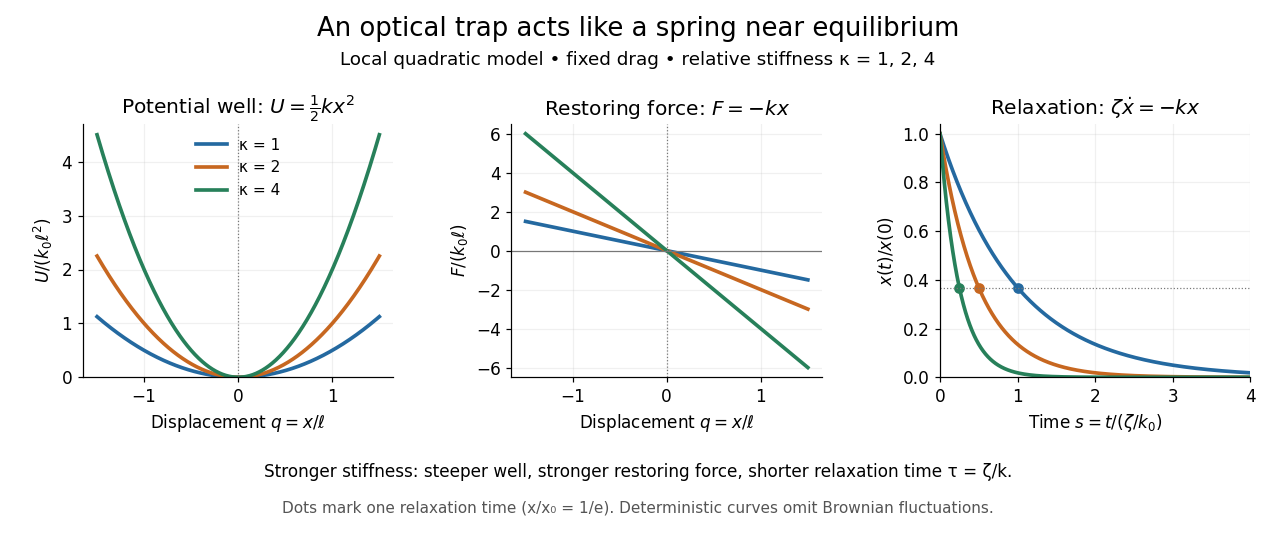
Local harmonic optical trap: potential well, restoring force and deterministic overdamped relaxation
. Details. The figure uses , and , with arbitrary positive reference length and stiffness . Thus , and, from , . At fixed drag, greater stiffness gives both a steeper potential energy well and faster relaxation. Thermal Brownian motion is omitted from these deterministic curves.
A bead in a liquid keeps undergoing Brownian motion even when an optical trap holds its average position fixed. For a stationary harmonic optical trap in thermal equilibrium at absolute temperature , the equipartition theorem assigns mean potential energy to this one quadratic coordinate. With the Boltzmann constant and at equilibrium,At the same temperature, quadrupling the spring constant divides the position variance by four and the standard deviation by two. The Boltzmann factor gives the complete equilibrium probability density function, a Gaussian distribution:The prefactor makes ; its second moment is . The probability density function has units of inverse length, and its area gives probability. This density is exact for the ideal quadratic model. In a finite optical trap it approximates the occupied well when thermal excursions remain within the harmonic region and escape is negligible during observation. Driven motion, appreciable nonconservative forces or laser heating need not give this equilibrium density.
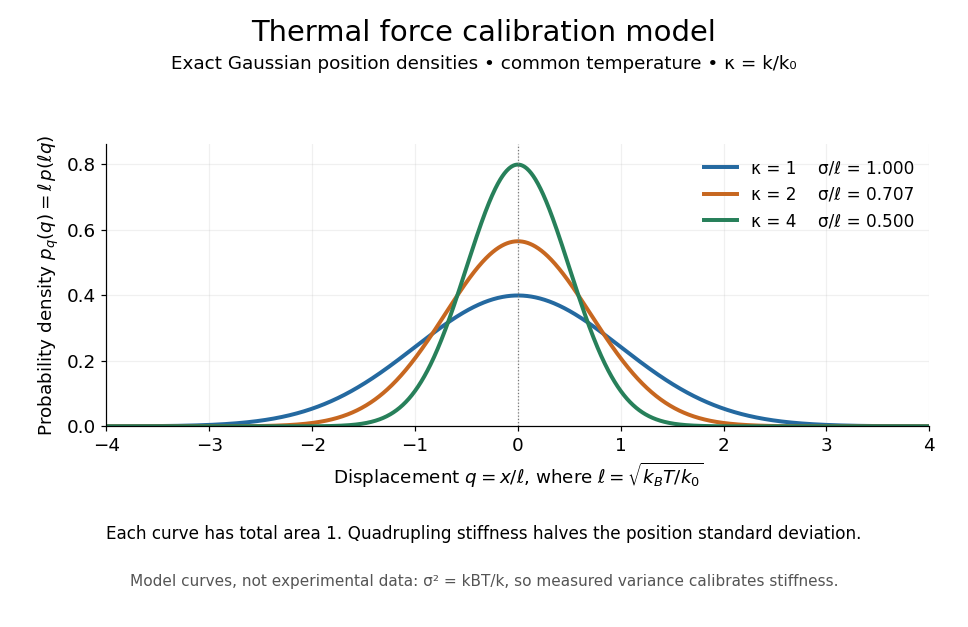
Thermal force calibration model: exact Gaussian position densities for relative trap stiffnesses 1, 2 and 4 at a common temperature
. Details. Here , and . The plotted density per unit is . Each curve has total area one; their dimensionless standard deviations are , and . The curves are exact model densities, not noisy experimental data.
Brownian motion becomes a measuring tool: a calibrated position measurement supplies , and the known temperature supplies . Once is known, a slowly applied constant external force shifts the mean by , so in the same harmonic range. Fluctuations therefore calibrate the conversion from displacement to force. Svoboda and Block used this equipartition theorem method when calibrating their bead traps. [ref]
https://www.andrew.cmu.edu/course/42-620/handouts/svoboda_cell_94.pdf. Svoboda and Block, 1994, trap stiffness calibration
.For the example stiffness and , and . Using a variance measured in uncalibrated detector units would not determine that physical stiffness. Measurement noise, finite exposure time, drift and insufficient sampling of the correlated Brownian motion can bias the estimate; record positions over many optical trap relaxation times and account for the detector response. The deterministic relaxation curve above describes relaxation without thermal forcing; an individual thermal trajectory continues to fluctuate.
Add the random thermal force to the deterministic optical trap relaxation time model. In one stationary coordinate of a harmonic optical trap, the overdamped Langevin equation isHere is Gaussian white noise understood through its integrals, is the Dirac delta function, and is the linear friction coefficient. The covariance coefficient has units ; multiplying by , of units , gives squared force. This fluctuation-dissipation relation for a Langevin particle makes the stationary variance , consistent with the equipartition theorem. The solution is an Ornstein-Uhlenbeck process with autocovariance functionIndeed, at positive lag the noise has zero correlation with the initial position, so ; its initial value is . This supplies both a decay time and an amplitude, making a stronger calibration test than a position histogram alone.
Specify the Fourier transform convention before using a power spectral density. For frequency in hertz, define and the one-sided density for . Integration of the exponential givesThe position power spectral density has units ; its integral is a variance, not a standard deviation. At it is half its zero-frequency plateau. Angular frequency conventions require a corresponding conversion in both axis and integration measure. If with position sensitivity in , then in before independent detector noise is added.
For an original invented calibration example, choose , dynamic viscosity , , , and . The unbounded no-slip Stokes drag law givesThe corresponding voltage standard deviation is , and the position power spectral density plateau is , or in the detector. Recovering both and is an internal model check; actual agreement also tests the assumed temperature, drag and detector response.
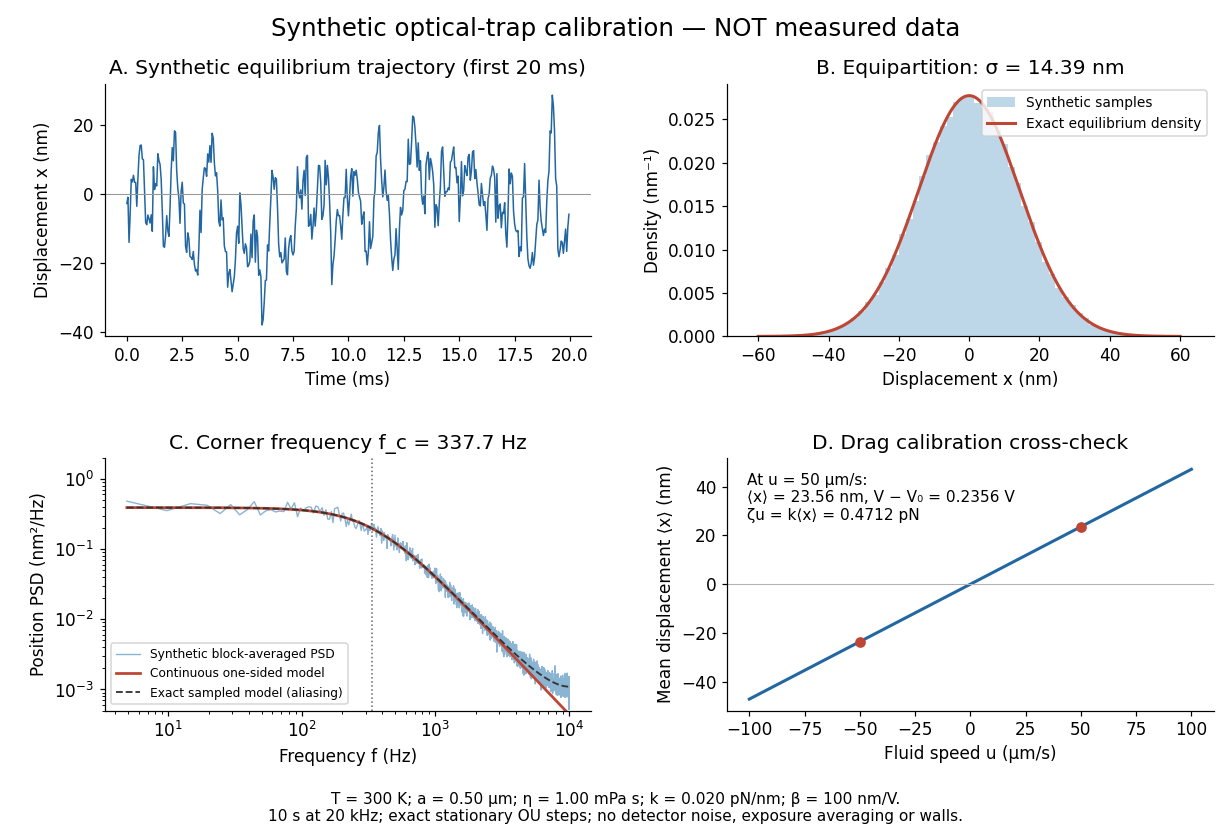
Synthetic harmonic optical trap fluctuations, power spectral density and optical trap drag calibration
. Original model calculations and seeded synthetic Ornstein-Uhlenbeck process samples; explicitly not measured data. The record is sampled at with no detector noise or exposure averaging. The dashed spectrum includes sampling aliases; the red continuous spectrum integrates to the exact equipartition theorem variance. The drag line is an exact steady-model prediction. Source. Details.The generator uses the exact stationary update , with and independent standard normal random variables . For a demeaned block of samples and its unnormalized discrete Fourier transform , the two-sided periodogram is ; doubling positive bins except the zero and Nyquist endpoints gives a one-sided density. Summing those bins times returns the block mean square by discrete Parseval identity. Independent detector noise, finite exposure and aliasing would alter a measured spectrum and must enter a fit before interpreting .
For an overdamped harmonic optical trap, impose a known sinusoidal local fluid velocity of amplitude and angular frequency . The coherent bead response has amplitude . Measuring the thermal corner frequency and detector-voltage amplitude therefore determines the position sensitivity in the displayed formula without a drag coefficient as input. Use a thermal record with the drive line removed to obtain stiffness from the equipartition theorem. Fluid-following, detector response and hydrodynamic corrections must remain valid. Combined thermal and stage measurements have experimentally calibrated an optical trap without drag as an input.[ref]
Calibration of optical tweezers with positional detection in the back-focal-plane by Simon F. Tolić-Nørrelykke and others. 2006 preprint abstract: calibration without drag as an input
Translate the liquid past a bead held in a stationary harmonic optical trap. At steady mean position, take as the local fluid velocity relative to the fixed trap and positive downstream. Averaging the overdamped force balance givesFor the invented optical trap Langevin calibration example, predicts , , and . Reversing reverses the mean shift but leaves the ideal thermal variance unchanged. A symmetric speed sweep tests the offset and the linear force range; the slope determines if position is calibrated.
Near a wall, is not the appropriate drag without a boundary correction; record bead height and direction of motion. Stage velocity must correspond to the local fluid velocity after transients have settled. Escape under increasing flow estimates a maximum holding force in that geometry, whereas small-displacement drag calibration estimates the local spring constant. They are different quantities. The atomic force microscopy similarly needs a calibrated spring constant to convert a measured deflection to force, but its cantilever is a physical spring rather than this optical field.
Write for the detector's position-related voltage variance, after characterizing independent detector noise and the acquisition response. The equipartition theorem estimate is . For small independent input standard uncertainties, first-order propagation givesIn this expression is the uncertainty of the variance itself. If the assumed independent relative uncertainties are , , and , respectively, the resulting relative standard uncertainty is . This invented budget excludes model bias. Shared calibration inputs introduce covariance terms: a force estimate using this same thermal estimate has , so treating and as independent would count their sensitivity incorrectly.
Correlated Brownian motion also makes sample count a poor proxy for independent information. For a long continuous stationary Gaussian record of duration , estimating from gives, to leading order,The Gaussian distribution fourth-moment identity gives ; integrating this covariance over the observation interval gives the result. Subtracting a fitted mean changes higher-order terms when . The ideal example gives about relative uncertainty in the variance, even though samples were recorded. This ideal statistical estimate does not include drift, detector noise or incorrect drag.
A detector measures a signal, not a force. One proposed arrangement collects transmitted and scattered light onto a quadrant photodiode, using a normalized difference of opposite segments as a position-sensitive signal. A camera can supply an independent image and bead-height check. Near a chosen operating point, a voltage channel may obey , but its linear range and sensitivity must be measured at that bead size, focus and collection geometry. An arbitrary scattered-light intensity is not automatically proportional to displacement.
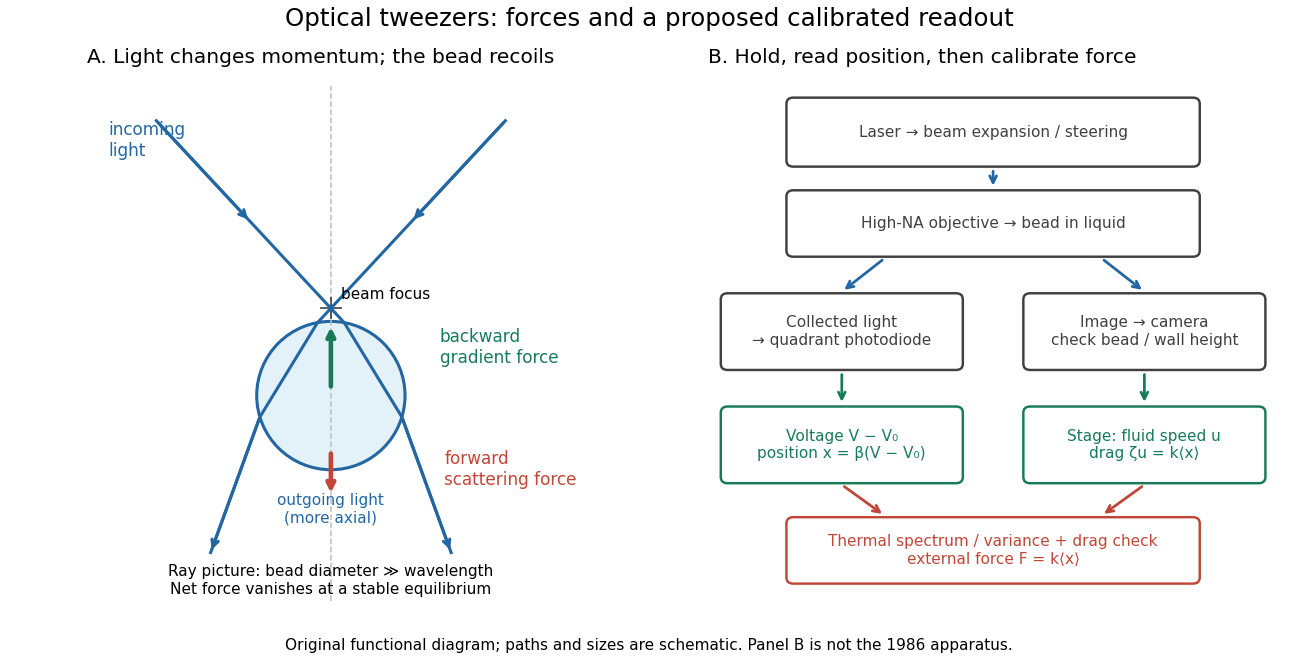
A useful proposed control sequence is to record detector offsets with illumination blocked, calibrate image scale against known stage travel, and test the detector response with independently known bead-relative motion. Moving a free trapped bead's chamber is not by itself a known bead displacement: fluid drag and trap stiffness determine the shift. Use a separate immobilized bead or an independently imaged trajectory for the position response, then check whether the response transfers to the actual trapped bead. Repeat the calibration after changing trapping power or optics.
Measure the acquisition frequency response and choose a sample rate that resolves , with sufficient signal bandwidth and control of aliasing. Compare thermal calibration of an optical trap with optical trap drag calibration, sweep small positive and negative flow speeds, inspect for multiple beads, and repeat at several wall distances. Check temperature and drift before interpreting a power-dependent stiffness: a changed fluid viscosity can change even at unchanged . These are proposed diagnostics of the model, not procedures attributed to the 1970 or 1986 papers.
An optical momentum efficiency expresses the net axial momentum transferred to a bead relative to incident power divided by vacuum light speed. It absorbs medium-index factors and the incident/outgoing ray geometry. Refractive-index contrast alone does not determine for a transparent bead illuminated by a focused beam. The estimate is a weak-contrast scale, not a universal force formula. An effective reflector with power reflectance instead gives in the simple vacuum-momentum convention.
For a force profile supported on an interval of width , set . If a trap of speed overtakes an overdamped particle with , then and . These expressions follow by changing to the trap-frame coordinate, whose velocity is . Smooth zeroes of can prevent finite passage.
If the maximum force-induced speed is smaller in magnitude than , expand the passage denominator as a uniformly convergent geometric series. For a localized conservative well with equal outside potential levels, the first force moment vanishes and displacement starts at order . An odd force has no cubic moment, giving the next correction at order . Compact force support alone does not guarantee a vanishing first moment or positive displacement.
In the trap frame, a particle under linear drag has relative speed . A uniform strictly negative relative speed guarantees finite passage through a compact support. For a bounded continuous force, supplies that condition. For ordinary smooth forces, an encountered zero of the relative speed is an equilibrium or a passage bottleneck, not a finite crossing. Negative forces do not impede forward trap passage.
For a passing optical trap on a circle of circumference with nonoverlapping support, a particle that is stationary between encounters receives displacement in each encounter. The trap revolution frequency and particle revolution frequency obey . This corrects the naive independent-kick estimate when the particle motion changes the encounter rate.
The exact separated-kick response is for circumference . Its relative correction to the independent-kick estimate is controlled by . For a localized well with force-induced speed bounded by , . Thus high speed is sufficient when the support width is below one circumference. The local straight-force approximation also requires a narrow trap on the curved track.
A triangular localized potential energy has forces behind and ahead of the trap centre. With , and , its circular response is for . A trapped particle has for , interpreting the discontinuous force at the cusp by a sticking or rounded-well limit.
For a translating potential energy profile with equal values at the two ends and linear drag force , a finite passing trajectory satisfies . Equivalently, since , . Compact support of the force alone is insufficient. At high speed the displacement is .
Articles by others on the same topic

Optical tweezers are sophisticated scientific instruments that use highly focused laser beams to manipulate microscopic particles, such as biological cells, viruses, and even small beads or other nanoparticles. The principle behind optical tweezers is based on the interaction of light with matter, specifically the way that photons—particles of light—carry momentum. When a laser beam is focused to a fine point, it creates a gradient of light intensity.



Sample usages:
- quantum computing startup Atom Computing uses them to hold dozens of individual atoms midair separately, to later entangle their nuclei