Let be independent fair bits, and let be their exclusive or: precisely when . The four possible triples are , each with probability . Each coordinate is a fair bit. Writing out all eight patterns givesEvery pair has all four cells with probability :For , the four allowed triples project to ; for they project to . Each projection lists each pair exactly once, proving pairwise independence. But differs from the product , so the three are not independent random variables. Indeed, any two determine the third. A single coordinate reveals nothing about another, while two coordinates together reveal it completely.
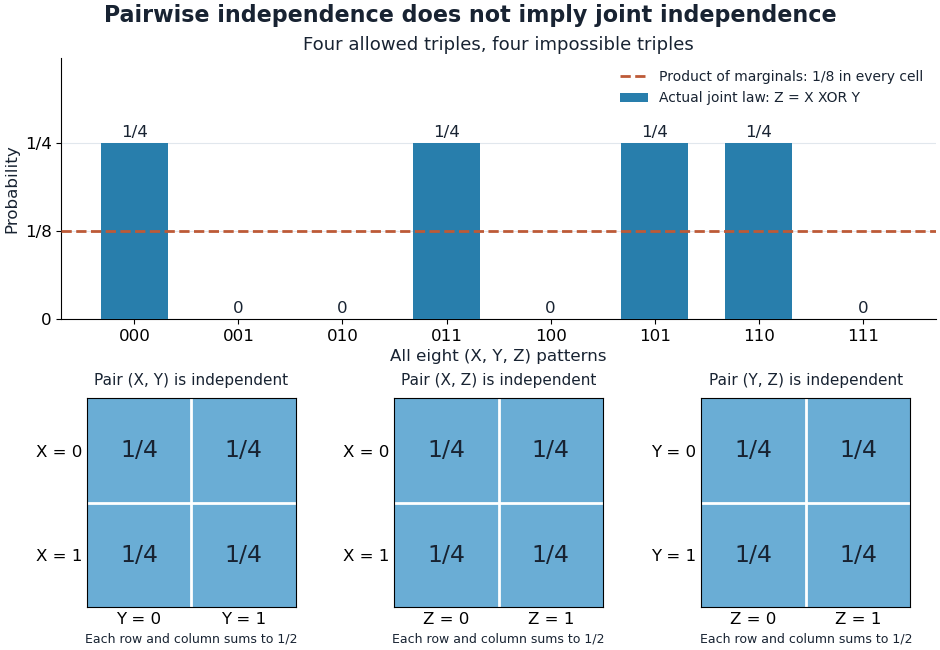
The XOR example hides joint dependence from every pairwise probability table
. The bars show all eight triple patterns against the reference for three independent fair bits. Below, all three pairwise joint probability mass functions have four equal cells of . Details.
The exclusive or example is the complementary-bit version of the two-toss exercise in Grinstead and Snell, Introduction to Probability, section 4.1, exercise 7, printed page 151. It is a compact reason to check the full product rule whenever a calculation uses three-way or higher events.
Articles by others on the same topic
There are currently no matching articles.