The Mott two-current model treats the two spin populations as parallel conduction channels when spin-flip scattering is weak. Thus and . Light, broad-band carriers conduct efficiently; scattering into narrow -like states relaxes their current. In a simple spin-conserving – picture,In copper, the filled bands supply little final-state phase space at , so both spin channels have low resistivity. In cobalt, the nearly filled majority band suppresses majority-channel scattering, while minority states remain available. The stated iron reversal corresponds to stronger scattering-weighted majority-channel phase space: its majority band is not closed as in cobalt. Band filling, exchange splitting, velocities and scattering matrix elements set this scattering-weighted spin-channel asymmetry; majority population alone does not select the better conductor. The given iron ordering is a material/scattering input, not a universal consequence of the two-current postulate. Different impurities and interfaces can change the asymmetry.[ref]
The spacer electrons mediate interlayer exchange coupling. Spin-dependent reflection at the two magnetic interfaces changes their electronic energy as the spacer thickness varies. In the oscillatory spacer-mediated exchange picture, Fermi-surface spanning wavevectors produce terms such as with a decaying envelope; real spacers can have several periods.
Define the coupling energy per area by . favours parallel moments and antiparallel moments. The oscillation period and phase depend on spacer band structure and interface reflection; there is no universal monotone rule or numerical crossover thickness from alone. Roughness and nonuniform thickness average and weaken the coupling. This is conduction-electron-mediated exchange, not a requirement that the nonmagnetic spacer itself be ferromagnetic.
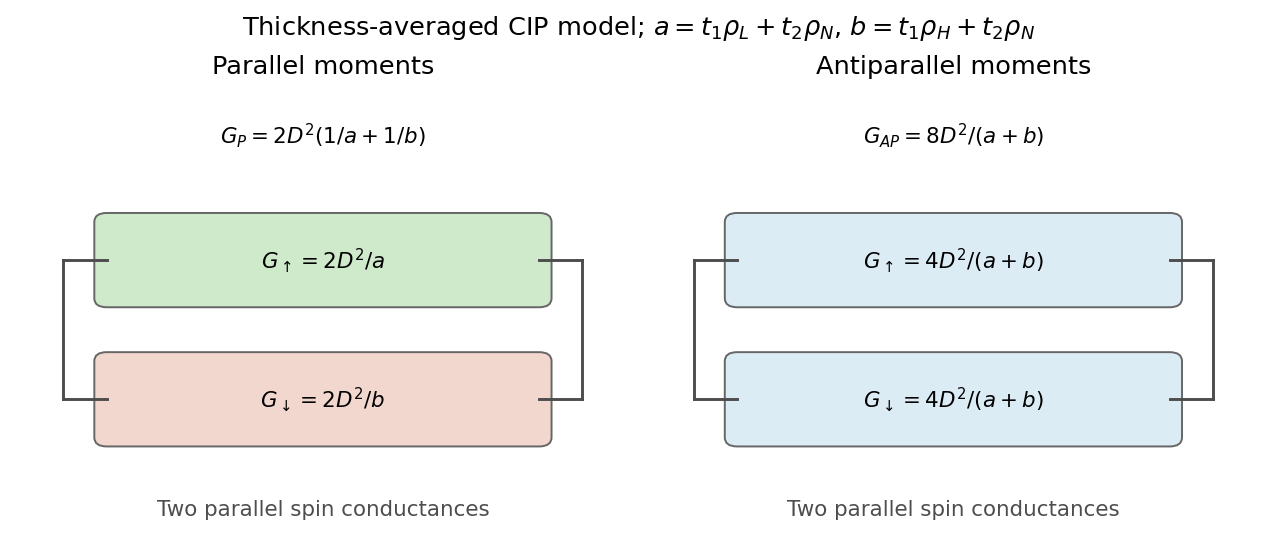
Put , and . In the CIP thickness-averaged two-current model, assume spin is conserved and electron trajectories sample the layers, so each channel's effective resistivity is the thickness average: , . This uses averaged relaxation rates with comparable transport weights, neglecting additional interface resistance. Here is the per-spin-channel resistivity, twice the measured nonmagnetic bulk resistivity. The stated long mean free path motivates sampling more than one layer.
A four-layer period has thickness . For an in-plane square, , hence the two parallel spin conductances add:The square's side cancels. The layers are not being treated as four macroscopic resistors in series along the in-plane current; the averaging is over the traversing carriers' scattering histories.
With opposite magnetic moments, a fixed global spin is the low-resistivity species in one ferromagnetic layer and the high-resistivity species in the other. Thus both spin channels have the same four-layer averaged resistivityEach channel's square resistance is , and the two channels run in parallel. ThereforeBoth channels encounter the strongly scattering magnetic layer; neither retains the uniformly favourable path available for parallel magnetizations.
An in-plane magnetic field lowers the Zeeman energy when moments align with it. It competes with antiferromagnetic interlayer exchange coupling; the layers generally cant or switch toward a parallel configuration and ultimately saturate if the field overcomes coupling and magnetic anisotropy. The high-resistance antiparallel state evolves toward the lower-resistance parallel state. The switching path and field scale depend on anisotropy, pinning and coupling strength, which are not numerically specified.
Combining the two results gives the GMR ratio for identical thickness-averaged layers:Thus a field that aligns initially antiparallel moments produces a resistance decrease. One spin channel conducts well throughout the aligned stack; in the antiparallel stack both channels sample strong scattering. For the low-resistance-state normalization,Normalizing the field-induced drop by instead gives . Large channel contrast can produce a large giant magnetoresistance; equal channels give none, and common nonmagnetic scattering dilutes the contrast. This is the spin-dependent alignment effect, distinct from anisotropic magnetoresistance of an individual magnetic layer.

Articles by others on the same topic
There are currently no matching articles.