2016 paper: Public original PDF, physical page 783. Student-answer availability for this paper remains unverified.
Original solutions to the released 2016 1/AQC paper. [ref]
https://www.whatdotheyknow.com/request/natural_science_tripos_physics_e_2/response/2340776/attach/2/FOI%202023%20399%20Zahid%20materials.pdf?cookie_passthrough=1#page=783. Original public PDF, physical pages 783–786; questions on pages 784–786
The absorptive dielectric function counts optically accessible electron-hole pairs. In the electric dipole approximation the perturbation is proportional to , with the light polarization and the electronic momentum operator. The squared matrix element between occupied valence and empty conduction states is the transition strength; it includes polarization and band-symmetry selection rules. The sums enumerate initial and final subbands. photon momentum is negligible on the crystal-momentum scale, so the transition is approximately vertical in the in-plane wavevector .
For each subband pair, is the constant-transition-energy contour in the two-dimensional Brillouin zone. Its line element is , and the reciprocal gradient weights the states satisfying energy conservation. Specifically, the level-set representation of the joint density of states isA small energy gradient means many nearly resonant states; a vanishing gradient can produce a Van Hove singularity or an edge. The displayed expression suppresses overall optical prefactors and assumes the momentum matrix element is approximately constant along each contour. More generally it stays inside that integral. Occupation factors are also implicit; at low temperature in an undoped well the relevant valence states are full and the conduction states empty. This is the independent-particle continuum contribution from Fermi's golden rule. Bound excitons add optical resonances below the corresponding free-pair thresholds.
The GaAs four-band model is rooted in bonding and spin-orbit coupling. Near the zone centre, the conduction edge is predominantly s-like and antibonding, while the upper valence manifold is predominantly p-like. Combining orbital angular momentum with spin splits the six p-derived states into a quartet and a lower doublet. The latter is the split-off valence band. Within the upper quartet, the and branches, defined relative to a propagation or quantization direction, have different curvatures and are called heavy holes and light holes. They coincide at the unstrained bulk zone centre but need not remain degenerate in a well. The conduction edge is a spin doublet. Thus “four bands” counts conduction, heavy-hole, light-hole and split-off branches, including their spin multiplicities; it does not count four individual states. Positive hole masses describe the downward valence curvature, whereas the conduction curvature is upward.
For the final exciton comparison, define the reduced mass and screened exciton Rydberg byThe resulting are approximately for heavy holes, for light holes and for split-off holes. In the ideal two-dimensional exciton model, the first two optically active internal states lie and below their continuum edge. Their separation is , independent of a common threshold offset. The corresponding three-dimensional separation would be only . The listed peak spacings specified for this theoretical spectrum giveHere each pair comprises the stronger lower-energy peak and its weaker nearby companion, in the order associated with the continuum edges calculated in part (c). The approximately 18-meV and 11-meV pair splittings support the two-dimensional series and are incompatible with the three-dimensional series at the supplied masses and permittivity. Equivalently, for a two-dimensional pair with energies , the inferred edge is ; the observed pair splittings predict ground-state bindings around 20 and 12 meV, close to .
Absolute agreement should not be overstated. For example, the stated square-well parameters give the first heavy-hole edge eV and the first light-hole edge eV. Their ideal two-dimensional peak predictions are approximately eV and eV, respectively. The listed peaks are lower by about 1–2 meV across the families; rounded parameters and this simple effective-mass model do not reproduce every absolute energy exactly. No gap, width or mass has been silently adjusted to fit them. The peak-spacing comparison remains useful because it avoids a common edge offset. The split-off transitions predicted by the four-band data are discussed separately in part (c), rather than assigned fictitious extra peaks.
At 300 K, meV, whereas the ideal ground-state binding energies are only about , and meV; excited states are still more weakly bound. None of these series is expected to remain a clearly resolved, robust bound-exciton peak at room temperature in this simple estimate. Thermal ionization and phonon broadening work against their visibility. This is a scale argument, not a theorem that the exciton population or all Coulomb-enhanced absorption becomes exactly zero: actual observability also requires temperature-dependent gaps, linewidths, screening and carrier density, which are not supplied.
Choose the growth direction as and the well as . In the envelope function approximation, write a subband state as , where is the band-edge cell-periodic Bloch factor. The infinite square well hasThe envelope has the same shape for electron and hole states: changing their effective masses changes the eigenenergies, but not these infinite-well eigenfunctions. With in-plane polarization, the leading interband momentum matrix element acts on the Bloch factors, while the slow envelopes giveorthonormality therefore yields the infinite-well interband selection rule . A nonzero band-level matrix element is still required; the overlap rule does not replace polarization selection rules. Finite barriers can make electron and hole envelopes different, and interface asymmetry or band mixing can relax this ideal same-index rule.
For a fixed allowed band/subband pair, parabolic dispersions give . If the photon energy exceeds the edge, the contour is a circle of radius and the gradient magnitude is . ThusBelow threshold the contour is absent. With the conventional normalization, the two-dimensional joint density of states per area and independent channel isWith a locally energy-independent optical matrix element, each allowed pair therefore adds a constant step to the continuum dielectric function in the approximation of the supplied equation. Different hole families need not have equal step heights: reduced masses, spin multiplicities and Bloch-state matrix elements differ. Frequency-dependent overall optical prefactors, nonparabolicity, broadening and excitonic Coulomb enhancement can modify the literal step shape outside this approximation.
electron confinement raises the conduction edge and hole confinement lowers the corresponding valence edge, so their positive confinement energies add. With nm, the common bare-mass scale isWriting and , the quantum-well interband thresholds areUse eV and eV. The thresholds in the requested window, using the printed masses without fitting, areThe next heavy-hole and split-off thresholds are about and eV, outside the interval. Each threshold marks a continuum onset or shoulder, not the stronger bound-exciton peak below it. The six heavy- and light-hole onsets follow the six paired peak groups in the supplied diagram. Their first members lie roughly 20 and 12 meV below their respective onsets, as the common solution above explains.
A qualification is necessary for the split-off branch. Its p-like bloch states have nonzero matrix elements to the s-like conduction states, so in-plane polarization does not generally forbid them. For example, a state has a nonzero orbital component with the appropriate spin, which couples to an s-like state through . The same-envelope rule therefore allows the two split-off thresholds in the table. The first nearly coincides with the third heavy-hole edge, while the second would give an additional onset near 2.086 eV. The supplied figure and twelve peak energies appear to retain only the heavy- and light-hole series; they do not specify a split-off-series oscillator strength or identify its extra features. Omitting the split-off transitions would require an additional approximation beyond the four-band information and polarization given. Their expected ideal two-dimensional first-state peaks would be near 1.9010 and 2.0701 eV; these are predictions of the stated model, not additional listed data.
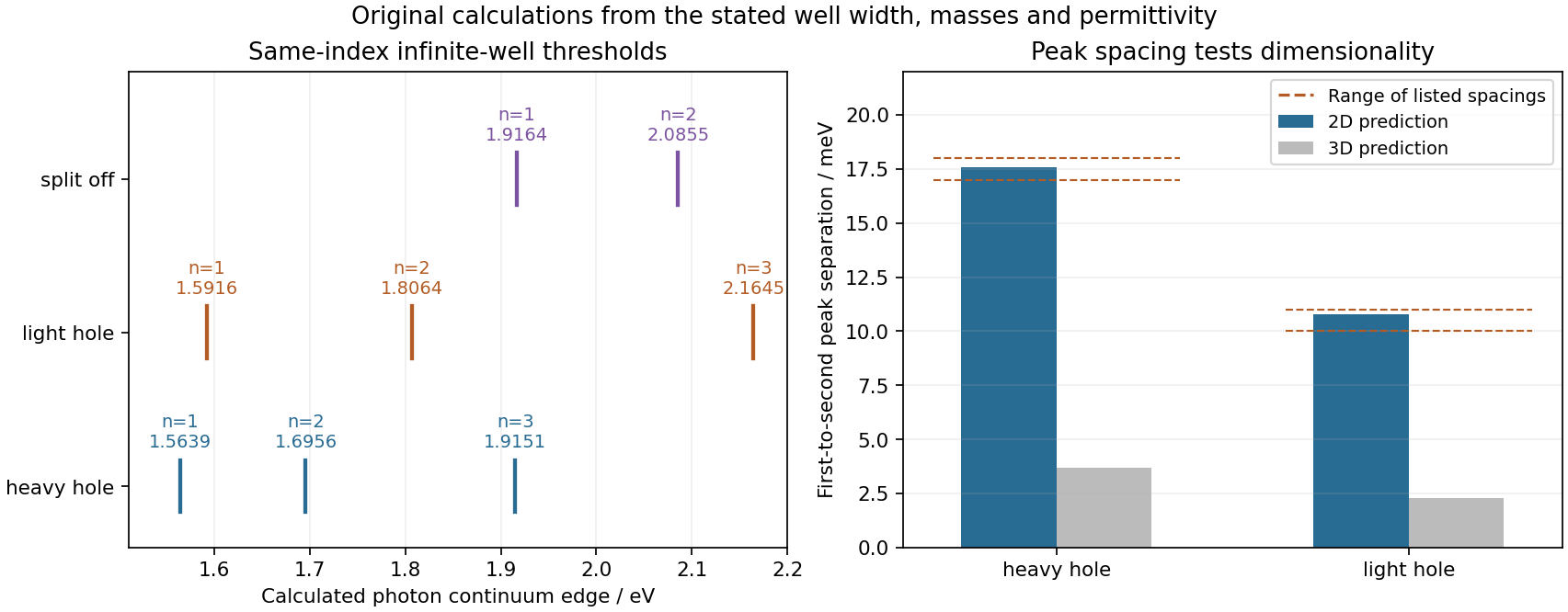
Original calculated continuum-edge map for all supplied bands and comparison of heavy- and light-hole peak-pair splittings
. Details. Start from electrons moving in the periodic equilibrium ionic potential. Displace ion by and expand its contribution as . Quantizing the harmonic normal modes expresses as a sum of creation and annihilation operators with displacement scale for a single simple branch. Expanding the electronic field in bloch states then gives a band-projected Fröhlich HamiltonianHere obey canonical anticommutation relations and remove/create an electron with crystal momentum and spin ; are boson operators for lattice modes. The matrix element contains the derivative of the ionic potential, phonon polarization, displacement normalization and electronic wavefunction overlaps. With phases chosen appropriately, ensures a Hermitian Hamiltonian. The displayed one-band, one-branch notation suppresses additional branch and band labels. “Fröhlich Hamiltonian” here means the linear electron-phonon model used in the question; it is not a requirement to use specifically the polar-optical-phonon coupling of a polar semiconductor. A harmonic lattice, small displacements and a weak enough coupling to organize perturbation theory are the underlying approximations.
The Fröhlich canonical transformation removes real linear phonon operators from the electron-only effective problem to first order. Choose an anti-Hermitian with . For and , one possible generator isIts Hermitian conjugate is its negative after relabelling momenta. The Baker--Campbell--Hausdorff formula givesThe commutator describes virtual emission and absorption of a phonon. normal ordering yields an electron-electron term as well as one-electron energy renormalizations and phonon terms. Retain the former, absorb single-particle shifts into and eliminate the explicit phonon sector. For elastic pair scattering the two virtual time orderings have the combined amplitudeUsing the usual factor one-half to count unordered pairs gives the coefficient in the printed Hamiltonian, with . The two outgoing momenta are and , so total momentum and the spins are conserved. A fully off-shell effective operator can instead use symmetrized denominators for both external legs; the displayed expression is the usual elastic-scattering reduction. Eliminating nearly resonant real phonons requires more care than this second-order construction.
For the denominator is negative: virtual phonon exchange is attractive in this low-energy channel. Physically, an electron changes the ionic density and a second electron can gain energy by responding to the delayed distortion. This is a retarded interaction, not an unscreened instantaneous attraction at every energy transfer. At large transfer the sign changes, and screened Coulomb repulsion must also be included when deciding the net low-energy pairing strength. The connection between lattice dynamics and superconductivity is supported by the isotope effect, but the mathematical attraction alone does not determine a measured transition temperature.[ref]
Electron-Phonon Interactions and Superconductivity by John Bardeen. pp. 55–57, lattice-coupling mechanism and isotope-effect motivation
For the pair calculation, make the model restrictions explicit. The filled Fermi sea is inert, and denotes that sea with no added particles, not an empty electronic vacuum. Project the interaction onto the previously empty shell , where and . Measure the added-pair energy relative to ; this is the negative in the final formula. If absolute one-electron energies are retained in the preceding eigenvalue equation, its eigenvalue must instead be . A shell-restricted state would not in general be an exact eigenstate of the completely unprojected, all-momentum contact Hamiltonian.
Write and . Within the zero-total-momentum pair subspace the two opposite-spin terms cancel the interaction's factor one-half, while same-spin s-wave terms cancel by fermionic antisymmetry. Thus the projected Hamiltonian acts asFor and , matching each basis coefficient givesThis is the stated coefficient formula in the consistent Fermi-level energy convention. Its even dependence on produces an even orbital state with a spin singlet. The constant is fixed up to an overall phase by normalization; for a bound state, . It cannot be set to zero for the nontrivial bound solution.
Put with and impose the sum defining :Here counts orbital states for one spin species, as appropriate to the unrestricted sum in this pair basis, and is approximately constant over the thin shell. If a two-spin total density of states is used, it must be divided by two in this integral. State-counting and the volume convention in and must be consistent. With as the paper's dimensionless coupling, inversion yieldsThe first approximation is the constant-density-of-states, restricted-shell model; the final exponential additionally assumes weak attraction. The binding energy is nonanalytic at zero coupling, so a finite-order power expansion in cannot produce it.
Cooper's problem asks whether two electrons added above an inert Fermi sea bind despite Pauli exclusion of lower states. An arbitrarily weak net attraction binds a zero-momentum singlet below the free-pair threshold, because the near-Fermi-surface integral diverges logarithmically as . Its wavefunction draws on many time-reversed momentum states and becomes dominated by a narrow region near the Fermi surface at weak coupling; the corresponding pair is spatially extended. This establishes a Cooper instability of the unpaired reference state.[ref]
Bound Electron Pairs in a Degenerate Fermi Gas by Leon Neil Cooper. pp. 1189–1190, two added particles above the filled sea and the bound-state criterion
The full superconducting ground state needs a coherent many-electron treatment in which overlapping pairs and the reorganized sea are included. BCS theory supplies that step; the two-electron binding scale alone is neither a calculation of the many-body gap nor a derivation of zero resistance.[ref]Theory of Superconductivity by John Bardeen and others. pp. 1175–1177, paired many-electron ground state and excitation gap
A Bravais lattice is the translation set generated by primitive lattice translation vectors. Translating by any member of leaves its surroundings equivalent. A crystal structure requires both this lattice and an atomic basis attached to every lattice point. The basis can lower the symmetry of the bare point lattice; a familiar-looking geometrical arrangement of atoms is not necessarily itself a Bravais lattice. For example, the diamond cubic structure is a face-centred cubic lattice with an identical-atom basis at fractional positions and in conventional cubic coordinates. The displacement between those two basis atoms is not itself a lattice translation.
The seven three-dimensional crystal systems are triclinic, monoclinic, orthorhombic, tetragonal, trigonal, hexagonal and cubic; the distinct translation types give 14 Bravais lattices. A conventional cell can contain several lattice points, while a primitive unit cell contains one. Simple cubic primitive lattice translation vectors can be chosen along the cube edges; for face-centred cubic they can be , and . Their primitive volume is , explaining the four lattice points per conventional face-centred cell.
A crystallographic point group comprises the orthogonal parts of the crystal's spatial symmetry operations. It constrains possible rotations, reflections, inversion and their combinations, while forgetting translations. Lattice preservation restricts proper rotational orders in three dimensions to ; a fivefold axis cannot be a symmetry of a periodic three-dimensional lattice. One quick argument restricts a rotation's integral lattice representation through , an integer trace, producing these orders. There are 32 crystallographic point-group types. Examples are the cubic full octahedral group with Hermann–Mauguin symbol , the tetrahedral class with symbol , and the polar tetragonal class with symbol .
The space group retains the full isometry. In Seitz notation acts by , and multiplication isIts translation subgroup is normal and the quotient is the crystallographic point group. A screw axis combines rotation with translation along the axis; for example, applying a screw twice gives one whole lattice translation. A glide plane combines reflection with a translation parallel to the plane; applying the glide twice likewise gives a translation. These operations can preserve the complete crystal without their rotation or reflection alone preserving it.
A symmorphic space group admits an origin and representatives for which the point-group operations have no translation component. A nonsymmorphic space group has essential fractional translations that cannot all be removed by moving the origin. There are 230 three-dimensional space-group types, distinguished more finely than their point groups. These counts refer to ordinary, nonmagnetic periodic space groups; magnetic and aperiodic generalizations are different classifications.[ref]
International Tables for Crystallography, Volume A: Space-group symmetry. 2016 edition, overview and Part 1 introduction to crystallographic and space-group symmetry
For concrete comparisons, a monatomic simple-cubic crystal has space group and point group . Rock salt has a face-centred cubic lattice, a two-species basis and symmorphic space group . Diamond has the same cubic point group and translation-lattice type, but its basis leads to nonsymmorphic . Replacing the two diamond basis sites by distinct species gives the zinc blende structure, exemplified by GaAs, with and point group ; inversion that would interchange the species is no longer a symmetry. The lattice specifies translations, the point group specifies the linear symmetry classes, and the space group specifies their complete spatial implementation. These examples show why none alone uniquely describes an atomic structure.
A quantum dot confines electronic motion in all three directions. A semiconductor dot can be thin enough that only one transverse subband is occupied, with discrete lateral states controlled by gates. In a rectangular hard-wall model,A smooth circular lateral confinement is often better approximated by , giving above the transverse ground energy. Shell contains orbitals, twice that many electrons before interactions split the spin degeneracy. Hence closed-shell electron numbers are . These are single-particle quantum numbers; an interacting dot's states are many-electron eigenstates, not simply one orbital occupied by a whole charged island.
A perpendicular magnetic field changes the harmonic spectrum to the Fock-Darwin spectrum. For an electron of charge , take and in the usual symmetric gauge. ThenReversing the definition of the angular label changes the displayed sign of its orbital term, not the set of energies. The Zeeman term lifts spin degeneracy, while exchange can favor parallel-spin filling in partially filled shells. These effects are distinguished by how peaks evolve with field rather than by identifying every irregular peak spacing with one-particle confinement.
For electrostatics, let and , where represents a fixed offset charge in the chosen convention. The constant interaction model givesThe charging energy is conventionally , whereas adjacent charge-state potentials differ byThis addition energy separates a capacitive contribution from orbital spacing. Exchange, nonuniform screening and correlations are corrections to the constant interaction model; a change in dot shape or effective capacitance can also alter spacings.
Connect the island weakly to source and drain reservoirs through tunnel barriers. sequential tunnelling is suppressed in a charge-stable region when neither adding nor removing an electron is energetically accessible. Sweeping the gate brings a charge electrochemical potential through the reservoir Fermi level, giving a Coulomb-blockade conductance peak. The gate lever arm is , so locally if the capacitances and level spectrum do not vary appreciably. At finite source-drain bias, alignment with either reservoir defines the boundaries of a Coulomb diamond. Its slopes constrain capacitance ratios, and lines parallel to its edges can reveal excited-state transport. The conversion from a diamond's bias height to an energy depends on bias convention; a full-height/half-height factor must not be assumed without declaring the circuit.
A clear charging spectrum requires and tunnel broadening smaller than the relevant addition energy; resolving individual orbital levels additionally requires them smaller than the orbital spacing. Tunnel resistances large compared with suppress strong charge fluctuations in the usual weak-junction regime. Blockade is not an assertion of mathematically zero current: higher-order cotunnelling can remain, and strong coupling or low-temperature spin correlations can invalidate the sequential model. An experimental check therefore combines gate sweeps with bias spectroscopy, temperature dependence and barrier tuning to separate level structure from broadening or uncontrolled charge traps.
In a primary vertical-dot experiment, gate-controlled current oscillations were converted into addition energies using finite-bias diamond spectroscopy; varying magnetic field then followed shell and spin filling. Reproducing enhanced addition energies at electron numbers 2 and 6 in several devices strengthened the shell assignment. The electron temperature was independently estimated above the refrigerator base temperature, an essential distinction when judging spectral resolution. Field-dependent reordering also revealed exchange effects beyond a purely spin-degenerate orbital model.[ref]
Shell Filling and Spin Effects in a Few Electron Quantum Dot by S. Tarucha and others. pp. 3613–3616, gate control, finite-bias calibration, sample comparisons, electron-temperature estimate and field-dependent spin filling
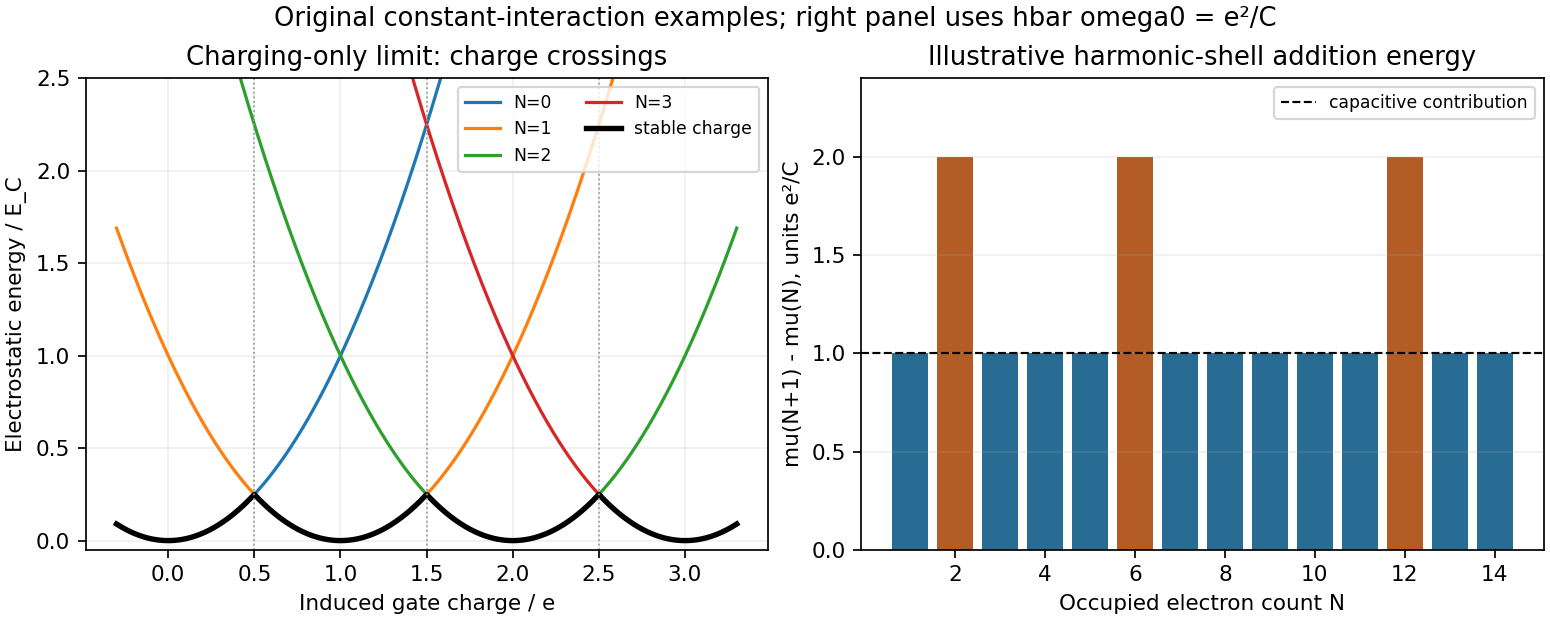
Original constant-interaction charge parabolas and addition-energy example showing charging, spin pairing and shell closure
. Details. Use a three-dimensional electron gas with a uniform positive background, the jellium model. The Hartree-Fock method minimizes the expectation of the interacting Hamiltonian over normalized Slater determinants. Antisymmetry is exact within that trial class, but correlations requiring a superposition of determinants are omitted. For orthonormal occupied spin orbitals , the energy iswhere is the direct Coulomb integral and the exchange integral; the spin overlap makes exchange vanish between opposite-spin orbitals. The self-interaction terms and cancel. Variation gives a self-consistent Fock operator ; exchange is nonlocal. Its eigenfunctions define occupied orbitals of a stationary determinant, and the determinant must be compared with competing self-consistent solutions to select a variational ground state.
The eigenvalues are orbital Lagrange multipliers. Their sum counts each interaction twice:Frozen-orbital removal energies may be estimated using Koopmans' theorem, but measured quasiparticle energies can contain relaxation and correlations absent from this approximation. Unoccupied orbital energies are not automatically an exact excitation spectrum. In particular, unscreened exchange in a uniform three-dimensional gas produces an unphysical logarithmic slope singularity at its Fermi surface; a one-determinant mean field does not reproduce the interacting Fermi liquid's screened response.
For a spatially uniform plane-wave determinant, electron-background and background-background terms cancel the uniform direct Coulomb contribution. Retain the background when making this cancellation: an isolated infinite electron charge distribution would have a divergent direct energy. The surviving contributions per particle are kinetic energy and negative same-spin exchange energy. Let define the Dimensionless Wigner-Seitz radius, with , and . ThenFor the unpolarized state this is approximately . The kinetic contribution penalizes spin polarization because it enlarges an occupied Fermi sphere; exchange favors polarization because equal-spin occupation gains more exchange energy. As density falls, the exchange scale overtakes the kinetic scale. The uniform fully polarized and unpolarized energies cross atThis is a variational comparison within the homogeneous Hartree-Fock electron gas, not an exact physical ferromagnetic phase boundary. It demonstrates how Pauli kinetic energy and exchange compete and why the allowed trial states matter.
Allowing spatial symmetry breaking changes the result: the Overhauser instability lowers the paramagnetic determinant's Hartree-Fock energy through a spin density wave, even in the high-density limit. A calculation restricted to uniform Fermi spheres therefore does not give the unrestricted Hartree-Fock ground state.[ref]
Spin Density Waves in an Electron Gas by A. W. Overhauser. abstract and p. 1437, instability of the uniform paramagnetic state to spin-density waves
At still lower density, localization and a Wigner crystal compete with fluid states. electron-gas correlation energy beyond a single determinant is important in assessing their competition. Quantum Monte Carlo provides a concrete route to comparing correlated fluid and crystal energies; the original stochastic calculation demonstrates why exchange-only energy differences are insufficient.[ref]Ground State of the Electron Gas by a Stochastic Method by D. M. Ceperley and B. J. Alder. abstract and pp. 566–569, correlation energies and competing fluid/crystal states
Hartree-Fock is a useful variational baseline with exact exchange, not a controlled complete low-density phase diagram. At high density the kinetic scale dominates, but even a small symmetry-breaking energy gain can invalidate a restricted determinant as the exact Hartree-Fock minimizer. At low density neglected correlations, screening and localization can change both transition locations and the ordering of candidate phases. A numerical phase boundary should therefore state dimension, spin constraints, background model and whether correlation and spatially modulated states were included.
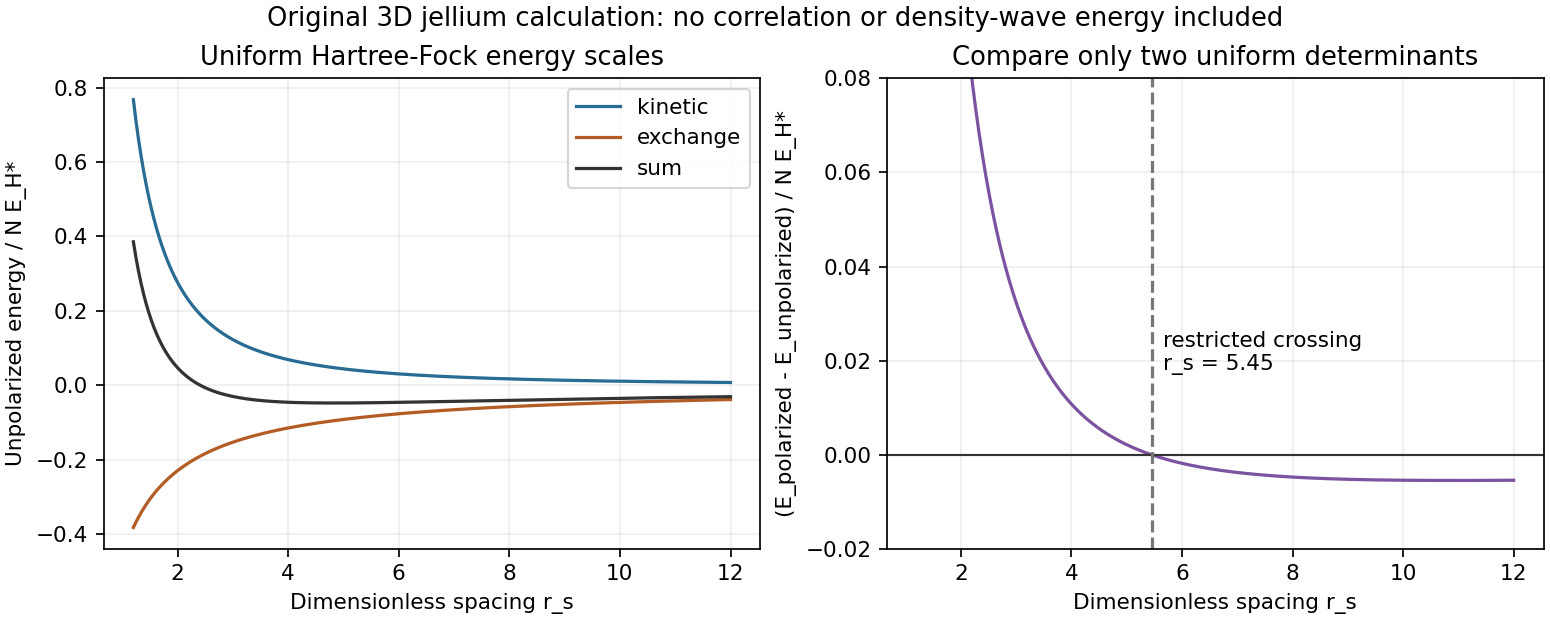
Original homogeneous Hartree-Fock kinetic and exchange energy comparison; the crossing is a restricted variational result
. Details. The Hartree-Fock method minimizes the expectation of an interacting-electron Hamiltonian over normalized Slater determinants of orthonormal one-particle spin orbitals. It is a variational, self-consistent mean-field approximation. The determinant enforces fermionic antisymmetry exactly within that class, while each orbital responds to the mean charge density and a nonlocal exchange operator generated by the occupied orbitals.
For an electron gas, this accounts for kinetic pressure, the average electrostatic field, same-spin exchange and the associated exchange hole, and possible spin polarization. It does not account for general dynamical electron correlation, such as the correlated avoidance of opposite-spin electrons, and cannot capture all screening or collective fluctuations merely by optimizing one determinant. Uniform plane waves are an additional restriction, not the definition of Hartree-Fock itself.
In the energy functional, the one-body term is the sum of electron kinetic energy and ionic-potential energy. The direct two-body term is the Hartree energy: the classical interaction of the mean electron density with itself. Its factor avoids counting every pair twice. The negative Fock term comes from exchanging the two indistinguishable electron labels in the antisymmetric state. For a spin-independent interaction, spin orthogonality makes this exchange act only between equal spin components. For an orbital interacting with itself, direct and exchange contributions cancel exactly; the exchange term removes the spurious one-electron self-interaction. Ionic background terms and their prescribed cancellation must be included consistently with the direct term.
Use normalized plane-wave spin orbitals and fill a separate Fermi sphere for each spin species. Each spin state counts once, soIts kinetic energy per volume isThe spin-independent contact interaction has uncancelled direct energy , with . By the imposed background assumption this direct contribution cancels. For the Fock term the contact delta function sets the two spatial positions equal; its spin factors then select equal spins. The local one-body density matrix for each spin has diagonal value , givingCombining these results gives the contact-interaction Hartree-Fock spin energyHere has units of energy times volume. The result is the model with the stated background subtraction; an isolated contact-interacting gas without that subtraction retains its direct contribution.
For the unpolarized gas write . The positive direct Hartree energy before background cancellation and the kinetic energy areTheir ratio is thereforeThis compares the separate direct and kinetic terms. The net Hartree-plus-background contribution after the stipulated cancellation is zero, so it would be incorrect to interpret as that residual contribution divided by . The exchange-energy magnitude in the unpolarized state is , not .
At fixed total density, the unpolarized and fully polarized candidate energies arePolarization increases the kinetic energy because one spin species must occupy a larger Fermi sphere, but gains negative exchange energy. The fully polarized candidate wins this endpoint comparison ifUsing the defined givesThus the specified two-state comparison indeed predicts a polarized state below the unpolarized state's energy for .
The endpoint and continuous polarization thresholds of a contact electron gas are different. To check the actual onset within the same uniform Hartree-Fock model, allow to vary continuously. In units ,The unpolarized state loses local stability already at . Full polarization becomes the minimizing endpoint only when , or . Between those values the optimum is partly polarized. Consequently is the requested endpoint crossing, not the exact onset of spontaneous polarization after all spin populations are allowed.
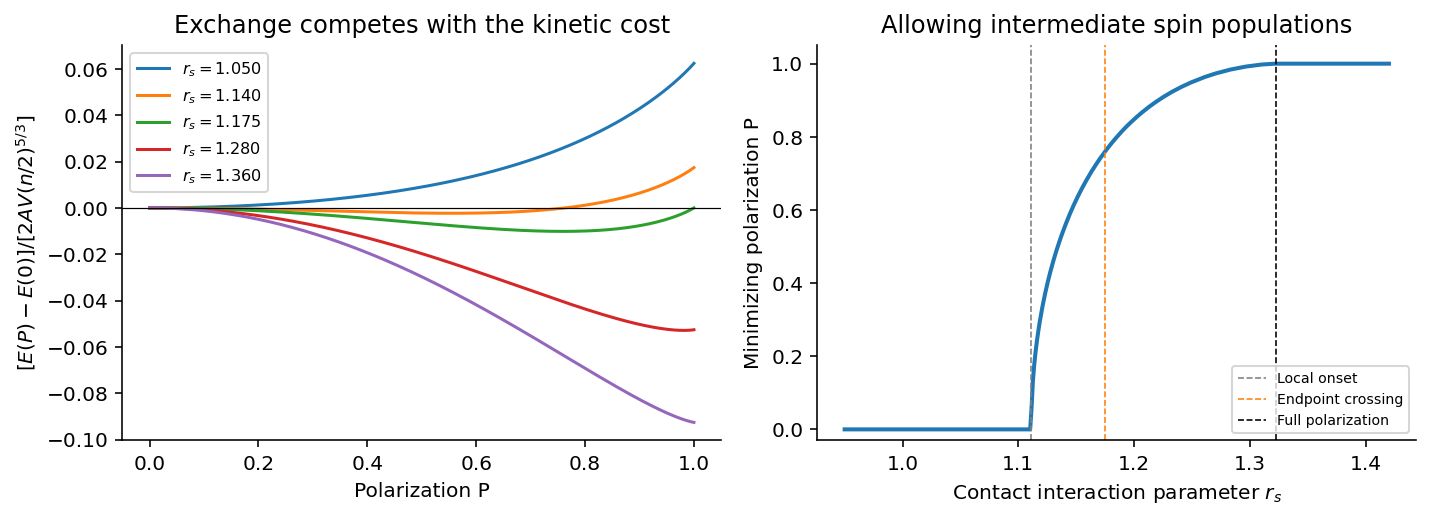
Contact-interaction spin energies showing partial polarization between the local onset and full saturation
. Details. The central limitation is that a Hartree-Fock electron gas includes exchange but omits the correlation energy that is not representable by one determinant. Opposite-spin electrons can lower their repulsion by avoiding one another in a correlated unpolarized state. Hartree-Fock misses that avoidance while retaining the exchange advantage of aligned spins, so it need not place a magnetic instability at a reliable interaction strength. The relevant energy differences between competing spin states can be much smaller than their total energies. Correlation calculations of the electron gas explicitly address this competition.[ref]
Ground State of the Electron Gas by a Stochastic Method by D. M. Ceperley and B. J. Alder. Author manuscript, physical PDF pages 4–8: competing phases, correlated trial functions and energy differences
There are further model restrictions. A constant contact coupling discards the momentum dependence of the Coulomb interaction and the resulting nontrivial screening. Real materials have a lattice, band structure and material-dependent effective interactions. Spatial magnetic textures or other competing states are excluded by a comparison restricted to uniform Fermi spheres. Even before those changes, part c's two endpoints do not find the continuous polarization onset.
The symbol also needs care. Here it is an energy ratio proportional to . The usual Dimensionless Wigner-Seitz radius of a three-dimensional Coulomb electron gas is , proportional to . They are not the same density parameter. A quoted experimental value of the latter cannot be compared numerically to without a model-specific mapping. The contact interaction, missing correlations, restricted variational class and parameter convention prevent the number from being a quantitative experimental prediction. The paper supplies no particular experimental threshold, so none is invented here.
Landau quasiparticles describe the long-lived low-energy excitations of an interacting normal Fermi liquid. Starting from a free Fermi gas, imagine switching on interactions without changing the phase or destroying the one-to-one labelling of low-energy states. The resulting excitation carries the quantum numbers of a dressed particle but has a renormalized energy and interactions with other excitations. Its microscopic wavefunction need not resemble a bare electron state. The occupied momenta define a Fermi surface, and the quasiparticle energy measured from the chemical potential vanishes on that surface.
The Landau quasiparticle energy functional expresses the change near equilibrium in terms of occupation changes:Differentiation gives the energy of one quasiparticle in the distorted distribution. This is a phenomenological expansion around the true interacting ground state, not the assertion that its total energy equals that of independent particles. For an isotropic system, spin-symmetric and spin-antisymmetric components of are expanded in Legendre polynomials. Multiplication by the appropriate Fermi-surface density of states defines dimensionless Landau parameters . The original formulation relates a change in the distribution to the energy shift.[ref]
On the Theory of the Fermi Liquid by Lev Davidovich Landau. Page 70, quasiparticle interaction and distribution variation
Pauli blocking makes the low-energy excitations sharp. The phase space for a quasiparticle to scatter while creating another particle–hole pair shrinks as the Fermi surface is approached, giving the regular three-dimensional low-energy Fermi-liquid quasiparticle lifetimeThus at zero temperature its width is small compared with its excitation energy. The single-particle spectral function has a pole with quasiparticle residue , generally less than one, and an incoherent remainder. In a conventional Fermi liquid the occupation distribution has a discontinuity of height at the Fermi surface, rather than a unit free-particle step.
For an isotropic three-dimensional system, define to include both spins. The quasiparticle density of states determines the low-temperature electronic heat capacity, . In the usual Landau-parameter normalization, the spin response is modified by and the compressibility by . In a Galilean-invariant continuum, ; that particular relation must not be imposed unchanged on a crystal band. A denominator approaching zero signals a possible instability of the assumed normal state.
The same interaction functional and a kinetic equation describe collective zero sound when the excitation frequency exceeds the collision rate. Ordinary first sound is the collision-dominated hydrodynamic limit. The theory organizes thermodynamics, response and transport through a small set of measured effective parameters while explaining why interactions coexist with long-lived fermionic excitations. It is not applicable without qualification in phases where the Fermi-liquid quasiparticle pole disappears or a gap opens over the relevant Fermi surface.
A Wannier-Mott exciton is a bound conduction-band electron and valence-band hole whose envelope extends over many lattice cells. That large radius permits an effective mass description and dielectric screening of the electron–hole attraction. With electron and hole masses , define reduced mass and center-of-mass mass . The bulk relative-motion Hamiltonian is hydrogenic with an appropriate relative permittivity :A semiconductor quantum well confines the electron and hole perpendicular to the plane while leaving approximately free in-plane center-of-mass motion. If the well width is small compared with the bulk exciton Bohr radius, their relative motion becomes quasi-two-dimensional. The ideal zero-width, same-dielectric limit isIts ground-state binding is , compared with in three dimensions, and the ground envelope decays on the scale . Stronger binding follows because confinement prevents the pair from separating in the third direction.
For a finite-width quantum-well exciton, average the Coulomb attraction over the normalized electron and hole confinement envelopes:This smooths the strict planar singularity and changes the binding. The ideal factor four is a useful reference, not a universal value for every real well. Finite barriers, dielectric mismatch, several confinement subbands and nonparabolic valence bands can require a coupled treatment.
Optical absorption creates a nearly zero in-plane center-of-mass wavevector exciton. For the lowest confinement subbands, its line lies approximately atThe discrete bound-state peaks occur below the free electron–hole continuum. Dipole-allowed envelope states have nonzero relative wavefunction at zero separation; the absorption strength also contains the confinement overlap . Confinement can increase the overlap and the binding, making excitonic optical structure more prominent. A perpendicular electric field shifts and separates the confinement envelopes, changing the transition energy and usually reducing their optical overlap: this is the quantum-confined Stark effect.
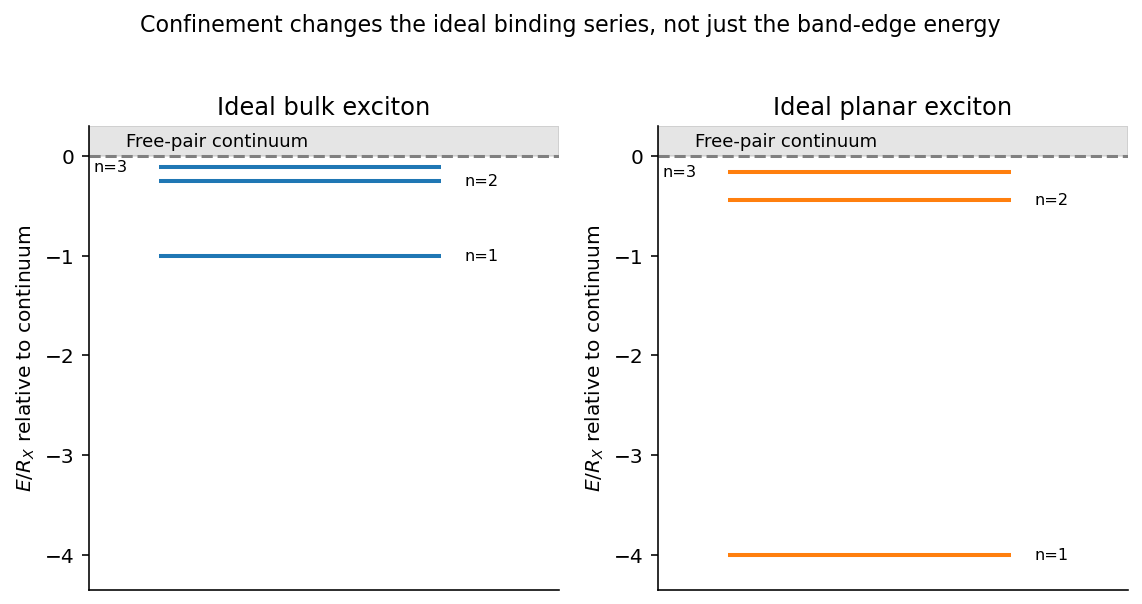
Quantum wells tune both the continuum threshold and the bound-state energy; an optical line shift is not automatically a change in binding alone. The hydrogenic envelope model requires a Wannier-sized state, rather than an exciton localized to one lattice cell.
Experimental tests of BCS theory compare several properties of the same superconducting state. In the conventional weak-coupling setting, phonon-mediated attraction pairs opposite momenta and spins, and the BCS quasiparticle spectrum is . Agreement with a single energy scale and its temperature dependence is more discriminating than observing zero resistance alone.
The superconducting isotope effect tests the lattice's role. Replacing one isotope by another changes ionic masses while leaving the chemical valence nearly unchanged. Phonon frequencies scale approximately as , so a weak-coupling phonon mechanism predicts with when other parameters stay fixed. The shift was measured in mercury before the microscopic pairing theory was developed.[ref]
Isotope Effect in the Superconductivity of Mercury by Emanuel Maxwell. 1950 primary report, transition-temperature comparison of mercury isotopes
Deviations from can result from Coulomb, anharmonic and strong-coupling effects; the isotope observation supports lattice-mediated pairing without uniquely proving every assumption of the simplest model.Thermodynamic measurements test the gapped excitations and condensation energy. An isotropic fully gapped superconductor has exponentially small low-temperature electronic heat capacity, rather than the normal linear law. At the transition the weak-coupling BCS thermodynamic ratios areHere means the electronic contribution after subtracting the lattice background. The gap closes at , and the same framework predicts the temperature dependence of penetration depth and thermodynamic critical field. These quantities were quantitative comparisons in the original theory.[ref]
Theory of Superconductivity by John Bardeen and others. Abstract and thermodynamic discussion: energy gap, specific heat and penetration depth
Electron tunnelling measures the excitation spectrum more directly. A normal-metal–insulator–superconductor junction has, at sufficiently low temperature and nearly constant tunnelling matrix element, proportional to the superconducting density of states at :The suppression below the gap and enhancement at its edges test the BCS electronic density of states. Giaever's thin oxide-barrier junction measurements established such energy-gap structure.[ref]
Energy Gap in Superconductors Measured by Electron Tunneling by Ivar Giaever. Physical Review Letters 5, 147–148; tunnel-current and differential-conductance measurements
For a junction between two superconductors the threshold involves the sum of their gaps, so it must not be read as a normal-metal single-gap spectrum without accounting for the two electrodes.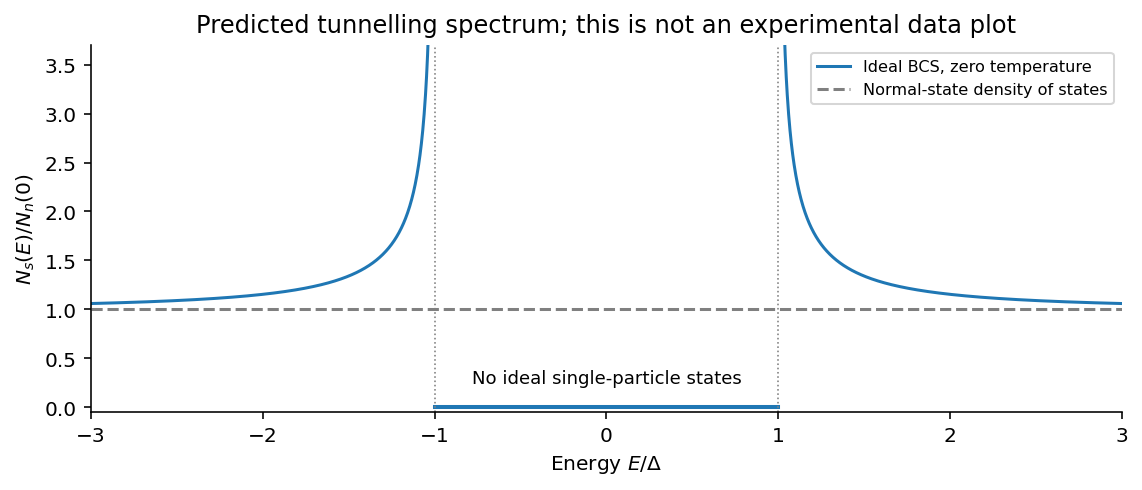
Ideal BCS density of states illustrating gap-edge spectroscopy; model prediction, not experimental measurements
. Details. Nuclear spin-lattice relaxation supplies a phase-coherence-sensitive test. In the conventional s-wave case, the Hebel-Slichter coherence peak just below is followed by a falling rate at lower temperature. Density of states alone is not enough: the BCS coherence factors enter the transition matrix elements. The contrast between nuclear relaxation and ultrasonic attenuation was explained using the paired state, unlike a simple two-fluid population model.[ref]
Nuclear Spin Relaxation in Normal and Superconducting Aluminum by L. C. Hebel and Charles Pence Slichter. Abstract: field-cycling method and comparison of nuclear relaxation with ultrasonic absorption
Finally, magnetic flux quantization in units and Josephson effects support a coherent charge- condensate. Those observations establish pairing and phase coherence more broadly; their existence alone does not specify a phonon mechanism or an isotropic weak-coupling gap. The converging isotope, spectroscopic, thermodynamic and coherence-factor tests support conventional BCS superconductivity, with explicit limits to its simplest universal ratios.
The first term assigns energy to occupying the localized orbital at site . The hopping term moves an electron between neighbouring sites, producing kinetic delocalization and band dispersion; Hermitian conjugate hops make the Hamiltonian Hermitian. The final term costs only when both spin states occupy the same local orbital. This is a Hubbard model with an on-site Coulomb penalty, not a classical interaction between magnetic dipoles.
At one electron per site and large , a real hop is energetically costly, but a virtual hop into a doubly occupied intermediate state is possible. Opposite-spin states can exploit these virtual processes and lower their energy, while parallel spins cannot occupy the same one-orbital site. The resulting singlet–triplet splitting produces antiferromagnetic Hubbard kinetic exchange.
There is a terminology qualification. The paper calls this overlap-mediated process “direct exchange” because the hopping is directly between neighbouring magnetic orbitals. In the stricter distinction between direct Coulomb exchange versus kinetic exchange, the displayed Hamiltonian omits an explicit intersite Coulomb exchange integral. The antiferromagnetic mechanism derived below is kinetic exchange; a genuine intersite direct exchange term is separate and can compete with it. This distinction also separates the model from ligand-mediated superexchange in part f.
Expand the field operator in orthonormal localized orbitals, . For a one-electron continuum Hamiltonian , projection givesThe coefficient in the displayed lattice Hamiltonian is . Thus the projected hopping matrix element and sign convention requireOrthogonality states ; it does not imply for a spatially varying potential. If the off-diagonal potential is assumed zero, for example when it is a constant, the hopping coefficient is . This is the kinetic integral requested by the paper, but it equals under the paper's own leading-minus convention. A convention writing the hopping term with a plus sign would instead call itself .
TODO: the printed positive equality for requires a missing assumption about and a consistent hopping-sign convention. It does not follow from orthogonality alone. The general projected relation above is the result supported by the supplied information. Rephasing an orbital changes both and the coefficient of the corresponding operator together; it does not remove this algebraic sign mismatch in a fixed convention. The spectrum in the remaining two-site calculation depends on , so the missing convention does not prevent solving those parts.
Fix canonical single-particle order and write the occupation ket as . The six states in the printed order are , , , , , . The last state is double occupancy on site 2.
For a fermionic raising and lowering operator acting on mode , the sign is , and annihilation requires that mode occupied while creation requires it empty. Starting from the second basis state, the hop that reaches the last state isIt therefore contributes . Starting from the third state instead,because the occupied mode precedes . The Hamiltonian's leading makes . Finally , so . No other displayed basis state reaches in one allowed hop. These signs verify the three nonzero entries without assigning distinguishable-particle hopping signs to fermions.
Use for the six printed basis vectors. The three singly occupied triplets areEach has energy zero: either Pauli exclusion prevents hopping to double occupancy or the two contributions cancel. DefineThe state has energy . In the subspace the Hamiltonian is , withFor , the fourth low-energy eigenstate is the normalized singletwhere . Its energy isThe four lowest energies are to leading order, with the singlet and triplets just given. The upper pair lie near and .
The low-energy Hamiltonian can be writtenusing dimensionless spin-half operators. It places the singlet below the triplet by , hence favors antiferromagnetic alignment. A lattice of such bonds can support antiferromagnetism, although its ordering pattern also depends on geometry and competing couplings. The physical energy gain comes from virtual charge fluctuations, not from a permanent double occupancy in the large- limit.
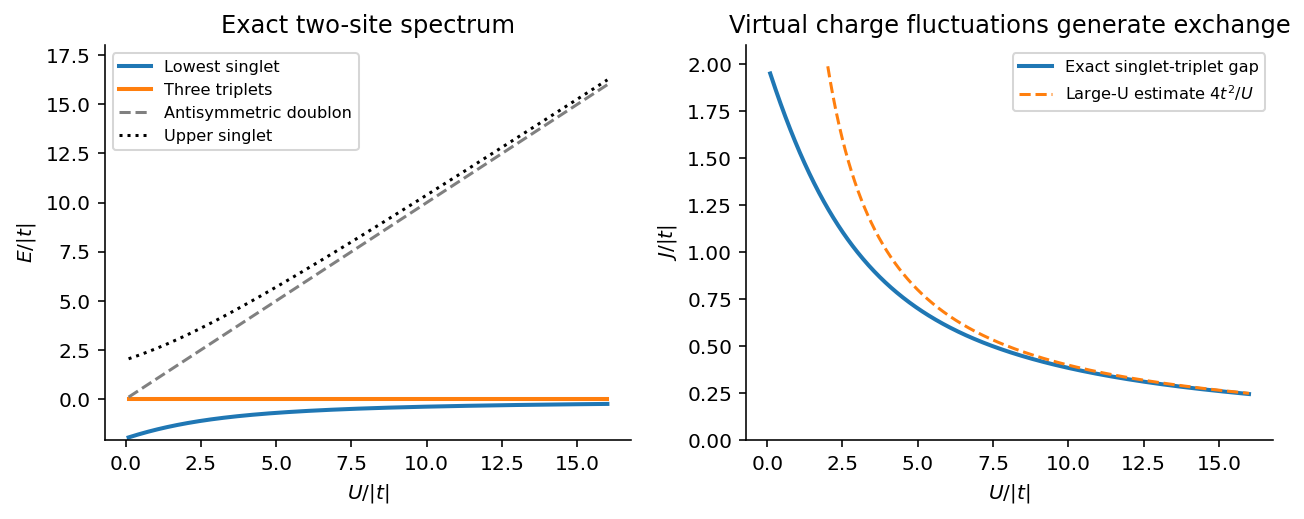
Exact singlet-triplet spectrum of the two-site repulsive Hubbard model and the large-U exchange scale
. Details. An overlap estimate must use nearest magnetic-ion separations. For the face-centered cubic lattice of Mn, ; for the body-centered cubic lattice of Fe, . The supplied radial functions have inverse decay lengths . Their intersite overlap therefore contains approximately , up to polynomial and angular factors. The decisive exponent difference isThe exponential orbital-tail estimate of exchange thus gives a hopping suppression approximately before polynomial corrections. Keeping the supplied radial prefactor in a midpoint overlap proxy givesThis proxy is not an evaluated hopping integral, but confirms that the polynomial factors do not undo the exponential loss. If comparable Coulomb denominators and nonexponential prefactors are assumed, a kinetic-exchange scale proportional to is suppressed by roughly –. Direct intersite Coulomb exchange likewise contains products of the small tails. Coordination-number differences cannot compensate for many orders of magnitude.
By contrast, the measured ordering-temperature ratio supplied in the question is , not an exponentially tiny number. Within this overlap model, direct Mn–Mn exchange cannot explain MnO's substantial magnetic ordering scale by extrapolating the Fe mechanism. Another exchange path is required.
This is an order-of-magnitude argument, not an exact relation between an itinerant Curie temperature and a localized-spin Néel temperature. The hydrogenic functions use the printed bare values; actual solid-state orbitals are screened and hybridized. Their literal absolute exchange scales should not be treated as quantitative predictions for Fe or MnO.
Use an oxygen-mediated superexchange path between two magnetic metal orbitals. A minimal one-active-orbital three-site charge-transfer superexchange Hamiltonian is clearest in a hole representation:Here describes a metal hole, a ligand hole, and is the energy needed to create the virtual ligand hole. The low-energy configuration has one hole on each metal orbital and no ligand hole, corresponding to a filled bridging ligand orbital in the electron picture. and penalize double hole occupancy on the corresponding sites.
Virtual metal–ligand hopping transfers charge through oxygen without producing a real mobile carrier. Eliminating the ligand gives an effective metal–metal hopping . Combining it with the large metal repulsion givesA ligand double-occupancy channel adds a contribution of the same sign for the simple half-filled straight-bond model, often organized as . The precise coefficients depend on the orbitals and hopping conventions; the essential mechanism is virtual charge transfer plus spin-selective access to intermediate states. The effective spin interaction favors antiparallel alignment while the material can remain insulating.
For MnO's rock salt structure, the strong approximately Mn–O–Mn path joins next-nearest Mn sites. It is not the nearest fcc Mn–Mn separation used in the direct-overlap estimate of part e. The oxygen-mediated path avoids relying on the tiny direct overlap of the two distant 3d tails. A realistic model includes several Mn 3d orbitals, Hund coupling and the high-spin Mn ion; the single-orbital Hamiltonian above isolates the antiferromagnetic exchange channel. Approximately paths and different orbital occupancies need not have the same sign.
A normal Fermi liquid is an interacting fermion phase continuously connected to a Fermi gas without broken symmetry. Its Landau quasiparticles are dressed particle/hole excitations near the Fermi surface, with the same conserved quantum numbers, finite quasiparticle residue and a decay width small compared with their excitation energy. Their reference dispersion already includes zero-temperature interaction renormalization; “bare quasiparticle” here does not mean a free atom.[ref]
The Theory of a Fermi Liquid by Lev Davidovich Landau. Low-energy quasiparticles and effective dispersion
The rate assumes , , regular scattering amplitudes and density of states, equilibrium Fermi-Dirac distributions, and two-body collisions conserving energy and momentum. Pauli exclusion principle restricts the available phase space. It describes a regular three-dimensional normal liquid, not a one-dimensional interacting electron liquid. On the surface, ; at and , it is proportional to . Hence excitations become increasingly sharp. The quoted asymmetric occupation factor is for particle out-scattering: a hole decay or full spectral width also needs the complementary in-scattering process; it does not imply exponentially stable deep holes.
Symmetry cancels the quadratic functional's factor one-half, giving the thermal Landau quasiparticle energy shiftHere , and the derivative is with respect to an occupation, not particle density. Replacing the homogeneous momentum sum by an energy integral defines a smooth angularly averaged kernel . With ,Fixed density gives ; fixed chemical potential instead has . Thus in either case, provided the kernels are smooth and no instability intervenes. This is the Sommerfeld expansion; singular spectra require separate treatment.[ref]
The leading entropy is therefore that of quasiparticles with their zero-temperature effective mass: here is the total, spin-summed density of states. The plotted low-temperature slopes require the enhanced masses at molar volume and at , rather than the bare-mass predictions. At fixed molar particle number, . Agreement is restricted to the low-temperature limit: the measured curves depart markedly from a fixed-mass ideal-gas extrapolation at higher temperature. This supports long-lived quasiparticles with smooth low-energy parameters, but heat capacity alone does not measure their lifetime or prove adiabatic continuity.
A GaAs–AlGaAs semiconductor heterostructure confines electrons normal to the interface in a semiconductor quantum well. Remote modulation doping supplies a high-mobility two-dimensional electron gas. Negative split gates deplete it laterally, leaving a narrow quantum point contact with discrete transverse subbands and continuous longitudinal momentum. A single occupied subband requires transverse excitation gaps larger than thermal and applied-bias energies.
Take and count one spin-resolved channel. In a length , right-moving states have density ; each contributes charge current . ThusThe second expression is the right reservoir's left-moving contribution expressed in the same left-to-right conventional-current sign. Since ,The limit needs and ballistic transport. Velocity cancels the one-dimensional state density. Two degenerate spin channels give , not an extra factor hidden in the quoted single-channel result.
For elastic phase-coherent scattering, expand each incident flux-normalized mode in outgoing lead modes. Its transmitted fraction is ; sum over all open outgoing and occupied incident . Linearizing the reservoir occupations gives the Landauer formulaThe source's denotes this amplitude matrix, not temperature or a probability matrix. Flux normalization is essential: ordinary wave-amplitude ratios need a velocity factor. Reservoirs equilibrate, contacts supply incoming Fermi distributions, and inelastic processes within the channel are neglected. Spin is included among channel labels. At , only transmissions at contribute; perfect channels each add one quantum. This is a two-terminal conductance including contact resistance, even with no internal backscattering.
Trace I has steps near integer as less-negative gate voltage opens successive spin-degenerate subbands. At the printed parallel field , Zeeman splitting separates the two spin thresholds, allowing approximately half-sized steps in the plotted units; the onset also shifts. Thermal broadening, imperfect transmission and unresolved thresholds round the plateaux. A parallel field primarily resolves spin in the ideal thin-interface model; finite layer thickness can also shift subband energies. The plot alone does not determine a unique effective factor or microscopic disorder model.
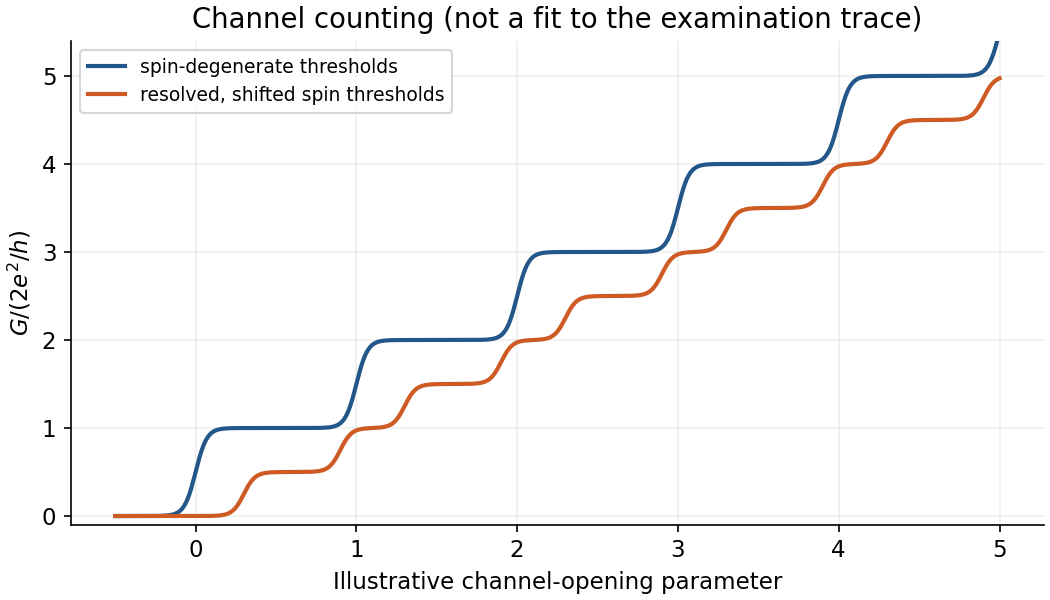
Illustrative spin-resolved channel thresholds produce full or half-sized conductance steps
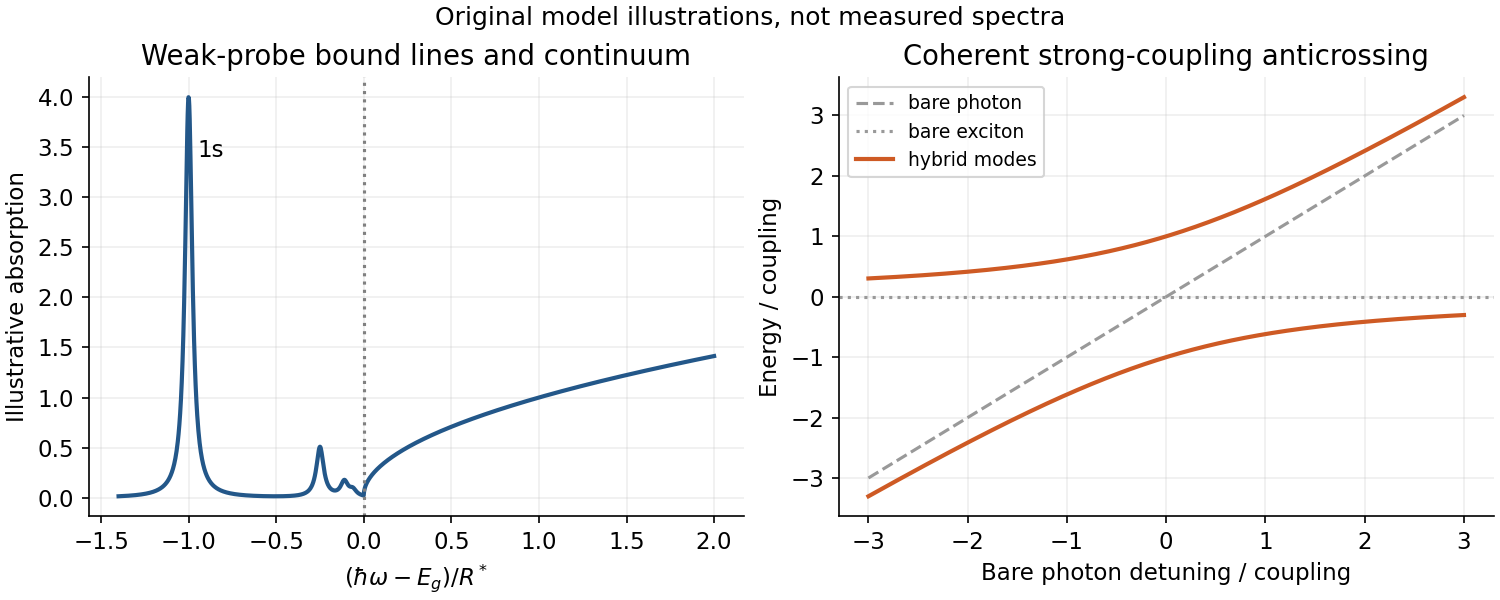
. Source. Details. In weak-probe optical absorption, Fermi's golden rule creates an electron-hole pair, with negligible population depletion. Negligible photon momentum makes a direct band gap transition nearly vertical in crystal momentum:For allowed transitions between three-dimensional parabolic bands, the joint density of states yields above the gap. Selection rules and polarization enter the dipole matrix element. An indirect band gap needs an additional phonon to conserve crystal momentum, with phonon absorption/emission weights and shifted thresholds.
Electron-hole attraction produces Wannier excitons below the continuum, approximately , with bright -state oscillator strength decreasing as . It also enhances the continuum edge. Screening, disorder and phonons broaden these features; heavy/light valence bands can create distinct series. This linear-response picture includes Coulomb binding but excludes a resolved coherent photon–exciton anticrossing: that would require a strong light–matter coupling treatment. “Weak coupling” here is distinguished from neglecting the electron-hole interaction altogether.
In mixed-valence manganites, mobile electrons hop between sites whose localized core spins are coupled to them by strong Hund's coupling. Projecting onto local spin-aligned states gives the double-exchange mechanismAlignment maximizes the hopping bandwidth and lowers carrier kinetic energy, favouring ferromagnetism. This involves real charge transfer, unlike insulating superexchange. Heating disorders core spins and reduces coherent transport; a magnetic field aligns spins, increasing mobility and reducing resistivity. The large negative response near the magnetic transition is colossal magnetoresistance.
Double exchange supplies the conduction–magnetism link, but its simplest spin-only model is insufficient for the full resistivity change. Lattice distortions, Jahn-Teller effect and carrier localization can amplify the effect; materials need not obey a universal resistivity-versus-magnetization law.[ref]
Interaction between the d-Shells in the Transition Metals. II. Ferromagnetic Compounds of Manganese with Perovskite Structure by Clarence Zener. Double exchange and magnetic conduction
[ref]An exciton is an electron-hole bound state and behaves approximately as a boson when the gas is dilute compared with the inverse exciton volume. A condensation experiment needs a long enough lifetime for cooling, high phase-space density and evidence of spontaneous coherence; excessive density causes ionization or a Mott transition instead.
Bulk Cu₂O offers long-lived excitons, but heating, losses and Auger recombination complicate interpretation. Spectral narrowing or anomalous transport alone is insufficient: early claims required reinterpretation. Coupled quantum wells separate electron and hole layers, increasing lifetime and enabling cold indirect-exciton gases, though disorder, trapping and nonequilibrium flow must be distinguished from condensation.[ref]
Bose-Einstein Condensation of Excitons in Cu2O: Progress Over Thirty Years by David Snoke and G. M. Kavoulakis. 2012 preprint: experimental history, losses and reinterpreted signatures
In a semiconductor microcavity, coherent strong coupling mixes an exciton with a light cavity photon to form polaritons with very small effective mass. Nonresonant pumping supplies particles without imposing the condensate's phase. The 2006 CdTe experiment reported a threshold, strong low-momentum occupation, increased temporal coherence and long-range spatial coherence. These combined signatures support an exciton-polariton condensate; a threshold or bright emission alone does not distinguish it from photon lasing. Check that strong coupling persists above threshold. Finite lifetime and pumping make this an open, driven system, so thermalization must be demonstrated rather than inferred merely from the word condensate.[ref]
Bose-Einstein condensation of exciton polaritons by J. Kasprzak and others. 2006: occupation, coherence and polarization measurements
The static Lindhard dielectric function describes the real, zero-frequency linear response of a uniform free electron gas. Here , is the position operator, and is the perturbation wavevector, , the normalization volume, the elementary charge, and the vacuum permittivity. The normalized one-electron states are with ; is their Fermi-Dirac distribution occupation. Both momentum sums exclude spin; the prefactor two counts the two equal spin populations. The density-operator matrix element is . Coincident energy denominators are interpreted by the static limit or Cauchy principal value.
A weak total electric potential perturbs an electron by . First-order state mixing produces , whereThe induced charge is . Self-consistent Poisson equation screening then gives , with . This is the random phase approximation: use the independent-electron response to the self-consistent total field.[ref]
Lecture Notes for Quantum Matter by Steven H. Simon. Chapter8,§8.3, printed pp.123–126: density response and the Lindhard function
At zero temperature . Shifting the integration variable in the second occupation term givesThe two angular integrals are equal. Using the supplied integral, with , givesThe limits are , and for large . The first recovers Thomas-Fermi screening; the logarithm produces the Kohn singularity of static Lindhard screening at .
Use the Fourier transform convention . A point charge has total screened charge and induced charge . Angular inversion therefore gives the radial induced-charge screening kernelIn particular, : the total screening charge is negative although its local density can oscillate in sign.
Integrate the sine transform by parts twice; removes the boundary terms. For the Friedel density tail from a derivative singularity, write and . ThenIndeed, near the principal value transform is for . Smooth terms do not remove this leading oscillatory long-range contribution. Thus .
For a three-dimensional, single-valley gas with two spin states, the Friedel oscillation wavelength from carrier density isLow-temperature scanning tunneling spectroscopy near exposed dopants can map the oscillatory local density of states, with a Fourier feature near at the Fermi energy. An energy-resolved tunnelling image measures local spectral weight, not directly the bulk energy-integrated charge: comparing occupied-bias maps and accounting for the surface geometry is necessary. In actual GaAs, the background relative permittivity and band effective mass change screening strengths; they do not change this wavelength at the stated density.
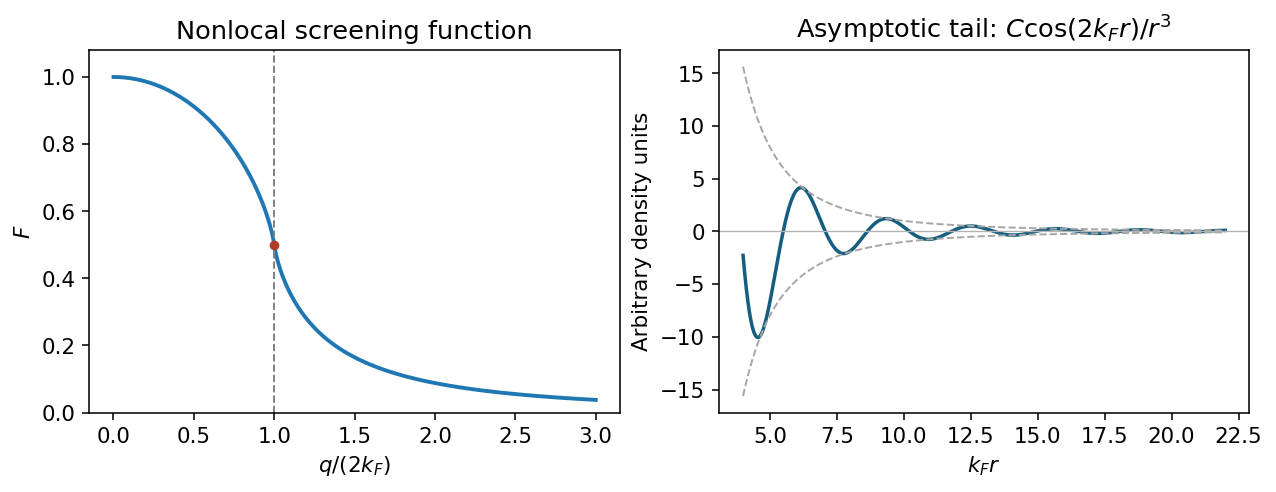
Static Lindhard screening has a singular slope at twice the Fermi wavevector and an oscillatory far-field density tail
. Source. Details. The Mott two-current model treats the two spin populations as parallel conduction channels when spin-flip scattering is weak. Thus and . Light, broad-band carriers conduct efficiently; scattering into narrow -like states relaxes their current. In a simple spin-conserving – picture,In copper, the filled bands supply little final-state phase space at , so both spin channels have low resistivity. In cobalt, the nearly filled majority band suppresses majority-channel scattering, while minority states remain available. The stated iron reversal corresponds to stronger scattering-weighted majority-channel phase space: its majority band is not closed as in cobalt. Band filling, exchange splitting, velocities and scattering matrix elements set this scattering-weighted spin-channel asymmetry; majority population alone does not select the better conductor. The given iron ordering is a material/scattering input, not a universal consequence of the two-current postulate. Different impurities and interfaces can change the asymmetry.[ref]
The spacer electrons mediate interlayer exchange coupling. Spin-dependent reflection at the two magnetic interfaces changes their electronic energy as the spacer thickness varies. In the oscillatory spacer-mediated exchange picture, Fermi-surface spanning wavevectors produce terms such as with a decaying envelope; real spacers can have several periods.
Define the coupling energy per area by . favours parallel moments and antiparallel moments. The oscillation period and phase depend on spacer band structure and interface reflection; there is no universal monotone rule or numerical crossover thickness from alone. Roughness and nonuniform thickness average and weaken the coupling. This is conduction-electron-mediated exchange, not a requirement that the nonmagnetic spacer itself be ferromagnetic.
Put , and . In the CIP thickness-averaged two-current model, assume spin is conserved and electron trajectories sample the layers, so each channel's effective resistivity is the thickness average: , . This uses averaged relaxation rates with comparable transport weights, neglecting additional interface resistance. Here is the per-spin-channel resistivity, twice the measured nonmagnetic bulk resistivity. The stated long mean free path motivates sampling more than one layer.
A four-layer period has thickness . For an in-plane square, , hence the two parallel spin conductances add:The square's side cancels. The layers are not being treated as four macroscopic resistors in series along the in-plane current; the averaging is over the traversing carriers' scattering histories.
With opposite magnetic moments, a fixed global spin is the low-resistivity species in one ferromagnetic layer and the high-resistivity species in the other. Thus both spin channels have the same four-layer averaged resistivityEach channel's square resistance is , and the two channels run in parallel. ThereforeBoth channels encounter the strongly scattering magnetic layer; neither retains the uniformly favourable path available for parallel magnetizations.
An in-plane magnetic field lowers the Zeeman energy when moments align with it. It competes with antiferromagnetic interlayer exchange coupling; the layers generally cant or switch toward a parallel configuration and ultimately saturate if the field overcomes coupling and magnetic anisotropy. The high-resistance antiparallel state evolves toward the lower-resistance parallel state. The switching path and field scale depend on anisotropy, pinning and coupling strength, which are not numerically specified.
Combining the two results gives the GMR ratio for identical thickness-averaged layers:Thus a field that aligns initially antiparallel moments produces a resistance decrease. One spin channel conducts well throughout the aligned stack; in the antiparallel stack both channels sample strong scattering. For the low-resistance-state normalization,Normalizing the field-induced drop by instead gives . Large channel contrast can produce a large giant magnetoresistance; equal channels give none, and common nonmagnetic scattering dilutes the contrast. This is the spin-dependent alignment effect, distinct from anisotropic magnetoresistance of an individual magnetic layer.
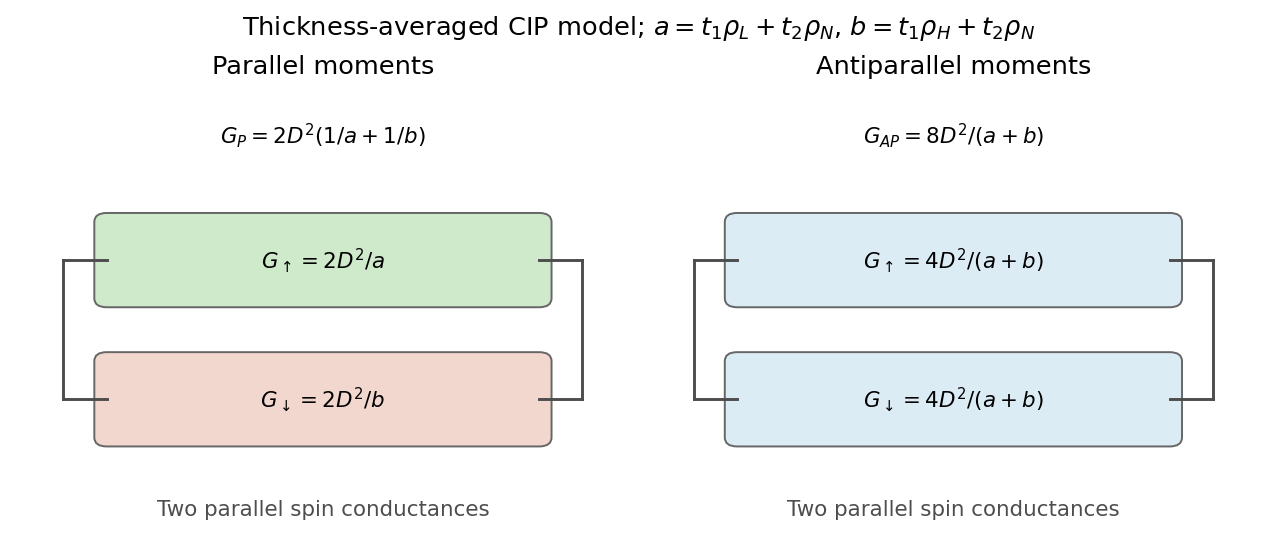
Parallel layer moments preserve a favourable spin channel; antiparallel moments equalize the two averaged channels
. Source. Details. An organic semiconductor has conjugated molecular units with strong intramolecular bonding and comparatively weak intermolecular electronic overlap. Optical excitation commonly promotes a electron from an occupied molecular orbital toward an unoccupied one. Weak dielectric screening and narrow bands favour bound Frenkel excitons, sometimes mixed with intermolecular charge-transfer states, rather than immediate production of free carriers. The optical excitation energy is below the unbound electron–hole threshold by the exciton binding energy, with relaxation conventions specified when comparing measured gaps.
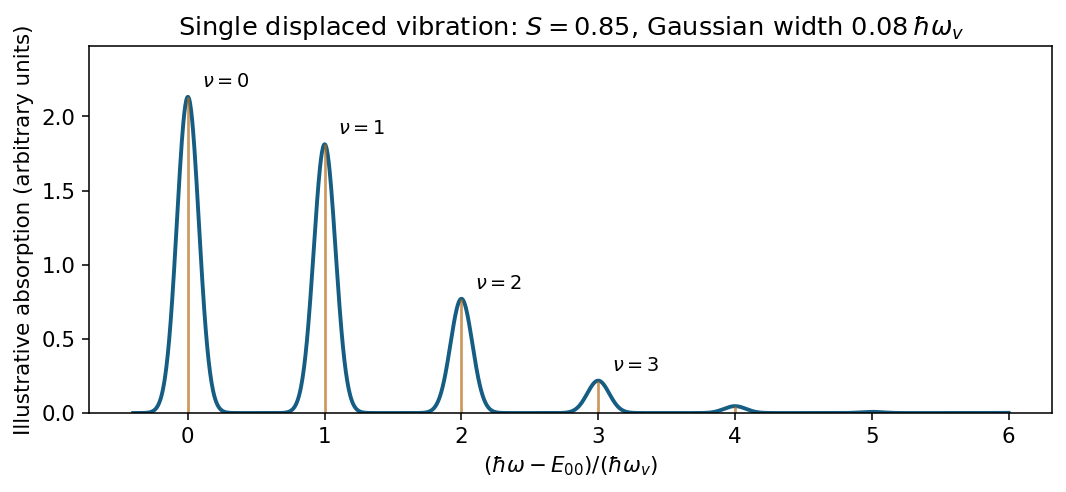
The electric-dipole interaction selects bright states through their transition dipoles, producing polarization-dependent absorption in oriented samples. From a singlet ground state, strong electric-dipole absorption normally preserves spin and reaches singlet excitons; direct triplet excitation is weak without spin mixing. The Franck-Condon principle treats excitation as vertical on the nuclear-motion timescale. For one displaced harmonic vibration at low temperature, the displaced-oscillator Franck-Condon progression has relative strengthsHere the Huang-Rhys factor measures the displacement and is the zero-vibration transition energy. Vibrational relaxation before emission produces a Stokes shift. Molecular packing and excitonic coupling shift or split bright features and change their intensities; disorder and vibrations broaden them. Consequently a universal parabolic-band absorption edge is inappropriate for a localized molecular excitation.[ref]
Organic Optoelectronics lecture notes by Vladimir Bulović. Lectures4–7: molecular levels, Franck–Condon shifts, aggregates and Frenkel/charge-transfer excitons


In quasi-one-dimensional quantum transport, transverse confinement makes discrete subbands while motion along a quantum wire remains continuous. Only occupied propagating subbands conduct. For elastic scattering between equilibrated reservoirs, the Landauer formula isThe sum explicitly counts spin. A perfectly transmitting spin-degenerate subband gives at low temperature; a quantum point contact shows steps as a gate opens additional subbands. The one-dimensional density of states cancels the carrier velocity in the current, giving a conductance quantum rather than a material-dependent velocity factor. Finite two-terminal contact resistance remains even without internal scattering.
Transport is ballistic transport for length , where is the mean free path. In a multichannel wire with below its localization length, scattering reduces transmission and gives approximately Ohmic behaviour. If the phase coherence length exceeds the sample length, amplitudes interfere; weak localization and sample-dependent universal conductance fluctuations can appear. At greater lengths, generic coherent disordered wires undergo Anderson localization, with localization length of order the channel number times , up to symmetry-dependent factors. Thermal averaging and dephasing smear the quantum features.
Strong interactions require more than independent-electron transmission. A clean single-channel interacting wire is described at low energy by a Luttinger liquid, with collective modes and possible spin-charge separation; impurities can generate temperature-dependent power laws. Ideal contacts to noninteracting leads can still fix the two-terminal conductance of a clean wire, so it must not automatically be multiplied by a bulk Luttinger parameter.
Density functional theory replaces the interacting many-electron ground state wavefunction by its spatial density . For fixed interaction and a nondegenerate ground state, the Hohenberg-Kohn theorem fixes the external potential up to an additive constant. If two distinct potentials gave the same density, their strict variational energy inequalities would sum to the contradiction .
The density functional variational principle minimizesover admissible densities of the correct particle number. The universal contains the kinetic and interaction energies. This is exact in principle; an explicit useful functional is the practical difficulty.[ref]
The Kohn-Sham equations introduce noninteracting orbitals with the same density and decompose . With ,The exchange-correlation functional includes exchange, correlation and the interacting kinetic-energy correction relative to . Guess a density, construct the potentials, solve and occupy orbitals, then mix and iterate to self-consistent field convergence. The local density approximation uses ; a generalized gradient approximation also depends on density gradients.
Kohn–Sham orbital energies are not generally excitation energies, and their sum double counts interactions. The Kohn-Sham energy double-counting correction iswith ion–ion energy added for a total crystal energy. Approximate functionals can miss self-interaction cancellation, band gaps and strong correlation; convergence alone does not prove the global ground state.[ref]
Self-Consistent Equations Including Exchange and Correlation Effects by Walter Kohn and Lu Jeu Sham. 1965: auxiliary noninteracting system and effective density-dependent equations
Articles by others on the same topic
There are currently no matching articles.