The static Lindhard dielectric function describes the real, zero-frequency linear response of a uniform free electron gas. Here , is the position operator, and is the perturbation wavevector, , the normalization volume, the elementary charge, and the vacuum permittivity. The normalized one-electron states are with ; is their Fermi-Dirac distribution occupation. Both momentum sums exclude spin; the prefactor two counts the two equal spin populations. The density-operator matrix element is . Coincident energy denominators are interpreted by the static limit or Cauchy principal value.
A weak total electric potential perturbs an electron by . First-order state mixing produces , whereThe induced charge is . Self-consistent Poisson equation screening then gives , with . This is the random phase approximation: use the independent-electron response to the self-consistent total field.[ref]
Lecture Notes for Quantum Matter by Steven H. Simon. Chapter8,§8.3, printed pp.123–126: density response and the Lindhard function
At zero temperature . Shifting the integration variable in the second occupation term givesThe two angular integrals are equal. Using the supplied integral, with , givesThe limits are , and for large . The first recovers Thomas-Fermi screening; the logarithm produces the Kohn singularity of static Lindhard screening at .
Use the Fourier transform convention . A point charge has total screened charge and induced charge . Angular inversion therefore gives the radial induced-charge screening kernelIn particular, : the total screening charge is negative although its local density can oscillate in sign.
Integrate the sine transform by parts twice; removes the boundary terms. For the Friedel density tail from a derivative singularity, write and . ThenIndeed, near the principal value transform is for . Smooth terms do not remove this leading oscillatory long-range contribution. Thus .
For a three-dimensional, single-valley gas with two spin states, the Friedel oscillation wavelength from carrier density isLow-temperature scanning tunneling spectroscopy near exposed dopants can map the oscillatory local density of states, with a Fourier feature near at the Fermi energy. An energy-resolved tunnelling image measures local spectral weight, not directly the bulk energy-integrated charge: comparing occupied-bias maps and accounting for the surface geometry is necessary. In actual GaAs, the background relative permittivity and band effective mass change screening strengths; they do not change this wavelength at the stated density.
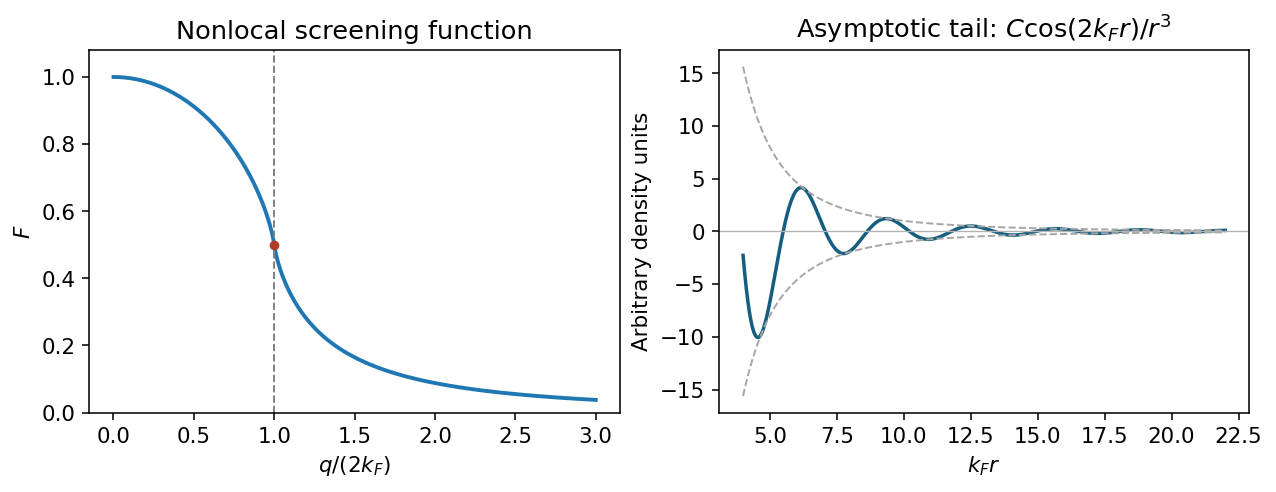
Static Lindhard screening has a singular slope at twice the Fermi wavevector and an oscillatory far-field density tail
. Source. Details. The Mott two-current model treats the two spin populations as parallel conduction channels when spin-flip scattering is weak. Thus and . Light, broad-band carriers conduct efficiently; scattering into narrow -like states relaxes their current. In a simple spin-conserving – picture,In copper, the filled bands supply little final-state phase space at , so both spin channels have low resistivity. In cobalt, the nearly filled majority band suppresses majority-channel scattering, while minority states remain available. The stated iron reversal corresponds to stronger scattering-weighted majority-channel phase space: its majority band is not closed as in cobalt. Band filling, exchange splitting, velocities and scattering matrix elements set this scattering-weighted spin-channel asymmetry; majority population alone does not select the better conductor. The given iron ordering is a material/scattering input, not a universal consequence of the two-current postulate. Different impurities and interfaces can change the asymmetry.[ref]
The spacer electrons mediate interlayer exchange coupling. Spin-dependent reflection at the two magnetic interfaces changes their electronic energy as the spacer thickness varies. In the oscillatory spacer-mediated exchange picture, Fermi-surface spanning wavevectors produce terms such as with a decaying envelope; real spacers can have several periods.
Define the coupling energy per area by . favours parallel moments and antiparallel moments. The oscillation period and phase depend on spacer band structure and interface reflection; there is no universal monotone rule or numerical crossover thickness from alone. Roughness and nonuniform thickness average and weaken the coupling. This is conduction-electron-mediated exchange, not a requirement that the nonmagnetic spacer itself be ferromagnetic.
Put , and . In the CIP thickness-averaged two-current model, assume spin is conserved and electron trajectories sample the layers, so each channel's effective resistivity is the thickness average: , . This uses averaged relaxation rates with comparable transport weights, neglecting additional interface resistance. Here is the per-spin-channel resistivity, twice the measured nonmagnetic bulk resistivity. The stated long mean free path motivates sampling more than one layer.
A four-layer period has thickness . For an in-plane square, , hence the two parallel spin conductances add:The square's side cancels. The layers are not being treated as four macroscopic resistors in series along the in-plane current; the averaging is over the traversing carriers' scattering histories.
With opposite magnetic moments, a fixed global spin is the low-resistivity species in one ferromagnetic layer and the high-resistivity species in the other. Thus both spin channels have the same four-layer averaged resistivityEach channel's square resistance is , and the two channels run in parallel. ThereforeBoth channels encounter the strongly scattering magnetic layer; neither retains the uniformly favourable path available for parallel magnetizations.
An in-plane magnetic field lowers the Zeeman energy when moments align with it. It competes with antiferromagnetic interlayer exchange coupling; the layers generally cant or switch toward a parallel configuration and ultimately saturate if the field overcomes coupling and magnetic anisotropy. The high-resistance antiparallel state evolves toward the lower-resistance parallel state. The switching path and field scale depend on anisotropy, pinning and coupling strength, which are not numerically specified.
Combining the two results gives the GMR ratio for identical thickness-averaged layers:Thus a field that aligns initially antiparallel moments produces a resistance decrease. One spin channel conducts well throughout the aligned stack; in the antiparallel stack both channels sample strong scattering. For the low-resistance-state normalization,Normalizing the field-induced drop by instead gives . Large channel contrast can produce a large giant magnetoresistance; equal channels give none, and common nonmagnetic scattering dilutes the contrast. This is the spin-dependent alignment effect, distinct from anisotropic magnetoresistance of an individual magnetic layer.
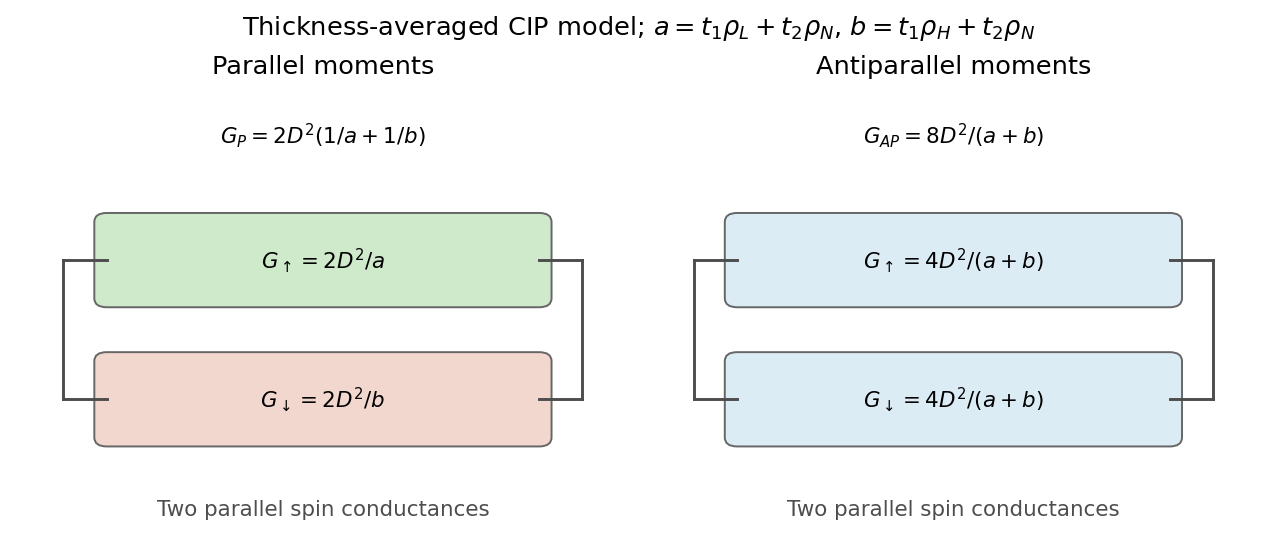
Parallel layer moments preserve a favourable spin channel; antiparallel moments equalize the two averaged channels
. Source. Details. An organic semiconductor has conjugated molecular units with strong intramolecular bonding and comparatively weak intermolecular electronic overlap. Optical excitation commonly promotes a electron from an occupied molecular orbital toward an unoccupied one. Weak dielectric screening and narrow bands favour bound Frenkel excitons, sometimes mixed with intermolecular charge-transfer states, rather than immediate production of free carriers. The optical excitation energy is below the unbound electron–hole threshold by the exciton binding energy, with relaxation conventions specified when comparing measured gaps.
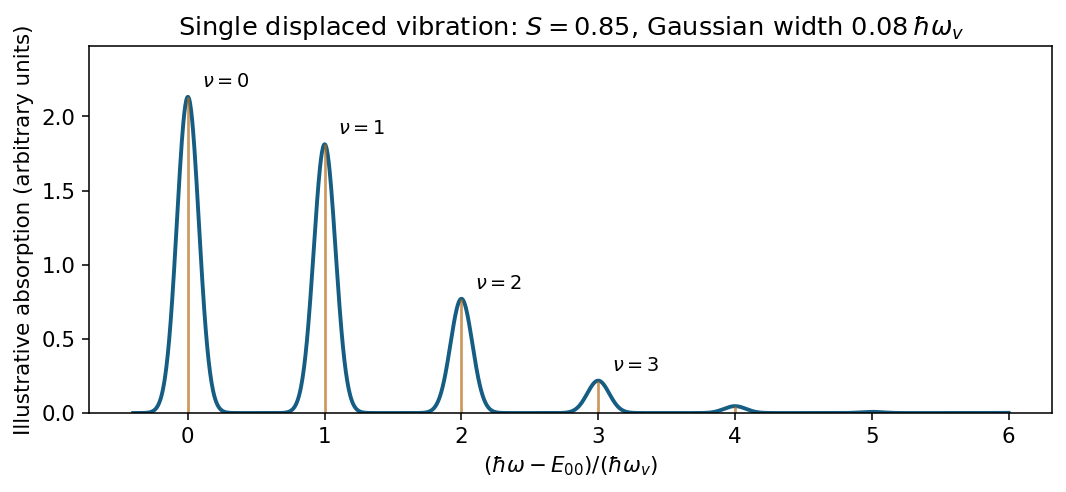
The electric-dipole interaction selects bright states through their transition dipoles, producing polarization-dependent absorption in oriented samples. From a singlet ground state, strong electric-dipole absorption normally preserves spin and reaches singlet excitons; direct triplet excitation is weak without spin mixing. The Franck-Condon principle treats excitation as vertical on the nuclear-motion timescale. For one displaced harmonic vibration at low temperature, the displaced-oscillator Franck-Condon progression has relative strengthsHere the Huang-Rhys factor measures the displacement and is the zero-vibration transition energy. Vibrational relaxation before emission produces a Stokes shift. Molecular packing and excitonic coupling shift or split bright features and change their intensities; disorder and vibrations broaden them. Consequently a universal parabolic-band absorption edge is inappropriate for a localized molecular excitation.[ref]
Organic Optoelectronics lecture notes by Vladimir Bulović. Lectures4–7: molecular levels, Franck–Condon shifts, aggregates and Frenkel/charge-transfer excitons


In quasi-one-dimensional quantum transport, transverse confinement makes discrete subbands while motion along a quantum wire remains continuous. Only occupied propagating subbands conduct. For elastic scattering between equilibrated reservoirs, the Landauer formula isThe sum explicitly counts spin. A perfectly transmitting spin-degenerate subband gives at low temperature; a quantum point contact shows steps as a gate opens additional subbands. The one-dimensional density of states cancels the carrier velocity in the current, giving a conductance quantum rather than a material-dependent velocity factor. Finite two-terminal contact resistance remains even without internal scattering.
Transport is ballistic transport for length , where is the mean free path. In a multichannel wire with below its localization length, scattering reduces transmission and gives approximately Ohmic behaviour. If the phase coherence length exceeds the sample length, amplitudes interfere; weak localization and sample-dependent universal conductance fluctuations can appear. At greater lengths, generic coherent disordered wires undergo Anderson localization, with localization length of order the channel number times , up to symmetry-dependent factors. Thermal averaging and dephasing smear the quantum features.
Strong interactions require more than independent-electron transmission. A clean single-channel interacting wire is described at low energy by a Luttinger liquid, with collective modes and possible spin-charge separation; impurities can generate temperature-dependent power laws. Ideal contacts to noninteracting leads can still fix the two-terminal conductance of a clean wire, so it must not automatically be multiplied by a bulk Luttinger parameter.
Density functional theory replaces the interacting many-electron ground state wavefunction by its spatial density . For fixed interaction and a nondegenerate ground state, the Hohenberg-Kohn theorem fixes the external potential up to an additive constant. If two distinct potentials gave the same density, their strict variational energy inequalities would sum to the contradiction .
The density functional variational principle minimizesover admissible densities of the correct particle number. The universal contains the kinetic and interaction energies. This is exact in principle; an explicit useful functional is the practical difficulty.[ref]
The Kohn-Sham equations introduce noninteracting orbitals with the same density and decompose . With ,The exchange-correlation functional includes exchange, correlation and the interacting kinetic-energy correction relative to . Guess a density, construct the potentials, solve and occupy orbitals, then mix and iterate to self-consistent field convergence. The local density approximation uses ; a generalized gradient approximation also depends on density gradients.
Kohn–Sham orbital energies are not generally excitation energies, and their sum double counts interactions. The Kohn-Sham energy double-counting correction iswith ion–ion energy added for a total crystal energy. Approximate functionals can miss self-interaction cancellation, band gaps and strong correlation; convergence alone does not prove the global ground state.[ref]
Self-Consistent Equations Including Exchange and Correlation Effects by Walter Kohn and Lu Jeu Sham. 1965: auxiliary noninteracting system and effective density-dependent equations
Articles by others on the same topic
There are currently no matching articles.