For the proper four-point interaction vertex, retain one-particle-irreducible Feynman diagrams with two labelled external photons and the two ends of a directed scalar line. Put for a cubic scalar–photon vertex and for a seagull vertex. The one-loop counting identities require . There are three possibilities, giving the nine proper scalar-QED seagull-vertex diagrams:
- Four cubic vertices: two box graphs, with scalar-line order or , where the end vertices are joined by the internal photon.
- Two cubic vertices and one seagull: one triangle with order , both external photons on the middle vertex; two with order , distinguished by which external photon is on the seagull; and two with order , with the same two choices.
- Two seagulls: two bubble graphs with order , distinguished by the external-photon assignment.
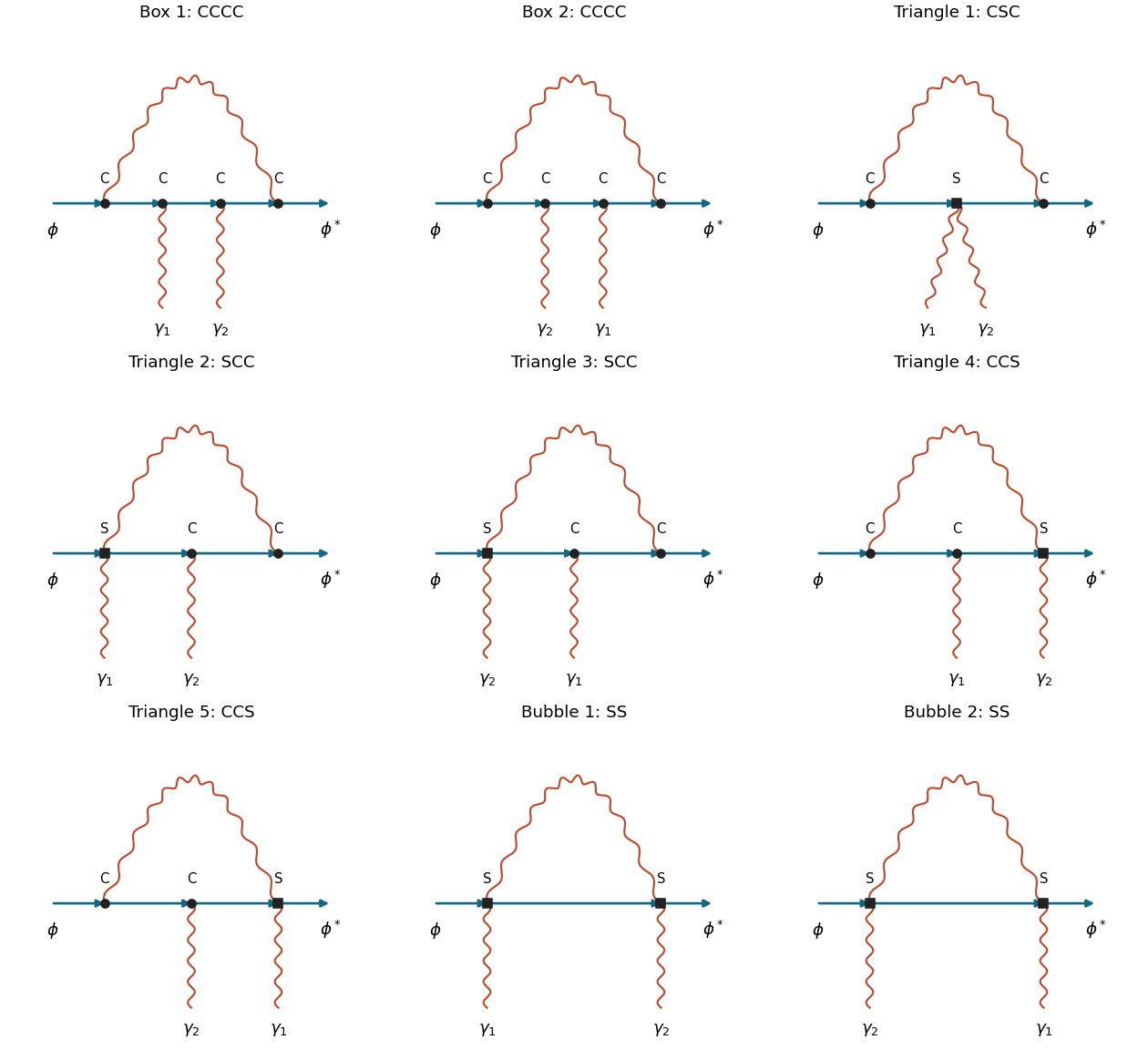

Each graph has Feynman-diagram symmetry factor one with these external labels: the internal photon and scalar are different species, and the charged scalar endpoints cannot be exchanged. The list is complete because the internal photon must join the ends of the open scalar chain for the graph to remain connected after any one internal line is cut. If it joined two interior points, an outside scalar segment would be a bridge and the graph would be one-particle reducible.
External-leg self-energy insertions contribute to an unamputated four-point correlation function, not this proper vertex. The local four-point counterterm from i is included separately when constructing the renormalized answer; it is not another one-loop topology. Abelian Faddeev-Popov ghosts do not interact in this linear gauge and add no diagram.
Articles by others on the same topic
There are currently no matching articles.