Let , , and define the renormalized coupling by . Write and . The complete renormalized Lagrangian density, with its counterterms already included, isSeparating off the classical renormalized terms leaves the counterterm LagrangianThe seagull vertex factor is thus . The bare covariant derivative fixes , rather than supplying an unrelated fourth charge parameter. The scalar QED Ward identity, for a symmetry-preserving regularization, gives and hence .
For an invertible quadratic gauge field operator, also include . One may choose , so this term needs no independent counterterm. The strict transverse limit is . Even if the renormalized quartic coupling is set to zero at one scale, its counterterm need not vanish: photon graphs generate a four-scalar interaction. The renormalized Lagrangian density must retain this allowed operator.
For the proper four-point interaction vertex, retain one-particle-irreducible Feynman diagrams with two labelled external photons and the two ends of a directed scalar line. Put for a cubic scalar–photon vertex and for a seagull vertex. The one-loop counting identities require . There are three possibilities, giving the nine proper scalar-QED seagull-vertex diagrams:
- Four cubic vertices: two box graphs, with scalar-line order or , where the end vertices are joined by the internal photon.
- Two cubic vertices and one seagull: one triangle with order , both external photons on the middle vertex; two with order , distinguished by which external photon is on the seagull; and two with order , with the same two choices.
- Two seagulls: two bubble graphs with order , distinguished by the external-photon assignment.
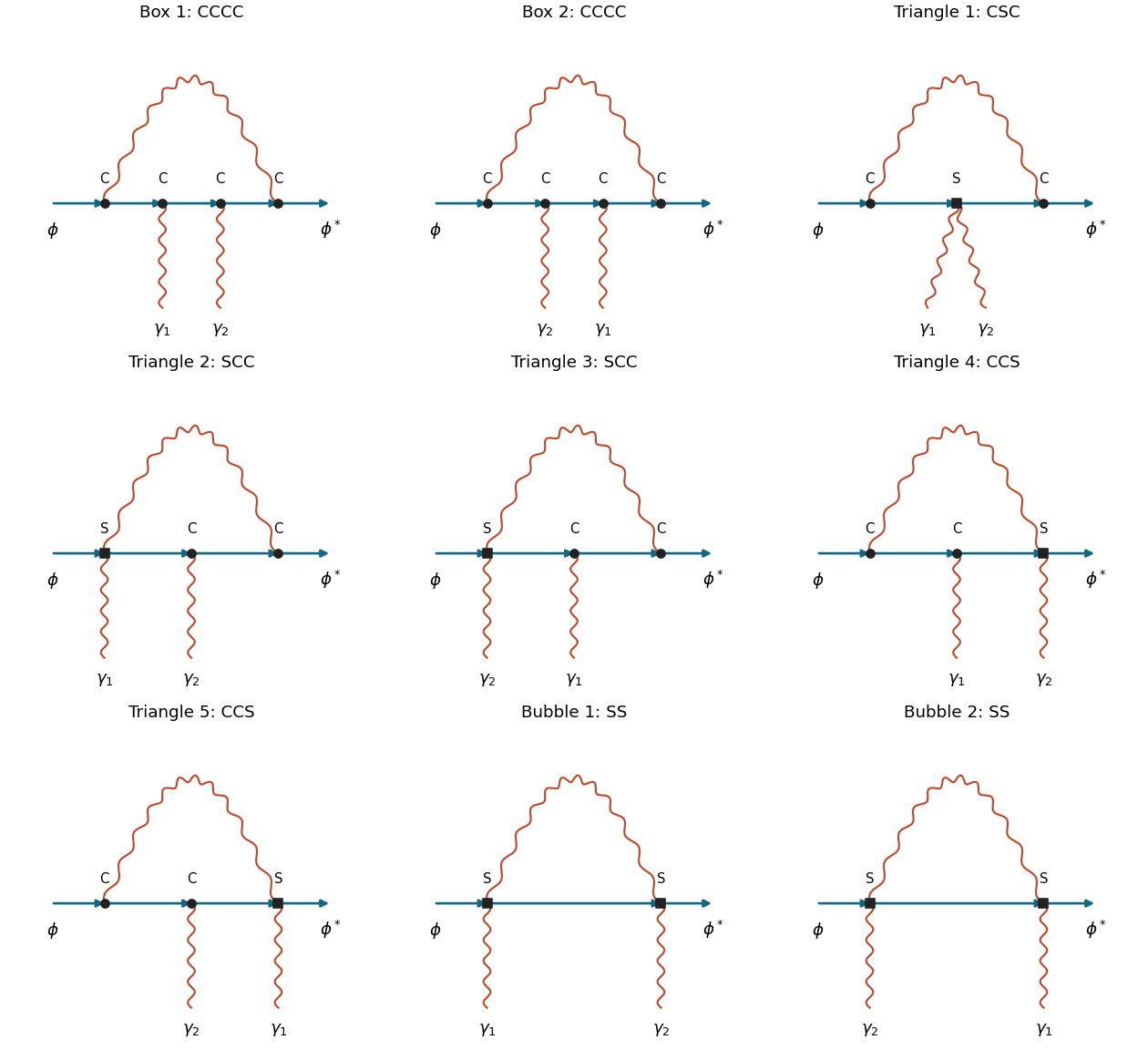

Each graph has Feynman-diagram symmetry factor one with these external labels: the internal photon and scalar are different species, and the charged scalar endpoints cannot be exchanged. The list is complete because the internal photon must join the ends of the open scalar chain for the graph to remain connected after any one internal line is cut. If it joined two interior points, an outside scalar segment would be a bridge and the graph would be one-particle reducible.
External-leg self-energy insertions contribute to an unamputated four-point correlation function, not this proper vertex. The local four-point counterterm from i is included separately when constructing the renormalized answer; it is not another one-loop topology. Abelian Faddeev-Popov ghosts do not interact in this linear gauge and add no diagram.
Set the external four-momenta to zero after identifying the proper diagrams. In each box or triangle, at least one endpoint of the internal photon is a cubic vertex adjacent to an external scalar of zero momentum. That vertex is proportional to , whereas the supplied numerator obeys . All seven such graphs vanish algebraically. This use of the transverse numerator is stronger than merely saying that one has chosen a generic Lorenz gauge.
The two surviving seagull vertex bubbles have vertex factors and . Combining their two propagators givesThis scalar-QED four-point vertex pole in transverse gauge calculation determines the proportionality constant as well as the required tensor structure. Keep while extracting the ultraviolet pole. Lorentz covariance inside the regulated integral replaces by , giving the factor .
For its scalar integral, Feynman parameter givesThere is no infrared divergence at with nonzero . At pole order the two photon assignments and the factor therefore yieldThe common engineering scale factor is included in ; finite logarithms are immaterial to the pole. Adding cancels it whenThis is minimal subtraction scheme, up to optional finite terms. It agrees with the transverse-gauge scalar QED wave-function pole and . Setting at the outset would instead make the zero-momentum integral scaleless and obscure its separate ultraviolet divergence.
Articles by others on the same topic
There are currently no matching articles.