For spin one-half, , henceThey raise or lower the spin projection by one unit of and annihilate the corresponding endpoint. The exchange identity preserves total spin projection.
Write , and . In the listed order , direct action givesThe printed matrix instead uses . Permuting the listed indices to recovers its central block and diagonal entries. This is a basis-order mismatch in the source, not a different Hamiltonian.
The two-spin exchange spectrum with unequal signed magnetic moments isUse the products as the signed magnetic coefficients in the stated Hamiltonian. Opposite physical charges must be represented in those signs; they do not by themselves imply equal moment magnitudes. Here denotes the source's magneton, not vacuum permeability.
At zero field, the spin-one-half triplet state has energy and degeneracy three; the spin-one-half singlet state has energy and degeneracy one:For the singlet is lower; for the triplet is lower. If , all four states coincide.
For , the mixed states approach opposite-spin product states andThe omitted mixed-branch correction is of order . The four levels are generically nondegenerate, apart from special moment choices or crossings.
For equal-and-opposite signed moments, , and the parallel-spin level remains exactly twofold degenerate at ; the other two approach . Equal moment magnitudes are an extra assumption, not implied by opposite charges alone. If , the differential Zeeman term vanishes and the singlet/triplet-zero block stays unmixed by the field. This is the strong-field limit of a two-spin exchange spectrum.
The square-root branches avoid one another when ; crossings with a parallel-spin branch are allowed because total spin projections differ. At zero field the positive- sketch has one lower singlet and a triplet above it. The source supplies no numerical moment ratio, so the two panels show explicit illustrative signed choices, including the exactly compensated case.
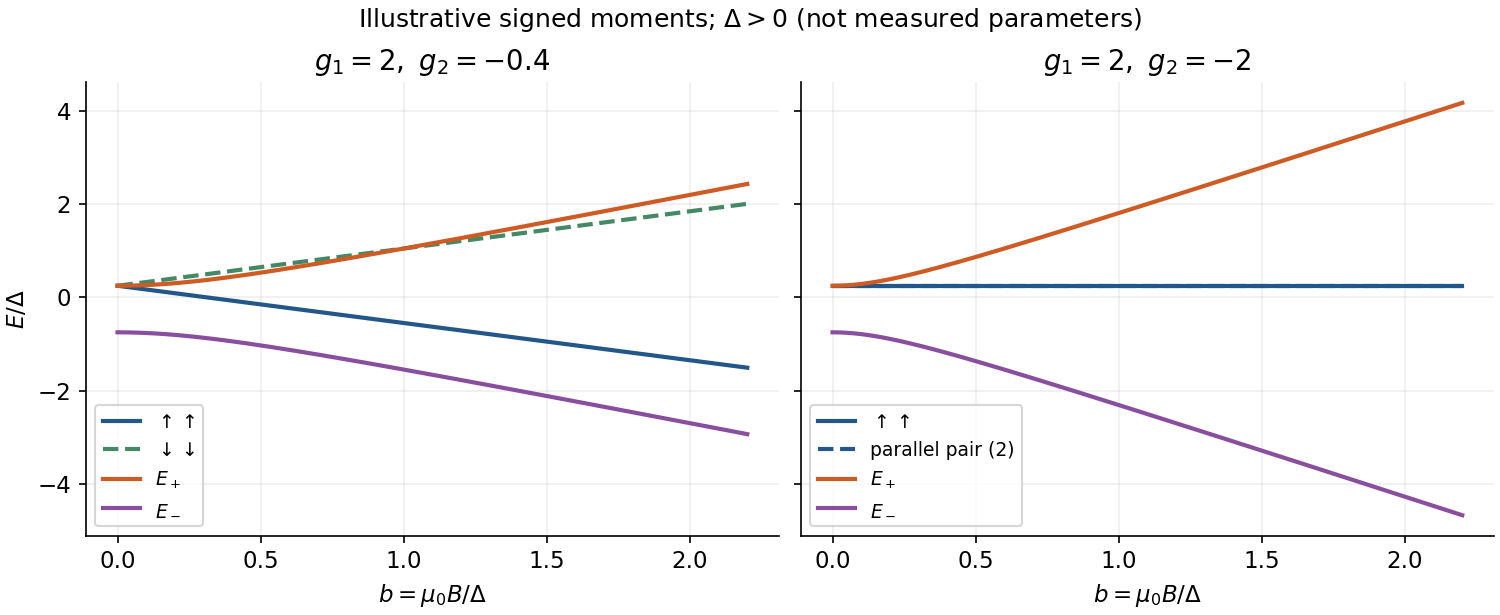
Two-spin exchange and Zeeman energies depend on the signed moment ratio, with an exact parallel-spin degeneracy for opposite equal moments
. Source. Details. 
Articles by others on the same topic
There are currently no matching articles.