The normalized quantum harmonic oscillator ground state has and energy . Its classical turning points are . With , the ground-state oscillator probability beyond the turning points isThe stated rounded error function gives ; the more precise Gaussian integral is .
An impulse integrated across its full support produces the impulsive quantum kick . Thus the leading transition amplitude is andHere has units of action. The off-diagonal two-state impulse is exactly for a Hermitian two-state impulse with zero diagonal. No energy denominator occurs: the impulse is instantaneous.
For two equivalent electrons, antisymmetry permitsTheir states exhaust . Hund's rules first maximize spin, then orbital angular momentum; the less-than-half-filled shell puts the smallest lowest. Hence the ground level is . This is the allowed LS terms of a p-squared configuration.[ref]
Energy Levels of Neutral Carbon by National Institute of Standards and Technology. Ground configuration2s²2p² and its³P,¹D,¹S levels
The postulates of quantum mechanics assign a pure state to a normalized ray in a complex Hilbert space, and an observable to a self-adjoint operator. A spectral outcome projector has Born rule probability . An ideal projective measurement updates the state to when ; degeneracy requires the full outcome projector.
Between measurements, an isolated system obeys , giving unitary evolution. Composite systems use tensor products; identical particles additionally obey the appropriate exchange symmetry. Mixed preparations use a density matrix, with . These postulates require a specified Hamiltonian and measurement model; they do not assign those automatically.[ref]
The central field approximation replaces the anisotropic many-electron environment by an average spherical potential, giving one-electron orbitals labelled by . Screening changes the effective radial attraction and removes the pure Coulomb degeneracy between different .
The Hartree method improves the potential self-consistently. For normalized occupied orbitals,Guess orbitals, construct their mean fields, solve the Hartree equations, and iterate to convergence. The sum excludes self-interaction in this product-state model. A spherical average can enforce the central-field specialization. A Hartree product state omits fermionic exchange and dynamical correlation; Hartree-Fock method adds antisymmetry and exchange through a Slater determinant. Converged orbital eigenvalues must not simply be added as the total energy, because that double counts pair interactions.[ref]
Topics in Quantum Mechanics by David Tong. Authored Atoms chapter,§7.3.1: Hartree self-consistency and product-state limitations
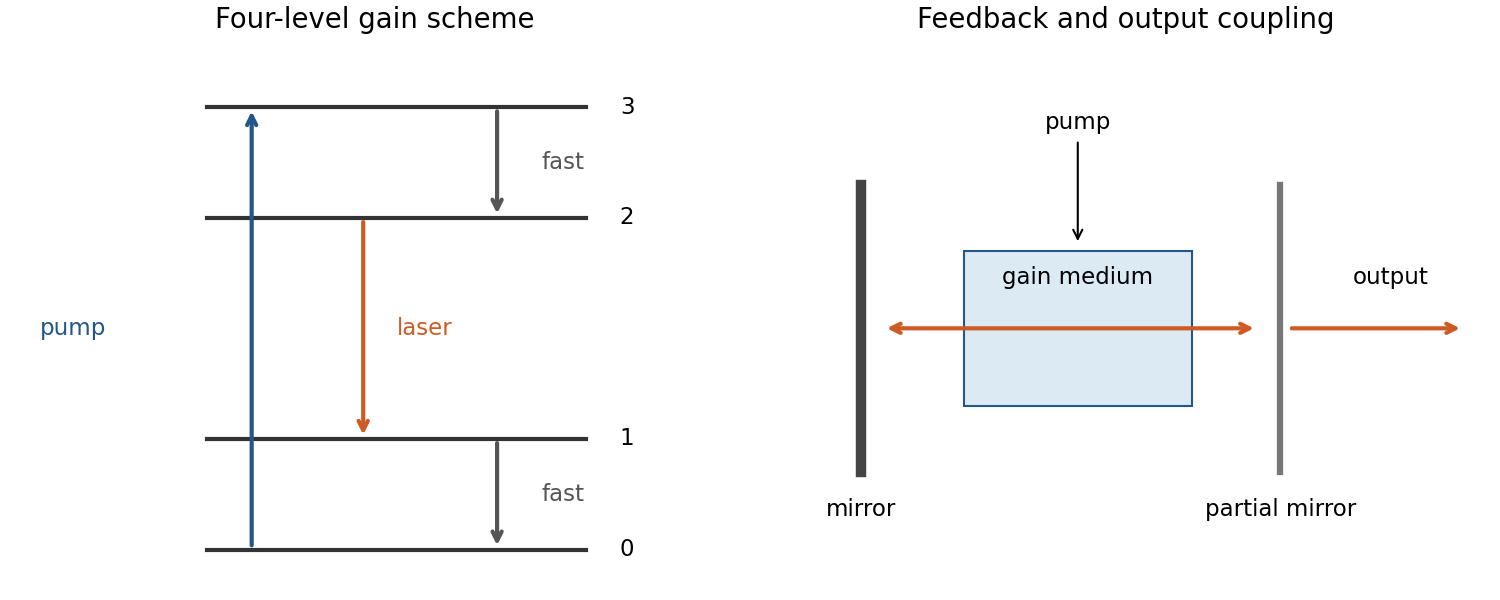
A laser combines pumping, an amplifying medium and optical feedback. Stimulated emission adds photons to an occupied optical mode; net amplification requires population inversion between the relevant levels after accounting for their degeneracies. Pumping through additional levels and rapid lower-level relaxation can sustain inversion; a closed two-level system under steady incoherent resonant pumping cannot sustain it.
An optical resonator selects modes and feeds light back through the gain medium. For intensity gain coefficient , internal intensity loss , length and mirror intensity reflectivities , the round-trip laser threshold condition isAbove threshold, saturation limits gain and a partially transmitting mirror provides output. Typical properties are strong directionality, substantial coherence and narrow bandwidth; multiple modes and pulsed operation are possible, so perfect monochromaticity is not universal.[ref]
Fundamentals of Photonics and Quantum Electronics lecture notes by Franz X. Kärtner. Chapter7,§§7.1–7.2 and laser threshold: feedback, gain and level schemes

For spin one-half, , henceThey raise or lower the spin projection by one unit of and annihilate the corresponding endpoint. The exchange identity preserves total spin projection.
Write , and . In the listed order , direct action givesThe printed matrix instead uses . Permuting the listed indices to recovers its central block and diagonal entries. This is a basis-order mismatch in the source, not a different Hamiltonian.
The two-spin exchange spectrum with unequal signed magnetic moments isUse the products as the signed magnetic coefficients in the stated Hamiltonian. Opposite physical charges must be represented in those signs; they do not by themselves imply equal moment magnitudes. Here denotes the source's magneton, not vacuum permeability.
At zero field, the spin-one-half triplet state has energy and degeneracy three; the spin-one-half singlet state has energy and degeneracy one:For the singlet is lower; for the triplet is lower. If , all four states coincide.
For , the mixed states approach opposite-spin product states andThe omitted mixed-branch correction is of order . The four levels are generically nondegenerate, apart from special moment choices or crossings.
For equal-and-opposite signed moments, , and the parallel-spin level remains exactly twofold degenerate at ; the other two approach . Equal moment magnitudes are an extra assumption, not implied by opposite charges alone. If , the differential Zeeman term vanishes and the singlet/triplet-zero block stays unmixed by the field. This is the strong-field limit of a two-spin exchange spectrum.
The square-root branches avoid one another when ; crossings with a parallel-spin branch are allowed because total spin projections differ. At zero field the positive- sketch has one lower singlet and a triplet above it. The source supplies no numerical moment ratio, so the two panels show explicit illustrative signed choices, including the exactly compensated case.
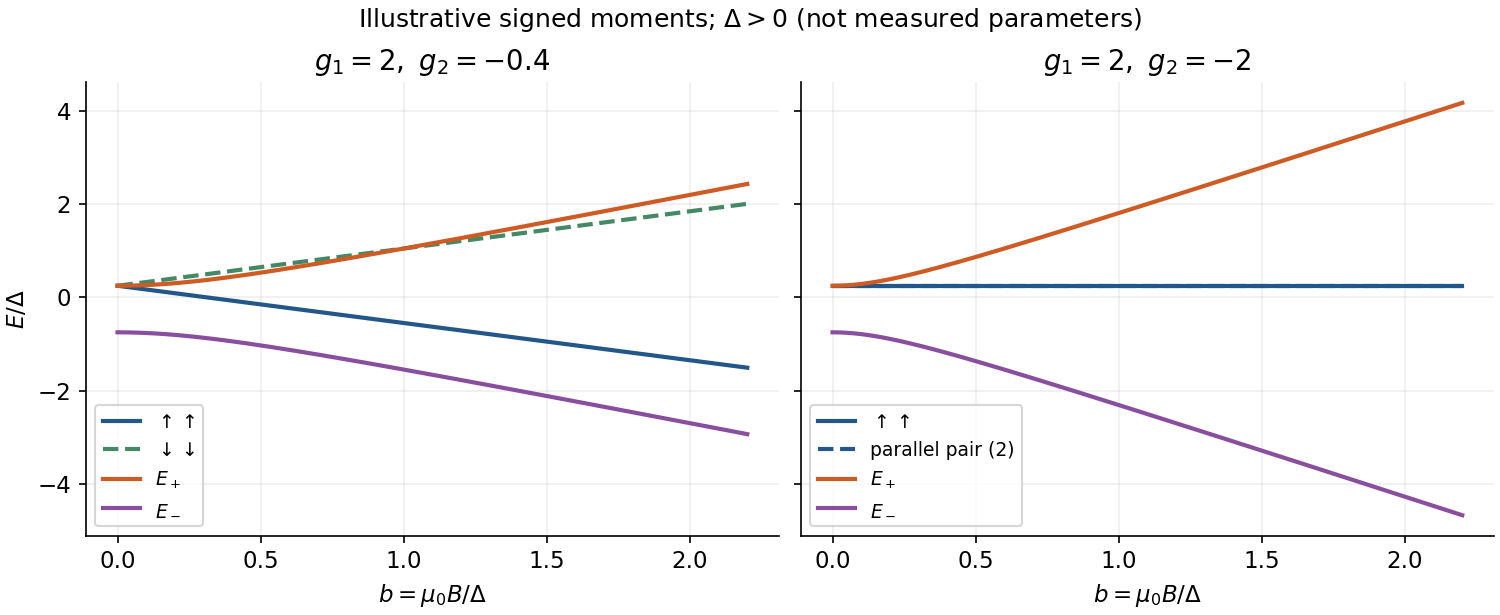
Two-spin exchange and Zeeman energies depend on the signed moment ratio, with an exact parallel-spin degeneracy for opposite equal moments
. Source. Details. 
The quoted expansion is nondegenerate perturbation theory for a known isolated eigenstate of a time-independent Hamiltonian. A useful small-mixing condition is for coupled states. First order is a diagonal expectation value; second order describes virtual mixing. A degenerate or nearly degenerate coupled subspace must first be treated by diagonalization there. Symmetry can eliminate terms, and convergence still needs checking. Ground-state second-order shifts are nonpositive because all denominators are negative.[ref]
Quantum Mechanics by Richard Fitzpatrick. Non-degenerate perturbation theory and its breakdown at coupled degeneracies
For the rotational Stark effect, , where is the polar angle to the field. The source calls it azimuthal, which is inconsistent with this coupling. Rotor states have parity , while is odd, so every first-order matrix element within one fixed- manifold vanishes. The degeneracy therefore causes no first-order splitting.
Only with the same contribute in second order. Using their energy differences and ,For this simplifies to the quadratic Stark shift of a polar linear rotor,For , only contributes, with squared angular matrix element and denominator :Here is the rotational energy constant, unlike the magnetic field in Question3.
The unperturbed line gives . The shifts are for and for . Subtracting the common lower-state shift gives transition shifts and . Their separation determines the dipole moment from a rotational Stark doublet:The unit is the debye. Using external and gives , consistent with weak-field perturbation theory. The two shifted frequencies are about and ; polarization selects or . The inferred value is a magnitude; these shifts do not determine the dipole's sign.[ref]
CODATA recommended values of the fundamental physical constants: 2022 by National Institute of Standards and Technology. Exact SI Planck constant
[ref]Triatomic Spectral Database by National Institute of Standards and Technology. Section5: debye conversion
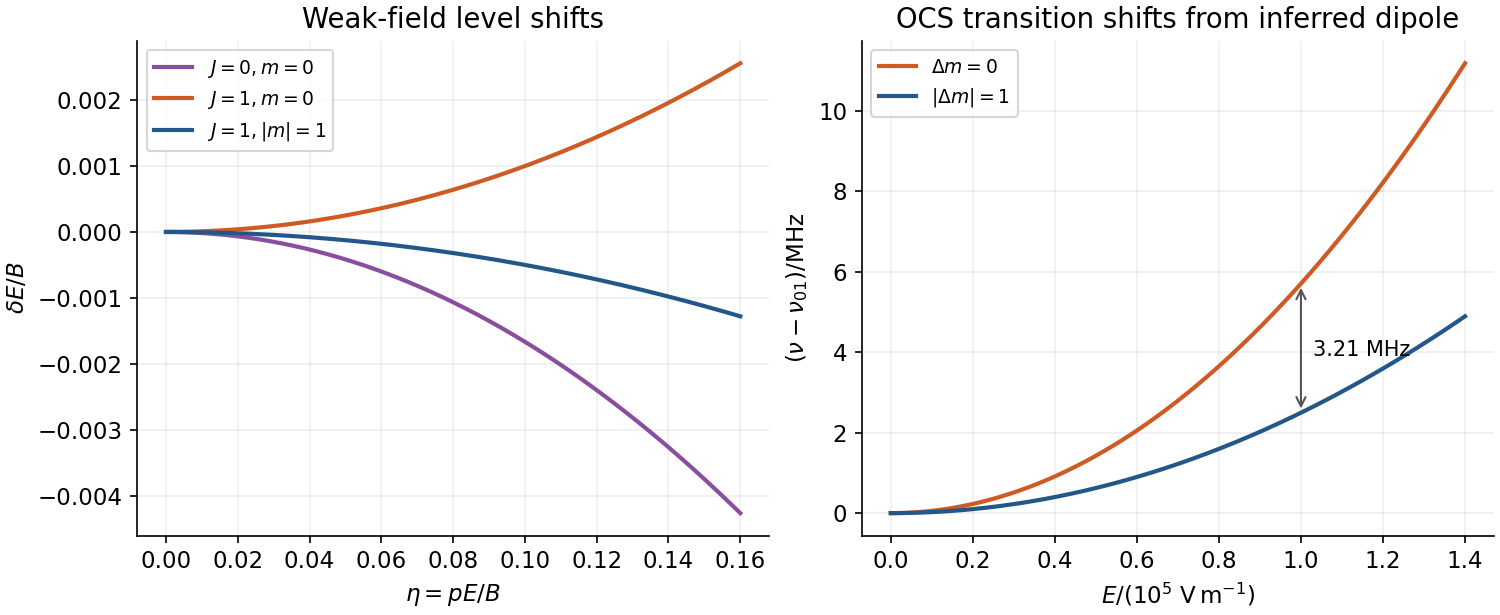
Opposite-parity mixing produces quadratic rotor shifts and a polarization-dependent rotational doublet
. Source. Details. 
Articles by others on the same topic
There are currently no matching articles.