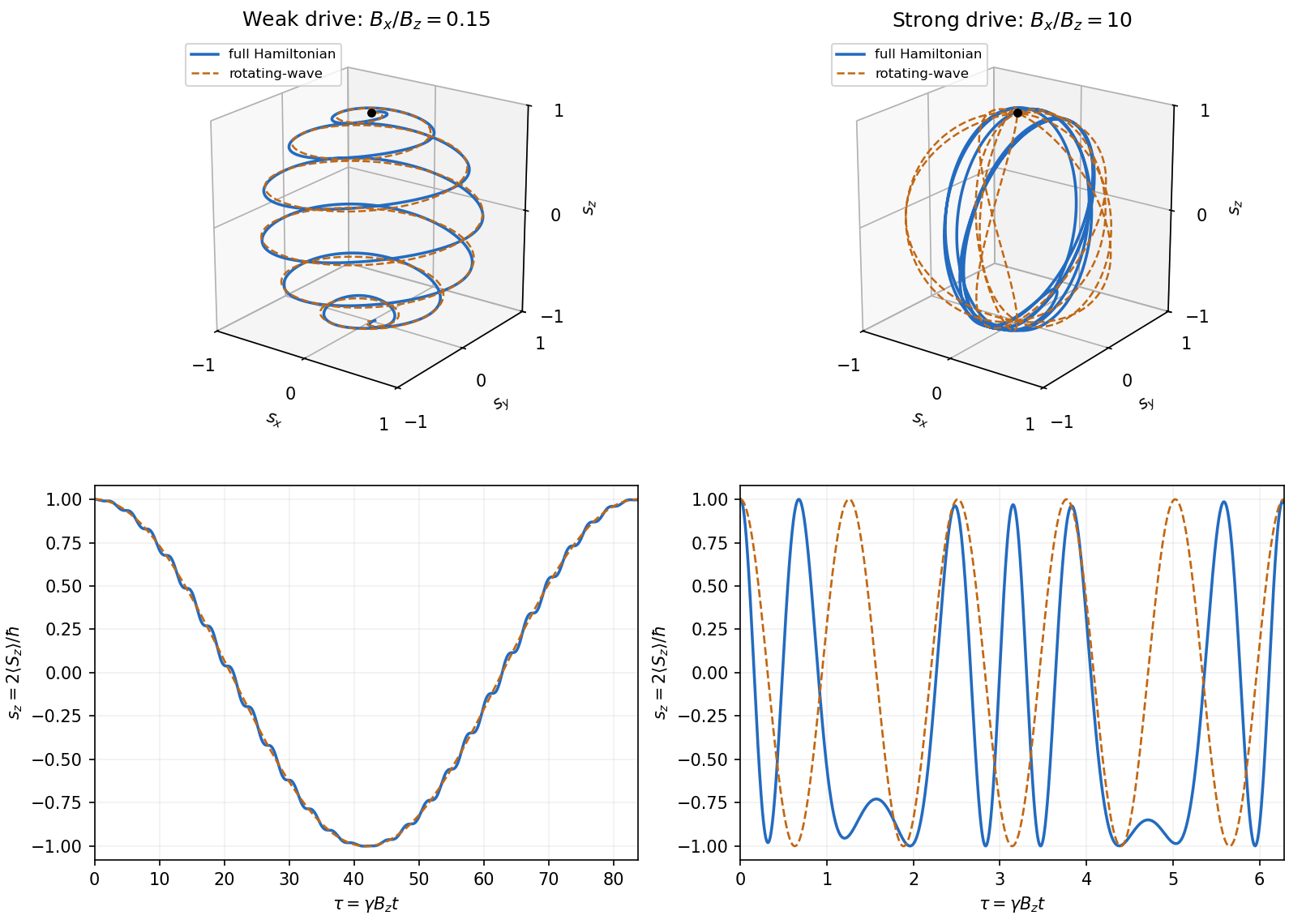
At resonance, retain the signed coupling . In the interaction picture, the given solution reduces to and . Returning to the Schrödinger picture givesFor a normalized spinor , the Pauli matrices give . Therefore the spin expectation value within the rotating-wave approximation isIts magnitude is : the Bloch vector stays on the unit sphere. In a frame rotating about at angular velocity , it makes a uniform rotation in the plane. For , this gives slow Rabi oscillations between the poles, accompanied by rapid laboratory Larmor precession about .
If the same formula is formally used for , it predicts fast meridional rotations whose plane turns slowly about . However, the original PDF really does ask for this opposite limit, and it lies outside the assumption used in part (b). That formal description is not a controlled prediction for the stated linearly driven Hamiltonian operator.
A valid strong-drive description starts from the exact equation for the Bloch vector :For times , neglecting the weak bias gives a controlled leading approximation, since the time integral of the omitted Hamiltonian operator has small norm. The remaining field has a fixed axis, so its generators commute at different times andAt the nominal resonance and on the early spin-rotation scale , this becomes . The initial rotation rate is consequently , twice the rate predicted by extrapolating the rotating-wave approximation. For longer times the exact differential equation must be retained. The following original calculation illustrates both regimes rather than asserting an exact strong-drive Rabi formula.

Articles by others on the same topic
There are currently no matching articles.