By definition, a best uniform approximation minimizes over . Write . The equioscillation theorem says that, if , optimality is equivalent to the existence of ordered points with signed errorsThe absolute-value bars on the left of the printed formula must be omitted for this alternating-sign statement. A nonnegative absolute value cannot equal a negative .
For sufficiency, suppose a polynomial had strictly smaller error. At the alternating points, must have the same sign as , since otherwise the new error would have magnitude at least . The difference polynomial therefore changes sign in all successive gaps and has at least distinct roots, impossible for a nonzero element of .
For necessity, suppose that no alternating extremal points exist. On the compact extremal set , group the signs of the error into consecutive blocks. The positive and negative extremal sets are disjoint compact sets, so sign changes are separated by positive distances; the number of blocks is finite. The absence of an alternating selection means there are at most blocks. Place a root in each gap between successive blocks and choose the overall sign of their product to agree with the error on . Then and is nonzero throughout .
By compactness and continuity, on a neighborhood of the signs still agree and is bounded below. A sufficiently small positive reduces the error there when is replaced by . On the compact complement of this neighborhood the old error is below by a fixed positive margin, and choosing smaller preserves that margin. This gives a strictly better approximation, a contradiction. If , the target already lies in and optimality is immediate.
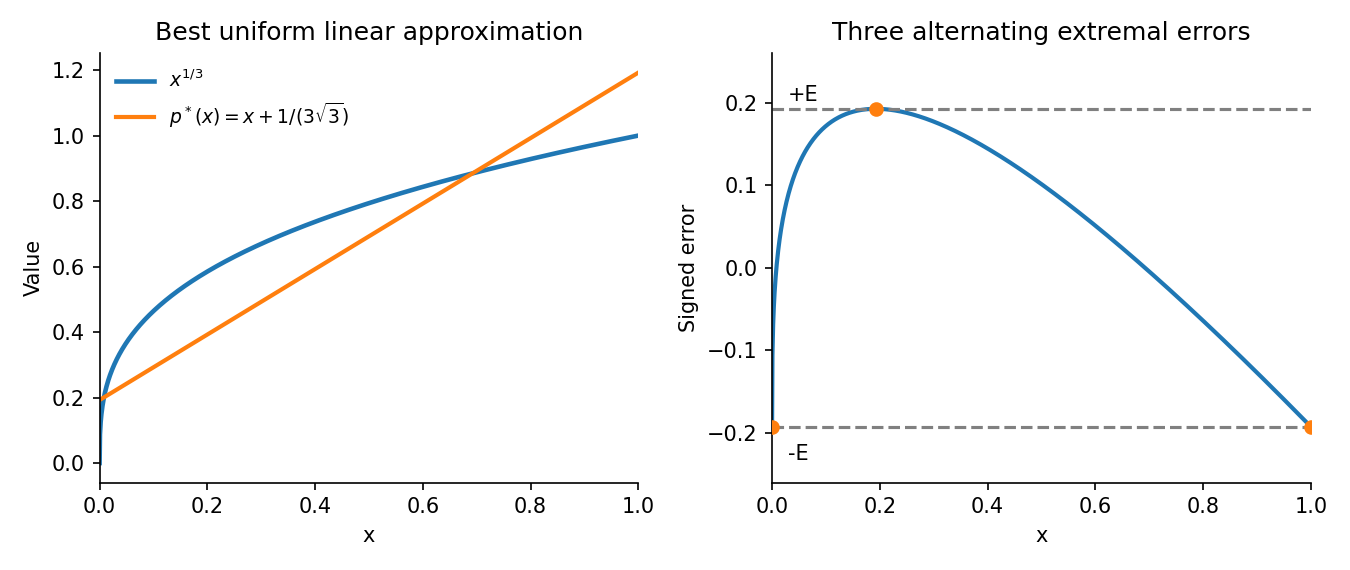
For , the chord is . Concavity gives , with maximum at and maximum value . Shift the chord up by half that amount. The errors at are respectively , so

Articles by others on the same topic
There are currently no matching articles.