Work in the usual bounded Lipschitz, polygonally triangulated setting in which Sobolev traces and conforming meshes are defined. Choose an lift of the smooth boundary data. Multiplying the Poisson equation by and integrating by parts gives the weak formulationThe test function has zero trace, so the boundary flux term vanishes. This formulation only needs first weak derivatives.
Let be the conforming finite element space of continuous functions affine on each triangle, and its zero-boundary subspace. Choose a nodal interpolation of the boundary lift and seek satisfying the same identity for every . General smooth boundary data need not be exactly representable by boundary piecewise linear functions; this is the usual discrete boundary approximation.
With nodal shape functions , interior coefficients satisfyHere and index interior and boundary vertices. Finite element assembly sums the triangle contributions.
Take a translated lower triangle with local vertices . Its local functions are , , . Their gradients are constant and the area is , giving the stiffness matrixTranslations preserve this matrix, while rotations or a different local vertex order permute its entries. The coupling across the hypotenuse is zero.
Each interior grid vertex belongs to six triangles. Summation gives diagonal value 4 and coupling to each of its four horizontal and vertical neighbors. Both positive-diagonal edge couplings vanish. Thus, before prescribed boundary values are removed, an interior equation has the five-point stencilThere is no factor in the assembled variational matrix; that factor belongs to a differently normalized finite-difference equation.
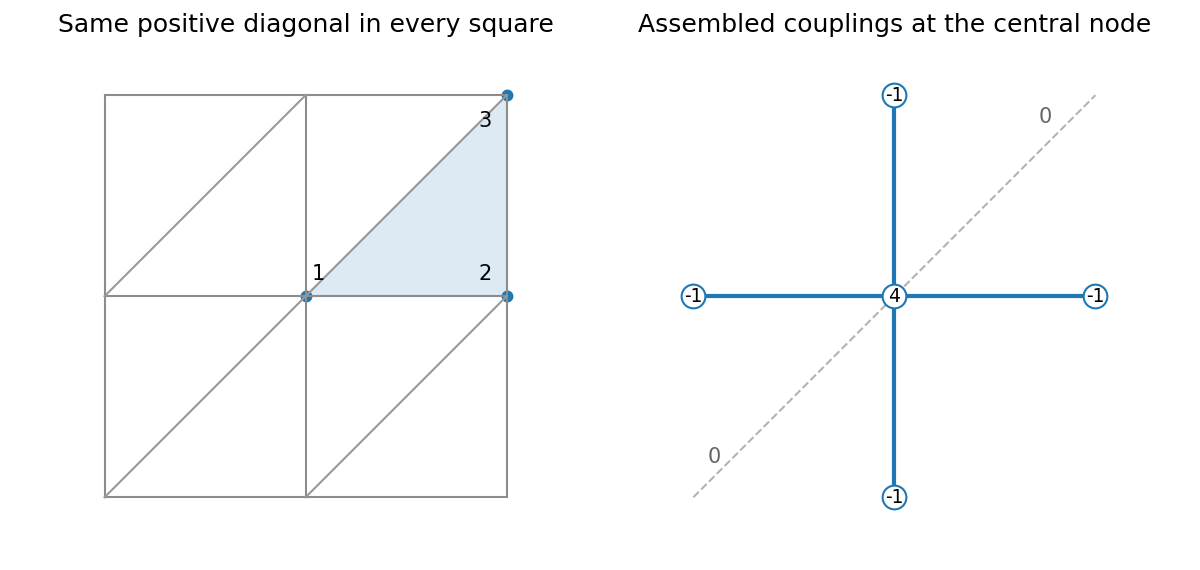

If and , lexicographic ordering makes the Dirichlet-reduced matrix block tridiagonal with diagonal blocks and neighboring blocks . A row with all four neighboring nodes unknown has five nonzeros: 4 once and four times. Rows adjacent to the boundary have fewer unknown-neighbor entries; their exact count is . Removed boundary contributions appear on the right, rather than as new nonzeros.
Articles by others on the same topic
There are currently no matching articles.