Work in the usual bounded Lipschitz, polygonally triangulated setting in which Sobolev traces and conforming meshes are defined. Choose an lift of the smooth boundary data. Multiplying the Poisson equation by and integrating by parts gives the weak formulationThe test function has zero trace, so the boundary flux term vanishes. This formulation only needs first weak derivatives.
Let be the conforming finite element space of continuous functions affine on each triangle, and its zero-boundary subspace. Choose a nodal interpolation of the boundary lift and seek satisfying the same identity for every . General smooth boundary data need not be exactly representable by boundary piecewise linear functions; this is the usual discrete boundary approximation.
With nodal shape functions , interior coefficients satisfyHere and index interior and boundary vertices. Finite element assembly sums the triangle contributions.
Take a translated lower triangle with local vertices . Its local functions are , , . Their gradients are constant and the area is , giving the stiffness matrixTranslations preserve this matrix, while rotations or a different local vertex order permute its entries. The coupling across the hypotenuse is zero.
Each interior grid vertex belongs to six triangles. Summation gives diagonal value 4 and coupling to each of its four horizontal and vertical neighbors. Both positive-diagonal edge couplings vanish. Thus, before prescribed boundary values are removed, an interior equation has the five-point stencilThere is no factor in the assembled variational matrix; that factor belongs to a differently normalized finite-difference equation.
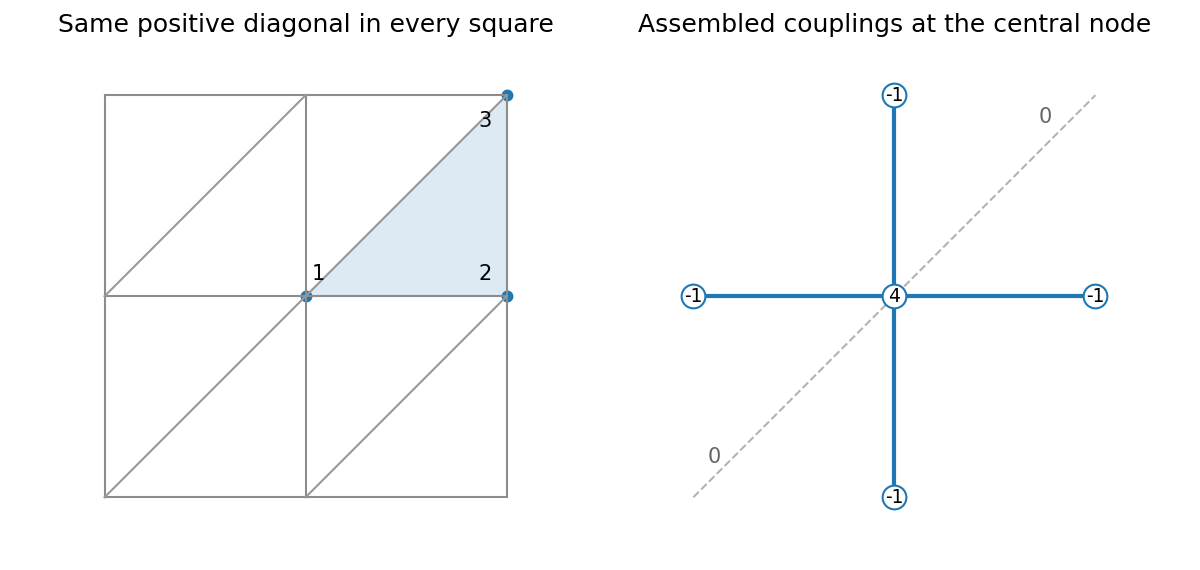

If and , lexicographic ordering makes the Dirichlet-reduced matrix block tridiagonal with diagonal blocks and neighboring blocks . A row with all four neighboring nodes unknown has five nonzeros: 4 once and four times. Rows adjacent to the boundary have fewer unknown-neighbor entries; their exact count is . Removed boundary contributions appear on the right, rather than as new nonzeros.
The Sobolev space consists of functions with a weak first derivative in , with normIn one dimension these functions have absolutely continuous representatives and well-defined endpoint Sobolev traces. PutThis is a closed subspace, hence a Hilbert space. Both trial and test functions belong to ; one does not impose a derivative boundary condition in this space.
Integrate the differential equation against :The printed condition uses the ordinary derivative, , so the weak form isSeek with for all . The coefficient in the endpoint term must be retained: replacing the ordinary derivative with the conormal flux would change the boundary problem.
Let . The Poincaré inequality on can be stated as . Also . Consequentlyproving coercivity. By Cauchy-Schwarz inequality and the trace bound,Thus continuity holds with . The load is continuous if , and the Lax-Milgram theorem gives a unique weak solution.
Choose a finite-dimensional conforming subspace , such as continuous piecewise linear functions vanishing at , and solve for every . Subtracting the weak equations gives Galerkin orthogonality .
Céa's lemma states, for a continuous coercive bilinear form with constants on a Hilbert space,To prove it, put and use orthogonality to write for any . Coercivity and continuity give . If the claim is immediate; otherwise cancel its norm and take the infimum. Any approximation theorem making the infimum tend to zero under mesh refinement therefore gives strong convergence in .
Finally, is symmetric and positive definite on . It is an inner product, so is an energy norm on all of : homogeneity and definiteness are immediate, and Cauchy-Schwarz inequality for this inner product gives the triangle inequality. No smaller space is required. In this norm the continuity and coercivity constants are one. More precisely, Galerkin orthogonality givessoThe finite element solution is the exact best energy-norm approximation.
Take linearly independent basis functions and write . The weak formulation of the heat equation, tested against , isThus the semidiscrete finite element heat equation isThe vector contains the basis coefficients. A natural initial vector is the projection of the initial data: , where , and . Other consistent initial approximations can be specified, but exact representation of an arbitrary in the trial space is not implicit.
For a nonzero coefficient vector , the function is nonzero by basis independence. Hence , proving that the mass matrix is symmetric positive definite. Also : if the derivative vanished, would be a constant, and its zero endpoint traces would make it zero. Therefore is symmetric negative definite, not merely semidefinite, for these homogeneous Dirichlet conditions.
The squared spatial norm is . Differentiating and using the semidiscrete system gives the energy identityUsing the trapezoidal rule in time gives the Crank-Nicolson methodThe left matrix is positive definite for every , so every step exists uniquely. To prove stability, set and . The update says . Multiplying by givesConsequentlyThe same inequality applied to the difference of two discrete solutions proves nonamplification of initial perturbations. This is unconditional stability in the mass-matrix norm, exactly the spatial norm of the finite element functions.
Articles by others on the same topic
There are currently no matching articles.