Use the supplied comoving distance Mpc. In a flat background, Mpc and Mpc. The observed wavelength is stretched by , soCare is needed with a luminosity per frequency. For corresponding emitted and observed frequencies, . Combining that bandwidth relation with the bolometric definition of givesThis is the spectral luminosity at the rest-frame frequency corresponding to 200 nm. A value at some different rest wavelength would require the quasar's spectral shape. The factor is different for a density per unit wavelength; interchanging these two conventions would give an incorrect redshift factor.
A transverse physical size is angle times angular diameter distance, not luminosity distance or comoving distance. Converting the apparent diameter into radians givesThis is the galaxy's projected proper diameter at the emission epoch. Its corresponding comoving diameter is three times larger.
The projected quasar-to-cloud separation isFor the usual transverse-separation estimate, take the cloud to lie at the same line-of-sight proper distance as the quasar. Since the cloud and galaxy are gravitationally bound, the local source-to-cloud path does not acquire the redshift factor that separates that system from us. Neglect internal relative Doppler shifts and attenuation. The observer in the cloud seesThis uses the quasar's isotropic intrinsic emission at the same rest frequency; anisotropic radiation or obscuration would modify it.
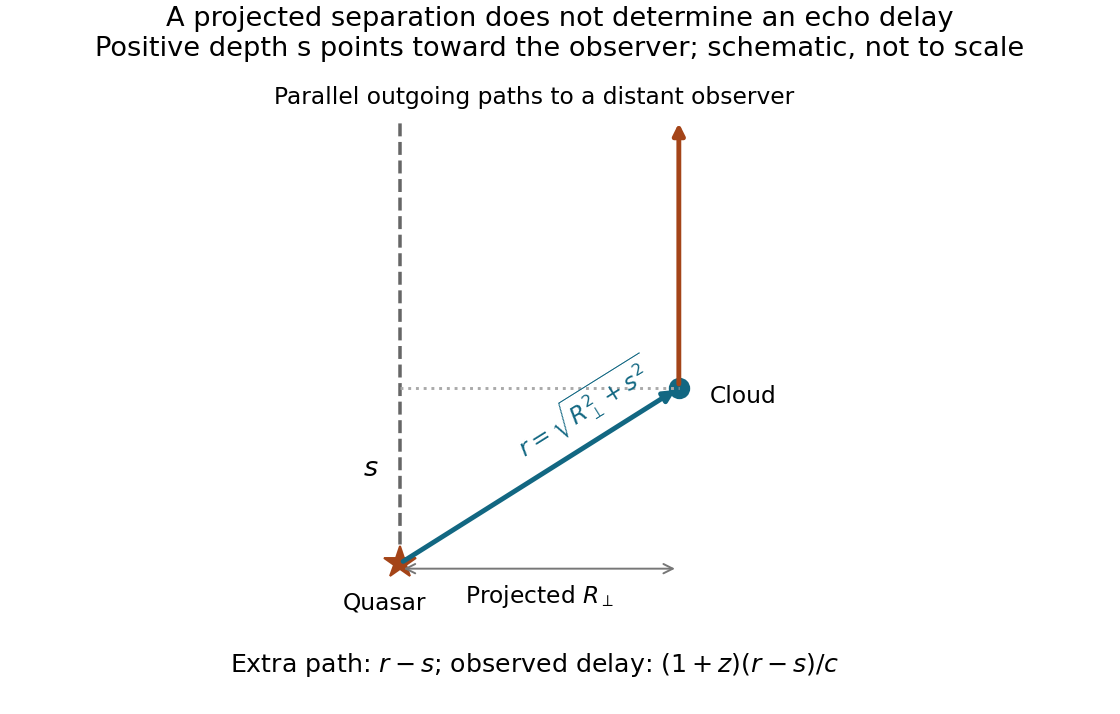
An angular separation only fixes . If is a source-to-cloud displacement toward us, the true local distance is and the general flux is . The quoted transverse value is therefore an upper estimate at fixed projected separation. Equality of cosmological redshift and gravitational binding do not by themselves measure the small internal line-of-sight displacement; a peculiar velocity can also mask it.
For a bound-cloud light echo, the relevant observed delay is the excess source–cloud–observer path over the direct source–observer path, with the interval dilated by cosmological expansion. For a cloud displaced by toward us,The formula assumes source and cloud separation is small compared with their cosmological distance, so their distant observer directions are effectively parallel. For the transverse configuration ,The local quasar-to-cloud travel time is about yr; the factor three is needed for the interval measured by us. A foreground cloud shortens the echo delay and a background cloud lengthens it. A unique value beyond this transverse estimate needs the otherwise unspecified depth, even if the cloud's intrinsic response is instantaneous.

For a small peculiar line-of-sight velocity within the group, cosmological and Doppler factors multiply:At fixed group redshift this gives . ThereforeUsing directly would give a detector-frame redshift interval without removing the cosmological stretch. This is the one-dimensional line-of-sight velocity dispersion requested, not the three-dimensional RMS speed. Redshift measurement errors or a large unbound line-of-sight extent would require additional corrections; neither is supplied here.
For a transverse comoving separation Mpc in a flat universe, the corresponding distance is the transverse comoving distance , soEquivalently the physical separation is Mpc and dividing it by Mpc gives the same angle. Dividing 100 comoving Mpc directly by would mix scale conventions. The density's Mpc is a characteristic inter-object spacing; a particular nearest neighbour has a distribution of distances and orientations.
For a small radial comoving interval, . At ,ThusThis uses the unbound cosmological radial separation between separate quasars, unlike the peculiar-velocity redshift dispersion of galaxies inside the bound group. Integrating the distance relation instead of linearizing gives a small correction for a specified direction and endpoint. The quoted characteristic spacing alone does not assert that the same nearest object lies both purely transverse and purely radial.
Articles by others on the same topic
There are currently no matching articles.