In the growing-mode spherical-collapse model, use and . Their ratio in c gives . Meanwhile , and the linear growing density contrast scales as . Matching at small therefore fixesThis is a linearly extrapolated growing-mode amplitude at any epoch, including epochs where the actual density contrast is nonlinear. It carries the initial-condition qualification in c.
Numerical comparison isThe last column measures the fractional underestimate of the actual density contrast. Linear theory is accurate at , but substantially underpredicts it by the time approaches unity. At , the shell reaches spherical-collapse turnaround; .
At , and the ideal pressureless density diverges at finite time . Yet the extrapolated linear value remains finite:This is the linear spherical-collapse threshold, not the true density contrast at collapse. Actual nonspherical collisionless systems undergo shell crossing and virialization rather than becoming uniform point singularities. The ideal virial theorem and conservation of energy estimate a final radius if the structural form is preserved.
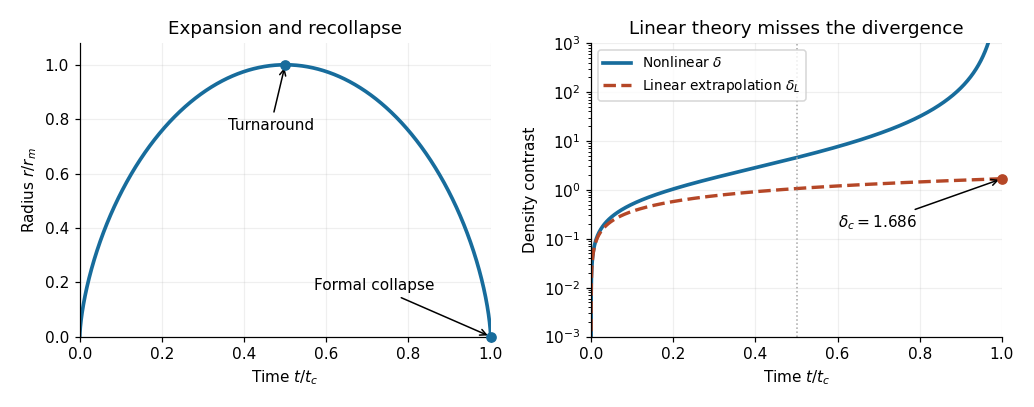
Parametric spherical collapse and the failure of the extrapolated linear density contrast
. Details. 
Articles by others on the same topic
There are currently no matching articles.