Take the initially expanding branch ; the printed squared velocity alone also permits an initially contracting branch, which would not reach a future maximum radius. Multiply the equation of motion by and integrate. The conserved outer-shell specific orbital energy isThe initial mass follows from the background critical density:ConsequentlyIf means the energy of a test shell of mass , . If it means the total energy of the entire uniform, homologously moving perturbation, direct integration instead gives , andThe common convention of writing the first integral as is therefore an energy per unit shell mass, not the total energy of the sphere.
At spherical-collapse turnaround, , so . HenceAny positive initial density contrast binds this pressureless perturbation in the stated Einstein-de Sitter universe.
For and , differentiation givesComparison with proves . Substitution into the conserved specific orbital energy gives . ThereforeThese constants exactly reproduce both the initial radius and expanding velocity. The initial parameter obeysIn an Einstein-de Sitter universe whose background big bang is , . Thus the exact required offset isExpanding givesOne cannot set exactly at finite while retaining the stated initial Hubble velocity and background time origin. For example , gives . Shifting to removes the offset from the local orbit, but the background then scales as , not . Setting is justified in the early-initial-time limit for subsequent evolution; the following standard growing-mode formulae use that approximation.
First retain the exact initial normalization. The scale factor obeys , so the cosmological redshift isAlso and . Using givesThese equations exactly accommodate the finite-time initial conditions in b.
Now neglect and retain leading order in . Since , the cosmological redshift relation reduces toDefine . ThenThe second equality is exact for the ideal common-bang growing-mode spherical-collapse model; it is approximate for the paper's finite-time initial Hubble-velocity data.
The factor has a physical origin. Linear mass conservation gives when the initial local expansion equals the background Hubble flow. The general linear dust solution is . Imposing and yieldsThus is the present extrapolation of the growing component, after neglecting the decaying transient. It is not the exact present value of the full linear solution for finite .
In the growing-mode spherical-collapse model, use and . Their ratio in c gives . Meanwhile , and the linear growing density contrast scales as . Matching at small therefore fixesThis is a linearly extrapolated growing-mode amplitude at any epoch, including epochs where the actual density contrast is nonlinear. It carries the initial-condition qualification in c.
Numerical comparison isThe last column measures the fractional underestimate of the actual density contrast. Linear theory is accurate at , but substantially underpredicts it by the time approaches unity. At , the shell reaches spherical-collapse turnaround; .
At , and the ideal pressureless density diverges at finite time . Yet the extrapolated linear value remains finite:This is the linear spherical-collapse threshold, not the true density contrast at collapse. Actual nonspherical collisionless systems undergo shell crossing and virialization rather than becoming uniform point singularities. The ideal virial theorem and conservation of energy estimate a final radius if the structural form is preserved.
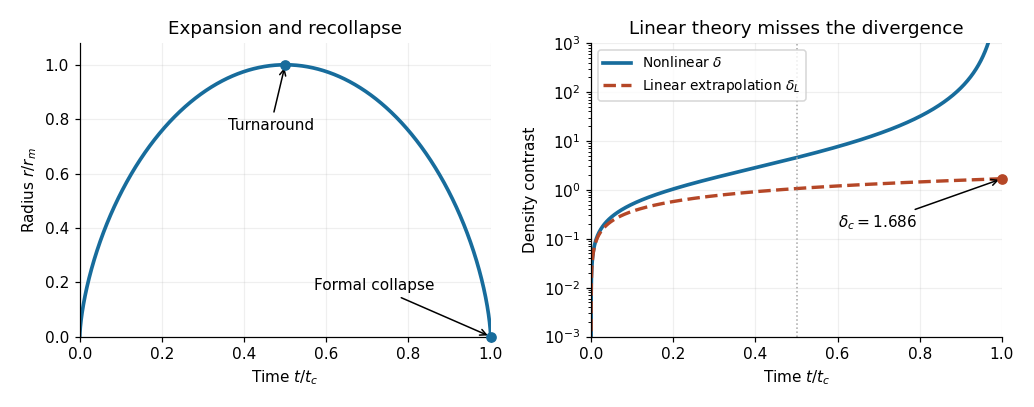
Parametric spherical collapse and the failure of the extrapolated linear density contrast
. Details. 
Articles by others on the same topic
There are currently no matching articles.