The radiative-convective structure of the terrestrial atmosphere reflects several processes. In the troposphere, absorbed sunlight heats the surface, which transfers energy upward by sensible heat and evaporation. Convection and large-scale ascent cool air by expansion; condensation releases latent heat and reduces the cooling rate of saturated ascent. Radiative cooling of the atmosphere balances part of this upward transport. The dry adiabatic lapse rate is ; moist convection generally gives a smaller lapse rate. The observed mean profile is a radiative–convective balance, not one universal dry adiabat.
In the stratosphere, ultraviolet absorption by ozone heats the layer and produces the mean temperature inversion, suppressing deep convection. Higher in the mesosphere, weaker ozone heating and radiative cooling allow temperature to decrease again. In the thermosphere, absorption of energetic solar radiation by the tenuous gas raises its kinetic temperature. Its low density means that a high kinetic temperature does not imply a large heat content.
Tropopause and other transition heights vary with latitude and season. Near-surface inversions and clouds further modify local profiles. [ref]
Layers of the Atmosphere by National Oceanic and Atmospheric Administration. Jetstream, troposphere through thermosphere and their heating mechanisms
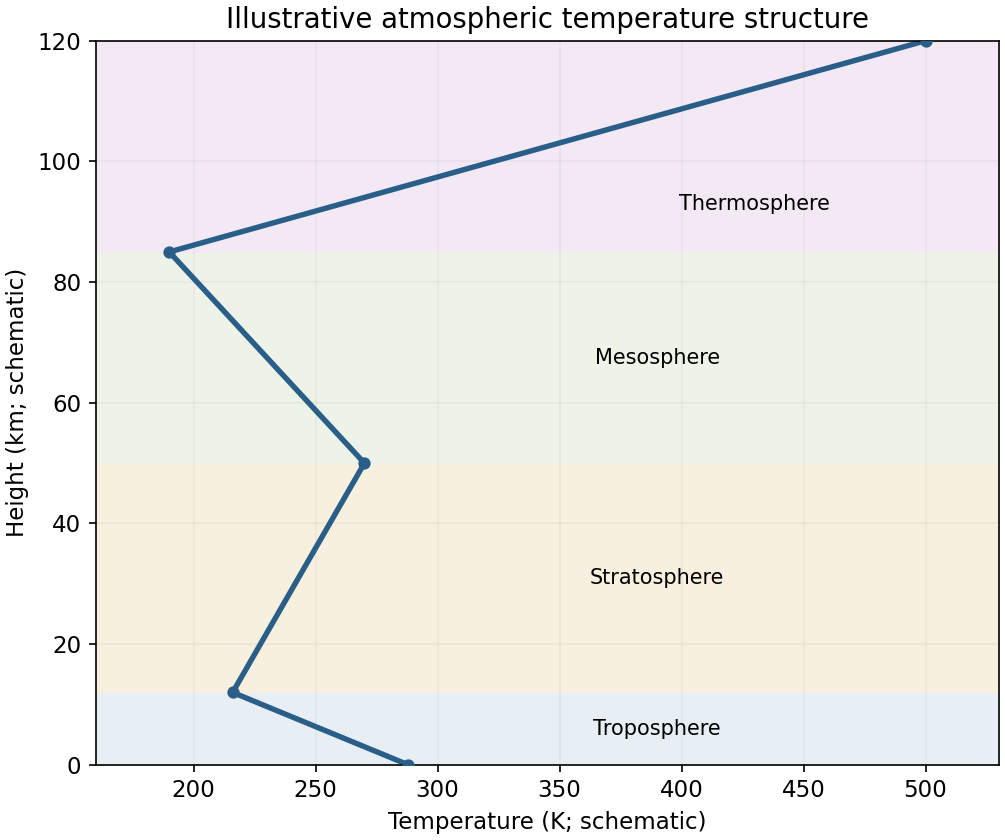
Atmospheric temperature profile
. Source. Details. 
Articles by others on the same topic
There are currently no matching articles.