
Sensible heat is transferred heat associated with a temperature change within a single thermodynamic phase. By contrast, latent heat can change the phase fraction while the temperature stays fixed during equilibrium phase coexistence. Neither name denotes an additional stored substance: both describe how transferred heat participates in a process.
For fixed mass and composition, use the heat capacity appropriate to the heating constraint. Under the quasistatic process assumptions in heat capacity, with only pressure-volume work and unchanged bulk kinetic energy and potential energy, fixed-pressure heating givesHere is specific heat capacity at constant pressure; fixed-volume heating instead uses specific heat capacity at constant volume . A cooling step has negative with the sign convention in heat. A temperature difference has the same numerical value in units of the kelvin or degree Celsius. The integral follows by adding the small transfers , rather than assuming a constant heat capacity.
As a stylized ice-to-water example for a fixed-composition closed system at fixed pressure , take , an initial temperature of , melting at , and a final temperature of . Assume constant specific heat capacity at constant pressure values and , and latent heat of fusion . These are stipulated, rounded model values; ignore the container and heat losses, retain all the material, and assume only pressure-volume work under the quasistatic process conditions above. The three steps areOnly the first and third terms are sensible heat; the middle term is latent heat. The plateau begins after and ends after of total supplied heat. At total input, half the mass is liquid water and the temperature remains . The equilibrium phase transition temperature depends on pressure; this example stipulates a single fixed pressure. [ref]
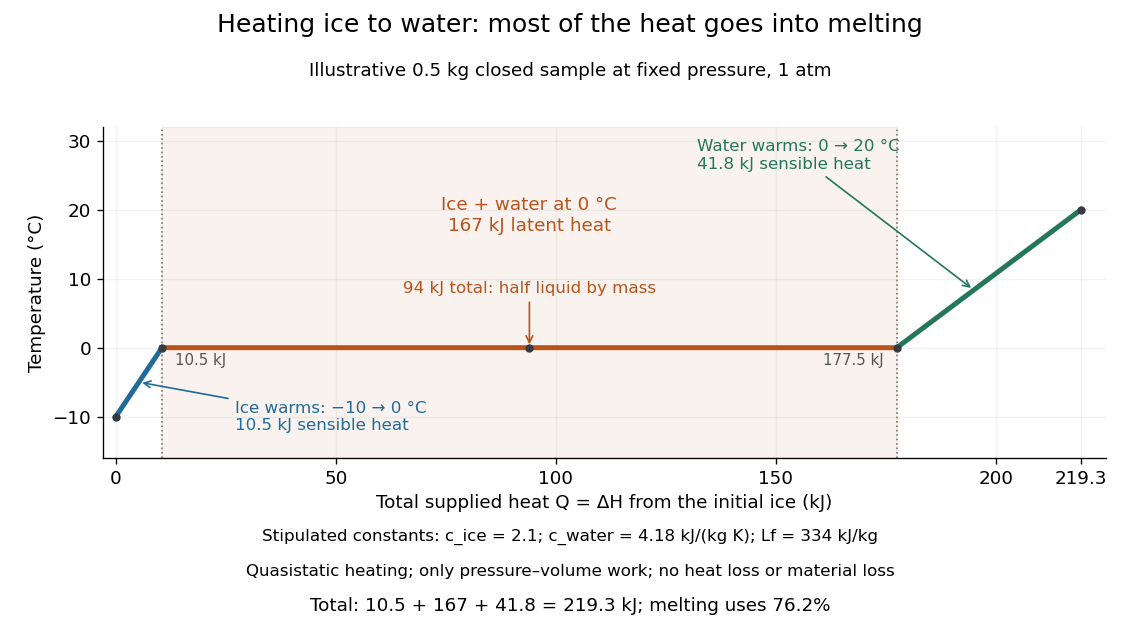
This split makes heating budgets easy to interpret: melting consumes of the supplied heat in this model despite causing no temperature rise. Within either single thermodynamic phase, the heating curve slope is ; a larger heat capacity makes the slope shallower. A flat interval represents changing phase fraction, so it cannot be modeled by applying across the phase transition. The complementary constructed example in latent heat tracks that phase fraction explicitly.


Sensible heat is the heat that causes a change in temperature of a substance without causing a change in its phase (state). When heat is added to or removed from a substance, the sensible heat is the energy that is responsible for the rise or fall in temperature.
New to topics? Read the docs here!