A blackbody absorbs all incident radiation and, in thermal equilibrium, emits the Planck law spectrum with integrated flux . Earth reflects some incoming sunlight, while its surface and atmosphere absorb and emit selectively with wavelength. With solar irradiance and Bond albedo A, the equilibrium planetary effective radiating temperature isReflection lowers this temperature relative to the zero-albedo value. The greenhouse effect makes the surface warmer than the effective emitting temperature: in a simple diagnostic , . This effective emissivity summarizes atmospheric transfer, not a universal material constant. At fixed absorbed sunlight, greenhouse warming does not require a different equilibrium outgoing flux. [ref]
Climate and Earth's Energy Budget by NASA Earth Observatory. Absorbed/reflected sunlight and effective radiating versus surface temperature
The stated is positive net energy uptake, not necessarily the imposed radiative forcing itself. A linear climate forcing-response energy balance isHere F is the perturbing forcing, is the net stabilizing radiative response and C is an effective areal heat capacity. The residual heats the Earth system, mainly through ocean heat uptake, with additional storage and melting. Finite heat capacity and ocean exchange delay equilibration. The imbalance alone determines neither F, the warming rate without C, nor the eventual equilibrium warming . Feedbacks change the response coefficient. The given number is treated as the examination's premise, not a present-day observational estimate. [ref]
The Earth's Energy Budget, Climate Feedbacks, and Climate Sensitivity by Piers Forster and others. §7.4.1 andBox7.1, forcing–response budget; sign convention here uses positive damping lambda
The entropy form of dry potential temperature follows from its parcel definition. The potential temperature is the temperature a parcel would reach if brought reversibly and adiabatically to a reference pressure . For dry air of fixed composition, treated as an ideal gas with constant specific heat capacity,Per unit mass, the first law of thermodynamics, together with for specific volume, gives . The reversible form of the Second law of thermodynamics then givesHence dry reversible adiabatic motion has . Pressure changes cause expansion cooling or compression warming, while the pressure factor in theta compensates exactly. Adiabaticity alone is insufficient if irreversible mixing or viscous dissipation produces entropy. Condensation or freezing supplies latent heating, so ordinary dry potential temperature need not be conserved in a moist adiabatically moving parcel.
The radiative-convective structure of the terrestrial atmosphere reflects several processes. In the troposphere, absorbed sunlight heats the surface, which transfers energy upward by sensible heat and evaporation. Convection and large-scale ascent cool air by expansion; condensation releases latent heat and reduces the cooling rate of saturated ascent. Radiative cooling of the atmosphere balances part of this upward transport. The dry adiabatic lapse rate is ; moist convection generally gives a smaller lapse rate. The observed mean profile is a radiative–convective balance, not one universal dry adiabat.
In the stratosphere, ultraviolet absorption by ozone heats the layer and produces the mean temperature inversion, suppressing deep convection. Higher in the mesosphere, weaker ozone heating and radiative cooling allow temperature to decrease again. In the thermosphere, absorption of energetic solar radiation by the tenuous gas raises its kinetic temperature. Its low density means that a high kinetic temperature does not imply a large heat content.
Tropopause and other transition heights vary with latitude and season. Near-surface inversions and clouds further modify local profiles. [ref]
Layers of the Atmosphere by National Oceanic and Atmospheric Administration. Jetstream, troposphere through thermosphere and their heating mechanisms
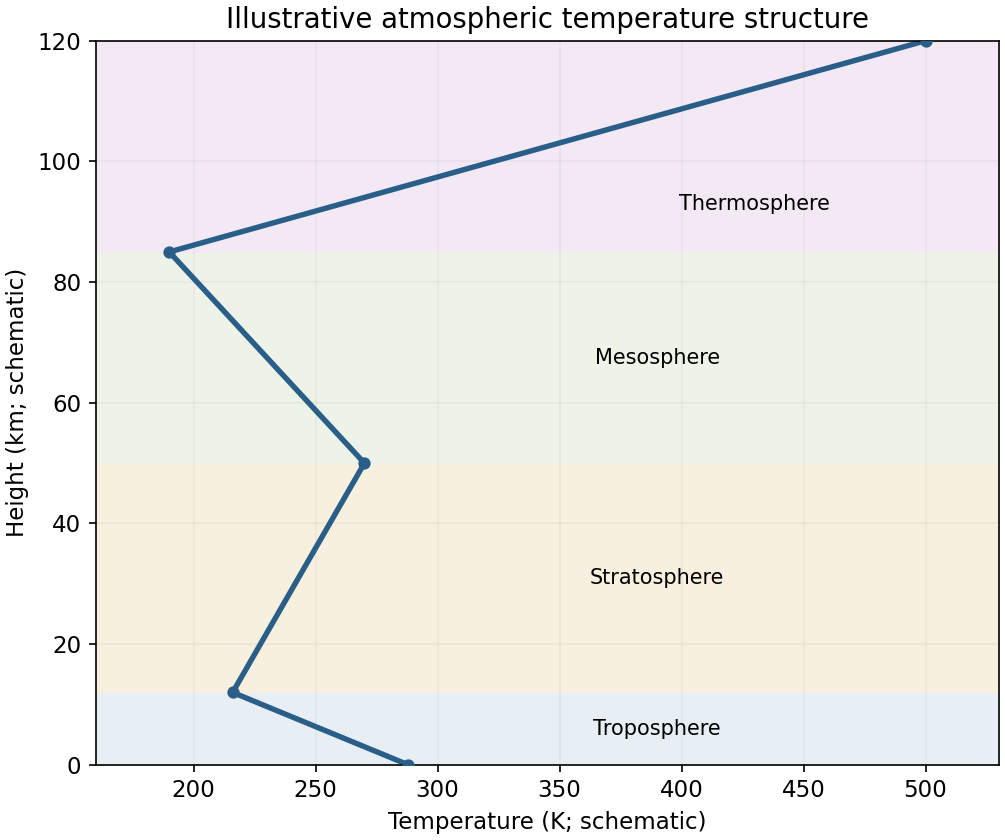
Atmospheric temperature profile
. Source. Details. 
Clouds reflect shortwave sunlight, usually cooling the planet, and absorb and emit thermal infrared radiation, usually warming the surface relative to clear sky. Their net effect depends on altitude, temperature, optical depth, phase and the underlying surface: thick low clouds often have strong shortwave cooling, while cold high clouds can have a comparatively strong longwave warming effect. Surface and top-of-atmosphere budgets must be distinguished; absorbing radiation within a cloud can heat the atmospheric layer while shading the ground.
Condensation and freezing release latent heat; evaporation and melting absorb it. These processes change buoyancy, stability and convective transport. Entrainment of dry air can evaporate droplets and cool the cloud edge, while precipitation removes condensate and water.
Microphysics controls the radiative properties. For liquid droplets with a fixed liquid-water path W, the cloud optical depth at fixed liquid-water path is approximatelyThus more numerous smaller droplets at fixed W give a brighter, optically thicker cloud: the Twomey effect. Ice habit, phase and particle-size distribution also alter scattering, absorption and precipitation. Cloud-water and lifetime adjustments need not preserve W, so a microphysical perturbation has no universal net radiative sign. [ref]
Articles by others on the same topic
There are currently no matching articles.