A convex liquid surface has additional surface free energy. The resulting Kelvin equation for a pure spherical water droplet isHere gamma is surface tension and is molar mass. Smaller droplets therefore need a higher environmental vapour pressure to avoid evaporating; forming pure-water embryos by homogeneous condensation has a large nucleation barrier.
An atmospheric droplet normally forms on a cloud condensation nucleus. Dissolved salt reduces water activity and hence equilibrium vapour pressure, opposing the curvature effect. Köhler theory combines them:Using the radius form, with radius and diameter conventions in Köhler activation kept distinct, the Köhler activation radius is , with . Supersaturation above this maximum activates a wet aerosol into a growing cloud droplet. Solubility, particle size and wettability determine the threshold; not every particle activates. Cooling by ascent commonly supplies the necessary modest supersaturation. [ref]
A single parameter representation of hygroscopic growth and cloud condensation nucleus activity by M. D. Petters and S. M. Kreidenweis. 2007, curvature/solute competition and critical activation; radius convention explicitly used here
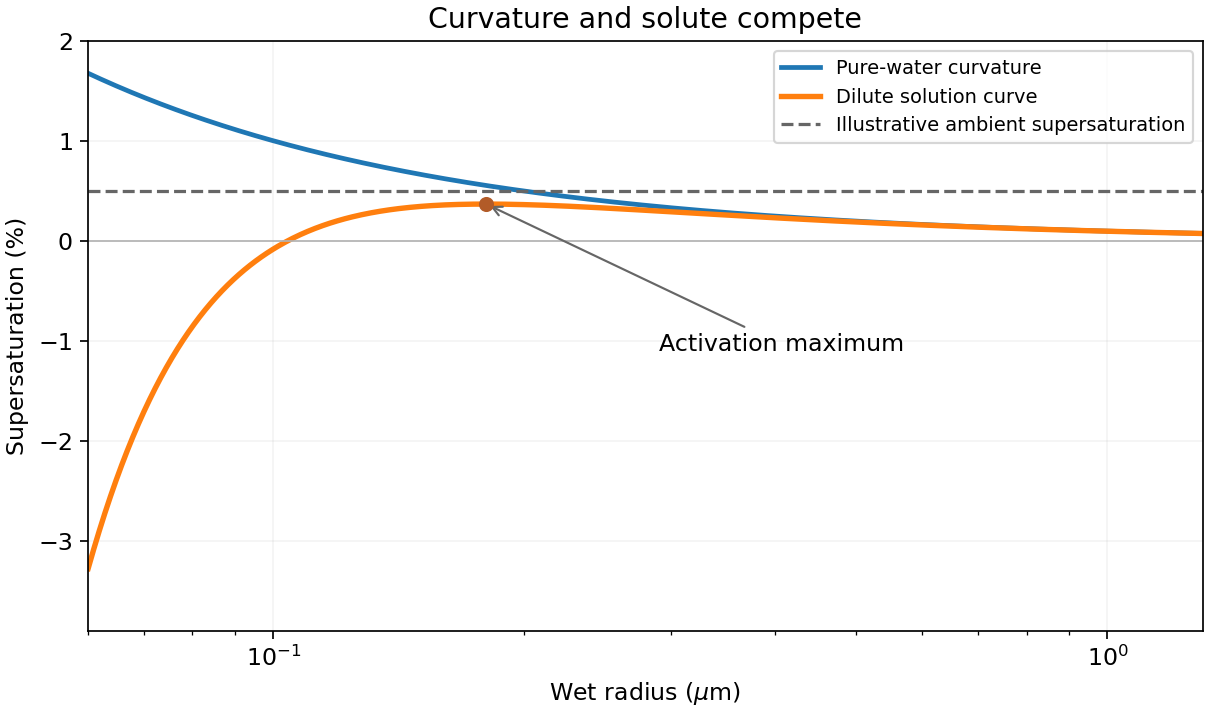
Köhler activation
. Source. Details. 
Warm-rain growth: condensation first creates cloud droplets, but its approximate growth narrows relative size differences and becomes inefficient at making large raindrops quickly. A broadened size spectrum lets larger, faster-falling drops collect smaller ones by collision-coalescence. The cloud-droplet collision kernel combines collection efficiency and differential settling. Turbulence, sufficient cloud depth and liquid-water content determine whether collector drops grow rapidly enough. Collisions must actually lead to merging rather than bypass, bounce or breakup.
Ice-phase growth: in a mixed-phase cloud, equilibrium vapour pressure over ice is lower than over supercooled liquid. Ice can grow by deposition while droplets evaporate: the Wegener-Bergeron-Findeisen process. Ice particles then grow further by riming of supercooled droplets and by ice-crystal aggregation. They may fall as snow or melt into rain. Deposition, riming and aggregation are distinct processes; depositing vapour alone need not complete precipitation growth.
Precipitation efficiency depends on the supply of suitable collector drops or ice, residence time, updraft speed, supersaturation and collection/sticking efficiencies. Competition among too many small particles can inhibit growth, and evaporation or sublimation below the cloud can prevent condensate from reaching the surface. Both pathways require growth and fall-out to compete successfully with these losses. [ref]
International Cloud Atlas by World Meteorological Organization. Glossary: accretion, aggregation, coalescence; snow as single or aggregated ice crystals
A droplet can remain liquid below its equilibrium melting temperature through supercooling: a microscopic ice embryo must first pay an interfacial free-energy cost. The nucleation barrier can therefore delay freezing even when bulk ice is thermodynamically favoured. Solutes, available surfaces, temperature, droplet volume and exposure time affect the probability; zero degrees Celsius is not an automatic freezing threshold for every atmospheric droplet.
At least four physical routes are relevant:
- Homogeneous ice nucleation: an ice embryo forms within deeply supercooled liquid without a foreign surface.
- Immersion freezing: a suitable particle already inside a liquid droplet catalyses an ice embryo.
- Contact freezing: a suitable particle contacting the droplet surface triggers heterogeneous freezing.
- Deposition nucleation: ice appears from vapour on a suitable solid surface under ice-supersaturated conditions; pore condensation or a thin liquid film can participate, so the observed mode need not imply a single direct molecular pathway.
Mineral particles provide nonbiological examples of heterogeneous nuclei. A particle's presence alone does not guarantee activity at a given temperature. The cloud ice nucleation versus ice growth distinction matters: the processes listed concern the formation of new ice; subsequent depositional growth, riming and aggregation are separate from initiating that first crystal.
There are several distinct radiative pathways:
- Direct scattering: predominantly nonabsorbing particles, such as many sulfate or sea-salt aerosols, redirect sunlight and commonly increase reflected shortwave radiation over a dark surface. Hygroscopic growth increases their wet size and can increase scattering.
- Direct absorption: absorbing particles, such as soot or some mineral dust, heat the layer containing them while reducing sunlight at the surface. The top-of-atmosphere sign depends on particle optics, altitude, clouds and surface albedo; atmospheric heating is not the same as surface warming.
- Cloud activation: a soluble, hygroscopic particle can act as a cloud condensation nucleus. At fixed liquid-water path, more activated droplets lower the effective radius and increase cloud albedo through the Twomey effect. Precipitation and water-content adjustments can modify that response. Insoluble particles may still activate when sufficiently wettable or coated, and some serve as ice nuclei, changing cloud phase.
- Cloud adjustment to aerosol heating: absorbing particles alter temperature, relative humidity and stability. This semi-direct aerosol effect can evaporate cloud or, in other configurations, help sustain it; its sign is not universal.
Solubility and optical absorption are independent properties: insoluble does not mean absorbing, and soluble does not mean nonabsorbing. Coarse particles can also affect terrestrial infrared radiation, while dark-particle deposition on snow can lower surface albedo. These effects should not be folded into a single universal aerosol cooling rule. [ref]
Articles by others on the same topic
There are currently no matching articles.