A convex liquid surface has additional surface free energy. The resulting Kelvin equation for a pure spherical water droplet isHere gamma is surface tension and is molar mass. Smaller droplets therefore need a higher environmental vapour pressure to avoid evaporating; forming pure-water embryos by homogeneous condensation has a large nucleation barrier.
An atmospheric droplet normally forms on a cloud condensation nucleus. Dissolved salt reduces water activity and hence equilibrium vapour pressure, opposing the curvature effect. Köhler theory combines them:Using the radius form, with radius and diameter conventions in Köhler activation kept distinct, the Köhler activation radius is , with . Supersaturation above this maximum activates a wet aerosol into a growing cloud droplet. Solubility, particle size and wettability determine the threshold; not every particle activates. Cooling by ascent commonly supplies the necessary modest supersaturation. [ref]
A single parameter representation of hygroscopic growth and cloud condensation nucleus activity by M. D. Petters and S. M. Kreidenweis. 2007, curvature/solute competition and critical activation; radius convention explicitly used here
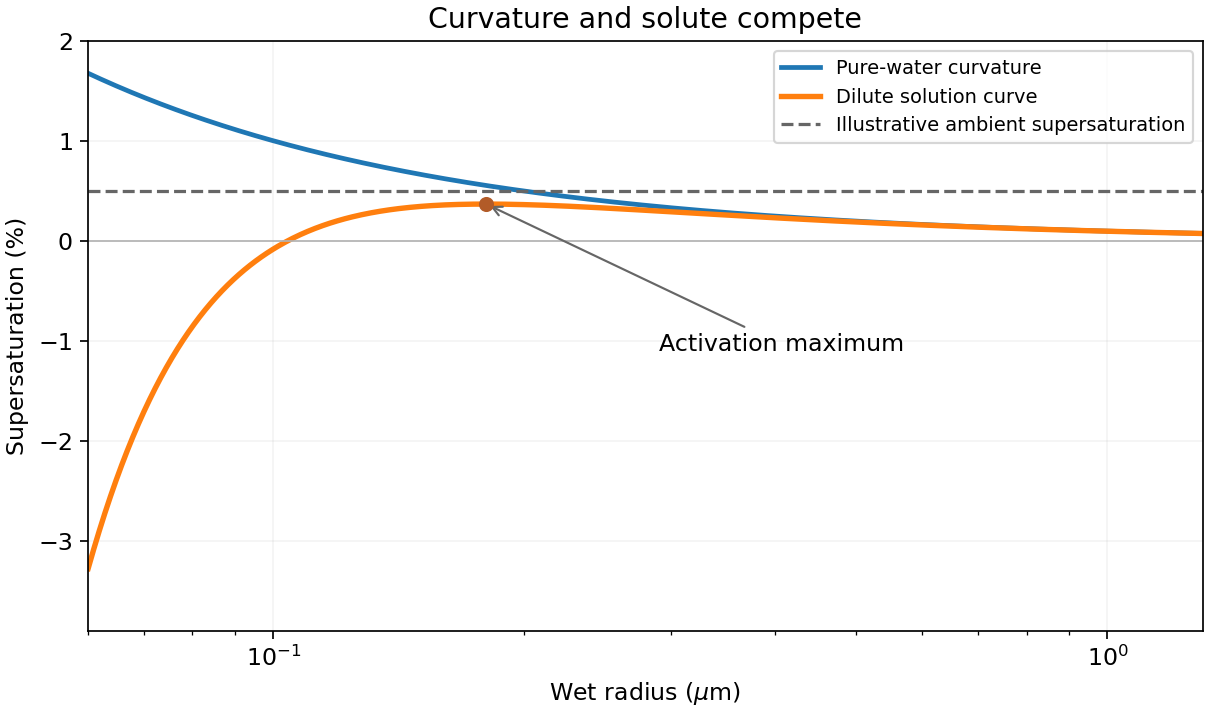
Köhler activation
. Source. Details. 
Articles by others on the same topic
There are currently no matching articles.