The reciprocal lattice is generated byIts points are spaced by along both reciprocal axes. Perpendicular bisectors between the origin and its four nearest reciprocal neighbours enclose the first Brillouin zone,The original drawing labels both the reciprocal-lattice spacing and the nearer zone boundaries. Its shaded disk is the occupied region for one electron per real-space cell.
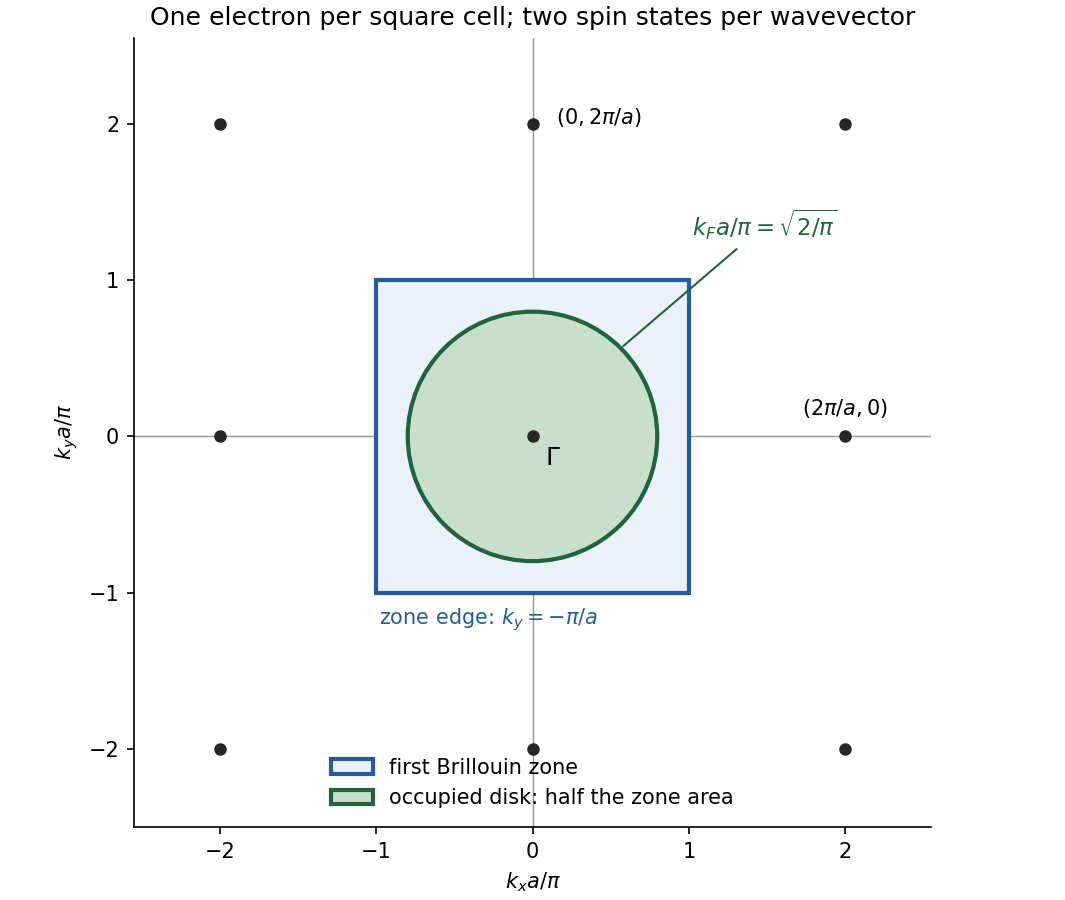

For one electron per square cell, , soNumerically, exceeds , so the fermi circle lies entirely inside the first Brillouin zone.
The state-counting explanation is that a spin-degenerate band has two electron states per primitive cell. One electron per cell therefore occupies half of that band. In the circular free-electron approximation the occupied reciprocal-space area isA disk of that area fits inside this square: its radius is less than the distance to an edge. Half filling alone is not a shape-independent theorem that every possible Fermi surface must avoid every zone boundary; the square geometry and circular free-electron dispersion make the statement true here.
An isolated spin-degenerate lowest energy band accommodates two electrons per atom when there is one atom per primitive cell. Starting from one per atom, the estimate for filling the band is thereforeThis corresponds to an additional areal carrier count of about . If a genuine band gap separates the filled first band from the next band, there are no partially occupied band states at low temperature, so ordinary metallic conduction is lost.
Simply touching an edge is insufficient. In the circular approximation first contact would occur at , corresponding to electrons per cell; that is a partly filled band and need not be insulating. Near zone boundaries, the periodic potential reshapes the free-electron contours. The two-electron filling estimate assumes a global gap without overlapping bands, rather than inferring an insulator merely from one local avoided crossing.
Articles by others on the same topic
There are currently no matching articles.