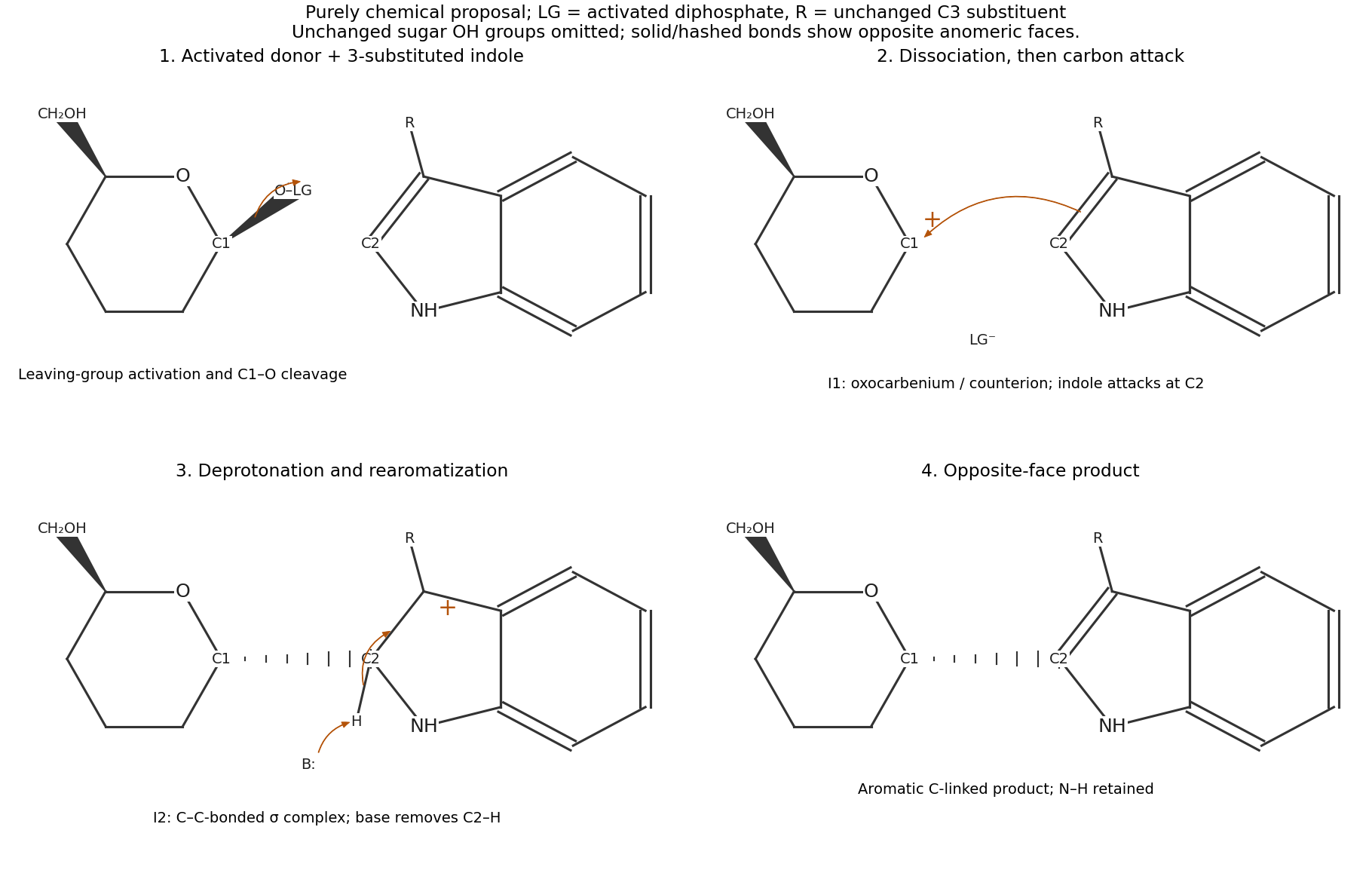
Treat the reacting carbon skeletons as an activated glycosyl donor and a 3-substituted indole. The new linkage is an anomeric-carbon–indole-C2 carbon–carbon bond, not a bond to indole nitrogen. A plausible purely chemical pathway is a dissociative electrophilic aromatic substitution:
- Activation of the anomeric diphosphate leaving group, for example by acid, permits cleavage of its bond to the anomeric carbon. The ring oxygen stabilizes the resulting glycosyloxocarbenium ion, represented by the resonance pair . A nearby diphosphate counterion may remain in a contact ion pair.
- The indole C2–C3 pi bond attacks C1 through C2. This makes the new C1–C2 bond and gives an arenium ion, with C2 temporarily tetrahedral and still bearing its original hydrogen. Positive charge can be delocalized over the pyrrolic portion, including an indolium resonance contributor.
- A base removes that C2 hydrogen. The C2–H bond electrons restore the C2–C3 pi bond and aromaticity, releasing the C-glycosylation product while retaining N–H.
The drawn donor and product have opposite anomeric faces: the anomeric leaving group is on the same face as the hydroxymethyl substituent, while the new carbon substituent is on the opposite face. Thus the target has net inversion at the anomeric carbon. A tight ion pair with the departing group shielding its original face can rationalize opposite-face capture in this proposed pathway. A freely solvated planar oxocarbenium ion would not by itself guarantee exclusive inversion; competing faces, hydrolysis and other products remain possible without an experimentally specified chemical promoter. This is a plausible non-enzymatic mechanism, not a claim that the uncatalysed reaction is rapid or clean in neutral water.

Articles by others on the same topic
There are currently no matching articles.