Each thiocyanate is a three-metal bridge, -: its nitrogen donates to one metal and its sulfur donates to two other metals. Thus the coordination ligand is ambidentate, but the structure uses both ends and shares the sulfur donor. Each metal receives two nitrogen and four sulfur donors, giving an approximately octahedral coordination sphere. Six donor contacts per metal are consistent with two coordination ligands per metal because each coordination ligand contributes three contacts across the lattice. Sharing these contacts produces a coordination polymer within each layer; the interlayer Van der Waals force does not add coordination bonds. The index counts metal centres, whereas a hapticity label would count adjacent coordinated coordination ligand atoms and would not describe this connectivity correctly.[ref]
Strengthening the Magnetic Interactions in Pseudobinary First-Row Transition Metal Thiocyanates, M(NCS)2 by Euan N. Bassey and others. Structural discussion of the layered first-row metal thiocyanates
Charge balance fixes each metal as . In an octahedral crystal field the lower set is and the upper set is . The measured spin-only magnetic moments select the following occupations:The result follows from and . Manganese(II) and iron(II) are high-spin complexes: their octahedral splitting is too small to compensate the additional pairing cost of their low-spin alternatives. Copper(II) is , with one unpaired electron regardless of which member of the upper pair is singly occupied. spin-orbit coupling and exchange interactions can produce deviations from the spin-only estimate in real measurements; no such correction is required to explain the supplied values.
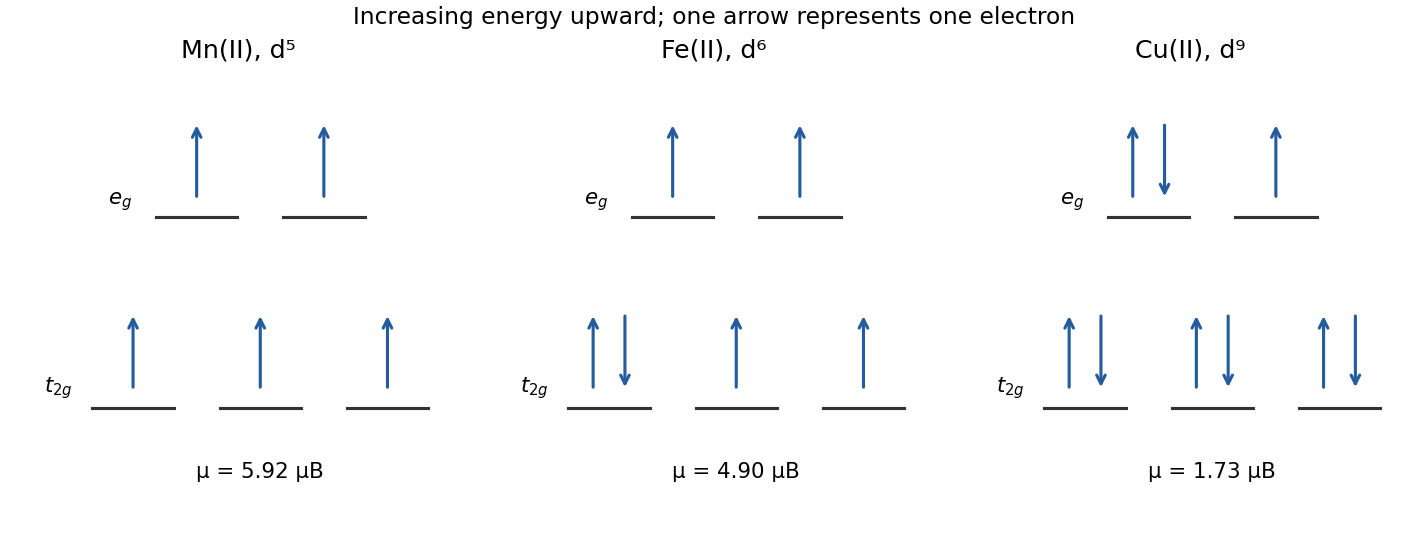
Octahedral occupations consistent with the three magnetic moments
. Details. 
At fixed oxidation state, increasing effective nuclear charge across the first transition series generally contracts the ionic radius. The first expectation is therefore shorter average metal–nitrogen and metal–sulfur distances toward copper. This is a trend in comparable coordination environments, rather than a requirement that every individual contact shorten monotonically. The occupation of metal–coordination ligand antibonding orbitals, donor identity and lattice distortion all affect the observed distances.
The high-spin and ions both have two electrons in the strongly sigma-antibonding set, so adding the sixth electron to does not itself introduce another sigma-antibonding electron. Copper(II), however, has occupation and is subject to the Jahn-Teller effect. A tetragonal Jahn-Teller distortion commonly gives four shorter and two longer contacts, so an elongated copper contact can oppose the overall size trend. Here the nitrogen and sulfur donors are already chemically inequivalent; the supplied schematic alone does not determine which trans pair becomes longest. One should compare actual M–N and M–S sets separately, rather than infer a unique axis or a numerical distance from the magnetic moments. The experimentally determined structures illustrate why the donor geometry and individual contacts matter.[ref]
Strengthening the Magnetic Interactions in Pseudobinary First-Row Transition Metal Thiocyanates, M(NCS)2 by Euan N. Bassey and others. Crystallographic characterization and comparison of the layered structures
For A, linear nitrogen coordination with predominantly nitrile-like bonding is consistent with all three measurements:The short C–N and long C–S distances correspond approximately to a triple bond and a single bond. An approximately nitrogen donor has its donor lone pair directed along the N–C axis, explaining the linear M–N–C angle.
For B, bent nitrogen coordination with increased chemical resonance character accounts for the longer C–N and shorter C–S bonds. In this limiting description both internal bonds have substantial double-bond character and nitrogen is approximately . One nitrogen lone pair can bind a metal with an M–N–C angle near ; alternatively, donation of both nitrogen lone pairs can give a trigonal, nitrogen-bridging unit:The nitrogen-bridging drawing is a compatible proposed bonding mode, but the listed internal distances and one angle alone do not prove the number of attached metals. In particular, B cannot be identified simply as terminal sulfur coordination: the specified angle explicitly contains an M–N bond. resonance structures explain relative bond orders; they do not imply an isolated coordination ligand with permanently localized integer bonds.
A distinct possibility is terminal sulfur coordination, . Unlike the sulfur donor in the layer, this sulfur need bind only one metal. The limiting resonance structure suggests and . These are single-/triple-bond-based estimates, not exact predictions for an unspecified metal complex. The M–S–C linkage should be bent, consistent with sulfur lone-pair donation.
Articles by others on the same topic
There are currently no matching articles.