Take the M–C–O direction as . carbon monoxide binds through carbon because its occupied donor orbital has a substantial carbon-end lobe. End-on overlap with an empty metal orbital of sigma symmetry gives CO-to-metal sigma donation. At the same time, occupied metal and orbitals overlap sideways with the two corresponding empty CO orbitals, giving metal-to-CO pi backbonding. Both channels strengthen the metal–carbon bond, while backbonding lowers the internal C–O bond order. The processes are synergic: sigma donation helps supply metal electron density for backbonding, while backbonding relieves electron accumulation at the metal.
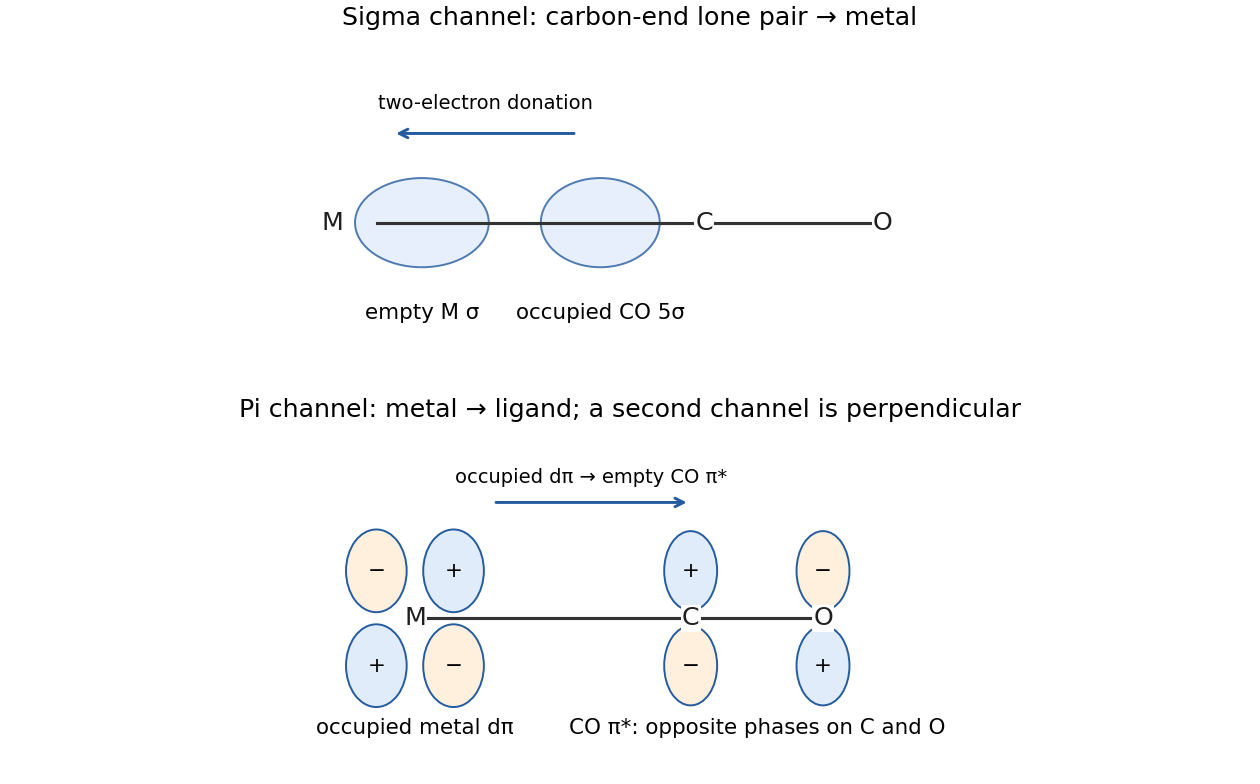

The original orbital sketch shows one of the two perpendicular pi channels. It is the occupied metal orbital, rather than an empty metal orbital, that supplies electrons to CO antibonding orbitals.
Articles by others on the same topic
There are currently no matching articles.