Take the M–C–O direction as . carbon monoxide binds through carbon because its occupied donor orbital has a substantial carbon-end lobe. End-on overlap with an empty metal orbital of sigma symmetry gives CO-to-metal sigma donation. At the same time, occupied metal and orbitals overlap sideways with the two corresponding empty CO orbitals, giving metal-to-CO pi backbonding. Both channels strengthen the metal–carbon bond, while backbonding lowers the internal C–O bond order. The processes are synergic: sigma donation helps supply metal electron density for backbonding, while backbonding relieves electron accumulation at the metal.
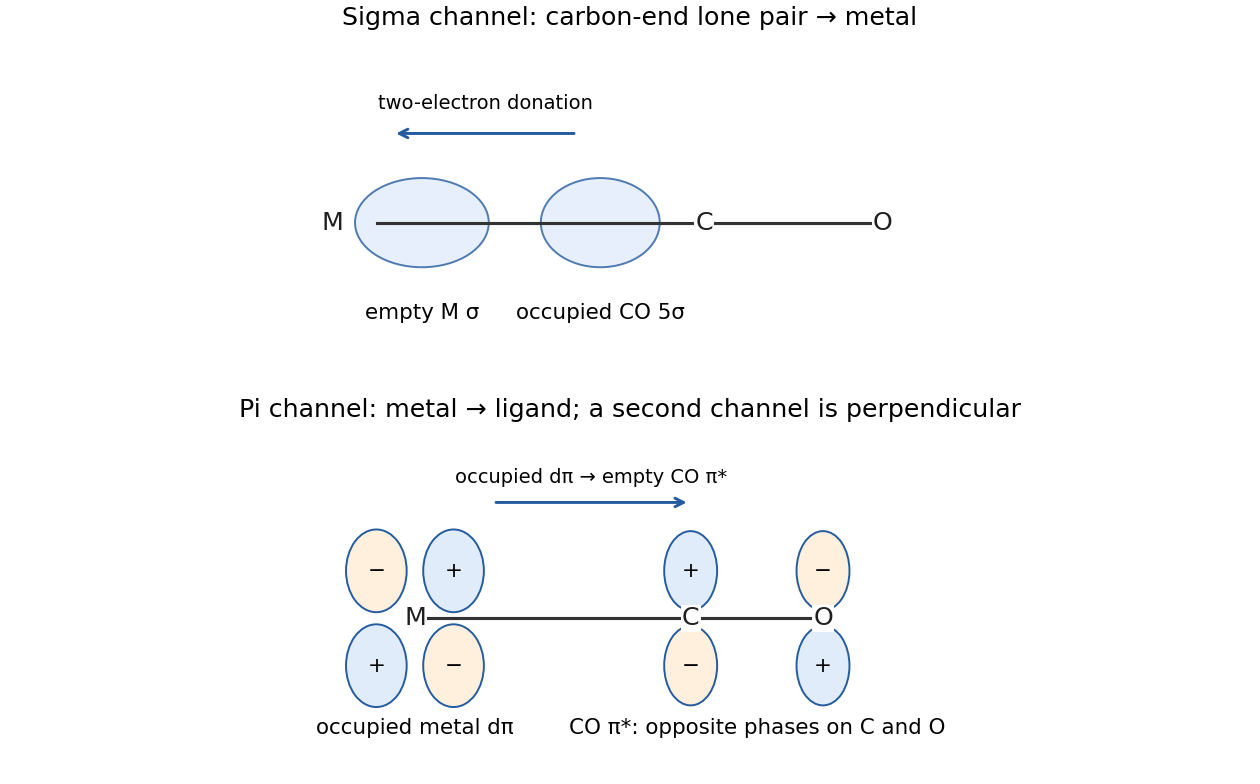

The original orbital sketch shows one of the two perpendicular pi channels. It is the occupied metal orbital, rather than an empty metal orbital, that supplies electrons to CO antibonding orbitals.
The arene and three carbonyl ligands are neutral, so chromium is in oxidation state zero, with a metal count. The eta-six arene contributes six electrons and each CO contributes two:The methoxy group changes the electronic properties of the arene without changing this formal electron count. The complex is a piano-stool complex, with the coordinated arene as the seat and the three carbonyl ligands as the legs.
The methoxy substituent donates electron density into the coordinated arene by chemical resonance. This increases the electron density available at chromium for pi backbonding to CO, weakening C–O and lowering its stretching frequencies. The ester substituent withdraws electron density from the arene, reducing pi backbonding and raising the carbonyl stretching frequencies. For both observed bands, the methoxy-substituted compound has the lowest carbonyl frequency, the unsubstituted compound is intermediate, and the ester-substituted compound has the highest.
In the harmonic oscillator approximation,so the trend reflects an increasing effective C–O bond force constant rather than a change in the CO reduced mass. For example, comparison of the higher-frequency bands gives . This is only an approximate local-bond interpretation because the observed normal modes couple the three CO oscillators. In the idealized local geometry they span , giving two infrared-active frequencies. A substituted arene can lower the exact molecular symmetry and split the pair, even if that splitting is unresolved experimentally.
triphenylphosphine is a good sigma donor and a substantially poorer pi acceptor than CO. Replacing CO by this phosphine ligand increases electron density at chromium and reduces competition among carbonyl ligands for pi backbonding. Backbonding into each remaining CO therefore strengthens, their internal bond force constants fall, and both remaining carbonyl stretching frequencies are expected to shift downward relative to the parent tricarbonyl.
The two remaining carbonyl ligands have coupled approximately symmetric and antisymmetric stretches; both are generally infrared active in this geometry. One should not treat the spectral change as simply deleting one of the original two bands. The substituted complex still has valence electrons. No numerical frequency shift follows from electron counting alone.
Photoinduced CO loss gives a 16-electron fragment. In the ester-substituted complex the pendant ester carbonyl oxygen can reach chromium and capture that vacant site. A suitable structure is , retaining the coordinated arene and adding intramolecular coordination of its ester oxygen. The added oxygen lone-pair donation restores an 18-electron count. The gaseous by-product is carbon monoxide.
heptane is a poor donor, but intramolecular ligand trapping avoids needing a donor solvent. Benzene has no pendant donor. Although the methoxy group has oxygen lone pairs, its directly attached oxygen does not have the same reach and favourable geometry as the projecting ester carbonyl oxygen; possession of a lone pair alone is insufficient. For these two substrates, acetonitrile can trap the unsaturated fragment through nitrogen to give . Without a suitable trap, CO recombination can reverse the initial photochemical dissociation.
Articles by others on the same topic
There are currently no matching articles.