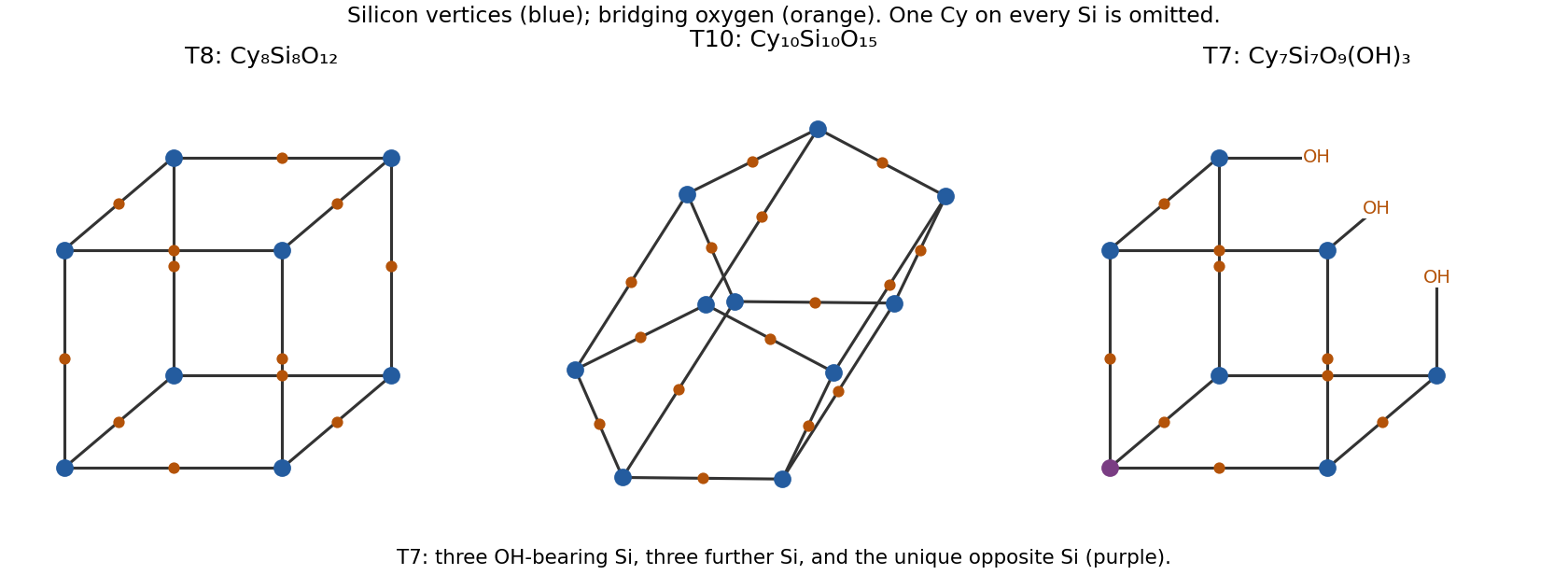
First count the organic groups and then the unsatisfied oxygen valences. A is the fully condensed T8 silsesquioxane cage, , with silicon at the eight vertices of a cube and bridging oxygen on its twelve edges. Each silicon has one cyclohexyl group and three siloxane bridges. Its eight cyclohexyl groups supply exactly .
B is a fully condensed T10 silsesquioxane cage, , for which a pentagonal-prismatic silicon skeleton with an oxygen on every edge is a standard compatible structure. Its ten groups give . The formula establishes full condensation but does not, without more structural data, rule out every other possible ten-vertex cage connectivity.
C is a corner-deficient T7 trisilanol cage, . Seven cyclohexyl groups account for , leaving three hydrogen atoms as Si–OH groups. Remove one silicon corner of the T8 cube and replace the three severed connections by terminal hydroxyl groups. Nine oxygen atoms remain as bridges and three become terminal silanol oxygen atoms, giving precisely twelve oxygen atoms. There are three silicon sites bearing OH, three further equivalent fully condensed sites, and one opposite fully condensed site, consistent with three silicon environments in a 3:3:1 site-count ratio. The less negative resonance is naturally associated with the three silanol-bearing sites; the remaining two resonances belong to the two fully condensed classes. Peak heights alone are not quantitative integrations.

The source figure appears to label the spectrum . The chemically appropriate routine experiment here is silicon-29 NMR, using the spin-one-half isotope ; the figure label is treated as an apparent isotope-label typographical error, not as evidence for another cage.
Each trisilanol cage loses its three hydroxyl protons and supplies a facial tridentate silanolate ligand of charge . Two such coordination ligands replace all six chlorides of tungsten(VI), givingwith approximately octahedral coordination. tungsten remains , is , and is bound to six oxygen donors, three from each cage. The six liberated protons combine with the six chlorides to give six HCl; no W=O bond or tungsten reduction is needed. The molecular formula is . This bis(cage) tungsten structure was directly prepared and characterized in the primary literature.[ref]
Preparation and Characterization of a Bis(silsesquioxane)tungsten Complex by Peter Smet and others. Inorganic Chemistry 37, 6583–6586: synthesis from tungsten hexachloride and the cyclohexyl-substituted trisilanol
Articles by others on the same topic
There are currently no matching articles.