Choose along M–N–N. The occupied dinitrogen orbital, with amplitude on the terminal N atoms, overlaps an empty metal orbital of sigma symmetry to give N-to-metal sigma donation. Filled metal and orbitals separately overlap the two empty N orbitals, giving metal-to-N pi backbonding. The lower-energy combination of each interacting pair is bonding and the higher is antibonding; each donation channel starts with two electrons in the occupied fragment orbital. The lower panel of the original orbital diagram shows these three channels.
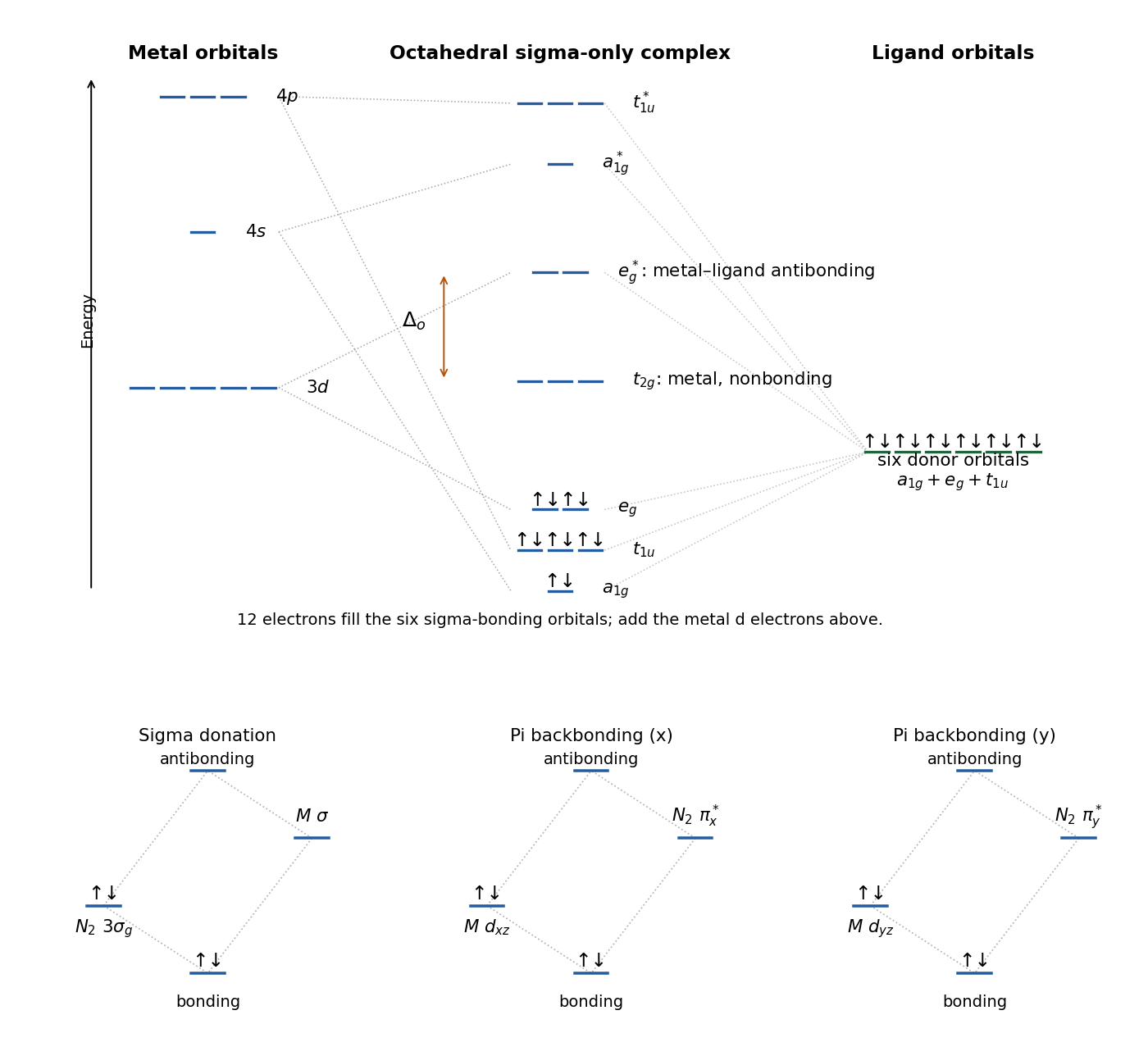

As for a terminal carbonyl ligand, the donor and acceptor interactions reinforce one another: sigma donation helps make electron density available at the metal, while pi backbonding strengthens M–N and weakens N–N. For conventional electron counting an intact end-on neutral N ligand is an L-type two-electron donor; counting the backbonded electrons a second time as extra donated ligand electrons would double count them.
Both coordinated frequencies are substantially lower than that of free N. In a local harmonic model,Thus coordination lowers the approximate N–N stretching force constant by about 27%, with B marginally more activated than A by this measure. Donation into N pi-antibonding orbitals provides the natural explanation: the M–N bond has an important backbonding component and N–N loses some multiple-bond character.
The same qualitative red shift occurs for CO when metal-to-CO backbonding populates CO orbitals. N is generally a poorer pi acceptor than CO, so low-valent electron-rich metal fragments are particularly helpful for stabilizing its complexes. A numerical claim that N always shifts more or less than CO would require a matched metal/ligand comparison. Neither the two frequencies nor the local-force approximation establish integer N–N bond orders, complete N–N cleavage, or catalytic nitrogen conversion; they establish significant weakening of intact coordinated N.
Articles by others on the same topic
There are currently no matching articles.