Six inward-directed donor orbitals form symmetry-adapted linear combinations of symmetry. They mix respectively with metal , and orbitals. Thus the sigma framework contains six occupied bonding molecular orbitals and six corresponding antibonding molecular orbitals. The metal orbitals have no sigma-compatible partner and remain nonbonding orbitals in this model. The important metal-dominated octahedral splitting isThe orbitals point directly toward the donors; the orbitals point between them. The original diagram shows the entire sigma framework, rather than treating the five metal d levels as the whole molecular-orbital diagram.
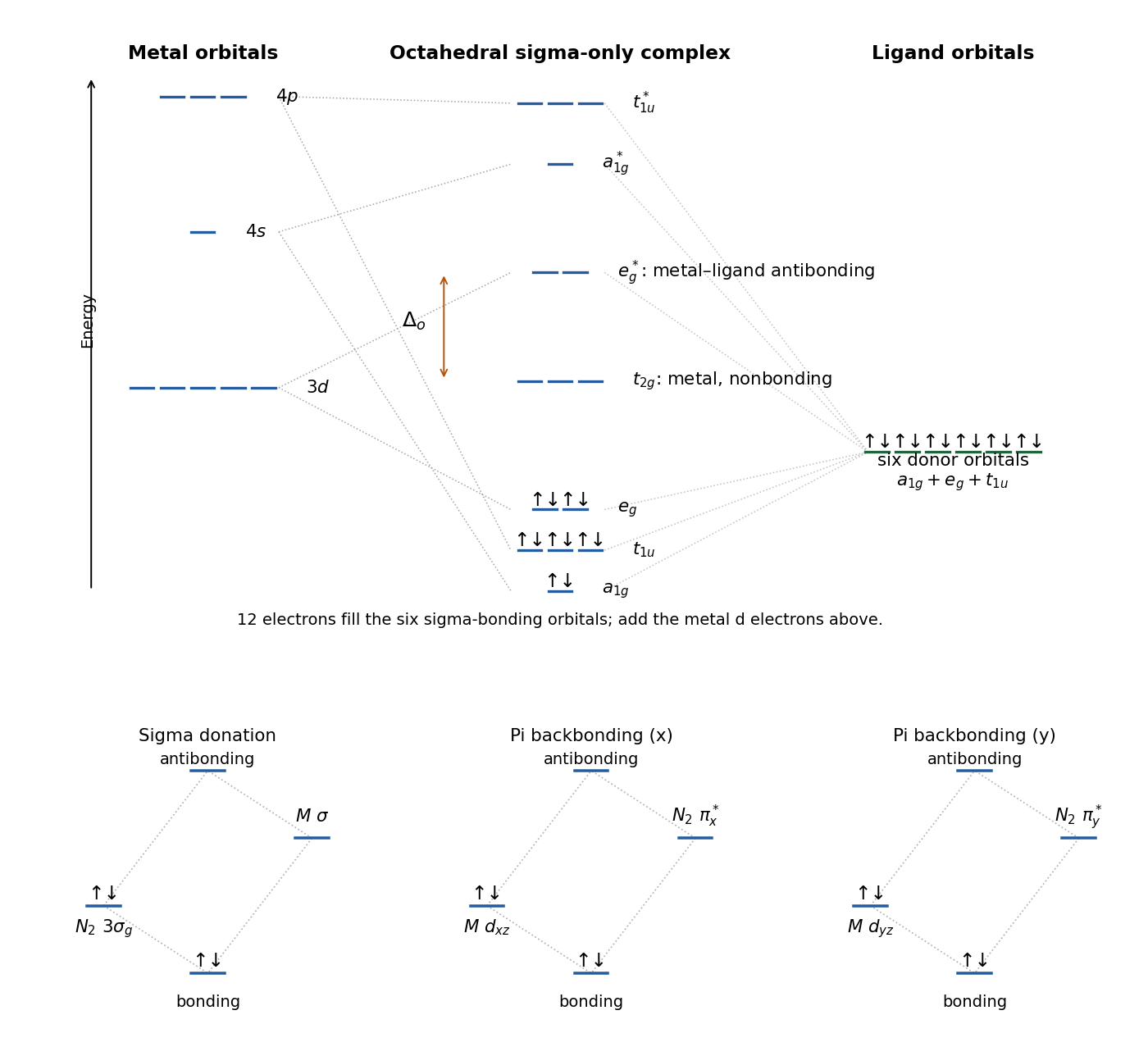
Sigma-only octahedral orbitals and the donation/backbonding channels of end-on dinitrogen
. Details. For the same donor set and approximately the same geometry, . The higher metal charge usually shortens the metal–donor distances and strengthens the interaction that raises . This comparison holds other chemical variables fixed: changing the ligand at the same time could reverse a comparison between two unrelated complexes.
Neutral pyridine contributes no formal charge. If of the two dioxolene ligands are dianions, the combined ligand charge is , so the cobalt oxidation state is . The distinct charge assignments are thereforeInterchanging the two ligand labels in the middle row does not make another charge combination. Co(IV) belongs in this unrestricted charge-balance list even though the subsequent magnetic analysis excludes it.
A Co(III) centre has , and charge balance requires one closed-shell catecholate ligand and one semiquinonate ligand. For low-spin Co(III), , the metal has , giving an independent-spin magnetic moment ofThus contains low-spin Co(III), , with its observed moment residing on the free radical ligand. High-spin Co(III), , would have and give under the stated independent-spin approximation, so it is inconsistent with this measurement.
For Co(II), , charge balance instead requires two semiquinonate ligands. High-spin Co(II) has and , soTherefore contains high-spin Co(II), . Low-spin Co(II), , would give when the two ligand spins are included. These four checks distinguish both oxidation state and metal spin.
The larger octahedral splitting at Co(III) exceeds the effective pairing energy and favours a low-spin complex; the smaller octahedral splitting at Co(II) favours a high-spin complex with occupation of both orbitals before further pairing. Interconversion also transfers an electron between cobalt and a dioxolene ligand, so this is valence tautomerism, rather than a metal-only spin change. Squared moments add here because the supplied model treats the centres as independent; adding the three spins first would be a different, exchange-coupled model.
water lies below pyridine and cyanide ligand in the spectrochemical series. At fixed metal and dioxolene charges, replacement by water decreases and favours the high-spin limits: Co(II) remains ; Co(III) can become if the splitting falls below the pairing threshold. Replacement by cyanide increases and favours Co(III), , and Co(II), . The two unchanged semiquinonate ligands would then give the Co(II) form a combined independent-spin moment of . The ranking predicts the direction of the change; two substituted donors alone do not guarantee a Co(III) spin crossover, since all six donors determine its splitting. A shift of the valence-tautomer equilibrium is also possible and is separate from this fixed-charge comparison.
Treat each semiquinonate ligand as a symmetric O,O chelate, with the free radical delocalized over the dioxolene framework. The ideal octahedral donor-connectivity structures are one trans form and two mirror-related cis forms, giving three stereoisomers. Trans refers to the two pyridine N donors, not to the two O atoms of a chelate, which must remain adjacent.
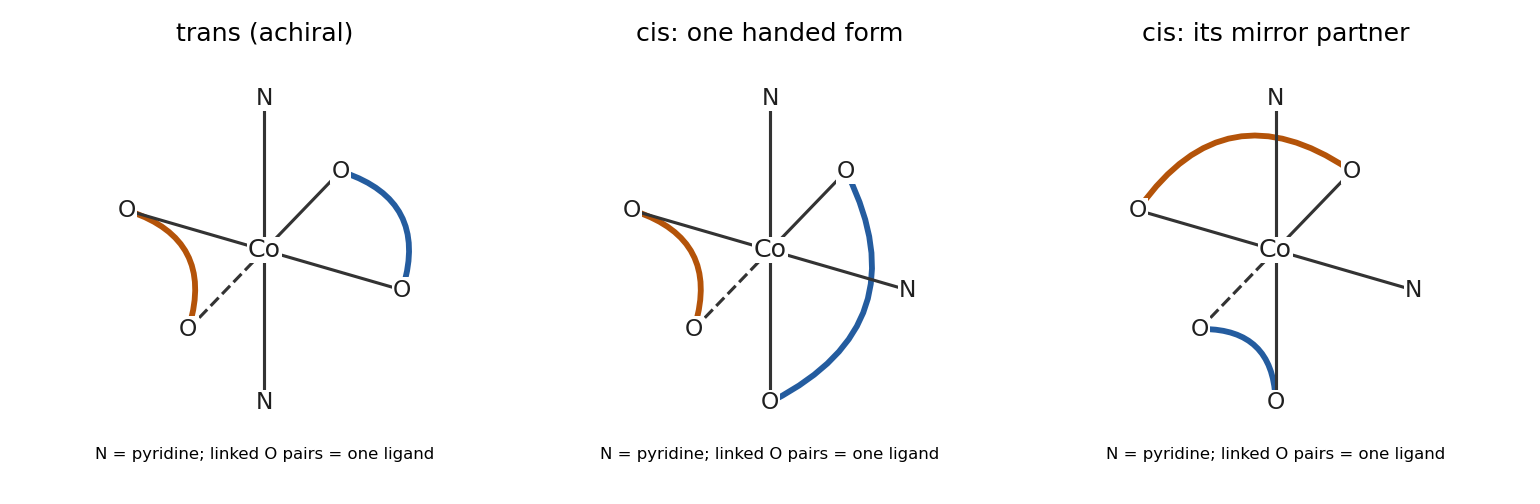
In the diagram, coloured curves join the two O donors belonging to one ligand. For an unambiguous coordinate specification, the trans form has Py at , with chelate pairs and . A cis pair has Py at , with chelates and ; reflecting gives the other cis form. Proper rotations cannot superpose those two cis arrangements. Ring conformations and pyridine rotations are not extra donor-connectivity isomers.
The Co(III) centre in has : every occupied d subset is orbitally balanced. There is no first-order metal-centred Jahn–Teller driving force in . This does not require all six experimental bond lengths to be equal, since pyridine and dioxolene are different donors.
The Co(II) centre in has . Its two orbitals each contain one electron, so that subset gives no first-order preference. The hole does give a weaker Jahn–Teller instability. To compare tetragonal distortions, take a positive small splitting parameter and retain each subset's orbital energy barycentre. On axial elongation let shift by and by . Five electrons then giveFor equal-magnitude compression the shifts reverse, and filling the lower orbital first givesThe two singly occupied orbitals contribute zero net shift in either case. Thus the elementary tetragonal splitting model favours elongation for high-spin , rather than equal electronic stabilization by the two signs. In a strictly sigma-only octahedral molecular orbital model is nonbonding, so this weak effect is absent; it arises when the electrostatic and non-sigma interactions neglected in that diagram are restored. spin-orbit coupling, unequal donors and chelate constraints can modify the actual distortion, so the argument does not establish which experimental Co–donor bonds must lengthen.
Four equivalents of base remove the four carboxylic-acid protons from two ligand molecules, giving two dianionic pyridine-2,5-dicarboxylate linkers per Pt/Mn pair. The ring nitrogen and neighbouring 2-carboxylate supply a five-membered N,O chelate. A consistent chain has Pt(II), NO, with square planar molecular geometry, and Mn(II), O, with octahedral molecular geometry.
At each Pt, two ligands bind through their ring N and one O of the adjacent 2-carboxylate; their remote 5-carboxylates point toward successive Mn sites. At each Mn, a remote carboxylate from each of two neighbouring Pt-containing units binds through both O atoms. Two coordinated water molecules complete Mn's six-coordinate sphere. The repeating connectivity, with each bracket denoting a single organic linker, isEach Pt has a second N,O chelate extending in the opposite chain direction; each Mn similarly receives two carboxylate chelates. The original donor-connectivity diagram makes those counts explicit.
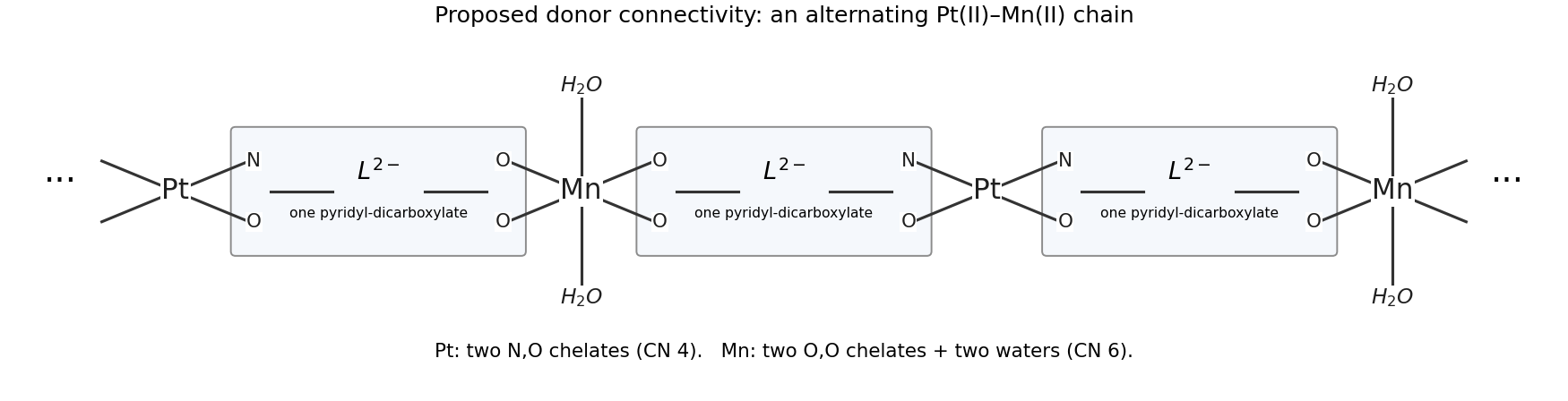


Pt(II) is and strongly favours square planar molecular geometry. Its affinity for the pyridyl N donor and the chelate effect select the mixed N,O pocket. Mn(II) is high-spin , is harder, and favours the carboxylate and water O donors; six-coordinate octahedral molecular geometry is natural in water. Charge balance per repeat is . A suitable repeat formulation is . This is a justified proposed coordination chain, not a unique crystal structure established from stoichiometry alone; water content, carboxylate bridging modes and actual porosity require structural characterization.
Four chloride ligands give Ti(IV), . Ionic electron counting givestetrahedral molecular geometry separates the four donors without placing them at . A centre has no occupied d orbitals providing a square-planar stabilization; the 18-electron rule is not a requirement for this early-metal compound.
Six neutral ammonia donors leave Cu(II), , soThe donor skeleton has octahedral molecular geometry with a pronounced tetragonal Jahn–Teller distortion, normally four shorter equatorial and two longer axial Cu–N distances. The occupation is orbitally degenerate in the ideal octahedral limit. An electron count above 18 is not a contradiction: ammonia is primarily a sigma donor and the occupied metal-derived antibonding levels make this a weak-field coordination complex rather than a low-valent carbonyl closed shell.
Neutral CO ligands require formal Cr(), hence . With five two-electron carbonyl ligands,A trigonal-bipyramidal molecular geometry is expected, analogous in electron count to . Strong pi-acceptor ligands stabilize a low oxidation state through backbonding, and this five-coordinate structure accommodates the closed-shell 18-electron configuration. The negative oxidation state is a formal assignment; it does not mean that a free chromium dianion is trapped inside the molecule.
With oxide charge and four thiocyanates each , gives V(IV), . Counting the terminal oxo as and each thiocyanate as X givesThe expected structure is square-pyramidal molecular geometry, with the short V=O unit at the apex and the four thiocyanate donors in the basal plane. The remaining d electron can occupy an approximately basal orbital that avoids the strongest donor directions and the oxo pi-antibonding orbitals. This is a high-oxidation-state oxovanadium complex; reaching 18 electrons is not its governing stability criterion. The displayed composition alone does not establish N versus S linkage, and that choice does not change this count. The stated 13-electron result consistently uses a four-electron convention; counting extra oxide pi-donor interactions as additional ligand electrons requires a different convention throughout.
In ionic counting, two cyclopentadienyl anions donate electrons. Therefore ferrocene, cobaltocene and nickelocene contain 18, 19 and 20 valence electrons, respectively: Fe(II) is , Co(II) and Ni(II) . ferrocene fills the bonding and approximately nonbonding levels while leaving the next metal–ring antibonding pair empty. cobaltocene and nickelocene add one and two electrons to that antibonding set.
Increasing antibonding occupation lowers the net metal–ring bond order. It therefore explains the simultaneous increase in M–C distance and decrease in dissociation enthalpy from Fe to Co to Ni. The trend does not follow the shrinking size of the isolated metal ions; the orbital occupation is decisive here. The specified enthalpy separates the entire sandwich into a gaseous metal dication and two gaseous ring anions. It measures that complete ionic dissociation process, not ten independent localized M–C bond energies, so dividing it by ten is not a justified bond-energy determination.
Oxidizing cobaltocene removes its antibonding nineteenth electron and gives the particularly favourable 18-electron cobaltocenium cation. iodine can accept the electrons, giving cobaltocenium iodide at the simple stoichiometryEach cobalt changes from Co(II), , to Co(III), ; each iodine atom changes from 0 to . Excess iodine can change the isolated counterion to a polyiodide such as . In contrast, oxidation of 18-electron ferrocene would remove an electron from its occupied closed-shell manifold to form 17-electron ferrocenium. iodine is insufficient to drive that reaction under the conditions implicit here. ferrocene can still be oxidized by suitable stronger oxidants; an electron count is a useful rationale for the comparative redox behaviour, not a universal proof of a numerical electrode potential.
The anionic nitrogen donor replaces iodide to giveHere Cp denotes cyclopentadienyl and specifies attachment through the ring nitrogen of the pyrrolyl anion, . Fe(II), , receives six electrons from Cp, four from the two CO ligands and two from an N-bound pyrrolyl ligand: .
Two coupled CO stretching modes, approximately symmetric and antisymmetric combinations, account for the two strong carbonyl-region absorptions. The bent two-CO arrangement of this piano-stool complex permits both combinations to be infrared active. They are not evidence for two different chemical products.
Heating expels two CO molecules and changes the binding of the pyrrolyl ligand from to , giving the sandwich azaferrocene,The four electrons lost with CO are replaced by the four additional electrons donated on changing the hapticity of the pyrrolyl ligand. Thus is also Fe(II), , and 18-electron: . Each complex has one time-averaged Cp proton environment, two pairs of protons from the pyrrolyl ligand, one adjacent to N and one farther from N. Hence three proton environments, with integrals , fit both structures. For proton nuclear magnetic resonance, three signals means three chemical shift environments; the individual resonances can still show coupling.
Choose along M–N–N. The occupied dinitrogen orbital, with amplitude on the terminal N atoms, overlaps an empty metal orbital of sigma symmetry to give N-to-metal sigma donation. Filled metal and orbitals separately overlap the two empty N orbitals, giving metal-to-N pi backbonding. The lower-energy combination of each interacting pair is bonding and the higher is antibonding; each donation channel starts with two electrons in the occupied fragment orbital. The lower panel of the original orbital diagram shows these three channels.
As for a terminal carbonyl ligand, the donor and acceptor interactions reinforce one another: sigma donation helps make electron density available at the metal, while pi backbonding strengthens M–N and weakens N–N. For conventional electron counting an intact end-on neutral N ligand is an L-type two-electron donor; counting the backbonded electrons a second time as extra donated ligand electrons would double count them.
Both coordinated frequencies are substantially lower than that of free N. In a local harmonic model,Thus coordination lowers the approximate N–N stretching force constant by about 27%, with B marginally more activated than A by this measure. Donation into N pi-antibonding orbitals provides the natural explanation: the M–N bond has an important backbonding component and N–N loses some multiple-bond character.
The same qualitative red shift occurs for CO when metal-to-CO backbonding populates CO orbitals. N is generally a poorer pi acceptor than CO, so low-valent electron-rich metal fragments are particularly helpful for stabilizing its complexes. A numerical claim that N always shifts more or less than CO would require a matched metal/ligand comparison. Neither the two frequencies nor the local-force approximation establish integer N–N bond orders, complete N–N cleavage, or catalytic nitrogen conversion; they establish significant weakening of intact coordinated N.
Use ionic electron counting, counting each ordinary donor atom once and keeping ligand charge distinct from denticity. A is 16-electron, B is 14-electron and C is 16-electron, so none is an 18-electron complex under this convention.
A contains a modified, monoanionic PNP pincer: the exocyclic double bond and altered pyridine-ring bond pattern in the drawing matter. Its two phosphines and its central N donor provide six electrons altogether, while neutral N provides two. Neutrality then gives Co(I), , and . Treating the modified pincer as a neutral intact pyridine ligand would incorrectly produce Co(0) and a 17-electron count. A four-coordinate approximately square planar molecular geometry in a complex can leave the strongly sigma-antibonding orbital empty and be stable at 16 electrons. The underlying modified-pincer chemistry has been examined using structure, spectroscopy and electronic-structure calculations.[ref]
Four-Coordinate Cobalt Pincer Complexes: Electronic Structure Studies and Ligand Modification by Homolytic and Heterolytic Pathways by Scott P. Semproni and others. JACS 136, 9211–9224; modified PNP framework and dinitrogen derivative
B has a neutral tertiary amine donor at the centre of its tripod and three anionic amido arms. Their combined charge is , so Re is Re(III), . The four N donors give eight electrons and N gives two: . Such an electron count is not inherently unexpected in an amido-supported complex: strong amido pi donation and the imposed five-coordinate geometry alter the orbital energies, and the empty orbitals are not nine equivalent slots that must all be filled. Steric protection and chelation also help stabilize this coordinatively restricted structure. The 14-electron figure uses the usual two-electron ionic count for each amido donor; pi bonding should not be appended to it inconsistently.
C has an anionic acyl carbon donor and a neutral phosphine in the chelate, together with two neutral PMe donors. Thus Co(I), , receives ligand electrons, giving . This is again a reasonable four-coordinate structure. The acyl C=O is part of a carbon-bound acyl ligand, not an additional free CO donor.
Step 1 is oxidative addition of Si–H to Co(I), giving Co(III)–H and Co(III)–SiR. It cleaves the Si–H bond and forms two metal–ligand bonds, increasing the formal metal oxidation state by two. The phosphine dissociation shown before this numbered step makes room for the reaction; alkene binding and phosphine exchange are ligand-substitution events rather than oxidative additions.
Step 2 is migratory insertion of the coordinated alkene into Co–H, equivalently intramolecular hydride migration to the alkene. One alkene carbon gains H and the other gains the Co–C bond. Co remains formally Co(III); a two-electron alkene ligand plus a hydride is replaced by one alkyl ligand, reducing the electron count by two before phosphine reassociation.
Step 3 is C–Si reductive elimination between the alkyl and silyl ligands. It releases the hydrosilylated alkane and regenerates Co(I). The electron count for the drawn sequence is consistent: the one-PMe alkene adduct is 16-electron; oxidative addition gives 18; insertion gives 16; PMe association gives 18; reductive elimination returns the 16-electron catalyst. Because insertion occurs into Co–H, this is the conventional Chalk-Harrod mechanism.
oxidative addition of an intact Si–H bond initially places H and SiR cis in the metal coordination sphere; this is the local arrangement generated by addition of a sigma bond. hydride and alkene must also attain adjacent sites for intramolecular insertion, and the eventual alkyl and silyl groups must be cis for direct reductive elimination. Subsequent rearrangements should not be confused with the stereochemistry of the bond-addition event itself.
For an alkyl-substituted terminal alkene, insertion puts Co on the terminal carbon and H on the substituted carbon, producing . It avoids the more crowded secondary metal–alkyl arrangement. Replacement of that Co–C bond by C–Si therefore gives the linear product , an Anti-Markovnikov addition outcome. Hydrometallation is syn at the coordinated alkene, although this simple terminal substrate generally does not retain two substituents whose relative stereochemistry could diagnose the complete sequence.
The opposite insertion orientation gives a benzylic metal–carbon bond, . C–Si reductive elimination then gives the branched productA plausible explanation is stabilization of the developing and final benzylic Co–C interaction by the adjacent aromatic pi system, which can outweigh the steric preference for a primary alkyl. That makes an electronically different choice from an ordinary alkyl substituent. This is a mechanistic rationale for the proposed cycle, not proof of its rate-determining step. In the absence of a chiral catalyst or another source of asymmetric induction, the new stereogenic carbon would give a racemic mixture.
P is a tetrahedron of four phosphorus atoms, with a P–P bond along every edge. Each P has three P–P sigma bonds and one lone pair. The P–P–P angles are , so these are strained, bent bonds rather than four independent tetrahedral electron-pair arrangements with ideal bond angles. This molecular unit is characteristic of white phosphorus.
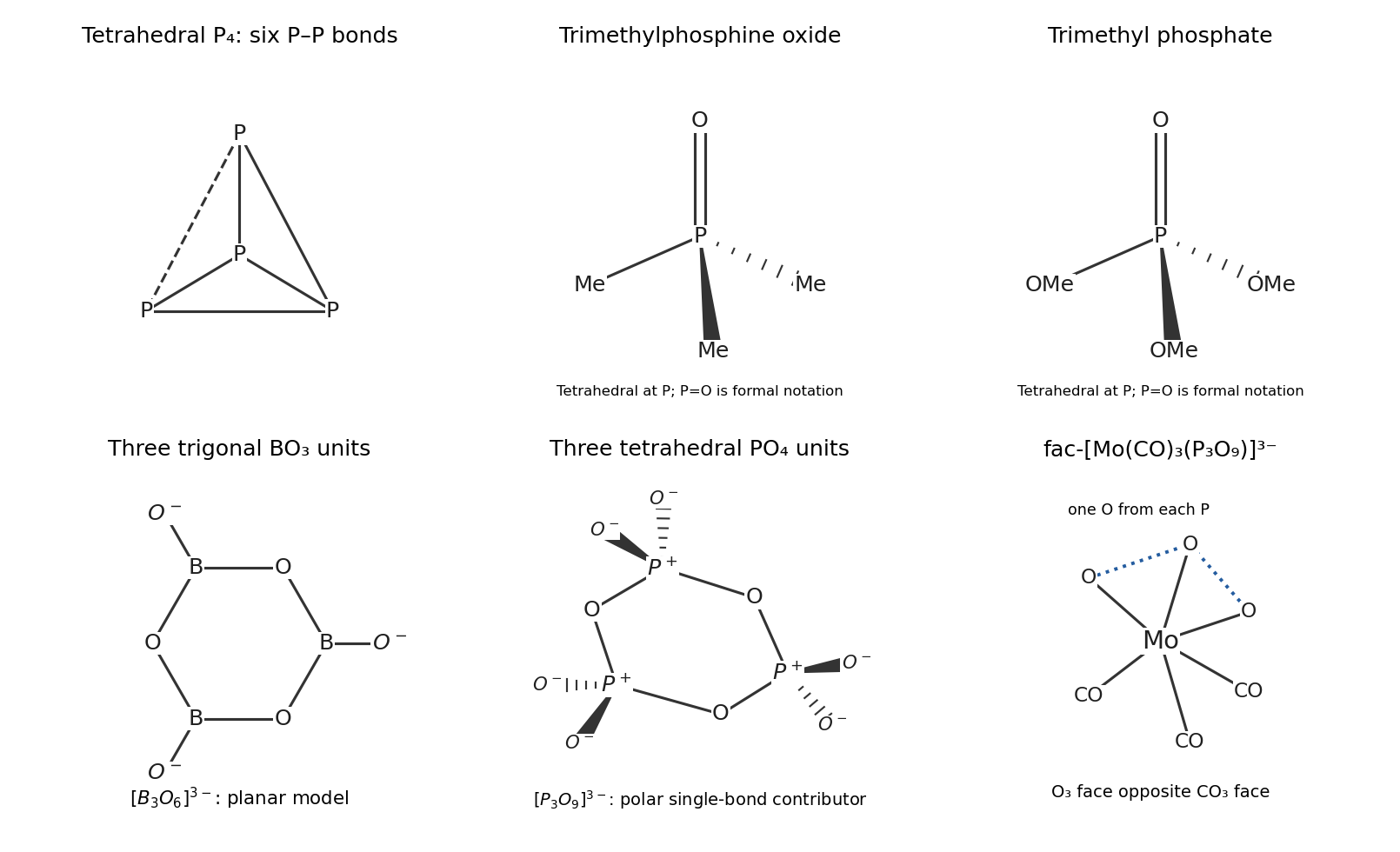
Original structures of P4, the two phosphoryl compounds, cyclic triborate and trimetaphosphate
. Details. 
The phosphorus centre is approximately tetrahedral, with three P–C sigma bonds and one short terminal P–O bond. Both and are useful Lewis contributors; the bond is strongly polar and has additional multiple-bond character. oxygen lone-pair donation into suitable P–C antibonding combinations provides a description of the additional stabilization without requiring a substantial localized phosphorus-3d/oxygen-2p pi bond. A combined diffraction and orbital study illustrates this sigma-bond/negative-hyperconjugation description.[ref]
Computational and experimental approaches to the molecular structure of the HCl adduct of Me3PO by Andreas Orthaber and others. §3.2 and Fig. 2a–c, orbital analysis of free Me3PO
Compared with the phosphate triester, this compound's methyl substituents are less electron withdrawing. The comparison of the two terminal P–O stretching force constants and the appropriate experimental control is given with the triester below.
also has approximately tetrahedral molecular geometry at phosphorus, now with three P–O–C sigma linkages and a terminal phosphoryl O. Only the latter is being compared with the terminal O of MePO; the three P–O–C bonds are chemically distinct.
The electronegative alkoxy substituents withdraw electron density from P and improve its capacity to accept donation from terminal O into the surrounding antibonding framework. The elementary substituent argument therefore predicts a stronger, stiffer terminal P–O bond in than in . A description invoking polar bonding and negative hyperconjugation avoids assigning a literal localized d-orbital double bond solely because the formula is written P=O.
Measure the terminal P–O stretching vibration by infrared or Raman spectroscopy under comparable, non-hydrogen-bonding conditions. In an approximate local-mode comparison the reduced mass is the same, so a larger terminal stretching wavenumber indicates a larger force constant, . Mode assignment can be checked by O substitution at the terminal oxygen or by a normal-mode calculation; otherwise an alkoxy P–O–C vibration could be compared by mistake. X-ray diffraction can supply a supporting bond-length comparison, but neither bond length nor a single coupled vibrational frequency directly measures an isolated bond-dissociation enthalpy.
The larger value for the carbonyl bond means that its dissociation costs more for the supplied comparison. A carbonyl combines a strong sigma bond with efficient pi overlap between spatially compatible C 2p and O 2p orbitals. This gives a substantial localized multiple-bond contribution.
The short P–O linkage in a phosphine oxide is also strong, but it is more polar, with a substantial contribution. P 3p and O 2p orbitals have less favourable radial and energy matching than C 2p/O 2p for a simple localized pi bond. oxygen donation into P–R antibonding orbitals adds stabilization, but it is not identical to the carbonyl pi bond. Therefore the formal double-bond notation does not imply equal bond strength. A substantial P-3d contribution is not needed to explain the bonding. The stated bond-dissociation values compare complete dissociation processes, so their magnitudes should not be derived solely from one overlap integral or from the two atoms' electronegativity difference.
Join three trigonal BO units corner to corner. The resulting alternating six-membered B–O ring has one terminal oxygen on each boron:The superscript records the total charge; the three explicit O labels each carry one share of it. Atom counting gives three B, three bridging O and three terminal O. Boron is three-coordinate and approximately trigonal planar. The original structure diagram shows the ring connectivity and terminal atoms.
A planar arrangement permits the perpendicular empty boron p orbitals to accept pi donation from suitable oxygen lone pairs. The terminal oxygens can donate effectively toward one boron, giving their B–O linkages more multiple-bond character and explaining why they are shorter than bridging B–O linkages. A bridging oxygen shares its interactions between two boron centres. An approximately planar ring is therefore expected from the trigonal units and favourable orbital alignment. This reasoning does not require describing the entire anion as benzene-like with an assumed six-electron aromatic ring; the oxygen lone pairs and terminal donations must actually be counted before making an aromaticity claim.
Three PO tetrahedra share corners in a ring. Each phosphorus has two ring-bridging oxygens and two terminal oxygens, sois one conventional Lewis representation of trimetaphosphate. Its three P and nine O atoms consist of three bridging and six terminal O atoms. Within each phosphate unit the two terminal bonds have delocalized character; drawing one P=O and one P–O is not a claim that every free anion has permanently different terminal oxygens.
A puckered six-membered P–O ring is expected. The tetrahedral phosphorus geometry and P–O–P torsional preferences allow folding without losing a required continuous perpendicular-p orbital system. This differs from the planar trigonal-boron arrangement. Tetrahedral P alone is not a geometrical proof of nonplanarity, since its two ring bonds could lie in a plane; the argument is that puckering is energetically accessible and relieves conformational strain without sacrificing a strong planar pi-conjugation benefit. The precise chair-like or boat-like distortion depends on environment and counterions.
A reasonable product is sodium facial trimetaphosphate–molybdenum tricarbonyl, with the anionOne terminal O from each phosphorus binds Mo; the three O donors occupy one octahedral face, while the three carbonyls occupy the opposite face. The ring bridges remain P–O–P bridges and are not replaced by Mo–P bonds. Mo remains Mo(0), , and electrons. Overall,acetonitrile can transiently replace CO during heating, but it is not required in the final six-coordinate proposal. The same anion has been structurally characterized with a different counterion: that primary study independently supports the facial O/CO connectivity, without establishing identical solubility or yield for the sodium salt.[ref]
Synthesis and characterization of the trimetaphosphate molybdenum tricarbonyl anion [(P3O9)Mo(CO)3]3- as its tris(bis(triphenylphosphine)iminium) salt by Christopher R. Clough and others. pp. 195–196, Scheme 2 and Fig. 1; §4.3 for Mo(CO)6 in refluxing acetonitrile
Label the carbon next to the carbonyl and the OH-bearing carbon . The three limiting routes are E1, E1cb and E2 elimination. They differ in whether C–O cleavage, C–H cleavage, or both occur in the first elementary event. In the following original transition-state structures, dotted lines denote changing bonds, marks developing partial charge, and the bracketed structures carry . Unmarked skeletal bonds remain present. The dotted line parallel to C–C denotes the developing pi bond, in addition to its existing sigma bond.
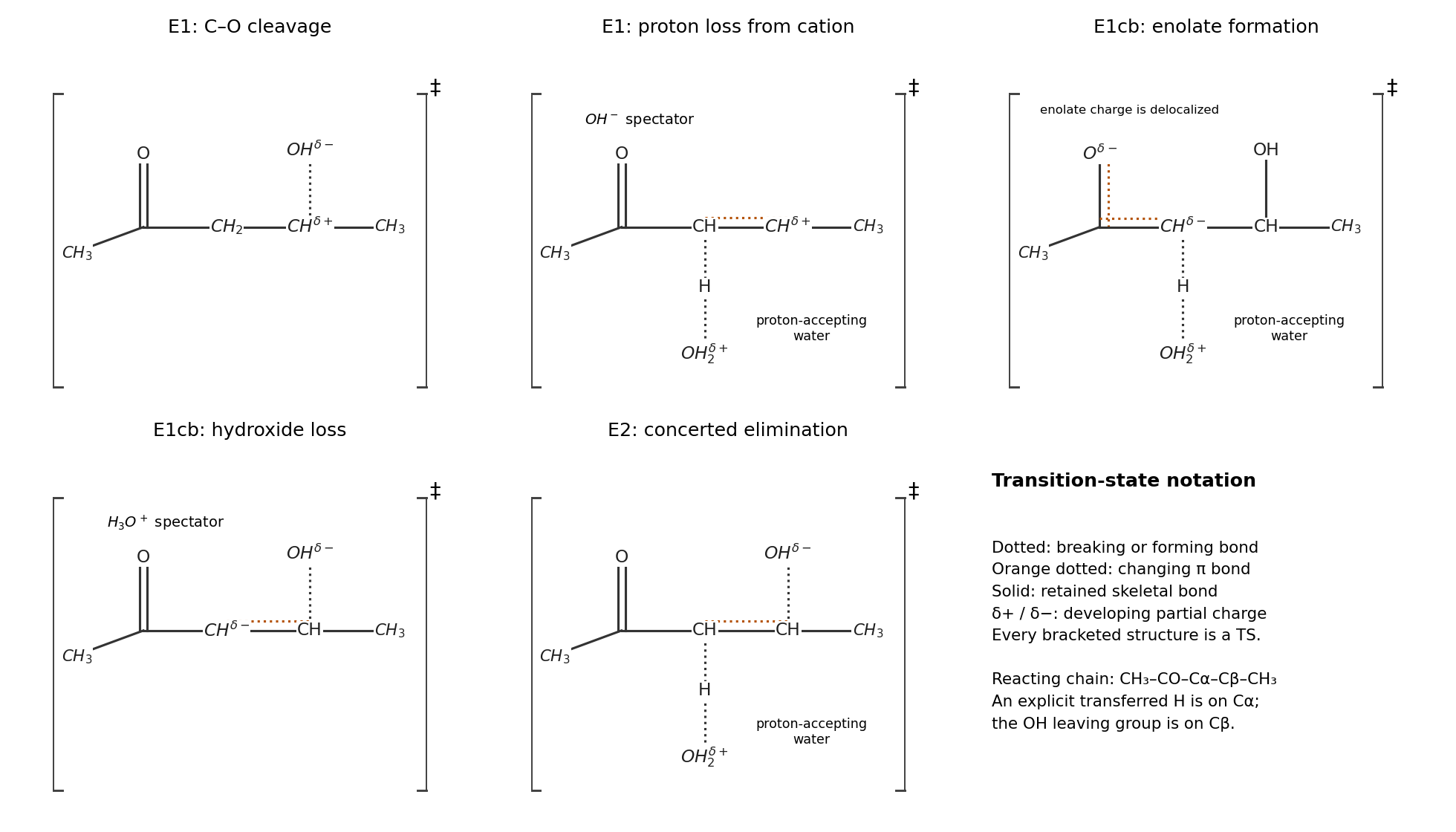
The five transition states in E1, E1cb and concerted E2 limiting elimination pathways
. Details. 
For E1, C–OH heterolysis occurs first. The electron pair in that bond goes to O, producing . Its first transition state has a partly broken C–O bond, developing positive charge on C and negative charge on the leaving O. Next, water uses a lone pair to remove the alpha proton; the C–H electron pair forms the C=C pi bond. This second transition state has partly broken C–H, partly formed water-O–H, and a partly formed C–C pi bond. Positive charge is transferred from the organic cation toward the incoming water/hydronium unit. hydroxide from the first step is a spectator in the second.
For E1cb, water first removes the alpha proton to form a resonance-stabilized enolate plus hydronium:The first transition state has partly broken C–H and partly formed O–H, with developing negative charge delocalized over the alpha-carbon/carbonyl-oxygen system and positive charge on the proton-accepting water unit. The enolate then expels hydroxide: use the carbon-centred contributor to send its alpha-carbon lone pair into C–C, while the C–O pair goes to oxygen. This second transition state has a partly formed alkene pi bond and partly broken C–O, with negative charge moving from the enolate framework onto the departing hydroxide. hydronium is a spectator in this second step.
For E2, water removes the alpha proton as hydroxide leaves in the same elementary step. Three electron-pair movements are simultaneous: water lone pair to H, C–H to the C–C pi bond, and C–O to O. Its single transition state therefore contains all three changing bonds: C–H, water-O–H and C–O, together with the developing pi bond. The departing O becomes negative, the proton-accepting water unit becomes positive, and partial charge at carbon depends on the synchrony of proton loss and leaving-group departure. The reacting conformation should align C–H and C–O approximately in an antiperiplanar conformation for efficient elimination.
These are formal limiting pathways for the displayed net process, not three claims of equal reaction rates in neutral water. In particular, unassisted loss of OH to a secondary carbocation is strongly disfavoured, and water is a weak base for making an enolate. The enolate pathway benefits from resonance stabilization and the final product is a conjugated enone, but actual rate and dominant pathway depend on chemical conditions. The displayed hydroxide and hydronium also rapidly neutralize each other; retaining them separately here tracks which bond cleavage supplied each species. No biological catalysis is needed to describe these chemical mechanisms.
TODO — user-deferred biology. This part is deferred at all four labelled sites (1–4), under the instruction to skip biological subquestions. No biological answer has been researched or supplied.
Articles by others on the same topic
There are currently no matching articles.