Choose along M–N–N. The occupied dinitrogen orbital, with amplitude on the terminal N atoms, overlaps an empty metal orbital of sigma symmetry to give N-to-metal sigma donation. Filled metal and orbitals separately overlap the two empty N orbitals, giving metal-to-N pi backbonding. The lower-energy combination of each interacting pair is bonding and the higher is antibonding; each donation channel starts with two electrons in the occupied fragment orbital. The lower panel of the original orbital diagram shows these three channels.
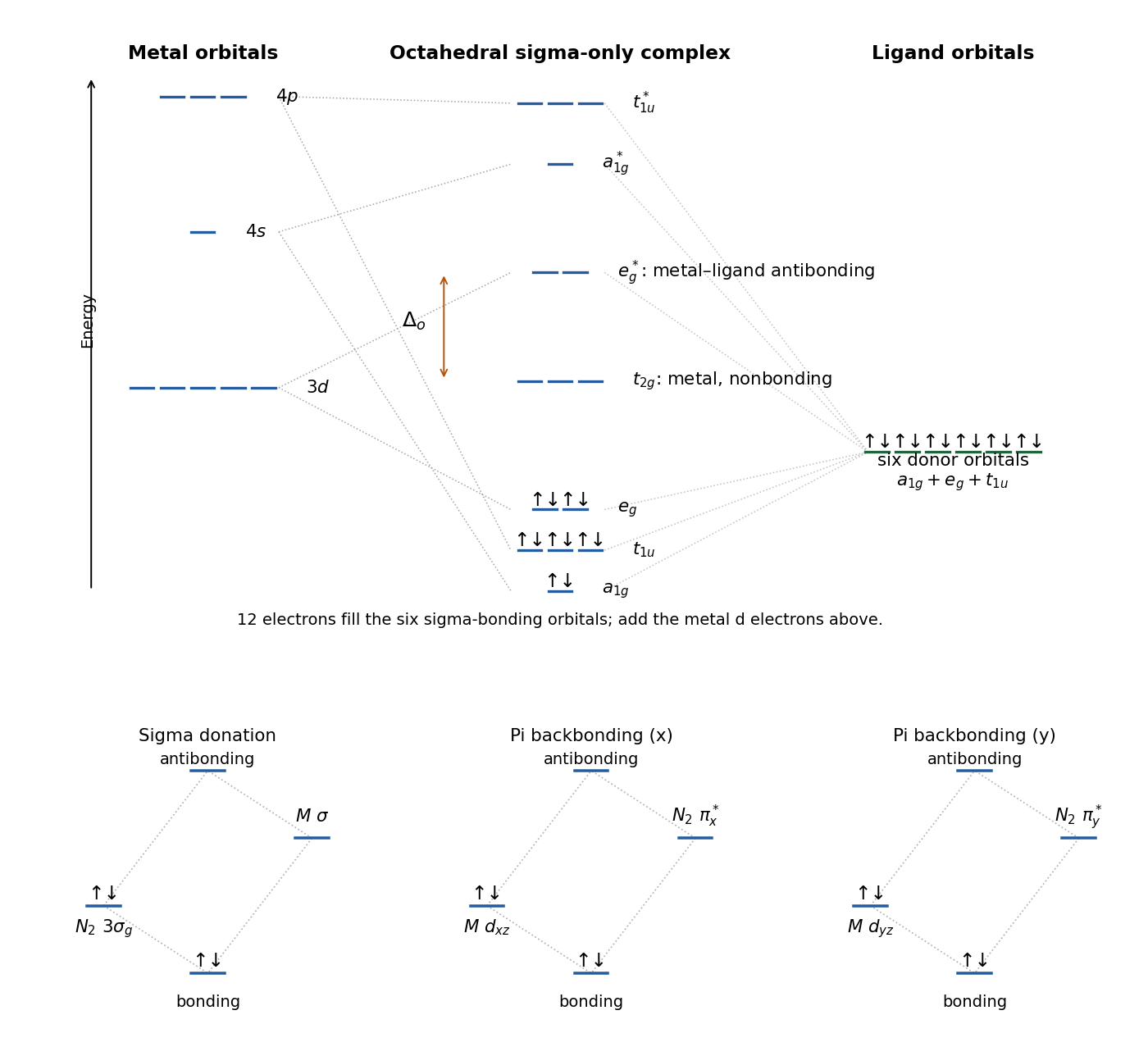

As for a terminal carbonyl ligand, the donor and acceptor interactions reinforce one another: sigma donation helps make electron density available at the metal, while pi backbonding strengthens M–N and weakens N–N. For conventional electron counting an intact end-on neutral N ligand is an L-type two-electron donor; counting the backbonded electrons a second time as extra donated ligand electrons would double count them.
Both coordinated frequencies are substantially lower than that of free N. In a local harmonic model,Thus coordination lowers the approximate N–N stretching force constant by about 27%, with B marginally more activated than A by this measure. Donation into N pi-antibonding orbitals provides the natural explanation: the M–N bond has an important backbonding component and N–N loses some multiple-bond character.
The same qualitative red shift occurs for CO when metal-to-CO backbonding populates CO orbitals. N is generally a poorer pi acceptor than CO, so low-valent electron-rich metal fragments are particularly helpful for stabilizing its complexes. A numerical claim that N always shifts more or less than CO would require a matched metal/ligand comparison. Neither the two frequencies nor the local-force approximation establish integer N–N bond orders, complete N–N cleavage, or catalytic nitrogen conversion; they establish significant weakening of intact coordinated N.
Use ionic electron counting, counting each ordinary donor atom once and keeping ligand charge distinct from denticity. A is 16-electron, B is 14-electron and C is 16-electron, so none is an 18-electron complex under this convention.
A contains a modified, monoanionic PNP pincer: the exocyclic double bond and altered pyridine-ring bond pattern in the drawing matter. Its two phosphines and its central N donor provide six electrons altogether, while neutral N provides two. Neutrality then gives Co(I), , and . Treating the modified pincer as a neutral intact pyridine ligand would incorrectly produce Co(0) and a 17-electron count. A four-coordinate approximately square planar molecular geometry in a complex can leave the strongly sigma-antibonding orbital empty and be stable at 16 electrons. The underlying modified-pincer chemistry has been examined using structure, spectroscopy and electronic-structure calculations.[ref]
Four-Coordinate Cobalt Pincer Complexes: Electronic Structure Studies and Ligand Modification by Homolytic and Heterolytic Pathways by Scott P. Semproni and others. JACS 136, 9211–9224; modified PNP framework and dinitrogen derivative
B has a neutral tertiary amine donor at the centre of its tripod and three anionic amido arms. Their combined charge is , so Re is Re(III), . The four N donors give eight electrons and N gives two: . Such an electron count is not inherently unexpected in an amido-supported complex: strong amido pi donation and the imposed five-coordinate geometry alter the orbital energies, and the empty orbitals are not nine equivalent slots that must all be filled. Steric protection and chelation also help stabilize this coordinatively restricted structure. The 14-electron figure uses the usual two-electron ionic count for each amido donor; pi bonding should not be appended to it inconsistently.
C has an anionic acyl carbon donor and a neutral phosphine in the chelate, together with two neutral PMe donors. Thus Co(I), , receives ligand electrons, giving . This is again a reasonable four-coordinate structure. The acyl C=O is part of a carbon-bound acyl ligand, not an additional free CO donor.
Step 1 is oxidative addition of Si–H to Co(I), giving Co(III)–H and Co(III)–SiR. It cleaves the Si–H bond and forms two metal–ligand bonds, increasing the formal metal oxidation state by two. The phosphine dissociation shown before this numbered step makes room for the reaction; alkene binding and phosphine exchange are ligand-substitution events rather than oxidative additions.
Step 2 is migratory insertion of the coordinated alkene into Co–H, equivalently intramolecular hydride migration to the alkene. One alkene carbon gains H and the other gains the Co–C bond. Co remains formally Co(III); a two-electron alkene ligand plus a hydride is replaced by one alkyl ligand, reducing the electron count by two before phosphine reassociation.
Step 3 is C–Si reductive elimination between the alkyl and silyl ligands. It releases the hydrosilylated alkane and regenerates Co(I). The electron count for the drawn sequence is consistent: the one-PMe alkene adduct is 16-electron; oxidative addition gives 18; insertion gives 16; PMe association gives 18; reductive elimination returns the 16-electron catalyst. Because insertion occurs into Co–H, this is the conventional Chalk-Harrod mechanism.
oxidative addition of an intact Si–H bond initially places H and SiR cis in the metal coordination sphere; this is the local arrangement generated by addition of a sigma bond. hydride and alkene must also attain adjacent sites for intramolecular insertion, and the eventual alkyl and silyl groups must be cis for direct reductive elimination. Subsequent rearrangements should not be confused with the stereochemistry of the bond-addition event itself.
For an alkyl-substituted terminal alkene, insertion puts Co on the terminal carbon and H on the substituted carbon, producing . It avoids the more crowded secondary metal–alkyl arrangement. Replacement of that Co–C bond by C–Si therefore gives the linear product , an Anti-Markovnikov addition outcome. Hydrometallation is syn at the coordinated alkene, although this simple terminal substrate generally does not retain two substituents whose relative stereochemistry could diagnose the complete sequence.
The opposite insertion orientation gives a benzylic metal–carbon bond, . C–Si reductive elimination then gives the branched productA plausible explanation is stabilization of the developing and final benzylic Co–C interaction by the adjacent aromatic pi system, which can outweigh the steric preference for a primary alkyl. That makes an electronically different choice from an ordinary alkyl substituent. This is a mechanistic rationale for the proposed cycle, not proof of its rate-determining step. In the absence of a chiral catalyst or another source of asymmetric induction, the new stereogenic carbon would give a racemic mixture.
Articles by others on the same topic
There are currently no matching articles.