The depicted trans-fused is chiral; cis-fused is achiral as a configurational species. The unsaturated ring makes the two sides of the fused system constitutionally different. At the trans junctions of , the mirror image cannot be superposed by a proper rotation; there is no surviving mirror plane or inversion center that exchanges the two distinct rings correctly. A twofold rotational relationship is compatible with chirality and does not remove it. This is why simply importing the chirality conclusion for fully saturated trans-decalin would be unsafe.
For , interchange of the two junction ends relates the opposite local stereochemical senses. An individual folded cis conformer may look chiral, but ring inversion interconverts its mirror-related conformations without changing junction configuration. The configurations therefore describe a meso/achiral species rather than a persistent enantiomeric pair. The conformational sketches below distinguish the rigid trans arrangement from the two accessible cis folds; the alkene ring is represented schematically as a half-chair-like unit.
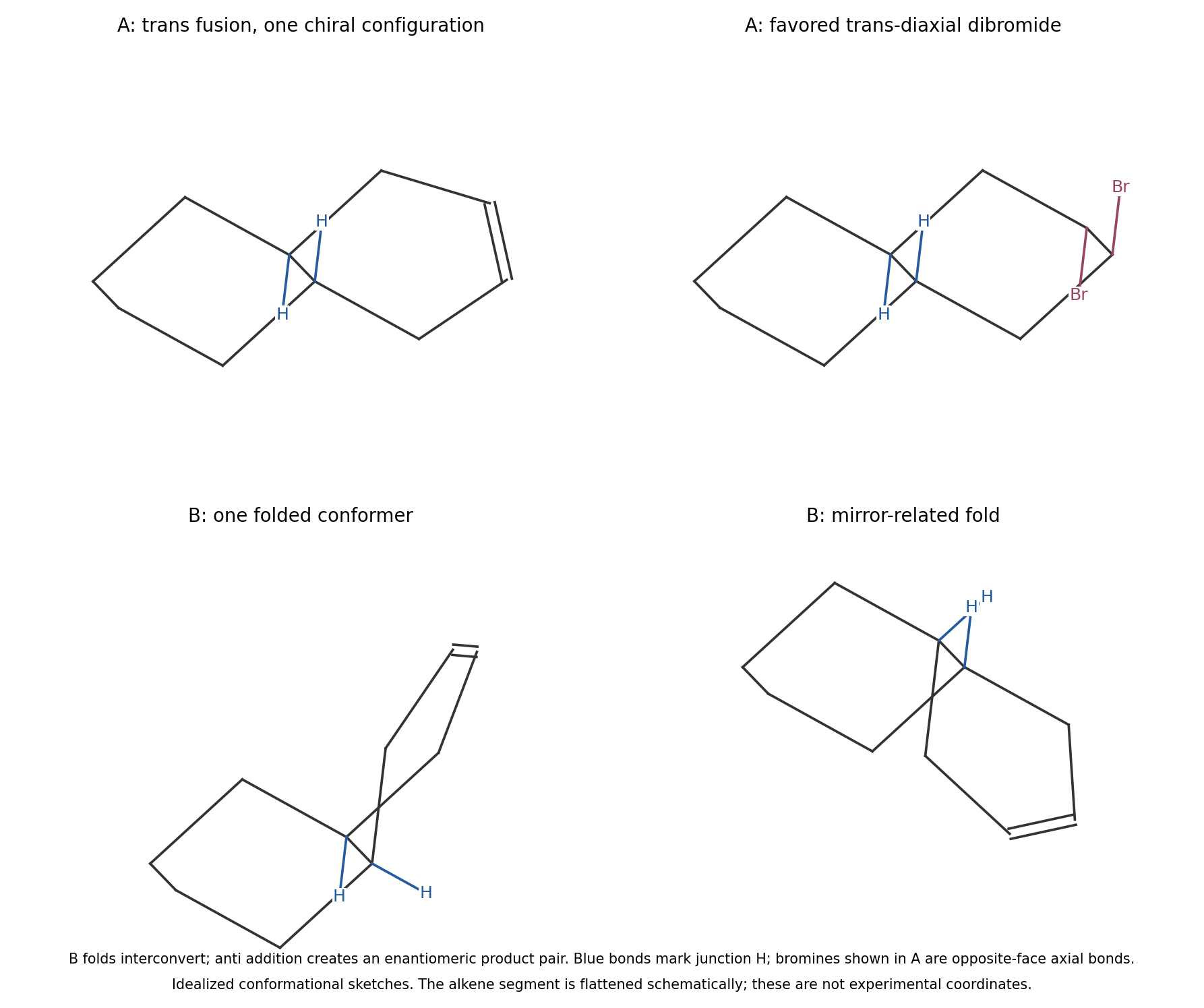
Fused-ring conformations and the stereochemical consequences of anti bromination
. Details. 
Articles by others on the same topic
There are currently no matching articles.