The depicted trans-fused is chiral; cis-fused is achiral as a configurational species. The unsaturated ring makes the two sides of the fused system constitutionally different. At the trans junctions of , the mirror image cannot be superposed by a proper rotation; there is no surviving mirror plane or inversion center that exchanges the two distinct rings correctly. A twofold rotational relationship is compatible with chirality and does not remove it. This is why simply importing the chirality conclusion for fully saturated trans-decalin would be unsafe.
For , interchange of the two junction ends relates the opposite local stereochemical senses. An individual folded cis conformer may look chiral, but ring inversion interconverts its mirror-related conformations without changing junction configuration. The configurations therefore describe a meso/achiral species rather than a persistent enantiomeric pair. The conformational sketches below distinguish the rigid trans arrangement from the two accessible cis folds; the alkene ring is represented schematically as a half-chair-like unit.
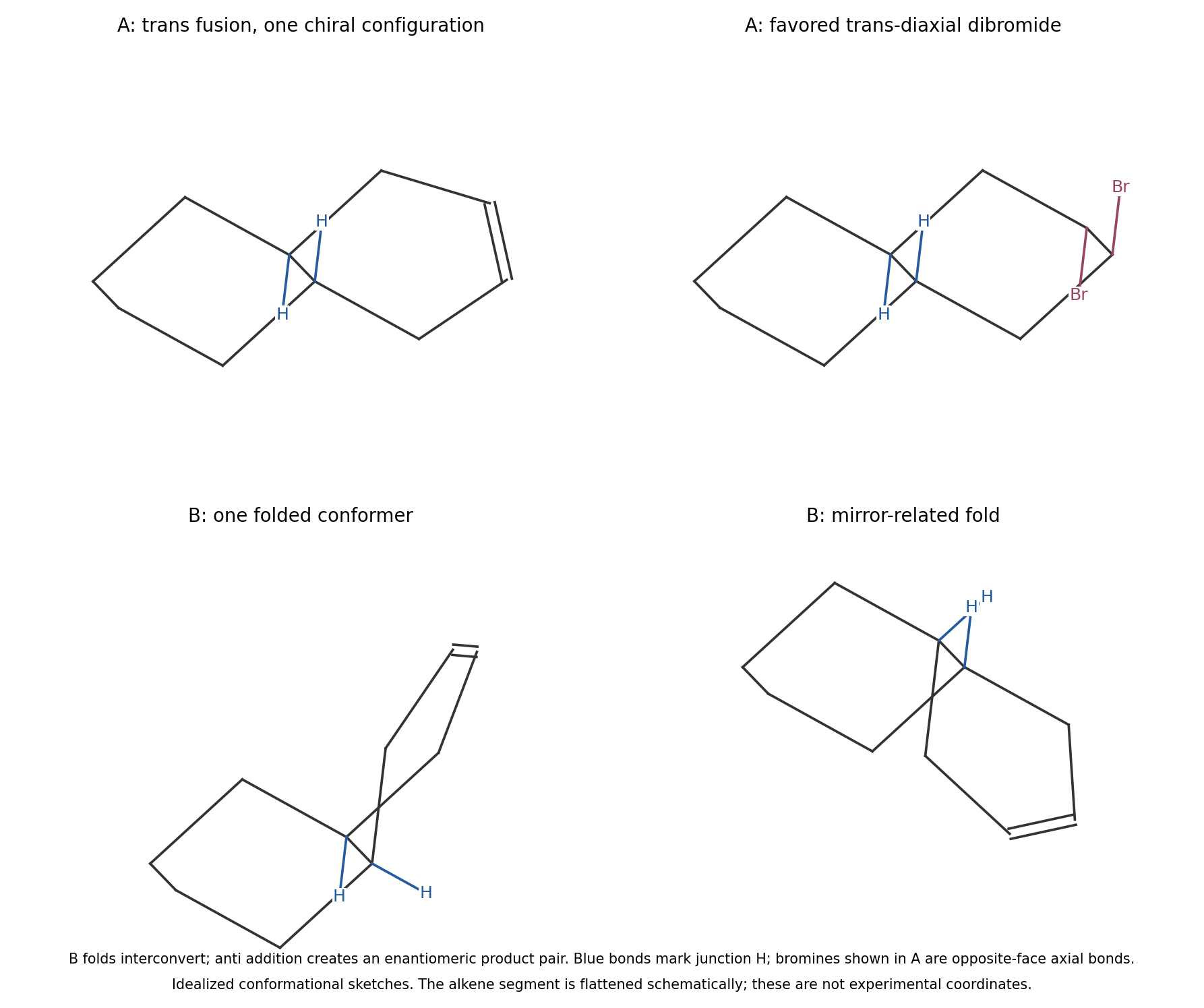
Fused-ring conformations and the stereochemical consequences of anti bromination
. Details. For both substrates, the alkene pi bond attacks bromine and polarizes/breaks Br–Br. A bromine lone pair completes a three-membered bromonium ion, and bromide subsequently attacks a carbon from the opposite face, cleaving that C–Br bridge bond. The two new C–Br bonds are anti. A free carbocation that rotates before capture is not needed.
In trans-fused , the fixed conformation makes the alternative anti-opening pathways diastereomeric. A chair-like, trans-diaxial opening is favored over a geometrically strained alternative that requires a twist/boat-like arrangement of the six-membered ring. The Fürst-Plattner rule describes this conformational preference. One depicted enantiomer of therefore gives essentially one dibromide diastereomer, with the two bromines occupying the trans-diaxial arrangement in its favored chair. If a racemic sample of were used, its other enantiomer would of course give the mirror product as well.
For cis-fused , the accessible mirror-related folds and the equivalent anti pathways produce mirror-related dibromides with equal rates in an achiral environment. Adding the two bromines destroys the symmetry that made the starting configuration achiral. gives a racemic dibromide pair. The racemate follows from equivalent enantiomer-forming pathways, not from a loss of anti stereospecificity.
Number the dioxane O1–C2–O3–C4–C5–C6, with methyl at C2 and tert-butyl at C5. Their cis relationship is maintained on ring inversion, but because they occupy opposite ring positions, one is axial and the other equatorial in either chair. The two alternatives are C2–Me equatorial/C5–tert-butyl axial, and C2–Me axial/C5–tert-butyl equatorial.
The key signal is U, the C5 methine, with only small vicinal couplings, 3.7 and 1.3 Hz. An axial H5 would have large trans-diaxial couplings to axial hydrogens on C4 and C6. Their absence identifies H5 as equatorial, hence the preferred conformer has axial tert-butyl and equatorial methyl. It is not sufficient to guess from tert-butyl bulk. The tert-butyl singlet itself supplies no vicinal H–H coupling information about its orientation.
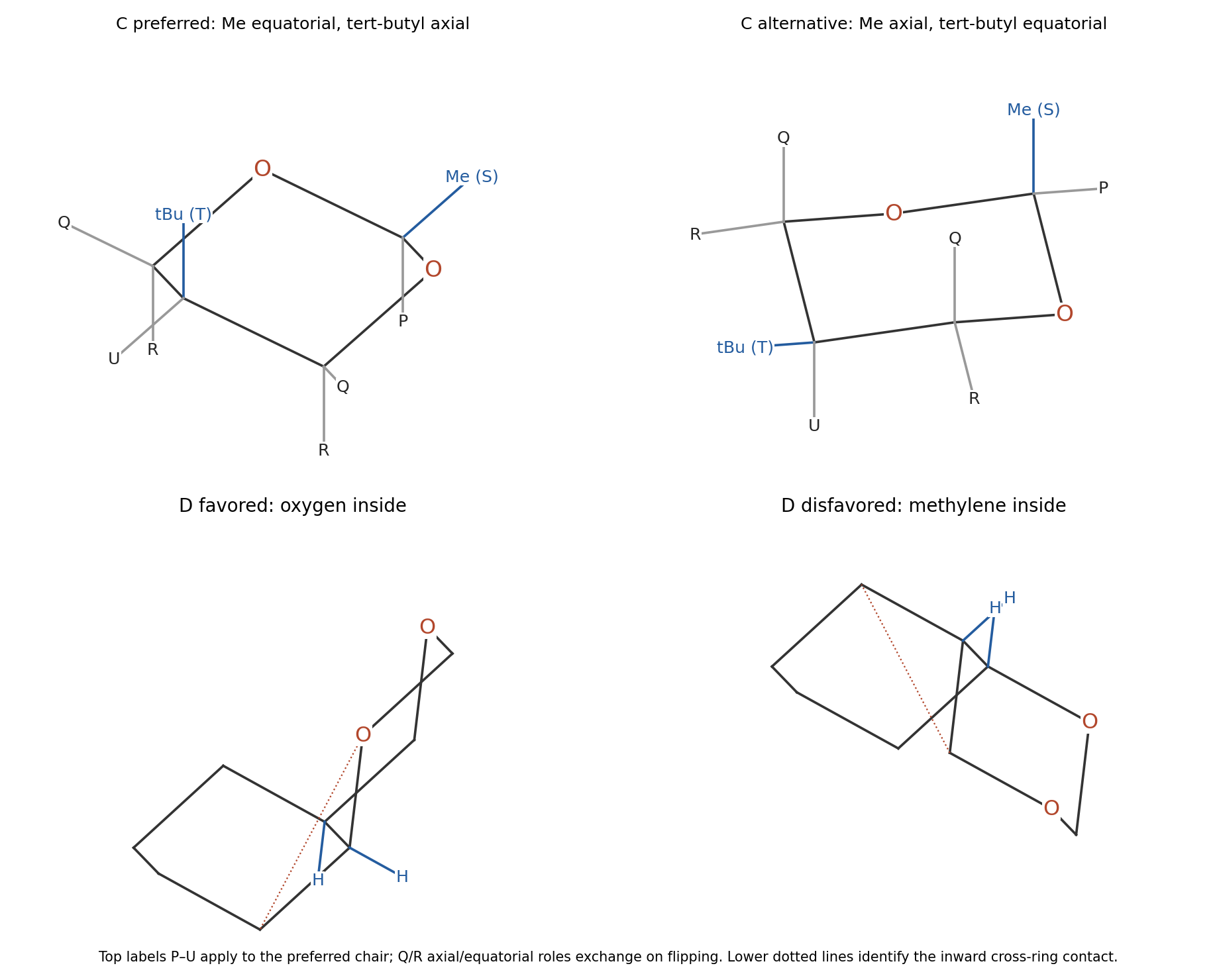


The axial penalties depend on the ring position. An axial methyl at C2 encounters the axial hydrogens on C4 and C6. The short C–O links and dioxane geometry make these 1,3-Diaxial interactions particularly unfavorable. In contrast, an axial substituent at C5 points toward ring oxygens O1 and O3 rather than toward axial C–H groups at those positions. Those oxygen sites present much less steric obstruction than axial hydrogens on carbon.
Avoiding the expensive axial C2 methyl outweighs the cost of axial tert-butyl at C5. Transferring cyclohexane tert-butyl preferences unchanged would therefore give the wrong answer. This is primarily a position-dependent steric comparison, not the usual anomeric preference for an axial electronegative substituent at an acetal carbon. Primary NMR work on substituted dioxanes documents this axial C5 tert-butyl conformer.[ref]
Carbon-13 magnetic resonance. Conformation in some tert-butyl-1,3-dioxanes by Alan J. Jones and others. 1971, pp. 4772–4777, discussion of cis-2-methyl-5-tert-butyl-1,3-dioxane
P is H2, the acetal methine between two oxygens; its only resolved coupling is to the attached methyl, giving the quartet. S is that C2 methyl, whose doublet has the same 6.9 Hz coupling. T is tert-butyl, integrating to nine equivalent hydrogens with no adjacent carbon-bound methine proton across its quaternary attachment.
U is equatorial H5, coupled to the four hydrogens at C4 and C6. The two equivalent equatorial methylene hydrogens are Q, each a doublet of doublets with a 12.3 Hz geminal coupling to its axial partner and a 1.3 Hz coupling to H5. The two equivalent axial methylene hydrogens are R, each with the same 12.3 Hz geminal coupling and a 3.7 Hz vicinal coupling to H5. Equivalence between C4 and C6 makes two pairs rather than four separately shifted methylene hydrogens.Coupling U to two equivalent R hydrogens and two equivalent Q hydrogens produces its triplet of triplets. The different small vicinal couplings are consistent with oblique H–C–C–H torsions for equatorial H5; the 12.3 Hz value is geminal and must not be mistaken for a large vicinal trans-diaxial coupling.
The cis fusion admits two chair–chair conformers, related by simultaneous ring inversion. The bridgehead hydrogens remain cis, while their axial/equatorial descriptions exchange. In one fold the oxygen next to the fusion occupies the concave, inside position; in the other, the corresponding inside position is occupied by a methylene group. Both chair-only structures are shown in the lower panels of the dioxane diagram.
The O-inside chair–chair conformer is strongly favored. In the unfavorable fold, the inward methylene and its C–H bonds create close nonbonded contacts with the other ring, analogous to costly 1,3-diaxial/gauche contacts in cis-decalin. Placing oxygen in that location removes the corresponding carbon-bound hydrogens and reduces the obstruction. The comparison is between the two conformers of the same cis configuration; making the fusion trans would be a configurational change, not a chair flip. Nor is it appropriate to flatten both six-membered rings into regular hexagons, which would hide the decisive inside contacts.
Articles by others on the same topic
There are currently no matching articles.