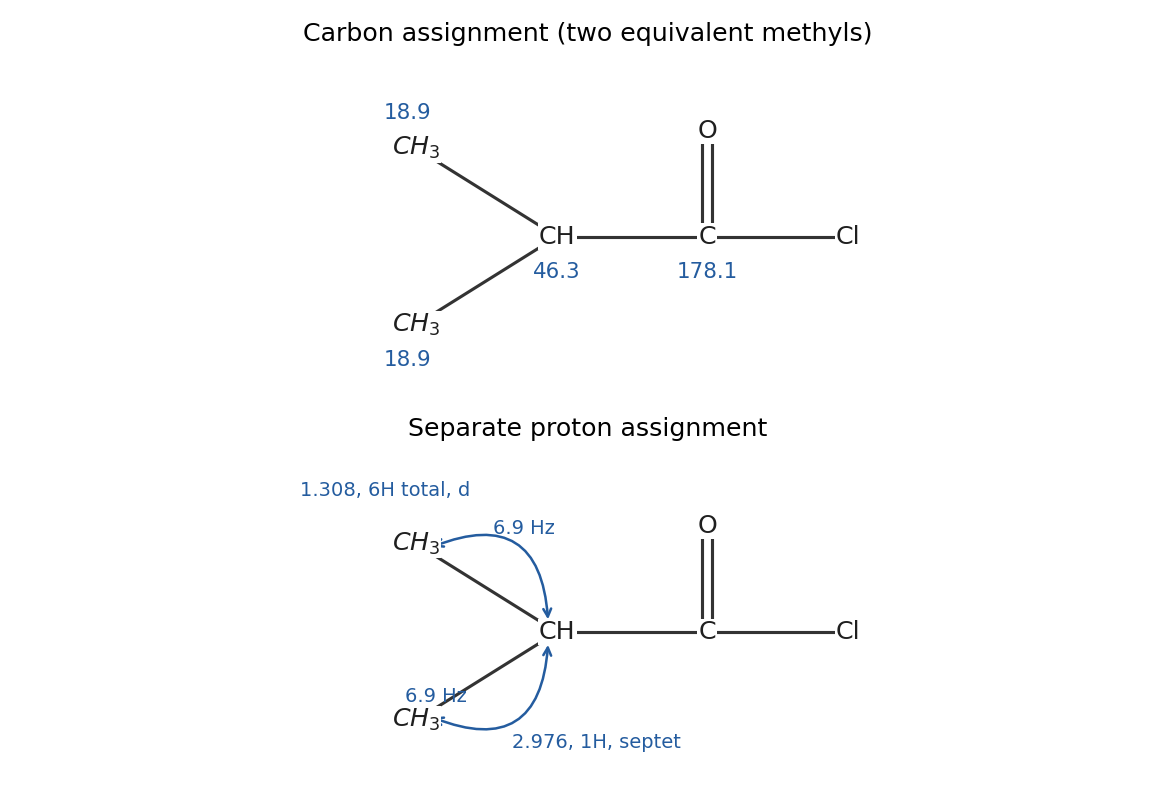
B is 2-Methylpropanoyl chloride, . The single index of index of hydrogen deficiency is supplied by the carbonyl. Its relatively high-frequency infrared spectroscopy band identifies an acyl chloride, while two equivalent methyl groups explain why four carbons produce only three carbon-13 NMR resonances.
Assign to the acyl chloride carbonyl, to the methine and ppm to both methyl groups. Their chemical equivalence in NMR follows from the symmetry of the isopropyl fragment in this achiral environment.
The strong band is an acyl chloride carbonyl stretching vibration. Compared with an ester, donation from a chlorine lone pair into the carbonyl antibonding molecular orbital is relatively ineffective, while chlorine's inductive effect withdraws electron density. The resulting stronger effective carbonyl force constant places the absorption above an ordinary saturated ketone band. Bond polarity alone is not a universal quantitative frequency rule.
The two methyl groups give one six-proton NMR doublet centred at ppm. The methine gives a one-proton NMR septet centred near ppm. The latter is split by six equivalent methyl protons, producing the first-order intensity pattern.This follows exactly from the methyl doublet spacing, , and approximately from the successive septet spacings, which alternate between and ppm within the precision of the printed labels. There is no methylene triplet or quartet: the six-proton integral and septet establish the branched skeleton.

Articles by others on the same topic
There are currently no matching articles.