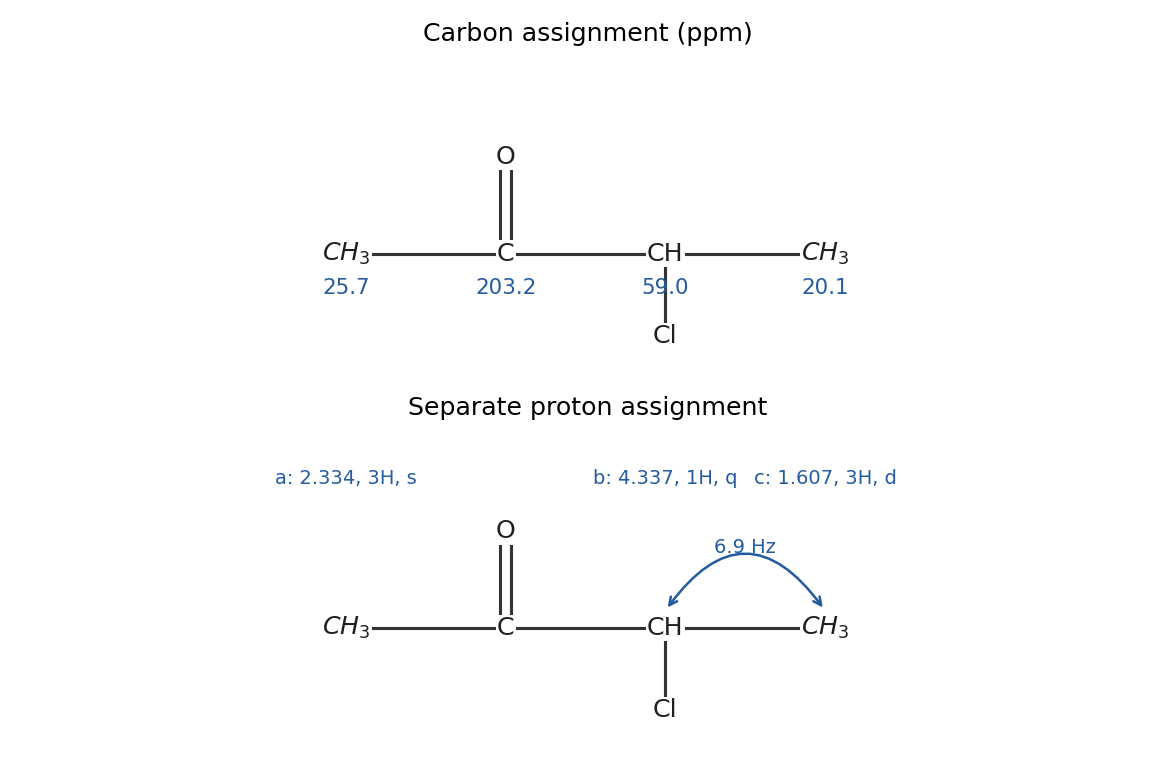
A is 3-Chlorobutan-2-one, . Counting chlorine as one hydrogen in the index of index of hydrogen deficiency gives . A single carbonyl accounts for that unsaturation; the resonance at ppm identifies a ketone, while the ppm methine bears chlorine.
The carbon-13 NMR assignments are for , for , for and ppm for . The four distinct carbon environments agree with the unsymmetrical structure. The small signal near 77 ppm belongs to the usual deuterated chloroform solvent, rather than to a fifth carbon of A.
The strong absorption is the carbonyl stretching vibration of a saturated ketone. Its exact wavenumber depends on substitution and measurement conditions; the important discrimination is that it is far below the high-frequency acyl chloride band in B and is accompanied by a carbonyl carbon-13 NMR resonance near 200 ppm.
Write the proton-labelled structure as . The assignments areThe NMR quartet is centred at ppm; each adjacent line differs by ppm. The NMR doublet has the same spacing, ppm. At 300 MHz,Three equivalent methyl protons split into a NMR quartet; the single methine proton splits into a NMR doublet. No resolved long-range scalar coupling splits the acetyl methyl, giving its NMR singlet. The integrals total seven protons.
B is 2-Methylpropanoyl chloride, . The single index of index of hydrogen deficiency is supplied by the carbonyl. Its relatively high-frequency infrared spectroscopy band identifies an acyl chloride, while two equivalent methyl groups explain why four carbons produce only three carbon-13 NMR resonances.
Assign to the acyl chloride carbonyl, to the methine and ppm to both methyl groups. Their chemical equivalence in NMR follows from the symmetry of the isopropyl fragment in this achiral environment.
The strong band is an acyl chloride carbonyl stretching vibration. Compared with an ester, donation from a chlorine lone pair into the carbonyl antibonding molecular orbital is relatively ineffective, while chlorine's inductive effect withdraws electron density. The resulting stronger effective carbonyl force constant places the absorption above an ordinary saturated ketone band. Bond polarity alone is not a universal quantitative frequency rule.
The two methyl groups give one six-proton NMR doublet centred at ppm. The methine gives a one-proton NMR septet centred near ppm. The latter is split by six equivalent methyl protons, producing the first-order intensity pattern.This follows exactly from the methyl doublet spacing, , and approximately from the successive septet spacings, which alternate between and ppm within the precision of the printed labels. There is no methylene triplet or quartet: the six-proton integral and septet establish the branched skeleton.
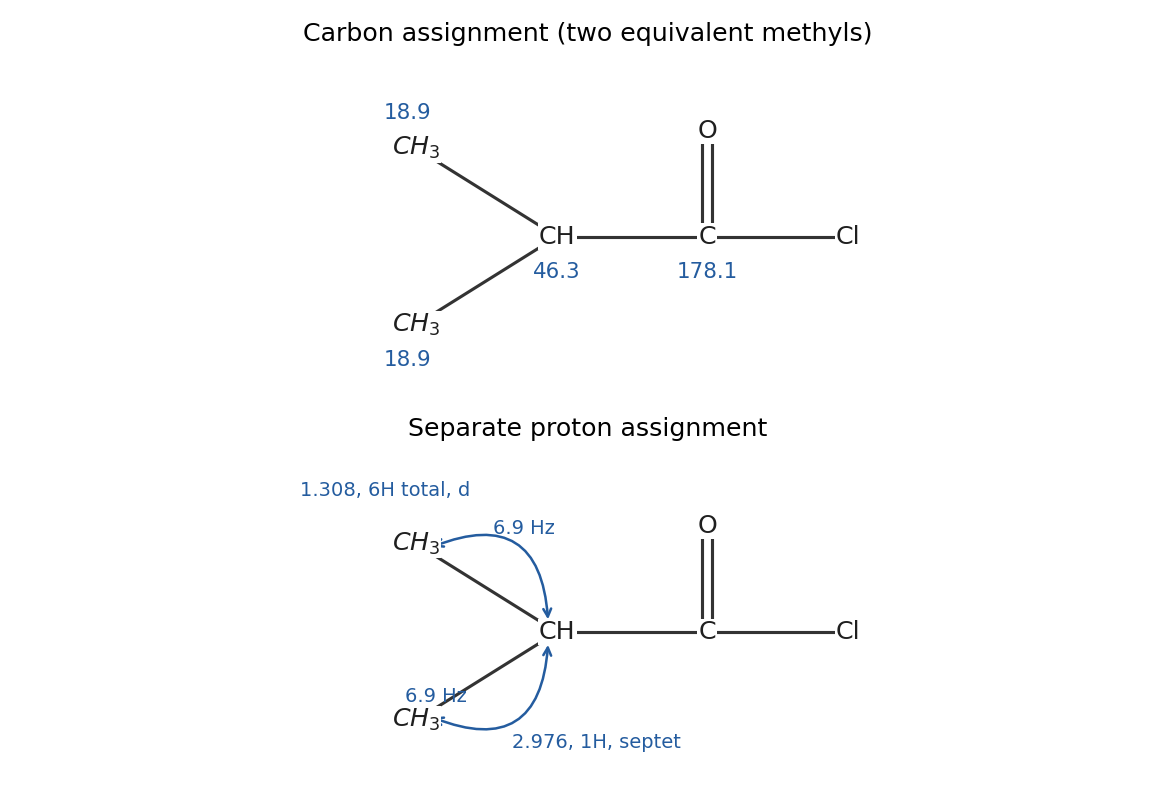
Independent original carbon and proton assignments for B; both equivalent methyl groups couple to the methine
. Details. C is 2-Chloroethyl vinyl ether, . There is one alkene and no carbonyl. Assign the carbon-13 NMR resonances asThe strongly differentiated pair of alkene shifts is characteristic of a vinyl ether; interpreting ppm as a carbonyl would leave the unusually shielded unsaturated ppm carbon and the three distinct vinylic protons unexplained.
The absorption is predominantly the carbon–carbon double-bond stretching vibration of the electron-rich vinyl ether. resonance donation from an oxygen lone pair changes both its frequency and its electric dipole moment variation during stretching. There is no carbonyl in the assigned structure, consistent with the absence of a carbon-13 NMR signal in the usual ketone or acyl chloride region.
Let be the internal vinylic proton, the terminal proton trans to , the terminal proton cis to , the oxygen-bound methylene and the chlorine-bound methylene. The assignments areFor the doublet of doublets, pairing corresponding lines gives Hz and Hz. The larger value identifies trans vinylic coupling; the smaller identifies cis vinylic coupling. The resonance confirms the large splitting, approximately Hz, and has a small geminal coupling to .
The small spacings are not perfectly reciprocal if treated as exact First-order NMR multiplets: the lines imply Hz, whereas the lines imply Hz and Hz. Thus report Hz, Hz and – Hz, rather than asserting incompatible exact constants. Printed precision and departures from a simple first-order pattern limit this line-picking estimate; a full spin-system fit would be needed for refined values. Splittings alone do not establish the signs of these couplings.
The two methylene groups split one another into approximate NMR triplets, with Hz; the oxygen-bound triplet gives approximately the same value from its rounded line labels. The three vinylic protons plus two methylenes give the required seven-proton integral. The terminal vinylic protons are diastereotopic, because replacing one or the other creates different alkene geometries.
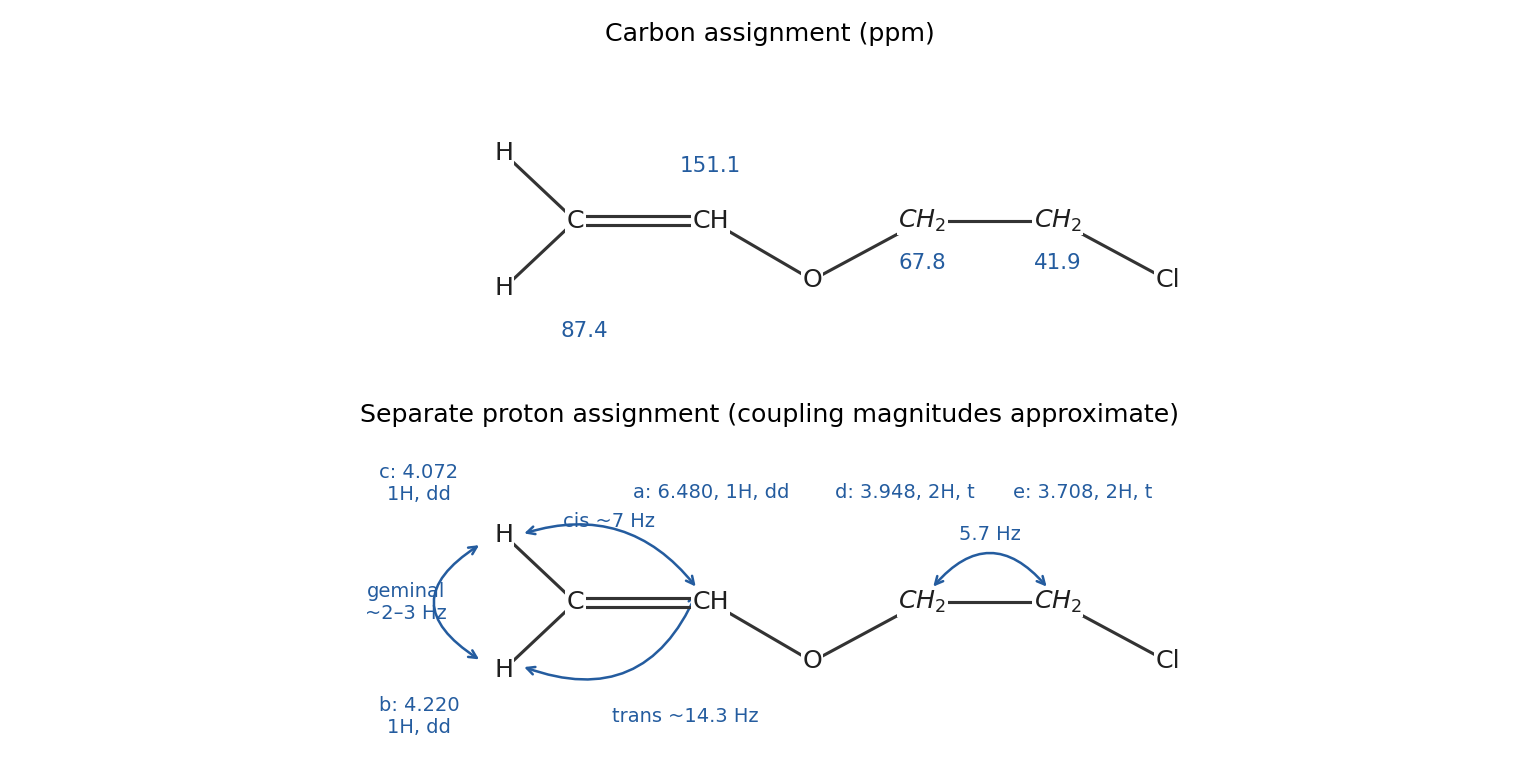
Original carbon and separate proton assignments for C, including trans, cis, geminal and methylene coupling paths
. Details. The vinyl ether has an important resonance contributorDonation from oxygen into the conjugated system increases electron density at the terminal unsaturated carbon, helping explain its unusually shielded ppm and its terminal protons near 4.1–4.2 ppm. The directly oxygen-bound unsaturated carbon is strongly deshielded at ppm; its proton at ppm also experiences the oxygen substituent and alkene magnetic anisotropy. These trends are consistent with the whole delocalized electronic structure; a chemical shift is not simply a meter for an atom's partial atomic charge.
For the saturated part, the stronger local deshielding by oxygen places at , , while lies at and ppm. The two terminal vinylic protons have different geometrical relationships to the oxygen substituent and therefore different chemical shifts as well as different vicinal couplings.
The one-electron species are and , so there is no electron–electron screening and the nuclear charges remain and .Within the stated hydrogen-like ion model, and all three atomic orbitals of a given species have the same energy. The energy zero is a separated electron and the residual nucleus.
The configurations are and . A simple complete-core-screening estimate subtracts the two electrons, giving for carbon and for nitrogen. This neglects screening by the other valence electrons, and is an explicitly rough estimate.
A more systematic estimate using Slater's rules includes for each electron and for each other electron in the group:Both models predict the important trend: nitrogen's valence shell experiences a greater effective nuclear charge. There is no unique numerical effective nuclear charge without specifying an orbital and a screening prescription; the one-electron formula in (a) does not by itself define neutral-atom orbital energies.[ref]
Atomic Shielding Constants by John C. Slater. 1930, printed pp. 58–59: screening prescription and grouping of ns and np electrons
The atomic orbital is spherically symmetric and has one radial node. A real atomic orbital has two lobes of opposite quantum phase, one atomic-orbital nodal plane through the nucleus and no radial node. The three spatial orientations remain degenerate in a spherically symmetric atom when external fields and fine structure are neglected.
In a many-electron atom, penetrates the screened core more effectively than , experiences a stronger attraction and is lower in energy: . The hydrogen-like ion degeneracy therefore does not survive screening. Both valence orbital types are generally more tightly bound and spatially contracted in nitrogen than in carbon, because of the larger effective nuclear charge. These are central-field orbital statements; the detailed atomic multiplet structure also involves electron repulsion and Hund's rules.
Take the bond axis as . The heavy-atom and atomic orbitals can mix with hydrogen to make three sigma-symmetry molecular orbitals. In the qualitative valence ordering, these are a low predominantly heavy-atom level, a bonding level and a higher level. The perpendicular orbitals form a degenerate approximately nonbonding pair because hydrogen has no valence orbitals of the matching sideways symmetry. The filled heavy-atom core is omitted from the diagram.
Counting valence electrons givesThus both exhibit paramagnetism: CH has one unpaired electron and NH has two in its ground state. For NH, Hund's rules favour separate parallel-spin occupation of the two degenerate orbitals. The corresponding observed ground terms are and ; the total bond order is approximately one in this simple sigma-bond/nonbonding-pi description.[ref]
NIST Chemistry WebBook, SRD 69. Methylidyne, CAS 3315-37-5, and Imidogen, CAS 13774-92-0: diatomic constants, ground-state rows
The nitrogen-derived orbital energies lie lower than the corresponding carbon-derived ones on an approximate common energy scale, while the isolated hydrogen reference is unchanged. The bonding orbitals consequently have different polarizations and mixing coefficients; drawing identical energies for C and N would miss the screening trend. The figure specifies ordering and occupancy, not measured gaps or a numerical prediction from (a).
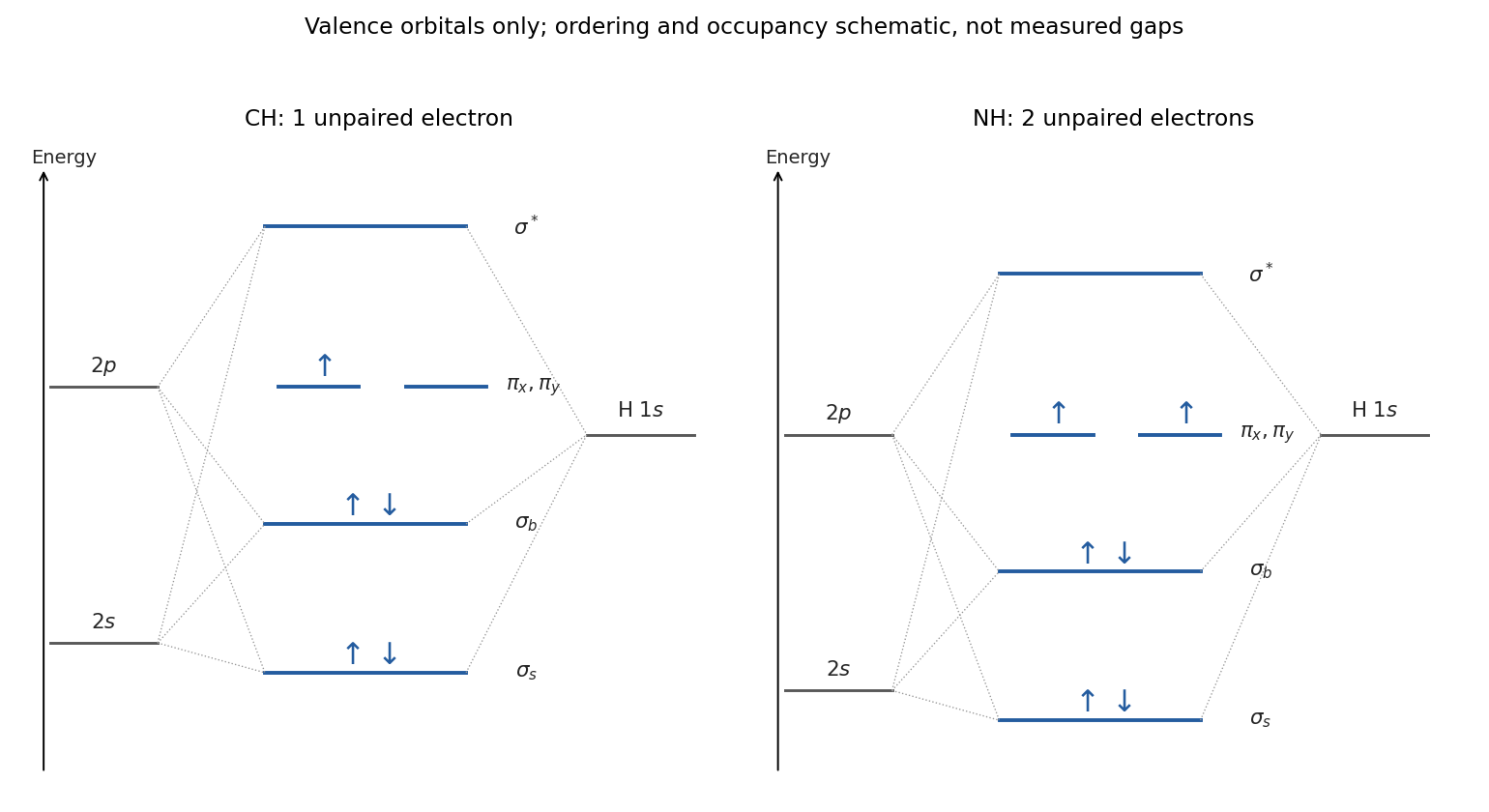
Original qualitative valence molecular-orbital diagrams of CH and NH with one and two unpaired electrons
. Details. The framework has a planar group attached to a straight C–N–N axis. Two useful octet resonance contributors areIn the left contributor, the terminal nitrogen has two lone pairs; in the right, the terminal nitrogen and carbon each have one. Each formula has 16 valence electrons and zero net electric charge. The double-headed resonance arrow changes the electronic allocation while retaining the same nuclear framework; these are not two different equilibrium species.
An internally consistent elementary orbital hybridisation model is at carbon and at both nitrogen atoms; the hydrogens use orbitals. The three carbon hybrids form two C–H sigma bonds and one C–N sigma bond, leaving one perpendicular p orbital. The central nitrogen uses opposite hybrids for its two collinear sigma connections, leaving two perpendicular p orbitals for the two pi systems.
At terminal nitrogen, one hybrid points toward the central nitrogen and the other houses an axial lone pair. One perpendicular p orbital forms the second, N–N-only pi system; the other participates in the three-atom C–N–N pi system. This description remains the same across both resonance contributors; counting lone-pair domains in just one drawing and assigning a different terminal hybridisation to each contributor would obscure the delocalization. orbital hybridisation is a useful choice of localized basis, not a uniquely measurable label: advanced treatments of diazomethane require a superposition of bonding patterns.[ref]
On the electronic structure of the diazomethane molecule by André G. H. Barbosa and João G. S. Monteiro. Abstract: limitations of single bonding patterns and multiconfigurational description
The four sigma bonds are the two C–H connections, C–N and N–N, containing eight electrons. A terminal-nitrogen axial lone pair contains two more. Of the remaining six electrons, two occupy an N–N pi bond lying in the molecular plane, while four occupy a perpendicular three-centre four-electron pi bond extending over C–N–N. There are therefore 16 valence electrons in total.
For orientation, a three-site model with equal on-site energy and adjacent interaction gives perpendicular pi levels at , , and . The lower two are doubly occupied and the upper is empty. The middle level has a terminal-end combination with little central-atom amplitude; unequal C and N orbital energies change its coefficients and make it only approximately nonbonding.
The highest occupied molecular orbital is the upper occupied perpendicular pi orbital, with substantial carbon amplitude, broadly above the strongly bonding sigma framework and the lower occupied pi orbitals. It is not the terminal axial nitrogen lone pair. Real diazomethane has C–N bonding and N–N antibonding character in this frontier orbital, rather than being an exactly nonbonding equal-site model. Photoelectron and Rydberg-state experiments support this assignment.[ref]
Vibronic structure and ion core interactions in Rydberg states of diazomethane: an experimental and theoretical investigation by Igor Fedorov and others. Abstract and discussion of ionization: removal from a C–N-bonding, N–N-antibonding pi orbital
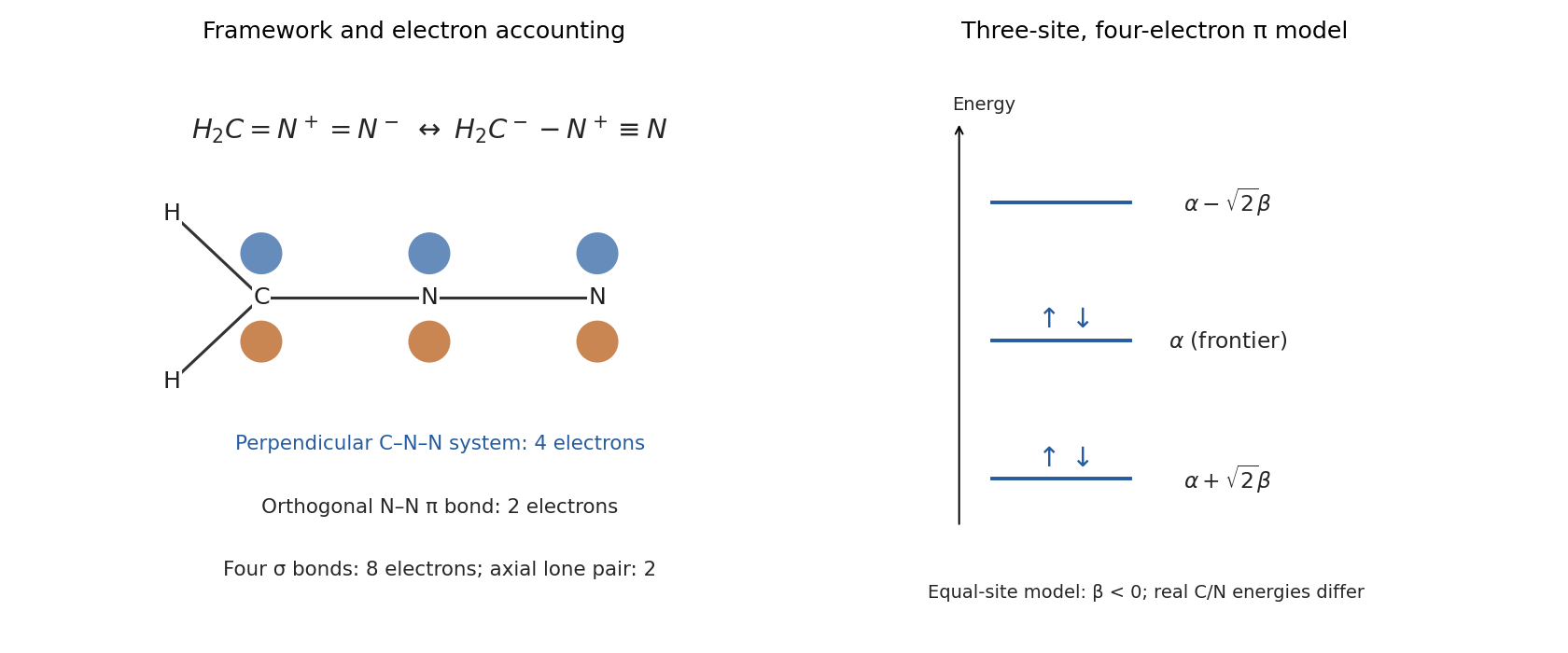
Original qualitative decomposition of diazomethane into four sigma bonds, an axial lone pair and two perpendicular pi systems
. Details. An intense band near is consistent with the high-frequency coupled C–N–N stretching motion of a diazo group, with substantial N–N multiple-bond character. It lies above a typical isolated C=N double-bond stretch, and supports contributions with a strong N–N connection. It does not establish that the molecule is a literal localized C–N single bond plus an unperturbed N≡N triple bond: a normal mode moves the coupled framework, and the resonance contributors describe one electronic structure.
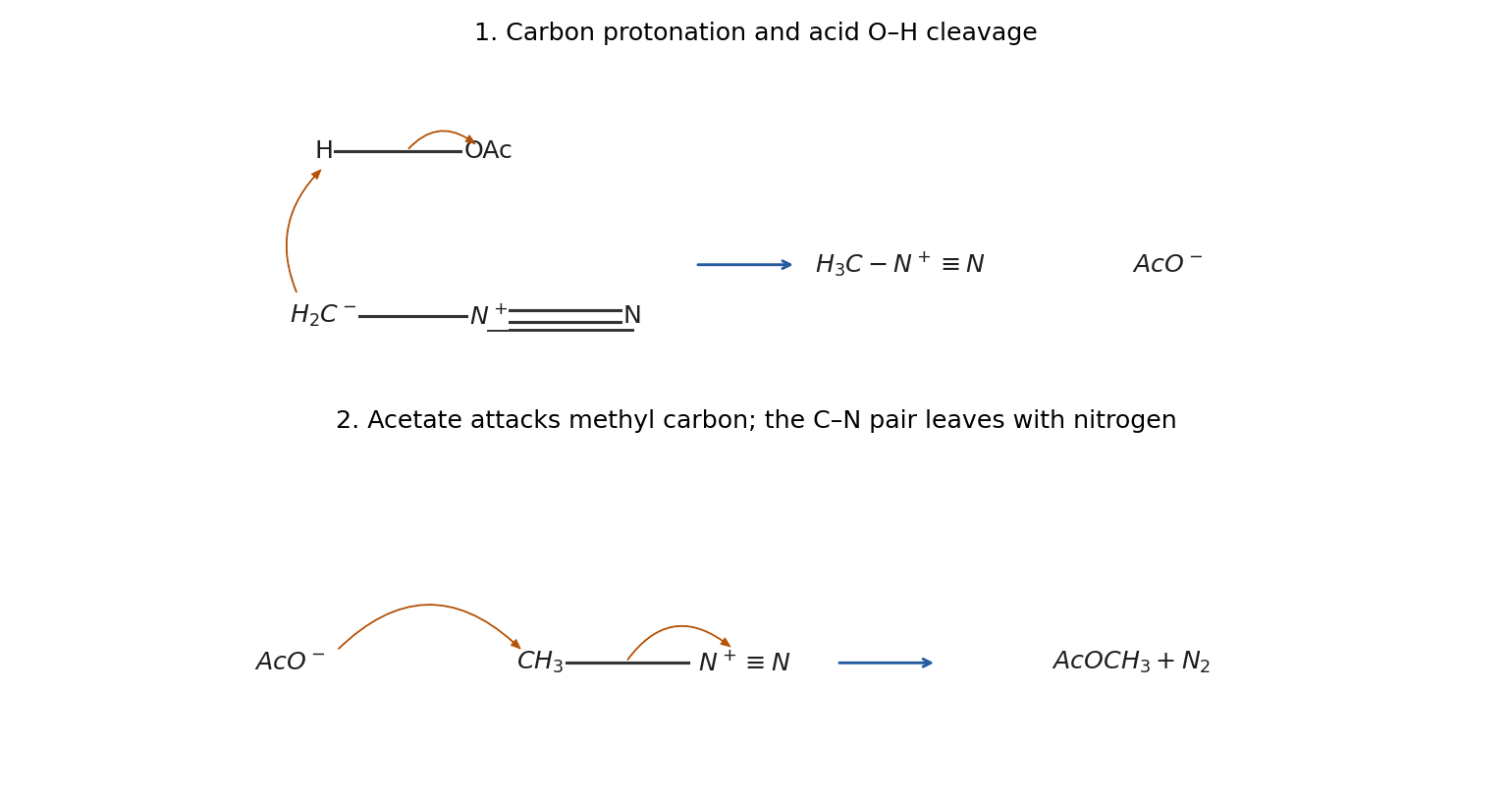
Protonation at the nucleophilic carbon gives methyldiazonium, . The carbon-rich highest occupied molecular orbital and the carbon-negative resonance contributor rationalize this site. Subsequent displacement of molecular nitrogen can be strongly favourable; the initial protonation product still contains both nitrogens.
First, proton transfer from acetic acid to the carbon of diazomethane gives methyldiazonium and an acetate ion:Draw an electron-pair arrow from carbon, using the carbon-negative resonance contributor, to the acidic hydrogen, and another from the acid O–H bond to oxygen. Second, an acetate oxygen attacks the diazonium methyl carbon by an SN2 reaction; an arrow from the C–N bond to nitrogen expels neutral :The acid's hydroxyl hydrogen has become the third hydrogen of the newly installed methyl group. This is a methyl-transfer sequence driven by formation of molecular nitrogen, without forming a free methyl carbocation or invoking Fischer esterification.
For the ordinary ester, the carbon nucleophile of a grignard reagent attacks the carbonyl carbon and moves the C=O pi pair onto oxygen. Collapse of the tetrahedral intermediate expels ethoxide, transiently giving . This ketone is more electrophilic than the starting ester because it lacks an alkoxy group's stabilizing resonance donation. A second equivalent of the grignard reagent therefore adds to it before isolation:The negatively charged intermediates are associated with magnesium counterions. Merely reducing the amount of reagent to one equivalent does not generally trap the ketone selectively; it can leave unreacted ester together with the double-addition product.
In the first successful preparation, magnesium insertion into the primary C–Br bond gives n-butylmagnesium bromide. The carbon chain has four carbons, so its acetylation produces hexan-2-one, , not pentan-2-one. Attack on acetic anhydride forms . Coordination of the anhydride-derived oxygens to magnesium can stabilize this tetrahedral addition complex. Under suitably cold, controlled-addition conditions it survives sufficiently to delay release of the free ketone until aqueous work-up has destroyed the remaining grignard reagent. Protonation followed by collapse releases acetate/acetic acid and the ketone.
This interpretation has direct experimental precedent: Melvin S. Newman and William T. Booth Jr. obtained methyl ketones by cold addition of grignard reagents to acetic anhydride, attributing selectivity to a persistent addition complex. The temperature and reagent-addition regime are genuine conditions on the explanation, rather than proof that an anhydride can never undergo overaddition; the exam scheme omits them.[ref]
The Preparation of Ketones from Grignard Reagents by Melvin S. Newman and William T. Booth Jr.. 1945, printed p. 154: proposed intermediate I and low-temperature dependence
For the benzonitrile route, n-butyl attacks the nitrile carbon and one C≡N pi pair moves to nitrogen, producing the magnesium ketimine salt . This anionic nitrogen-containing intermediate resists a second nucleophilic addition much more than a neutral carbonyl does. The ketone appears only during acidic aqueous work-up, after organomagnesium has been quenched. Protonation gives the iminium ion; water attacks its carbon, proton transfers give a carbinolamine, and C–N cleavage from its nitrogen-protonated form produces the protonated ketone and ammonia, followed by deprotonation. In the acidic mixture ammonia is present largely as ammonium. This sequence explains why nitrile addition stops at a ketone without requiring the ketone itself to be resistant to grignard reagents.
The atom-labelled hydrolysis sequence isWater's lone pair attacks the iminium carbon while its C=N pi pair moves to nitrogen; the carbinolamine oxygen then reforms C=O while the C–N pair moves to the departing protonated amino group. Final deprotonation gives the neutral ketone. The arrows involving protonation and hydrolysis also exchange protons with the acidic aqueous reservoir; the condensed sequence tracks the carbon–nitrogen and carbon–oxygen transformations rather than displaying every solvent molecule.
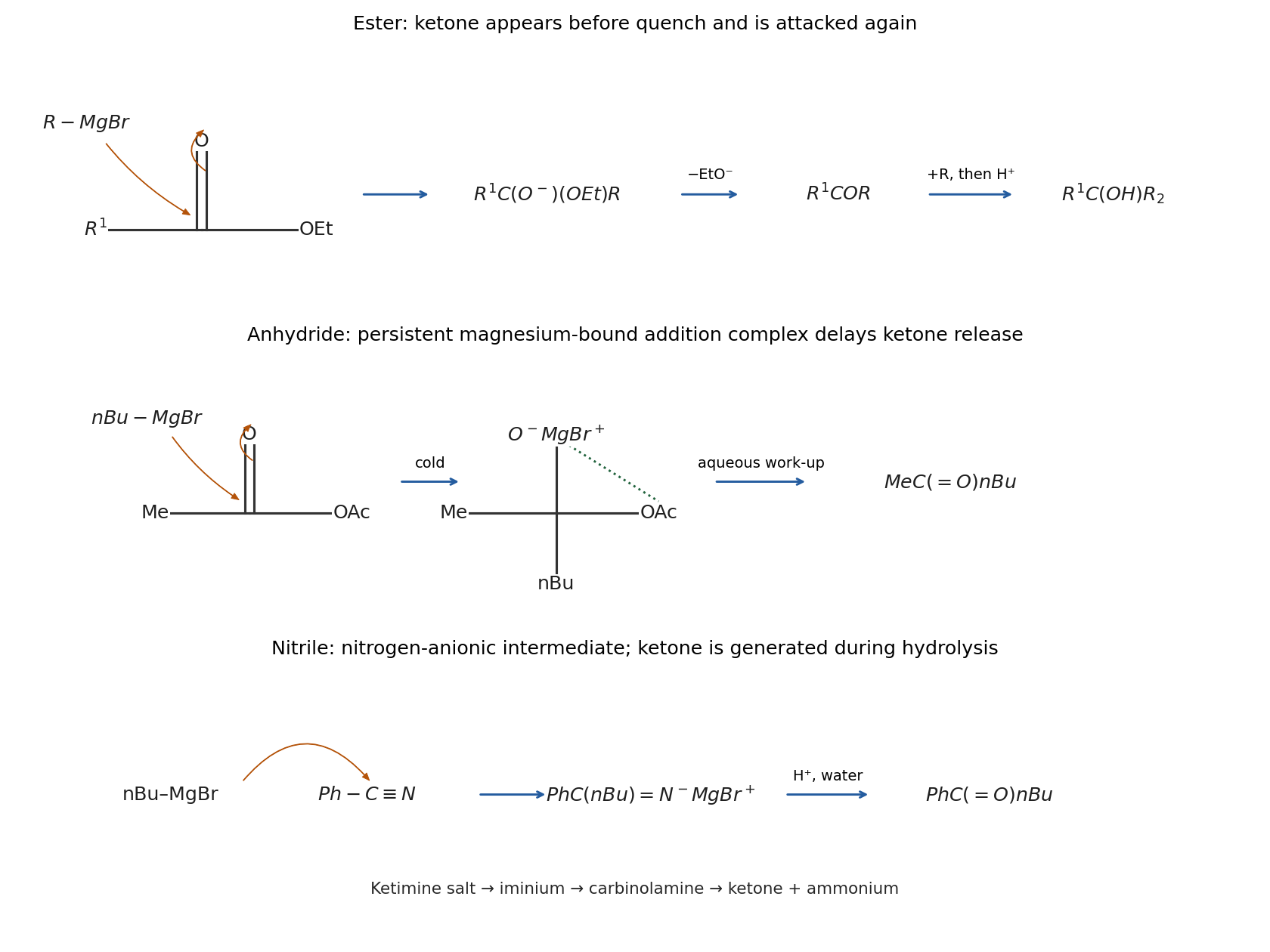
Original electron-flow summary contrasting ester overaddition with anhydride trapping and nitrile hydrolysis
. Details. The two starting ester groups are adjacent on the benzene ring. Select one ester carbon as the site receiving both incoming methyl groups. A first methyl addition gives a tetrahedral intermediate; its collapse expels methoxide to give the ortho-substituted ketone . A second methyl addition produces , with the alkoxide bound to magnesium.
The newly generated oxygen is now positioned to attack the remaining ester intramolecularly. Draw an arrow from its lone pair to that ester carbonyl and another from the C=O pi bond to its oxygen. Collapse of the resulting tetrahedral intermediate reforms the carbonyl and expels methoxide, closing a five-membered lactone. Protonation of magnesium-bound species in the work-up gives 3,3-Dimethylphthalide. Equivalently, protonation can first give the ortho hydroxy ester, followed by acid-assisted lactonization with loss of methanol; both descriptions show the same required bond formation.
The oxygen in the new ring is the oxygen of the first ester's original carbonyl; the surviving lactone carbonyl comes from the second ester. The product retains the six ring carbons and both original acyl carbons, loses the two ester methoxy carbons, and gains two carbons from methylmagnesium bromide. The favourable intramolecular five-membered closure accounts for the displayed product. It does not make the isolated lactone universally inert to a large excess of grignard reagent; stoichiometry and trapping/work-up conditions matter.
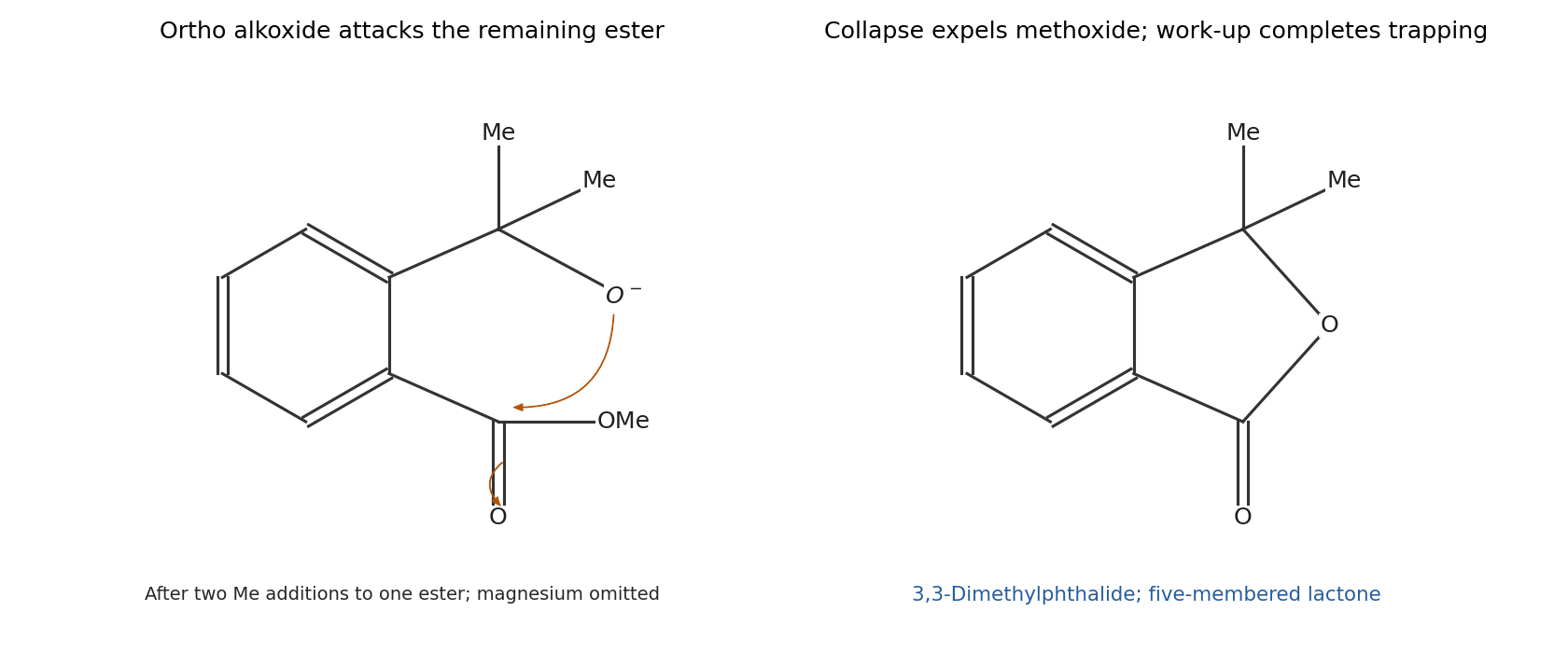
Original sequence of two methyl additions followed by five-membered lactone closure, with oxygen provenance retained
. Details. The oxygen substituent changes position through a halohydrin–epoxide sequence. First, hydroxide attacks the acetate carbonyl of , giving a tetrahedral intermediate. Collapse expels the substrate alkoxide, and proton transfer gives plus acetate. This is saponification, breaking the acyl–oxygen bond rather than replacing bromide directly with hydroxide.
A small equilibrium population of undergoes intramolecular SN2 reaction at the adjacent primary carbon: the O lone pair attacks and its C–Br pair leaves with bromide. The result is 2,2-Dimethyloxirane. Addition of HBr protonates the ring oxygen. bromide then attacks preferentially at the more substituted carbon, where the protonated ring has greater carbocation character, breaking that C–O bond and leaving oxygen attached to the former primary carbon:The middle formula denotes a three-membered epoxide, not an open-chain ether. Acidic opening of this highly unsymmetrical epoxide has the opposite regioselectivity to a simple basic nucleophilic opening at its less substituted carbon.
Finally, the primary alcohol oxygen attacks acetyl chloride. The tetrahedral intermediate collapses with chloride departure, and triethylamine removes the O–H proton and captures HCl. The product is . oxygen is carried through the epoxide to the other carbon; it is not necessary to invent a methyl migration or a carbon-skeleton rearrangement.
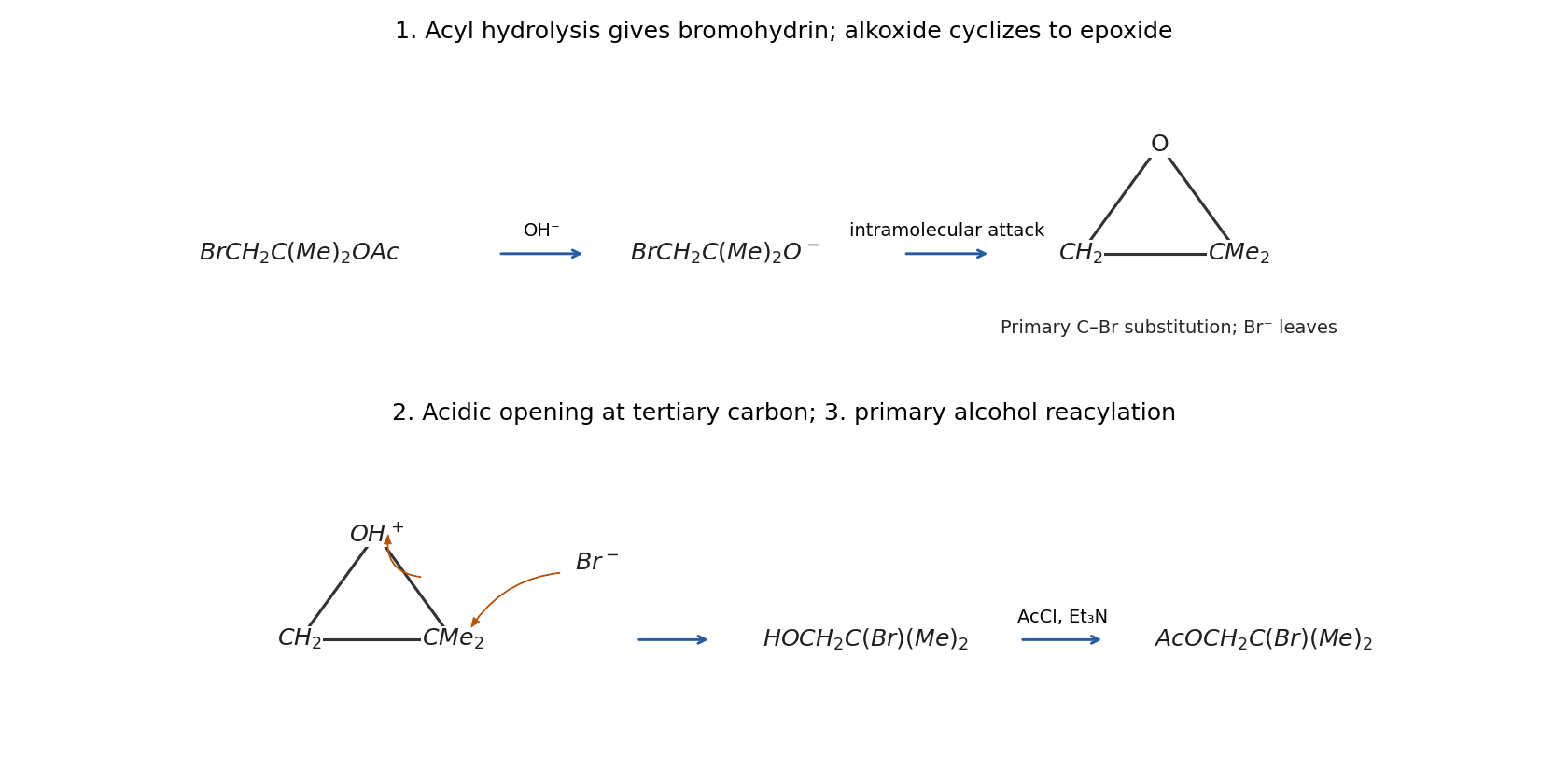
Original electron-flow drawing for bromohydrin cyclization, acid-directed epoxide opening and reacylation
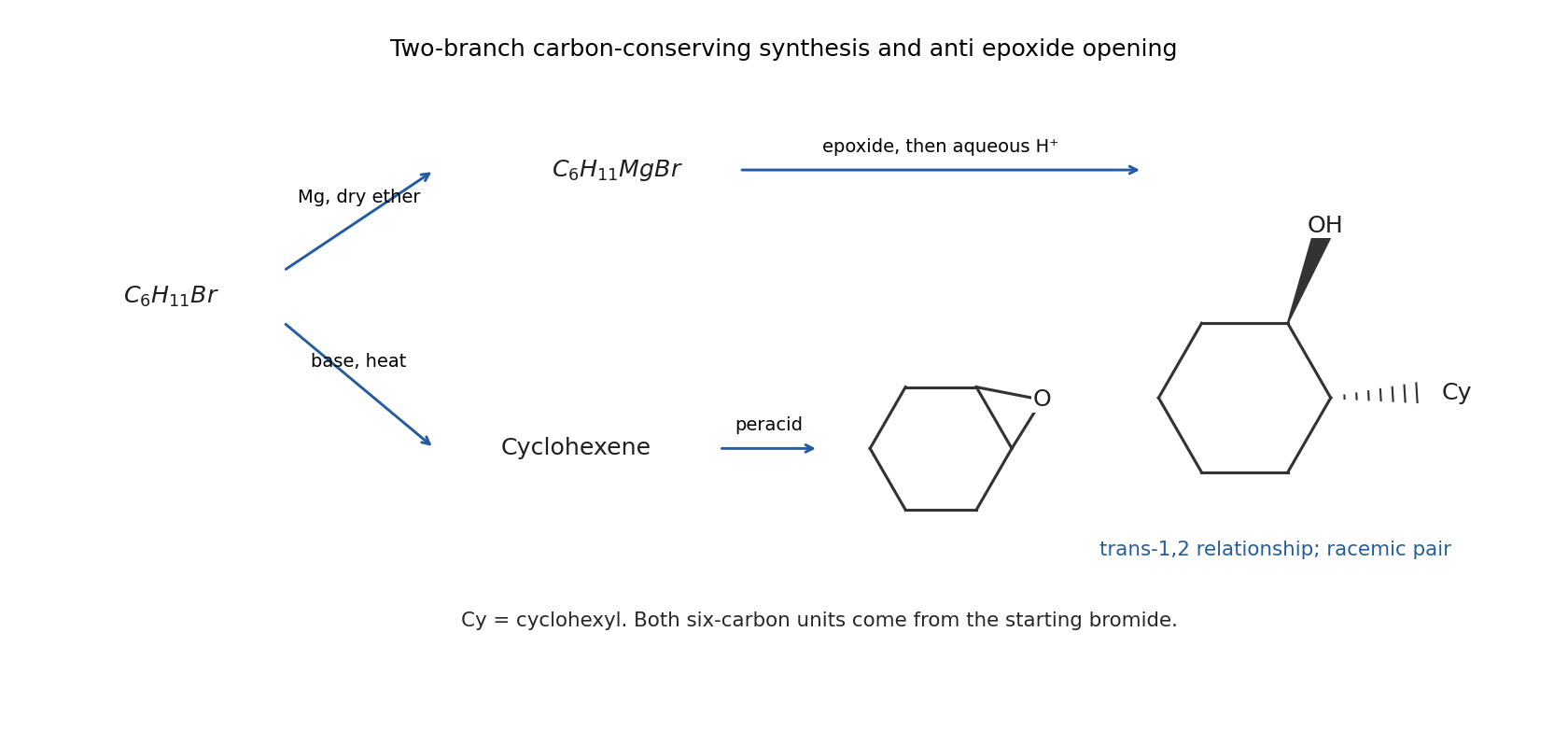
. Details. Disconnect the new bond between the two six-carbon units. One portion of bromocyclohexane supplies a grignard reagent; another supplies cyclohexene oxide:A bulky strong base can favour E2 elimination in the alkene-forming step; a peracid such as meta-chloroperoxybenzoic acid provides epoxidation. None of its carbons enters the target.
Treat cyclohexene oxide with cyclohexylmagnesium bromide, then perform acidic aqueous work-up. Backside attack on one epoxide carbon breaks its C–O bond and installs cyclohexyl opposite the retained oxygen. Protonation of the oxygen gives trans-2-cyclohexylcyclohexan-1-ol, the required relative configuration. The two six-carbon reactant portions supply all 12 target carbons. An achiral synthesis produces a racemic mixture trans pair; obtaining only the particular enantiomer represented by the drawing would require resolution or an enantioselective step. The useful stable chair can place the two large trans-1,2 substituents approximately diequatorial.
Here is absolute pressure, is volume, is amount of substance in moles, is the molar gas constant and is absolute thermodynamic temperature in kelvin. This is the ideal gas law; consistent SI units give pressure in pascals, volume in cubic metres and in .
The ideal gas model takes the particles' own volume to be negligible compared with the container volume and neglects intermolecular interactions except during idealized elastic collisions. These assumptions remove excluded-volume and attractive-force corrections to the ideal gas law. A classical dilute gas also requires that quantum-statistical effects be negligible, but the first two are the requested mechanical assumptions.
The standard enthalpy of formation is the enthalpy change on forming exactly one mole of the specified compound in its stated standard state from its constituent chemical elements in their reference states at the same specified temperature. The reference states are normally the stable elemental forms at the standard pressure. A standard state does not itself mean 298 K; temperature must be stated separately.
The Clausius statement of the second law forbids a cyclic device whose sole effect is transfer of heat from a colder thermal reservoir to a hotter one. The Kelvin-Planck statement of the second law forbids a cyclic device whose sole effect is complete conversion of heat drawn from a single thermal reservoir into work. These are equivalent formulations of the Second law of thermodynamics; an ordinary refrigerator is allowed because supplied work is an additional effect.
For , reversing the standard formation reaction gives . Thus decomposition is thermodynamically favoured under the corresponding standard conditions. benzene persists because it is kinetically stable on the laboratory timescale. Breaking and reorganizing its bonding framework requires access to high-activation energy pathways, and suitable reactive intermediates or catalysts are absent under ordinary storage conditions. A negative Gibbs free energy change specifies the favoured thermodynamic direction, not a rapid reaction rate; thermal energy does not automatically overcome a large barrier.
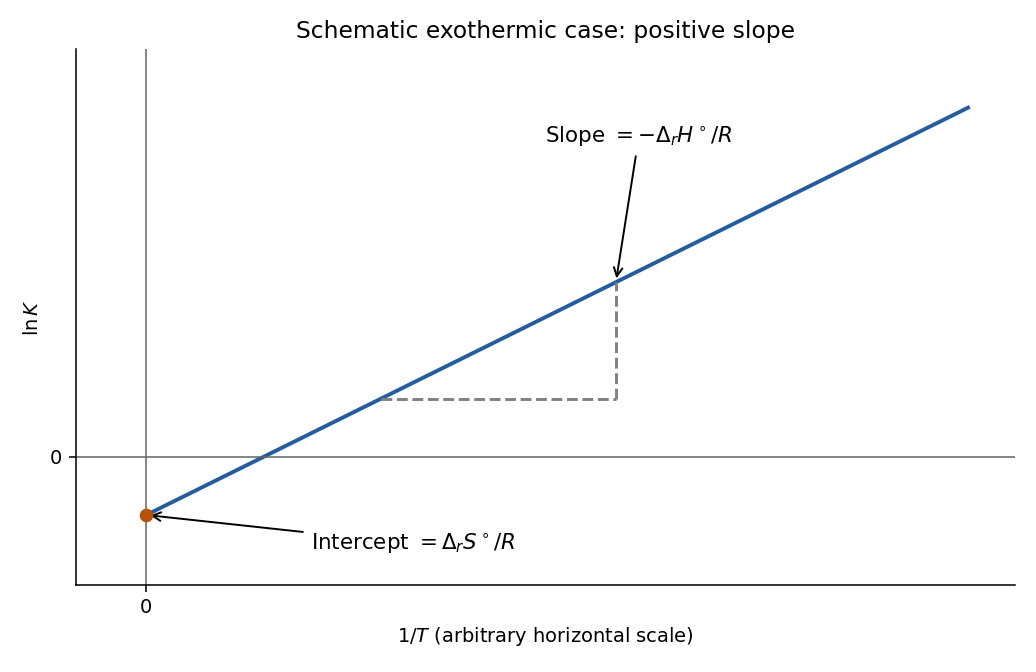
Combining with the equilibrium relation givesIf reaction enthalpy and reaction entropy are approximately constant over the measurement interval, a plot of against is straight, with slope and intercept . An exothermic reaction therefore has a positive slope. In the more general local form, the Gibbs–Helmholtz equation giveswhich is the Van't Hoff equation without assuming a constant enthalpy.
Use a dimensionless equilibrium constant built from thermodynamic activities. Measure sufficiently separated temperatures after verifying true equilibrium, and avoid phase changes or a changing chemical reaction. Temperature-dependent heat capacities cause curvature: the fitted straight-line slope then estimates an interval-dependent enthalpy. Small errors in the equilibrium measurements can produce large slope errors over a narrow range. The entropy intercept is particularly sensitive because requires distant extrapolation, and slope/intercept errors are correlated. A numerical line through a few points is not, by itself, evidence that all these assumptions hold.


The exponential function makes modest Gibbs free energy differences correspond to extreme equilibrium ratios. At 298 K, ; for example,The minor equilibrium component may therefore lie below detection, or a species' required thermodynamic activity may be experimentally inaccessible. Apparently complete conversion supplies a bound on , rather than an accurate finite value. Additionally, some reactions do not reach chemical equilibrium within a practicable observation time because of kinetic barriers. The thermodynamic identity still holds even when direct room-temperature determination of both sides of the equilibrium ratio fails.
For red-to-yellow conversion, subtract the red values from the yellow values:HenceThe positive value makes the red form the lower-Gibbs free energy form at 298 K within the supplied bulk-phase model. The calculation uses 298 K as the conventional reference temperature; the paper supplies no separate numerical temperature for this subpart. Keeping enthalpy and entropy in the same energy units is essential.
At coexistence of the two pure solid forms, their chemical potentials are equal and . Treating the tabulated enthalpy and entropy differences as constant givesAbove this temperature the model favours the higher-entropy yellow form; below it the red form is favoured. This is a prediction from the given thermodynamic data, not a guarantee of an immediately visible colour change: kinetic trapping, particle-size effects and temperature-dependent heat capacities are not included. A ratio of masses of two coexisting pure solids is not the equilibrium constant, since their bulk solid activities are each unity.
With the forward direction defined as cis-to-trans, the elementary steps have rates and . One trans molecule is gained per forward event and lost per reverse event, soEach rate constant has units , and the right side has units of concentration per unit time. This net rate can have either sign, even though the individual event rates are nonnegative.
At chemical equilibrium, the forward and reverse event rates are equal, rather than both reactions stopping:For the dilute-solution concentration model,The ratio is dimensionless because both concentrations and both rate constants have matching units. An exact thermodynamic equilibrium constant uses activities; here the common standard concentration and ideal-solution activity coefficients cancel.
Let , which is conserved for this closed one-to-one isomerization at fixed volume. Substitute into the equilibrium ratio:ThereforeThe equilibrium split is independent of having started with pure cis, provided equilibration is complete and no side reaction changes the total concentration.
The forward and reverse pathways pass through the same transition state. Measured from the cis minimum, the forward barrier is ; measured from the trans minimum, the reverse barrier is . Since , the trans minimum lies below the cis minimum in the elementary energy-profile model:The absolute barrier heights cannot be deduced from their difference. The following original profile uses an arbitrary transition-state height and labels that distinction explicitly.
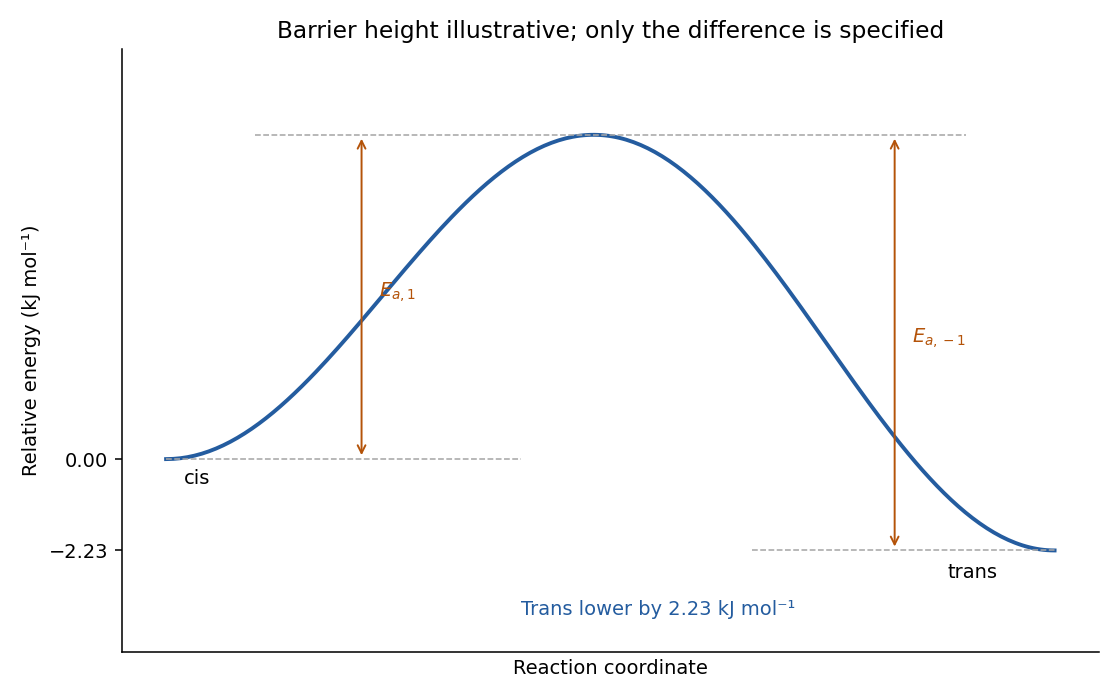
Original elementary energy profile with trans below cis and the reverse barrier larger by 2.23 kJ per mole
. Details. 
The equal Arrhenius prefactors cancel in the ratio:Hence , favouring trans, with trans fraction . The factor 1000 converting the barrier difference from kilojoules to joules is essential.
At the higher temperature the same equilibrium rate balance givesThis is a reverse first-order rate constant, not the net relaxation rate, which includes both elementary directions.
The temperature increase shifts the equilibrium towards cis. The ratio decreases from about to , so the trans fraction falls from to . Trans remains the more abundant isomer; “favours cis” describes the direction of the change, rather than requiring cis to become the majority.
Integrating the Van't Hoff equation with approximately constant reaction enthalpy givesUsing the full calculated yieldsThe negative sign agrees with the decrease of on heating. This is the two-temperature estimate from the supplied equilibrium data. It is not exactly the implied by treating equal prefactors and a fixed activation-energy difference as exact throughout the interval: that stricter model predicts rather than . The data and idealizations are therefore only approximately mutually consistent; no rounding of intermediate calculations can make both numerical enthalpy estimates identical.
Eliminate cis using :ThusBoth directions restore the perturbed distribution: an excess of trans both increases its reverse consumption and reduces cis available for forward formation. This explains why the chemical relaxation time is , rather than the reciprocal of only one rate constant.
Take the rapid temperature jump to occur at . Neglect thermal expansion as in the stated constant- model. The composition is initially unchanged, so the curve is continuous through , withIt is horizontal at the first value before the jump, then decreases exponentially towards the lower second plateau, without overshoot:The initial post-jump slope is negative, and the curve is concave upward. A discontinuous vertical step in the composition would incorrectly make a finite reaction happen instantaneously.
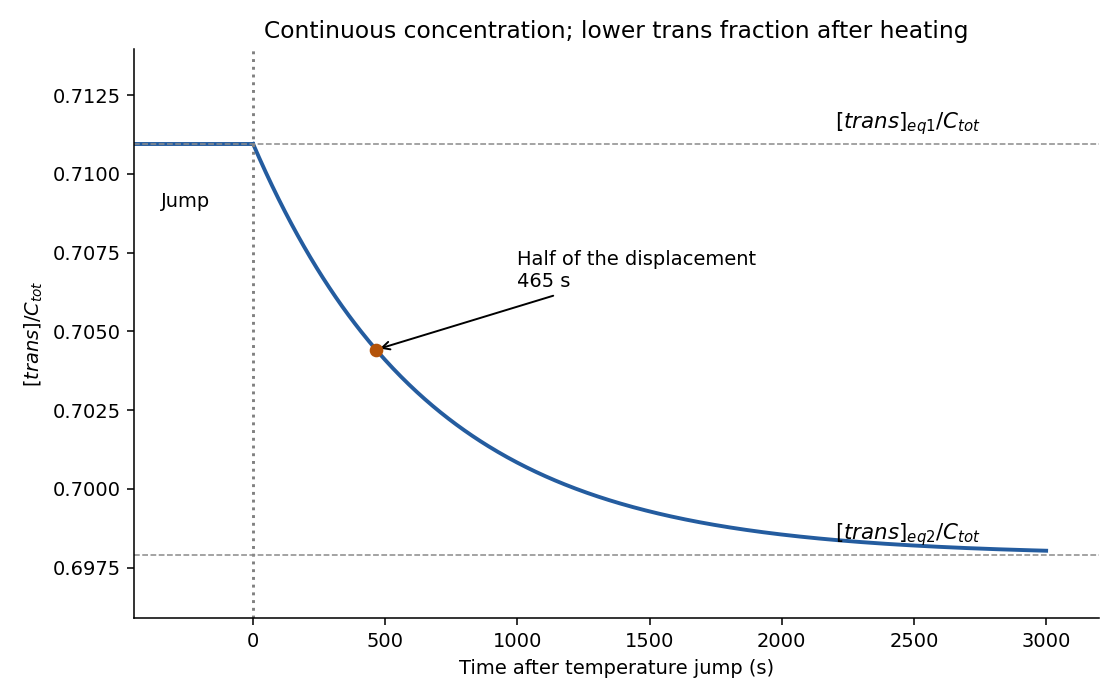
Original normalized trans-concentration relaxation curve, continuous at the temperature jump and approaching its new lower plateau
. Details. 
Articles were limited to the first 100 out of 119 total.
Articles by others on the same topic
There are currently no matching articles.