Take the bond axis as . The heavy-atom and atomic orbitals can mix with hydrogen to make three sigma-symmetry molecular orbitals. In the qualitative valence ordering, these are a low predominantly heavy-atom level, a bonding level and a higher level. The perpendicular orbitals form a degenerate approximately nonbonding pair because hydrogen has no valence orbitals of the matching sideways symmetry. The filled heavy-atom core is omitted from the diagram.
Counting valence electrons givesThus both exhibit paramagnetism: CH has one unpaired electron and NH has two in its ground state. For NH, Hund's rules favour separate parallel-spin occupation of the two degenerate orbitals. The corresponding observed ground terms are and ; the total bond order is approximately one in this simple sigma-bond/nonbonding-pi description.[ref]
NIST Chemistry WebBook, SRD 69. Methylidyne, CAS 3315-37-5, and Imidogen, CAS 13774-92-0: diatomic constants, ground-state rows
The nitrogen-derived orbital energies lie lower than the corresponding carbon-derived ones on an approximate common energy scale, while the isolated hydrogen reference is unchanged. The bonding orbitals consequently have different polarizations and mixing coefficients; drawing identical energies for C and N would miss the screening trend. The figure specifies ordering and occupancy, not measured gaps or a numerical prediction from (a).
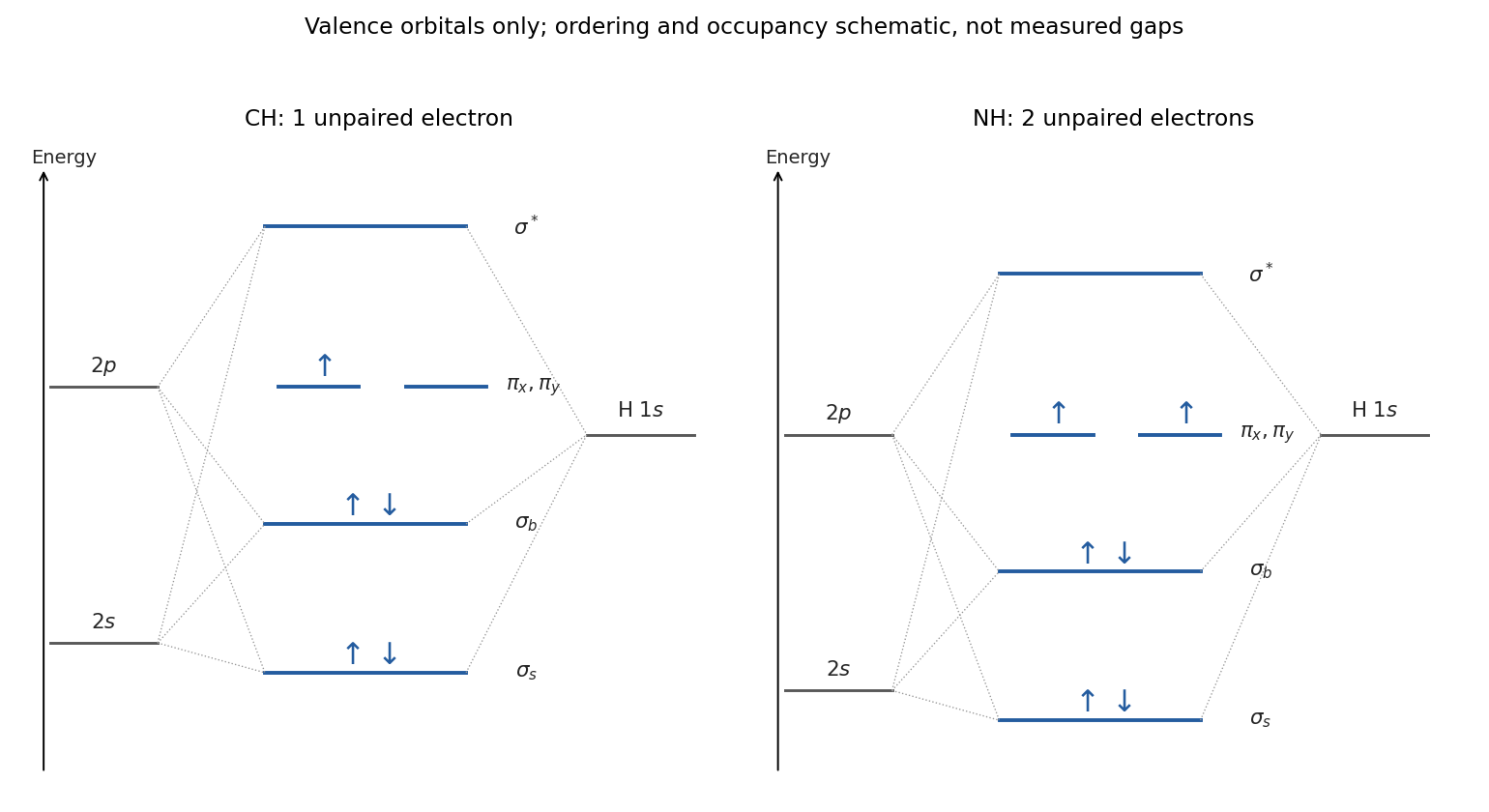
Original qualitative valence molecular-orbital diagrams of CH and NH with one and two unpaired electrons
. Details. 
Articles by others on the same topic
There are currently no matching articles.