The one-electron species are and , so there is no electron–electron screening and the nuclear charges remain and .Within the stated hydrogen-like ion model, and all three atomic orbitals of a given species have the same energy. The energy zero is a separated electron and the residual nucleus.
The configurations are and . A simple complete-core-screening estimate subtracts the two electrons, giving for carbon and for nitrogen. This neglects screening by the other valence electrons, and is an explicitly rough estimate.
A more systematic estimate using Slater's rules includes for each electron and for each other electron in the group:Both models predict the important trend: nitrogen's valence shell experiences a greater effective nuclear charge. There is no unique numerical effective nuclear charge without specifying an orbital and a screening prescription; the one-electron formula in (a) does not by itself define neutral-atom orbital energies.[ref]
Atomic Shielding Constants by John C. Slater. 1930, printed pp. 58–59: screening prescription and grouping of ns and np electrons
The atomic orbital is spherically symmetric and has one radial node. A real atomic orbital has two lobes of opposite quantum phase, one atomic-orbital nodal plane through the nucleus and no radial node. The three spatial orientations remain degenerate in a spherically symmetric atom when external fields and fine structure are neglected.
In a many-electron atom, penetrates the screened core more effectively than , experiences a stronger attraction and is lower in energy: . The hydrogen-like ion degeneracy therefore does not survive screening. Both valence orbital types are generally more tightly bound and spatially contracted in nitrogen than in carbon, because of the larger effective nuclear charge. These are central-field orbital statements; the detailed atomic multiplet structure also involves electron repulsion and Hund's rules.
Take the bond axis as . The heavy-atom and atomic orbitals can mix with hydrogen to make three sigma-symmetry molecular orbitals. In the qualitative valence ordering, these are a low predominantly heavy-atom level, a bonding level and a higher level. The perpendicular orbitals form a degenerate approximately nonbonding pair because hydrogen has no valence orbitals of the matching sideways symmetry. The filled heavy-atom core is omitted from the diagram.
Counting valence electrons givesThus both exhibit paramagnetism: CH has one unpaired electron and NH has two in its ground state. For NH, Hund's rules favour separate parallel-spin occupation of the two degenerate orbitals. The corresponding observed ground terms are and ; the total bond order is approximately one in this simple sigma-bond/nonbonding-pi description.[ref]
NIST Chemistry WebBook, SRD 69. Methylidyne, CAS 3315-37-5, and Imidogen, CAS 13774-92-0: diatomic constants, ground-state rows
The nitrogen-derived orbital energies lie lower than the corresponding carbon-derived ones on an approximate common energy scale, while the isolated hydrogen reference is unchanged. The bonding orbitals consequently have different polarizations and mixing coefficients; drawing identical energies for C and N would miss the screening trend. The figure specifies ordering and occupancy, not measured gaps or a numerical prediction from (a).
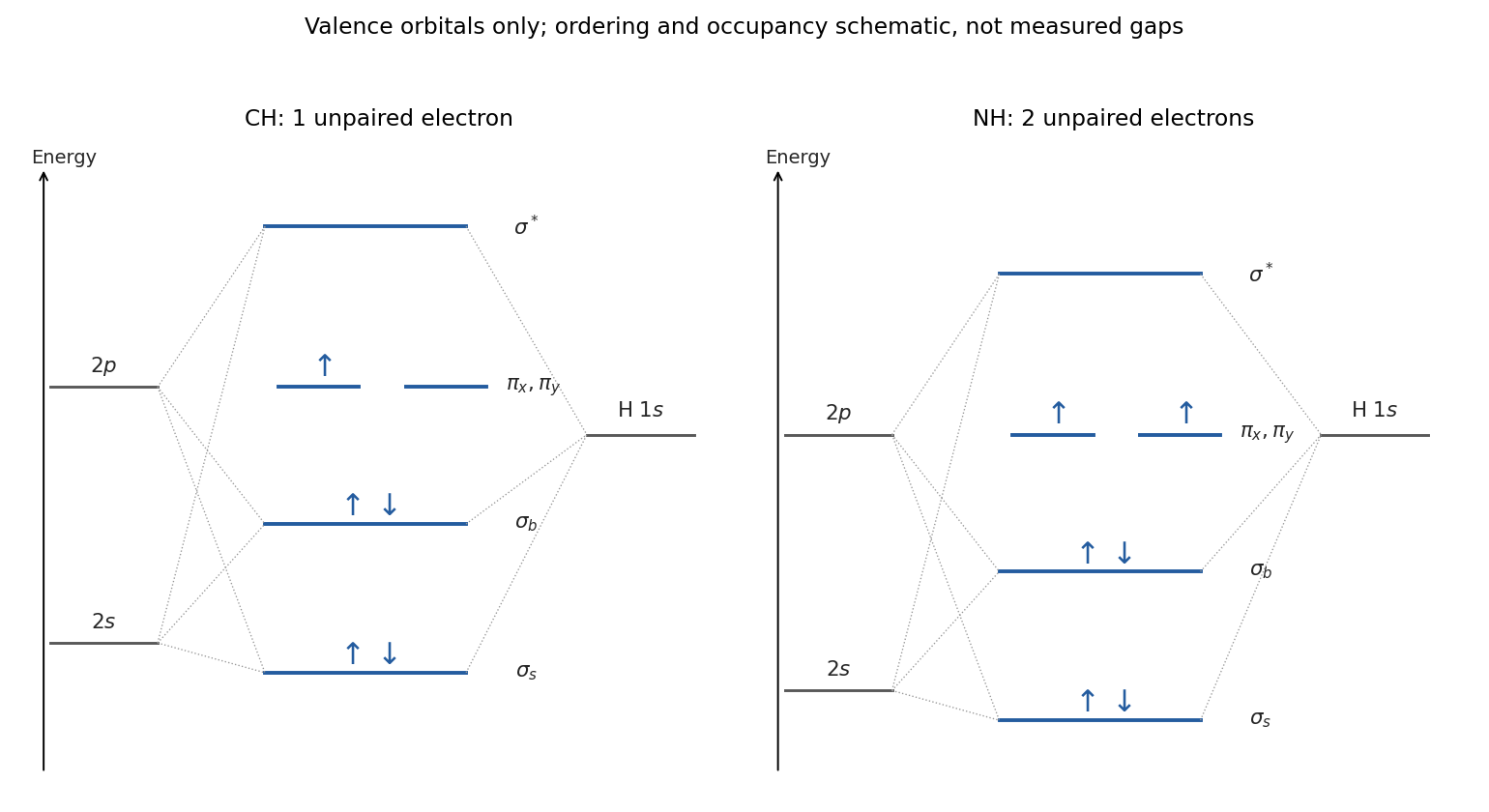
Original qualitative valence molecular-orbital diagrams of CH and NH with one and two unpaired electrons
. Details. The framework has a planar group attached to a straight C–N–N axis. Two useful octet resonance contributors areIn the left contributor, the terminal nitrogen has two lone pairs; in the right, the terminal nitrogen and carbon each have one. Each formula has 16 valence electrons and zero net electric charge. The double-headed resonance arrow changes the electronic allocation while retaining the same nuclear framework; these are not two different equilibrium species.
An internally consistent elementary orbital hybridisation model is at carbon and at both nitrogen atoms; the hydrogens use orbitals. The three carbon hybrids form two C–H sigma bonds and one C–N sigma bond, leaving one perpendicular p orbital. The central nitrogen uses opposite hybrids for its two collinear sigma connections, leaving two perpendicular p orbitals for the two pi systems.
At terminal nitrogen, one hybrid points toward the central nitrogen and the other houses an axial lone pair. One perpendicular p orbital forms the second, N–N-only pi system; the other participates in the three-atom C–N–N pi system. This description remains the same across both resonance contributors; counting lone-pair domains in just one drawing and assigning a different terminal hybridisation to each contributor would obscure the delocalization. orbital hybridisation is a useful choice of localized basis, not a uniquely measurable label: advanced treatments of diazomethane require a superposition of bonding patterns.[ref]
On the electronic structure of the diazomethane molecule by André G. H. Barbosa and João G. S. Monteiro. Abstract: limitations of single bonding patterns and multiconfigurational description
The four sigma bonds are the two C–H connections, C–N and N–N, containing eight electrons. A terminal-nitrogen axial lone pair contains two more. Of the remaining six electrons, two occupy an N–N pi bond lying in the molecular plane, while four occupy a perpendicular three-centre four-electron pi bond extending over C–N–N. There are therefore 16 valence electrons in total.
For orientation, a three-site model with equal on-site energy and adjacent interaction gives perpendicular pi levels at , , and . The lower two are doubly occupied and the upper is empty. The middle level has a terminal-end combination with little central-atom amplitude; unequal C and N orbital energies change its coefficients and make it only approximately nonbonding.
The highest occupied molecular orbital is the upper occupied perpendicular pi orbital, with substantial carbon amplitude, broadly above the strongly bonding sigma framework and the lower occupied pi orbitals. It is not the terminal axial nitrogen lone pair. Real diazomethane has C–N bonding and N–N antibonding character in this frontier orbital, rather than being an exactly nonbonding equal-site model. Photoelectron and Rydberg-state experiments support this assignment.[ref]
Vibronic structure and ion core interactions in Rydberg states of diazomethane: an experimental and theoretical investigation by Igor Fedorov and others. Abstract and discussion of ionization: removal from a C–N-bonding, N–N-antibonding pi orbital
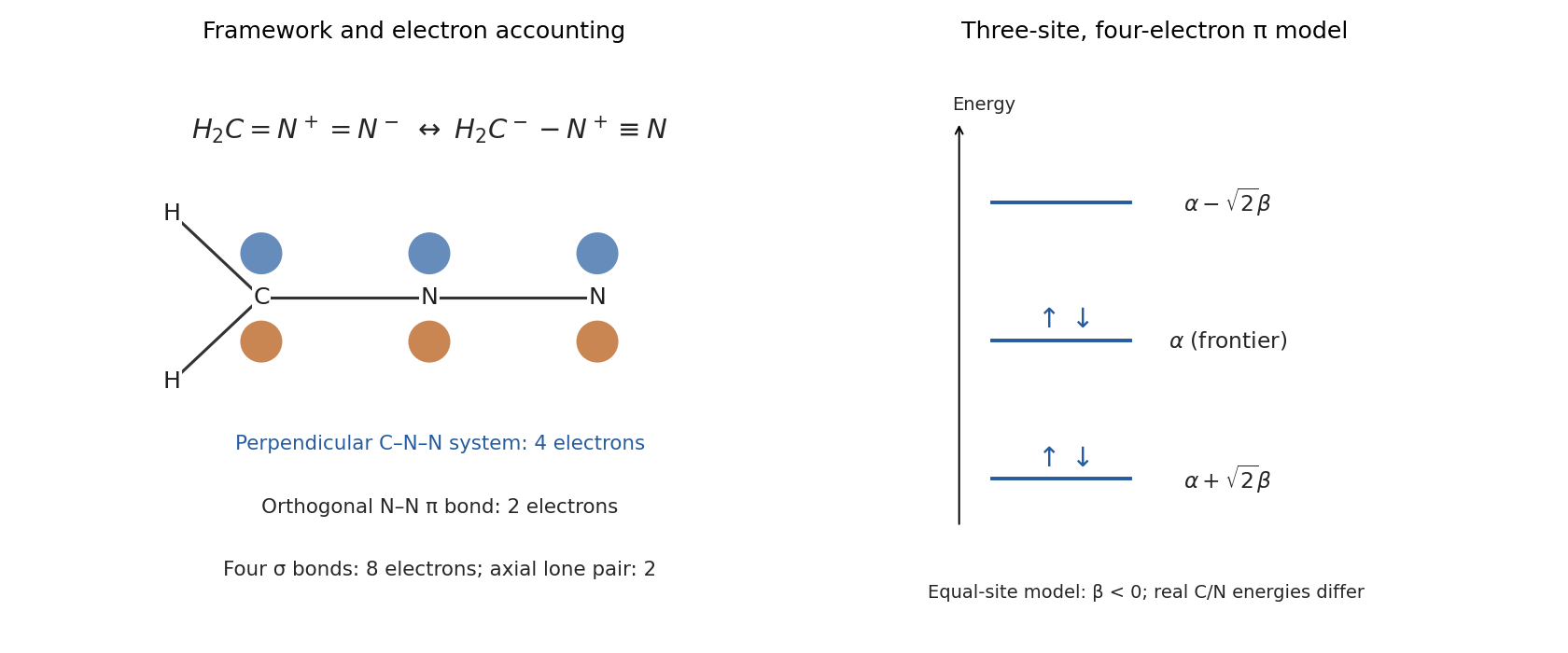
Original qualitative decomposition of diazomethane into four sigma bonds, an axial lone pair and two perpendicular pi systems
. Details. An intense band near is consistent with the high-frequency coupled C–N–N stretching motion of a diazo group, with substantial N–N multiple-bond character. It lies above a typical isolated C=N double-bond stretch, and supports contributions with a strong N–N connection. It does not establish that the molecule is a literal localized C–N single bond plus an unperturbed N≡N triple bond: a normal mode moves the coupled framework, and the resonance contributors describe one electronic structure.
Protonation at the nucleophilic carbon gives methyldiazonium, . The carbon-rich highest occupied molecular orbital and the carbon-negative resonance contributor rationalize this site. Subsequent displacement of molecular nitrogen can be strongly favourable; the initial protonation product still contains both nitrogens.
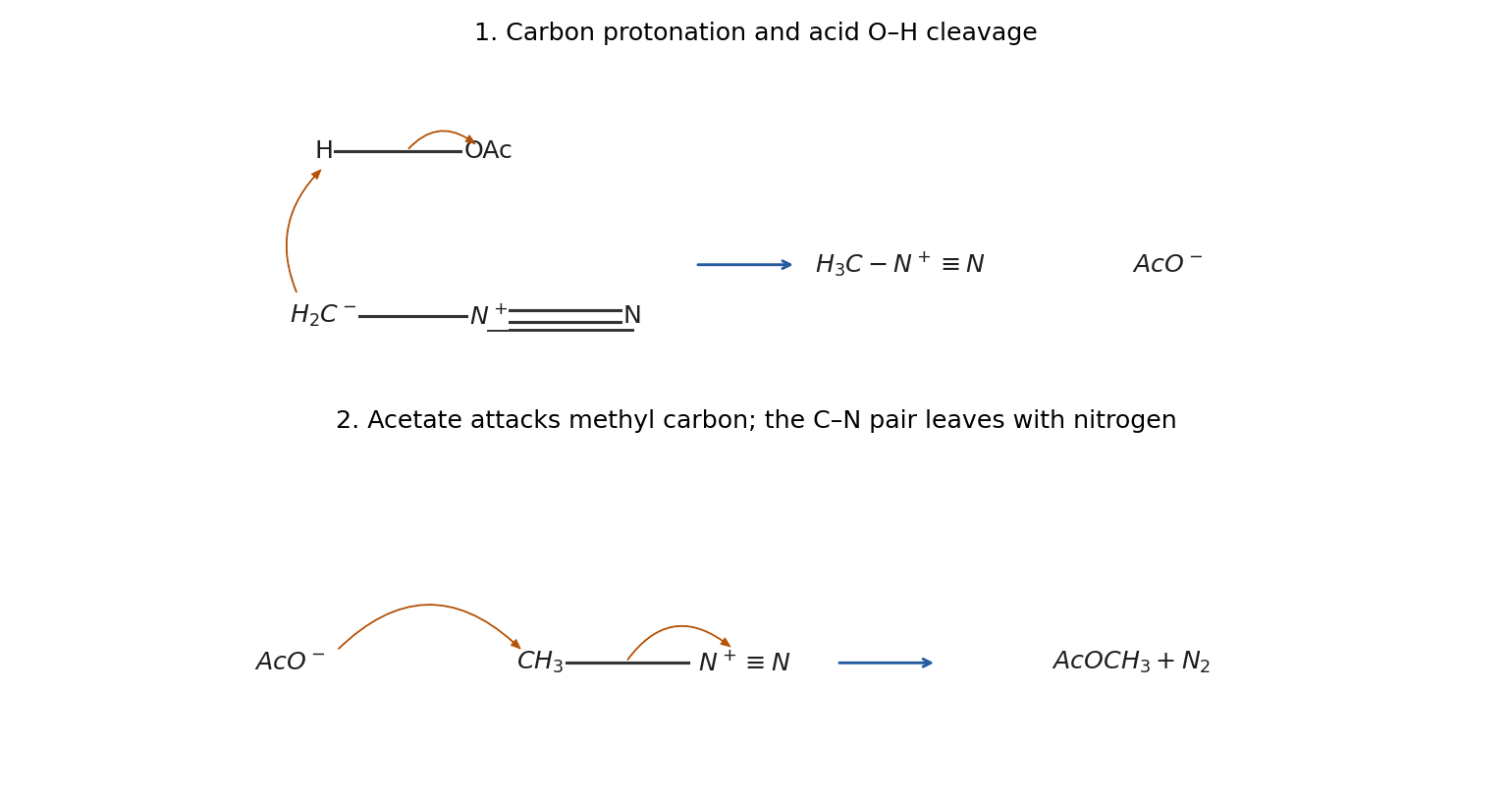
First, proton transfer from acetic acid to the carbon of diazomethane gives methyldiazonium and an acetate ion:Draw an electron-pair arrow from carbon, using the carbon-negative resonance contributor, to the acidic hydrogen, and another from the acid O–H bond to oxygen. Second, an acetate oxygen attacks the diazonium methyl carbon by an SN2 reaction; an arrow from the C–N bond to nitrogen expels neutral :The acid's hydroxyl hydrogen has become the third hydrogen of the newly installed methyl group. This is a methyl-transfer sequence driven by formation of molecular nitrogen, without forming a free methyl carbocation or invoking Fischer esterification.


Articles by others on the same topic
There are currently no matching articles.