Use for the acetyl methyl, for the O-bound methylene group pair, for the internal vinyl proton, and for the terminal vinyl protons respectively trans and cis to . The assignments areThe two terminal protons are diastereotopic: one is cis and the other trans to , so they have different shifts and different vicinal couplings. Each terminal proton also couples through geminal coupling to the other and through long-range scalar coupling to the two protons. When those small couplings coincide, an underlying doublet of doublets of NMR triplets collapses to the observed NMR doublet of apparent NMR quartets. The O-bound protons are enantiotopic and have chemical equivalence in NMR in this achiral environment; they are split by and by the two terminal protons. The integrated terminal envelope contains two protons, not two equivalent protons at one shift.
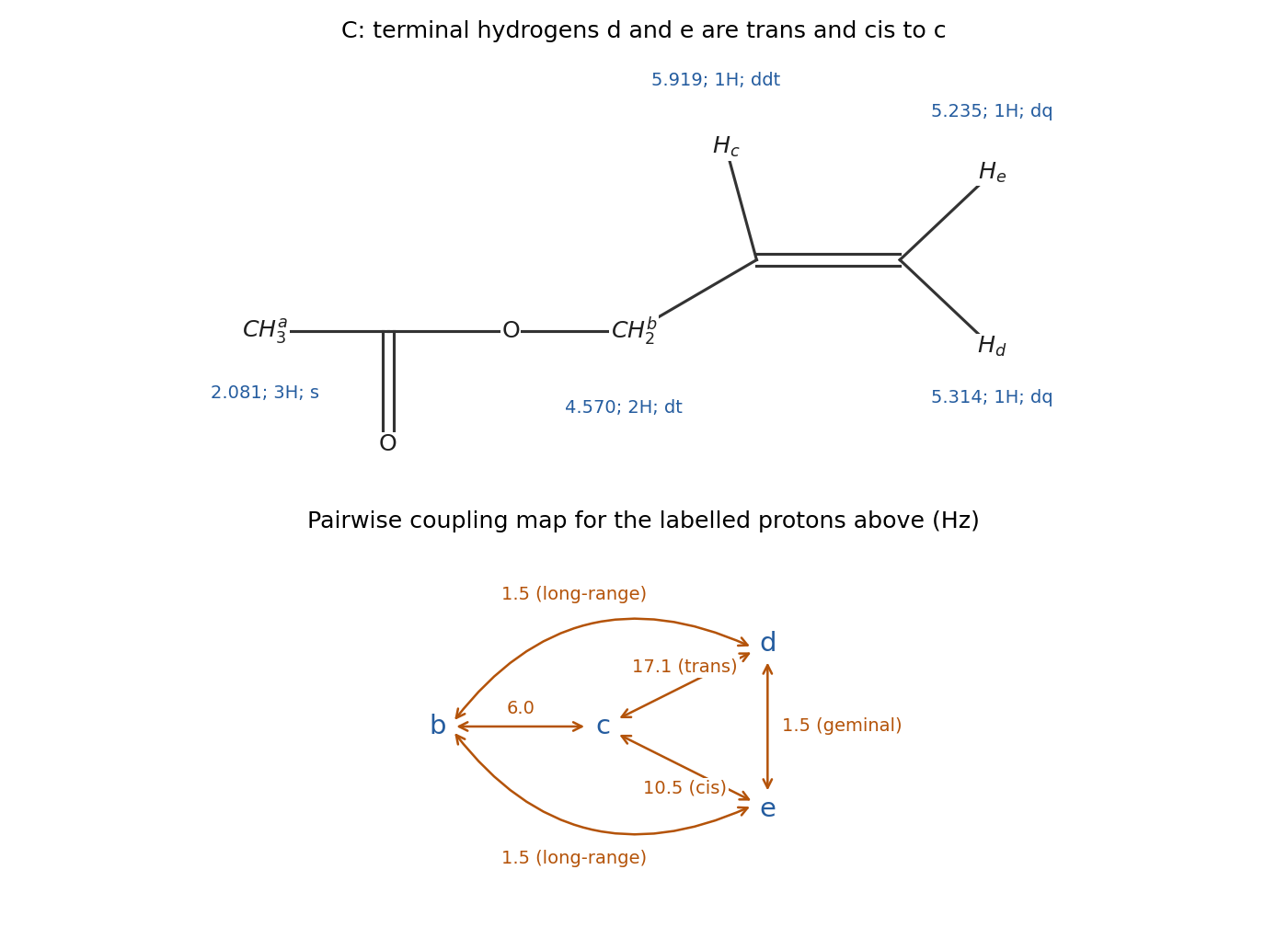
Original stereochemically labelled proton structure for C with all resolved vicinal, geminal and long-range couplings
. Details. 
The large vinyl couplings are 17.1 Hz trans and 10.5 Hz cis; the O-methylene-to-vinyl coupling is 6.0 Hz. At this field, convert every separation by . Comparing the centres of corresponding terminal-proton submultiplets givesThe repeated 0.005-ppm fine spacing from allylic scalar coupling and geminal coupling gives the magnitudesFor example, splitting by a geminal proton and two equivalent long-range-coupled methylene protons, all with the same magnitude, produces overlapping lines with intensities . The 6-Hz splitting of creates two such small NMR triplets centred at 4.580 and 4.560 ppm. An independent check comes from the internal-vinyl multiplet: a centre at 5.919 ppm with splittings 17.1, 10.5 and 6.0 Hz, the last to two equivalent protons, reproduces all twelve labelled line positions. The spectrum determines these coupling magnitudes, not their algebraic signs.
Articles by others on the same topic
There are currently no matching articles.