A is pentane-2,3-dione, . Its index of hydrogen deficiency is , accounted for by two ketone carbonyls. The two resonances near 200 ppm, together with the three saturated carbon signals and the proton integrals, identify an unsymmetrical adjacent diketone rather than an ester or an alkene-containing structure.
The assignments are the carbonyl-adjacent methyl at , the methylene at , and the terminal ethyl methyl at ppm. The two carbonyl carbons give and ppm. Their individual ordering is not uniquely established by the supplied one-dimensional spectra; either ordering between the methyl-side and ethyl-side carbonyls should be kept tentative without a correlation or another independent assignment. In the displayed attached proton test phase convention, the two methyls have one sign, while the methylene and the nonprotonated carbonyls have the opposite sign. The solvent signal near 77 ppm is not a sixth carbon of A.
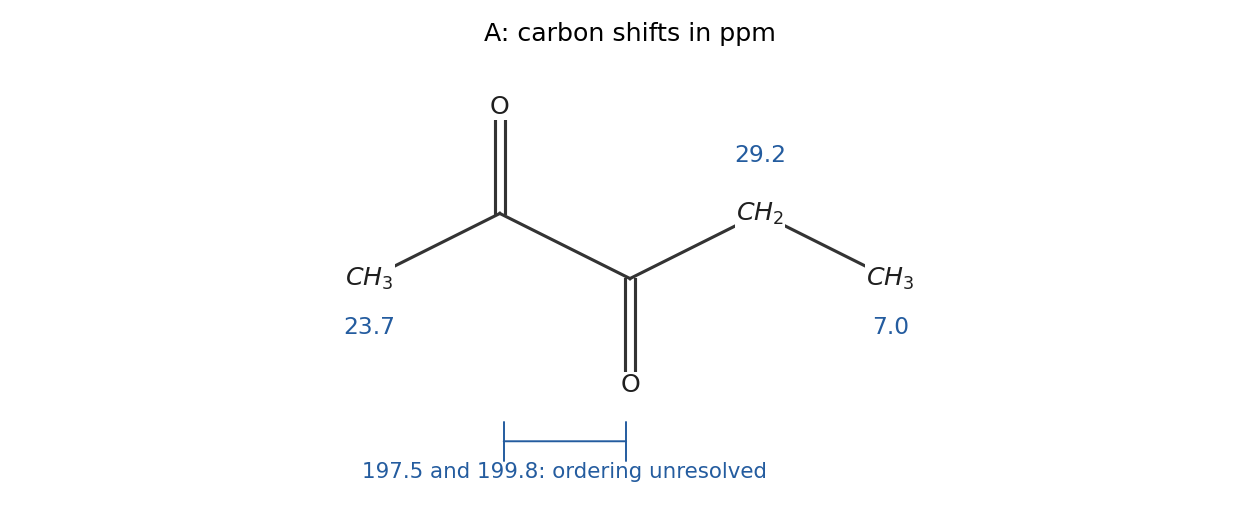
Original structural assignment of the five carbon environments in A; the two carbonyl shifts are an unordered pair
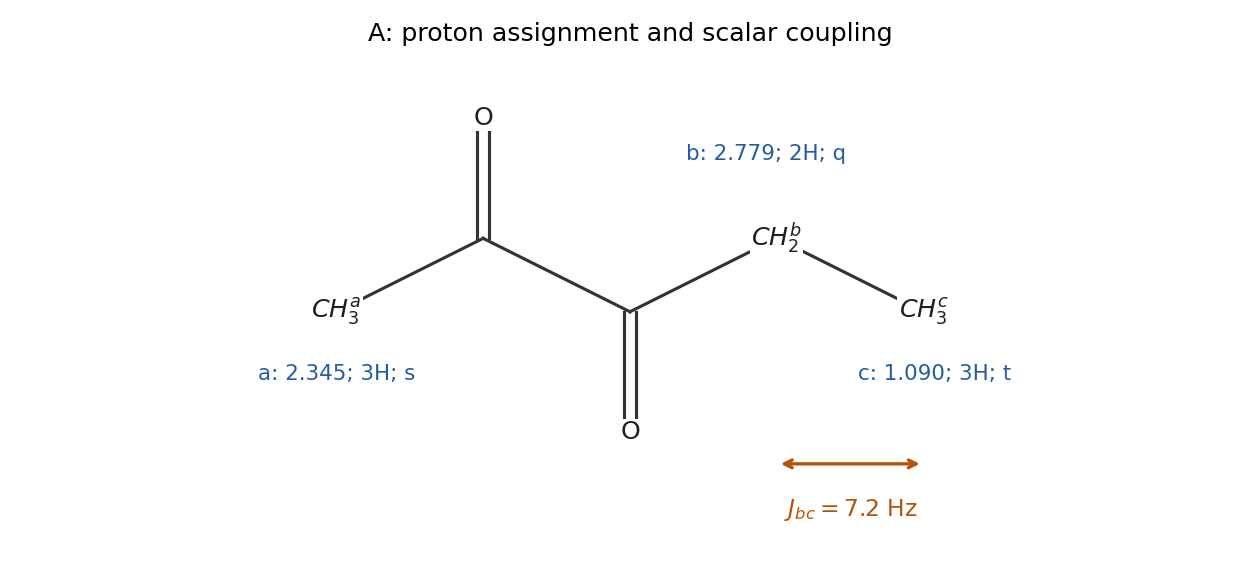
. Details. Label the acetyl methyl , the methylene , and the terminal methyl in . The assignments areThe NMR multiplet centre of the NMR quartet is the mean of its outer lines, ppm. Its adjacent lines differ by 0.024 ppm; the NMR triplet has the same spacing. ThereforeThe two groups, through vicinal coupling, split one another into the expected NMR quartet and NMR triplet. The acetyl methyl has no resolved neighbouring proton across its adjacent carbonyl and appears as a NMR singlet. The integrals sum to eight protons.


B gives spectrum 4. Number the unsaturated acyl chain from its carbonyl carbon. For , the assignments areThe strongly deshielded beta carbon and relatively shielded alpha carbon reflect polarization of the conjugated ester. All four protonated carbons here are CH or methyl environments and share one attached proton test phase, whereas the carbonyl has the opposite phase. The methoxy resonance is decisive: B has an O-bound methyl, not an O-bound methylene.
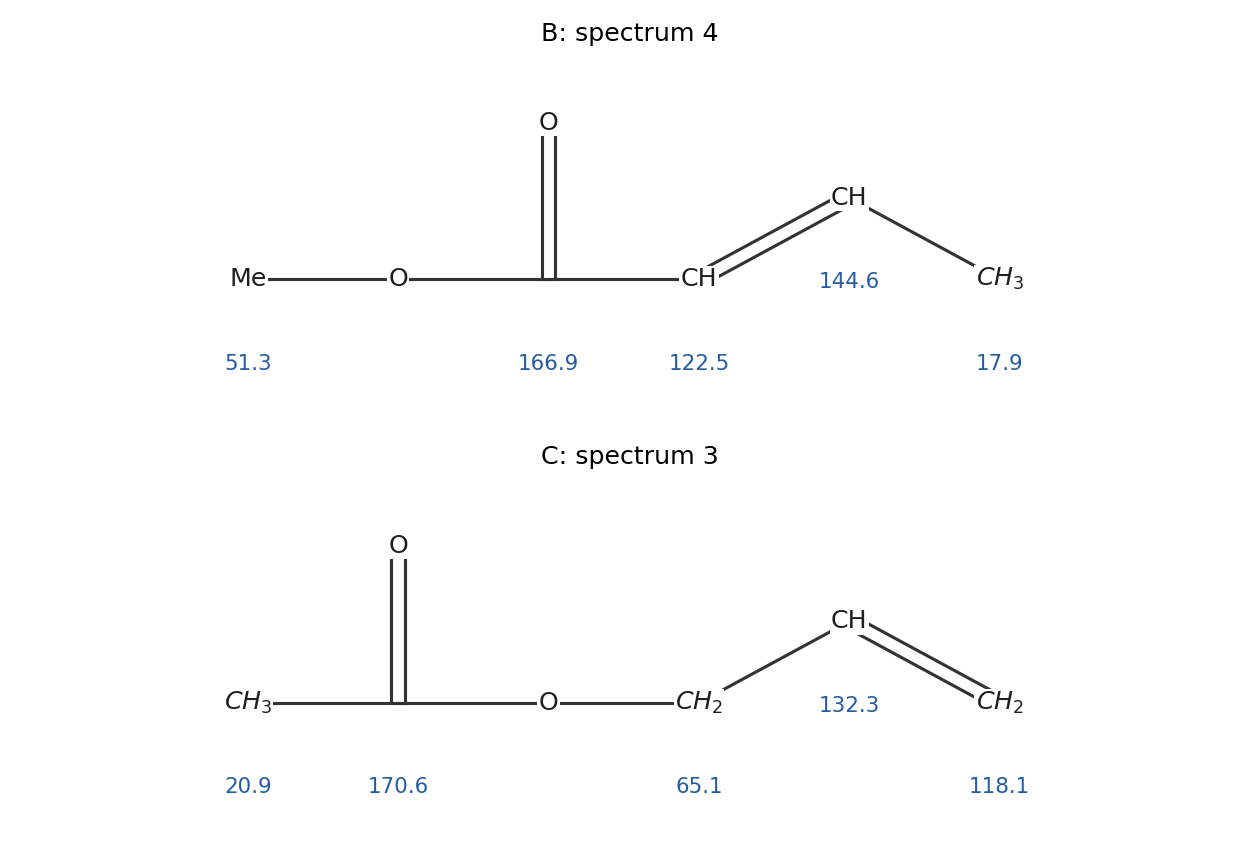
Original carbon-assignment structures for B and C, showing the distinction between a conjugated acyl group and an allyl alcohol-derived group
. Details. 
C gives spectrum 3. For allyl acetate, , assignThe 65.1-ppm resonance is the oxygen-bound methylene. Its attached proton test phase matches the terminal alkene methylene and the nonprotonated carbonyl, while the alkene CH and acetyl methyl have the opposite phase. The carbonyl is not conjugated with the alkene because oxygen and a saturated methylene interrupt the carbon–carbon conjugated path. This explains its higher carbonyl shift relative to B without requiring the two esters to have identical electronic environments.
B should have a lower carbonyl stretching frequency because its ester carbonyl is conjugated with a C=C bond. A typical diagnostic comparison is a conjugated ester carbonyl around – for B versus a nonconjugated ester carbonyl around – for C; the precise positions depend on the measurement conditions. conjugation distributes the pi bonding over the acyl fragment and lowers the effective carbonyl bond force constant.
C also has a terminal alkene, giving characteristic out-of-plane C–H bending features near 990 and . B has an internal, trans-disubstituted alkene, for which a band near is useful. Both compounds contain ester C–O bonds and alkene C–H bonds, so merely observing those general features would not distinguish them. The carbonyl comparison plus the alkene substitution pattern is the stronger identification.
Use for the acetyl methyl, for the O-bound methylene group pair, for the internal vinyl proton, and for the terminal vinyl protons respectively trans and cis to . The assignments areThe two terminal protons are diastereotopic: one is cis and the other trans to , so they have different shifts and different vicinal couplings. Each terminal proton also couples through geminal coupling to the other and through long-range scalar coupling to the two protons. When those small couplings coincide, an underlying doublet of doublets of NMR triplets collapses to the observed NMR doublet of apparent NMR quartets. The O-bound protons are enantiotopic and have chemical equivalence in NMR in this achiral environment; they are split by and by the two terminal protons. The integrated terminal envelope contains two protons, not two equivalent protons at one shift.
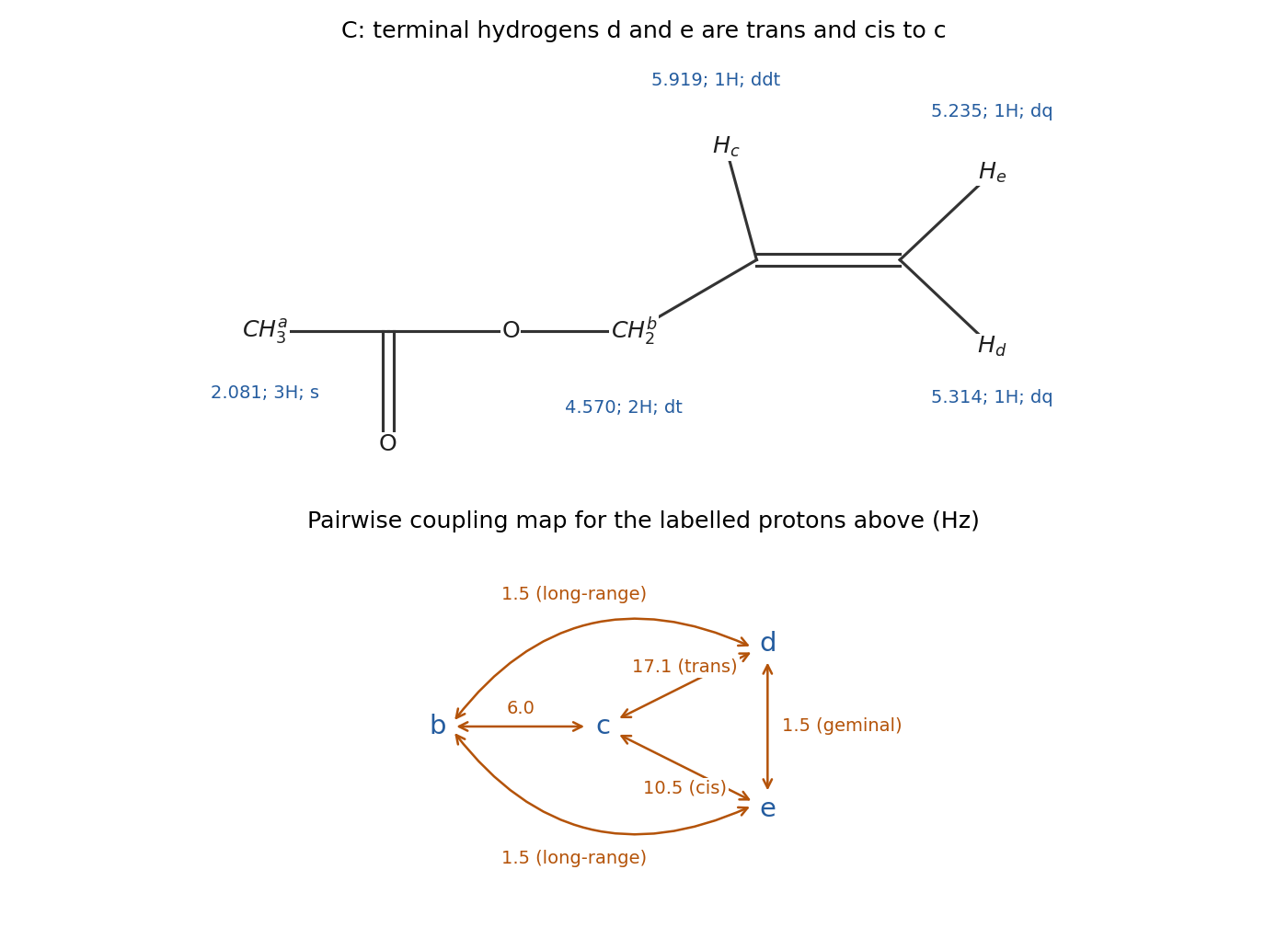
Original stereochemically labelled proton structure for C with all resolved vicinal, geminal and long-range couplings
. Details. 
The large vinyl couplings are 17.1 Hz trans and 10.5 Hz cis; the O-methylene-to-vinyl coupling is 6.0 Hz. At this field, convert every separation by . Comparing the centres of corresponding terminal-proton submultiplets givesThe repeated 0.005-ppm fine spacing from allylic scalar coupling and geminal coupling gives the magnitudesFor example, splitting by a geminal proton and two equivalent long-range-coupled methylene protons, all with the same magnitude, produces overlapping lines with intensities . The 6-Hz splitting of creates two such small NMR triplets centred at 4.580 and 4.560 ppm. An independent check comes from the internal-vinyl multiplet: a centre at 5.919 ppm with splittings 17.1, 10.5 and 6.0 Hz, the last to two equivalent protons, reproduces all twelve labelled line positions. The spectrum determines these coupling magnitudes, not their algebraic signs.
Articles by others on the same topic
There are currently no matching articles.