A is pentane-2,3-dione, . Its index of hydrogen deficiency is , accounted for by two ketone carbonyls. The two resonances near 200 ppm, together with the three saturated carbon signals and the proton integrals, identify an unsymmetrical adjacent diketone rather than an ester or an alkene-containing structure.
The assignments are the carbonyl-adjacent methyl at , the methylene at , and the terminal ethyl methyl at ppm. The two carbonyl carbons give and ppm. Their individual ordering is not uniquely established by the supplied one-dimensional spectra; either ordering between the methyl-side and ethyl-side carbonyls should be kept tentative without a correlation or another independent assignment. In the displayed attached proton test phase convention, the two methyls have one sign, while the methylene and the nonprotonated carbonyls have the opposite sign. The solvent signal near 77 ppm is not a sixth carbon of A.
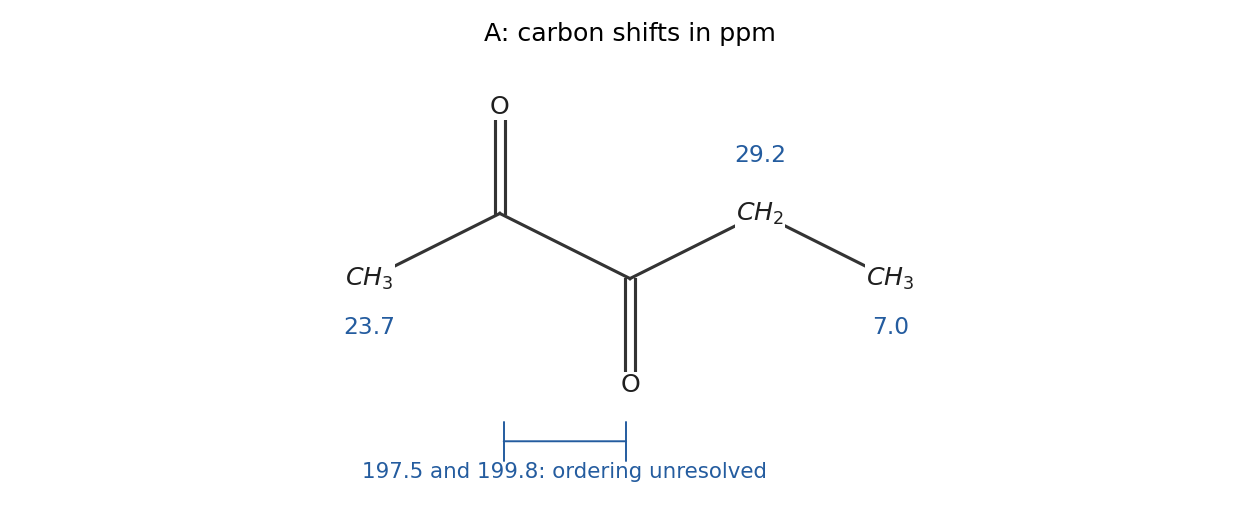
Original structural assignment of the five carbon environments in A; the two carbonyl shifts are an unordered pair
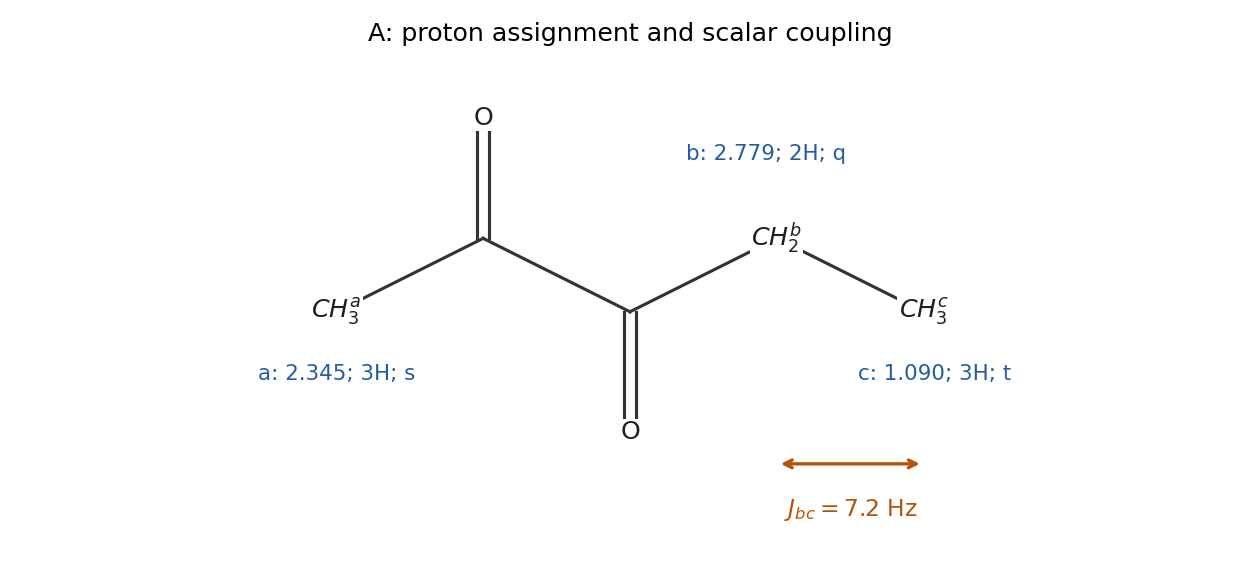
. Details. Label the acetyl methyl , the methylene , and the terminal methyl in . The assignments areThe NMR multiplet centre of the NMR quartet is the mean of its outer lines, ppm. Its adjacent lines differ by 0.024 ppm; the NMR triplet has the same spacing. ThereforeThe two groups, through vicinal coupling, split one another into the expected NMR quartet and NMR triplet. The acetyl methyl has no resolved neighbouring proton across its adjacent carbonyl and appears as a NMR singlet. The integrals sum to eight protons.
B gives spectrum 4. Number the unsaturated acyl chain from its carbonyl carbon. For , the assignments areThe strongly deshielded beta carbon and relatively shielded alpha carbon reflect polarization of the conjugated ester. All four protonated carbons here are CH or methyl environments and share one attached proton test phase, whereas the carbonyl has the opposite phase. The methoxy resonance is decisive: B has an O-bound methyl, not an O-bound methylene.
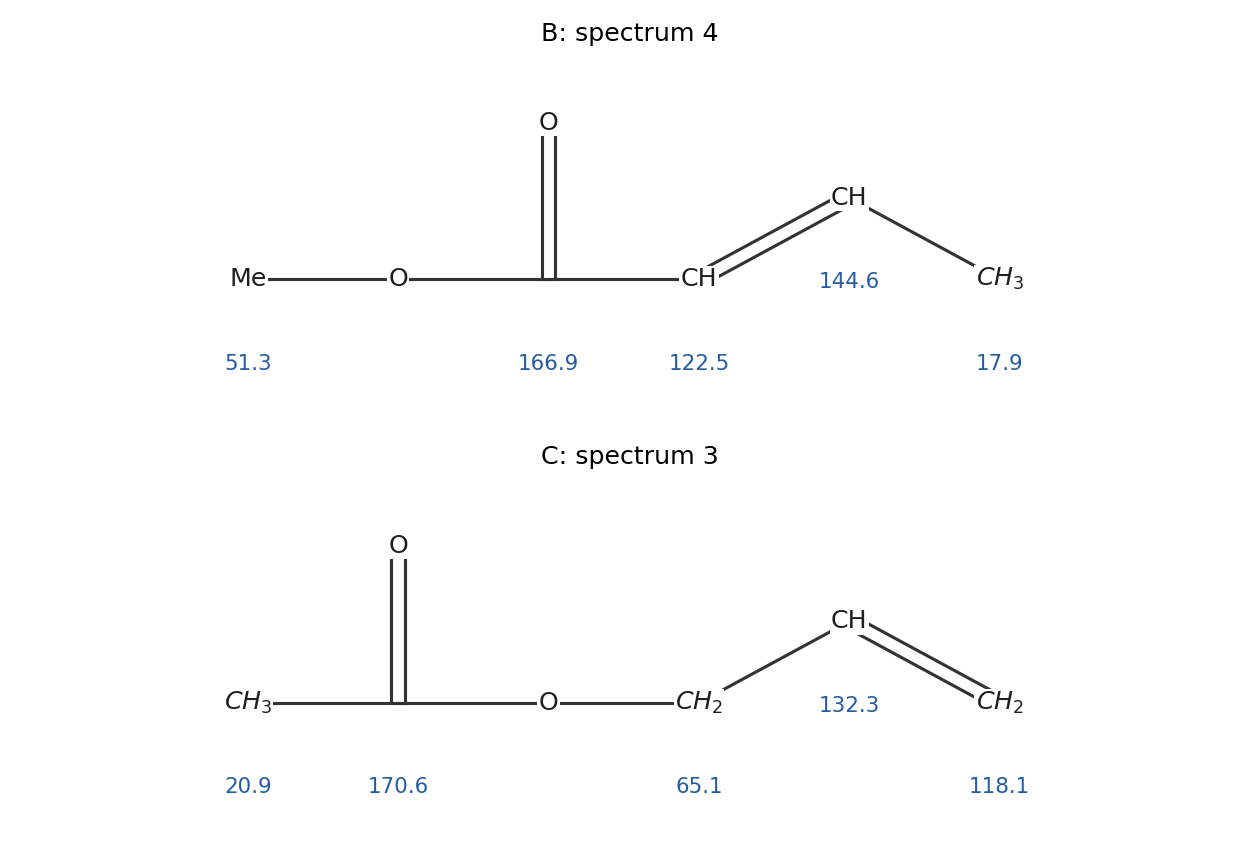
Original carbon-assignment structures for B and C, showing the distinction between a conjugated acyl group and an allyl alcohol-derived group
. Details. C gives spectrum 3. For allyl acetate, , assignThe 65.1-ppm resonance is the oxygen-bound methylene. Its attached proton test phase matches the terminal alkene methylene and the nonprotonated carbonyl, while the alkene CH and acetyl methyl have the opposite phase. The carbonyl is not conjugated with the alkene because oxygen and a saturated methylene interrupt the carbon–carbon conjugated path. This explains its higher carbonyl shift relative to B without requiring the two esters to have identical electronic environments.
B should have a lower carbonyl stretching frequency because its ester carbonyl is conjugated with a C=C bond. A typical diagnostic comparison is a conjugated ester carbonyl around – for B versus a nonconjugated ester carbonyl around – for C; the precise positions depend on the measurement conditions. conjugation distributes the pi bonding over the acyl fragment and lowers the effective carbonyl bond force constant.
C also has a terminal alkene, giving characteristic out-of-plane C–H bending features near 990 and . B has an internal, trans-disubstituted alkene, for which a band near is useful. Both compounds contain ester C–O bonds and alkene C–H bonds, so merely observing those general features would not distinguish them. The carbonyl comparison plus the alkene substitution pattern is the stronger identification.
Use for the acetyl methyl, for the O-bound methylene group pair, for the internal vinyl proton, and for the terminal vinyl protons respectively trans and cis to . The assignments areThe two terminal protons are diastereotopic: one is cis and the other trans to , so they have different shifts and different vicinal couplings. Each terminal proton also couples through geminal coupling to the other and through long-range scalar coupling to the two protons. When those small couplings coincide, an underlying doublet of doublets of NMR triplets collapses to the observed NMR doublet of apparent NMR quartets. The O-bound protons are enantiotopic and have chemical equivalence in NMR in this achiral environment; they are split by and by the two terminal protons. The integrated terminal envelope contains two protons, not two equivalent protons at one shift.
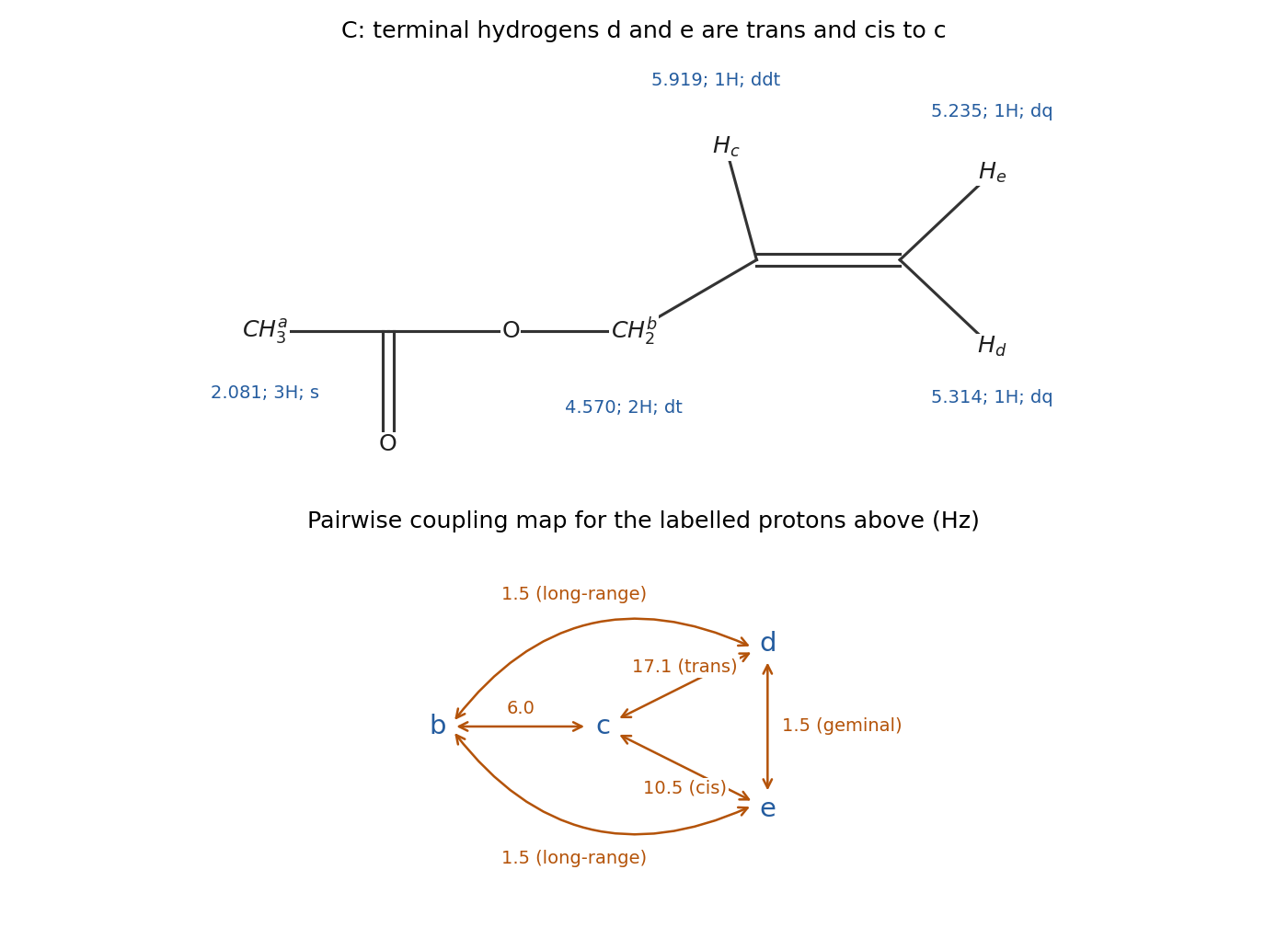
Original stereochemically labelled proton structure for C with all resolved vicinal, geminal and long-range couplings
. Details. The large vinyl couplings are 17.1 Hz trans and 10.5 Hz cis; the O-methylene-to-vinyl coupling is 6.0 Hz. At this field, convert every separation by . Comparing the centres of corresponding terminal-proton submultiplets givesThe repeated 0.005-ppm fine spacing from allylic scalar coupling and geminal coupling gives the magnitudesFor example, splitting by a geminal proton and two equivalent long-range-coupled methylene protons, all with the same magnitude, produces overlapping lines with intensities . The 6-Hz splitting of creates two such small NMR triplets centred at 4.580 and 4.560 ppm. An independent check comes from the internal-vinyl multiplet: a centre at 5.919 ppm with splittings 17.1, 10.5 and 6.0 Hz, the last to two equivalent protons, reproduces all twelve labelled line positions. The spectrum determines these coupling magnitudes, not their algebraic signs.
The reactive occupied orbital of ethoxide is an oxygen lone pair; the acyl electrophile accepts into its carbonyl orbital. Draw the ethoxide lone pair as a directional oxygen-centred lobe directed toward an electrophile. In a lithium-ion-pair picture the low unoccupied acceptor on lithium is an empty, diffuse Li-centred orbital, with 2s/2p character depending on coordination. It should not be confused with an occupied Li–O covalent bonding pair.
For methyl acetate, the occupied frontier donor is principally an oxygen nonbonding orbital, mixed with the ester orbital system. Its low-lying reactive acceptor is , with opposite phases on carbon and oxygen and a relatively large accepting lobe on the carbonyl carbon. The corresponding sketch must show a node between the carbonyl atoms. These are chemically useful frontier-orbital descriptions; lithium alkoxide aggregation and ethanol solvation make a unique isolated-molecule orbital energy diagram an oversimplification.
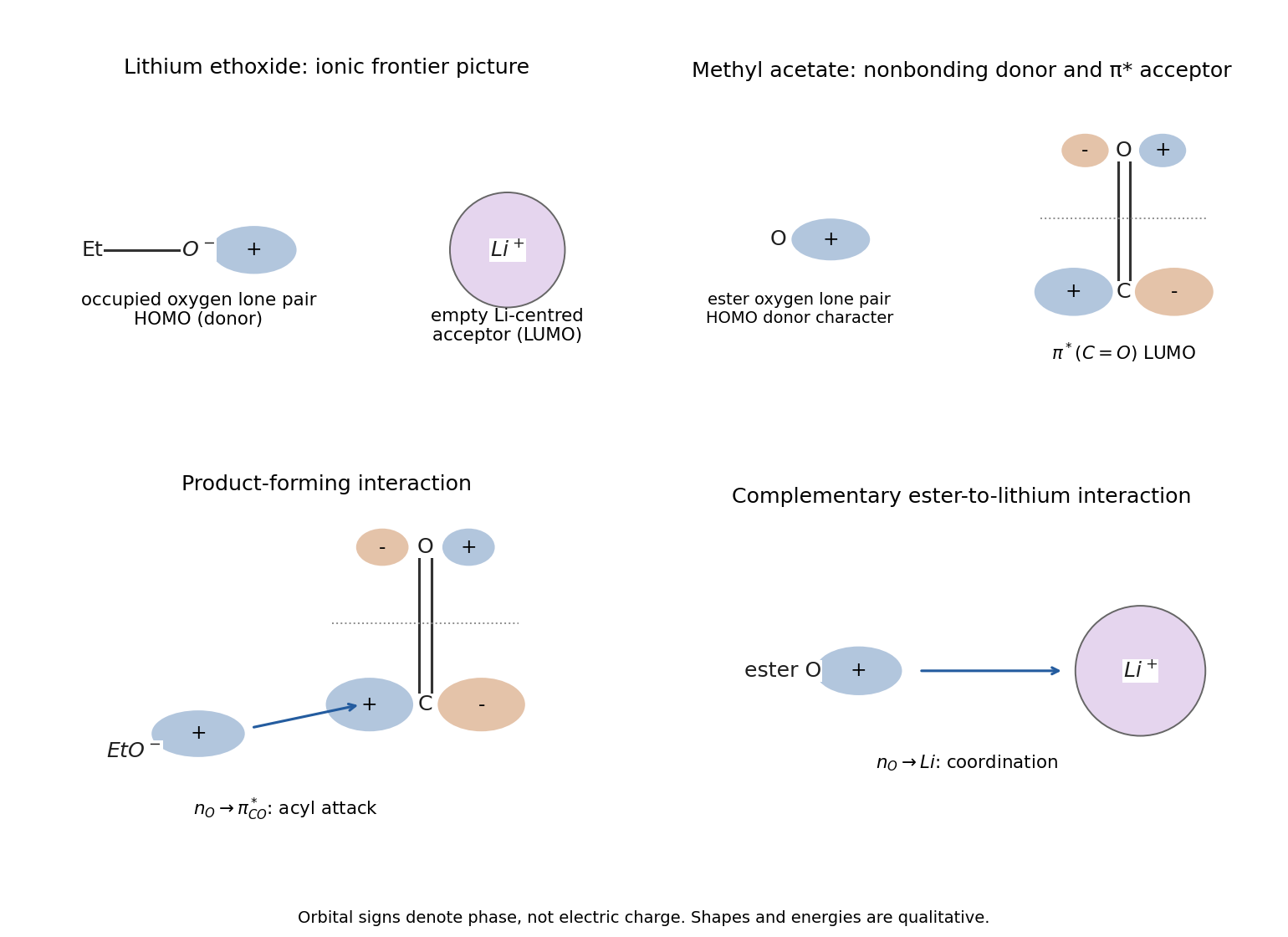
Original frontier-orbital sketches and the two complementary donor–acceptor contacts in the ester–lithium ethoxide encounter
. Details. The product-forming pairing is . Orient an occupied ethoxide oxygen lobe toward the large carbon lobe of the carbonyl acceptor with matching phase. An oblique approach permits constructive overlap while the pi bond weakens; this is the usual Bürgi-Dunitz trajectory to acyl carbon. The high-energy occupied orbital on the anion makes ethoxide the stronger electron-pair donor than the neutral ester oxygen.
The reverse frontier pairing, , gives oxygen-to-lithium coordination. It is a plausible stabilizing contact and can coexist with the first interaction, rather than constituting an alternative way to replace the ester alkoxy group. In the elementary frontier picture, the anionic donor-to-carbonyl interaction is the important pairing for the new covalent bond and is favoured by its donor strength and appropriate accepting coefficient at carbon. The Li contact can polarize the carbonyl and organize the reacting pair. Precise energy-gap rankings require a specified solvated lithium species; the sketches alone do not justify pretending that lithium coordination cannot occur.
The mechanism is nucleophilic addition followed by elimination of methoxide. An ethoxide oxygen lone pair attacks the carbonyl carbon, while the C=O pi pair moves to oxygen:The tetrahedral intermediate collapses when its anionic oxygen reforms the carbonyl and the C–OMe bond breaks with its electron pair going to the methoxy oxygen:lithium is a coordinating counterion; it does not supply an electron pair to the acyl carbon. proton exchange with ethanol connects the methoxide produced to the ethoxide catalyst pool and gives methanol, so the net solvent-mediated exchange is methyl acetate plus ethanol to ethyl acetate plus methanol. The reversibility of the elementary acyl steps is important: changing an alkoxy group is not automatically an irreversible reaction.
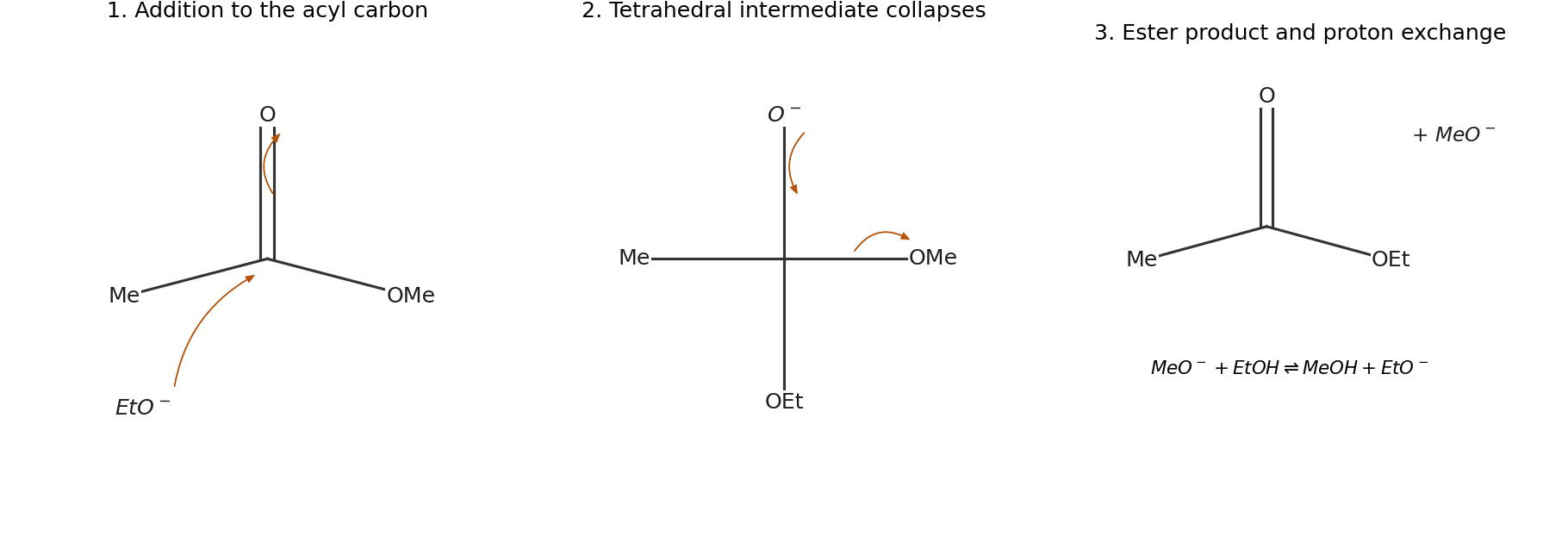


ethanol undergoes proton transfer with the methoxide produced. The oxygen lone pair of methoxide attacks the hydroxyl proton of ethanol, while the ethanol O–H bond pair returns to its oxygen:The alcohol acidities are similar, so this is an equilibrium, not an overwhelmingly one-way deprotonation determined solely by intrinsic acidity. The large ethanol reservoir and initially small methanol concentration nevertheless matter. This exchange means that lithium ethoxide need not be consumed stoichiometrically in the net transesterification. Neutral ethanol can also participate in proton shuttling; it is not acting as a reducing reagent or as a substrate for elimination under these conditions.
Excess ethanol drives a reversible ester exchange mainly through the actual mixture composition, not through a large new bond-energy advantage. The net reaction exchanges one ester and one alcohol for a closely related ester and alcohol. It preserves the main bond types and has no obvious large exothermicity. Solvation and ion pairing can contribute to its enthalpy, but there is no basis here for asserting a large negative standard reaction enthalpy.
There are two molecules on each side, so an increase in particle count is not the entropy explanation. Instead useWith ethanol as the solvent and little methanol initially, the reaction quotient is small; product formation and mixing lower the Gibbs free energy until the exchange equilibrium is reached. ethanol can be treated approximately as having fixed activity near its pure-solvent value, rather than assigned an arbitrarily enormous activity, while methanol remains dilute. This composition-dependent chemical-potential contribution is the appropriate entropic/mixing argument. It explains forward conversion under these conditions without claiming that must be positive, or that complete conversion follows without an equilibrium constant or removal of methanol.
Both dimers have two electrons in a valence sigma-bonding orbital and a formal valence bond order of one. For hydrogen the minimal-basis configuration is , with the -derived as highest occupied molecular orbital and as LUMO. The bonding combination has no internuclear node; the antibonding combination does.
For lithium, include the filled core pair of levels as well as the valence levels:The first two orbitals are predominantly core combinations whose bonding and antibonding occupations cancel in a simple bond-order count. The highest occupied molecular orbital is predominantly , denoted ; the LUMO is , predominantly the antibonding combination but modified by mixing with compatible contributions. The nearby empty -derived sigma and pi levels must also be shown. Only orbitals of matching symmetry mix, so this does not mean that every combination mixes with every combination.
On a common qualitative energy reference, hydrogen is much lower than lithium's valence , while lithium's core levels lie much deeper. The Li valence bonding–antibonding separation is smaller, consistent with its longer and weaker bond. The figure uses a compressed core region and schematic gaps, not measured orbital energies. The role of symmetry-compatible s–p orbital mixing in the first-row diatomics is illustrated in institutional molecular-orbital notes.[ref]
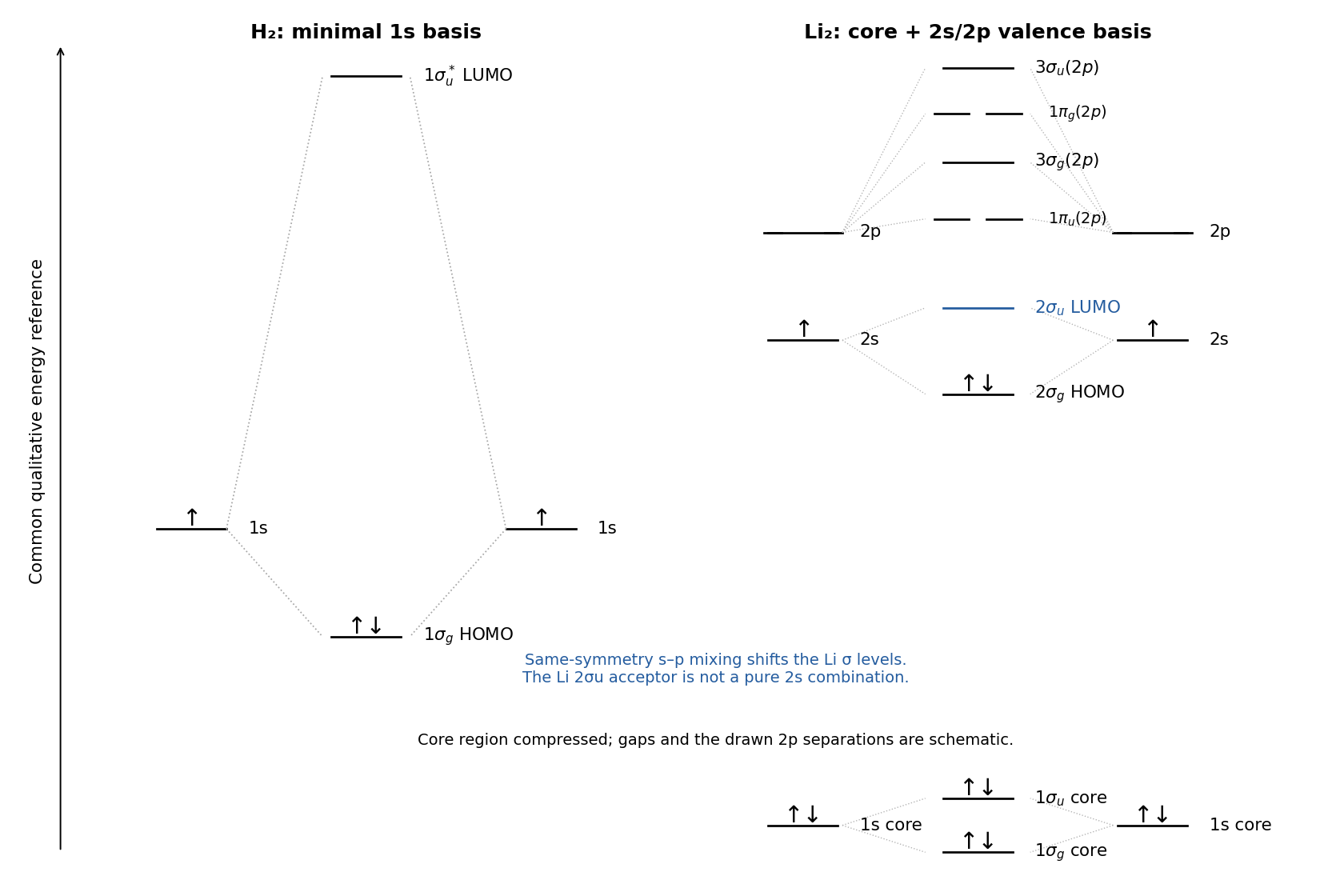
Original common-reference qualitative orbital diagrams for hydrogen and lithium dimers, including lithium 2p-derived levels and core occupancies
. Details. 
Two electrons can occupy a fully bonding orbital delocalized equally over all three hydrogen atoms. Three atomic orbitals on an equilateral triangle form one totally symmetric combination and a degenerate pair of higher orbitals. In an orthonormal equal-interaction model with diagonal energy and off-diagonal ,The lower orbital is proportional to , with constructive overlap along every edge. Its two electrons give a three-centre two-electron bond and equivalent interactions between every pair of nuclei. At the equilibrium distance, this bonding competes with nuclear Coulomb force to favour the symmetric triangular arrangement. The occupied shell is nondegenerate and closed, so there is no first-order Jahn-Teller incentive to distinguish the three edges. A straight-line or localized single-bond description would miss that equally shared bonding pattern.
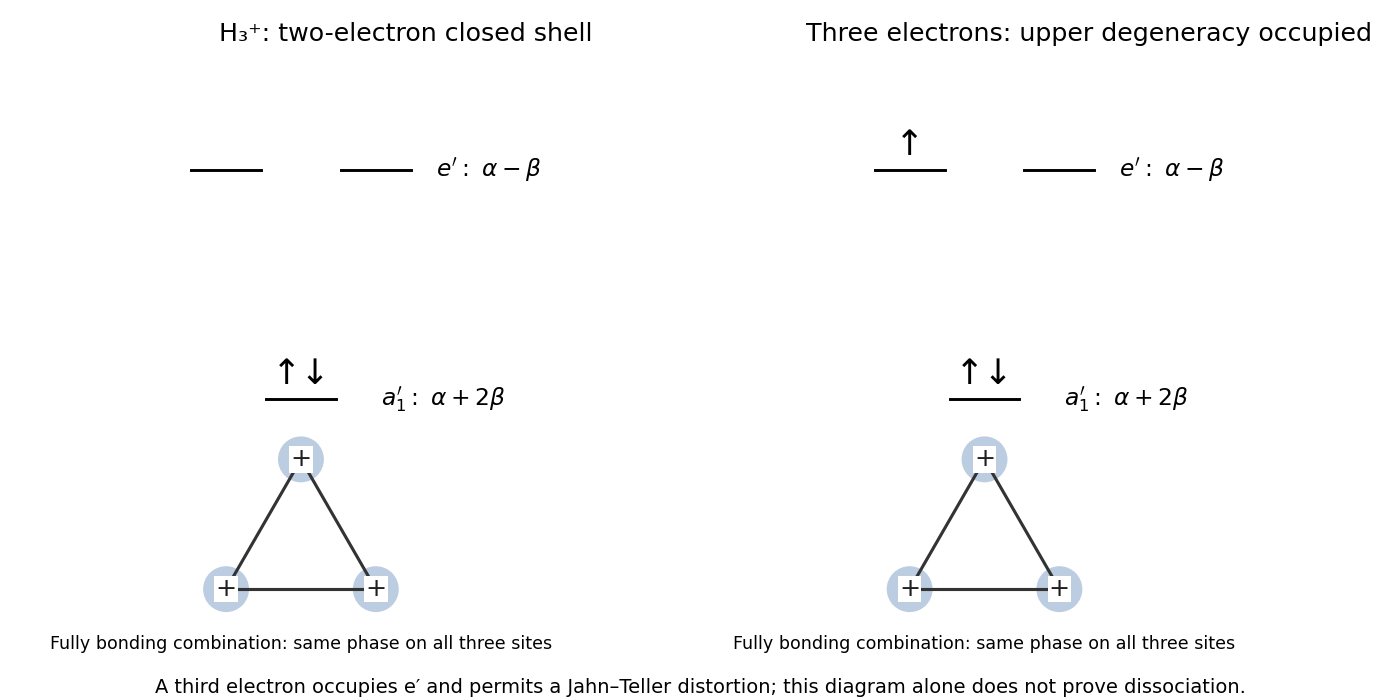
Original three-site orbital filling for the two-electron cation and the effect of a third electron on a degenerate triangular shell
. Details. 
The third electron must enter the higher, degenerate and partly antibonding orbital pair rather than the already filled fully bonding orbital. At an equilateral geometry the configuration becomes . This weakens the collective bonding and creates orbital degeneracy, so a distortion can lower the singly occupied component and localize bonding. Along the ground-state reaction coordinate, formation of a normal two-electron H–H bond with a separated hydrogen atom becomes favourable.
The result is ground-state dissociation to , not loss of a proton from the cation or formation of three isolated atoms. One should not claim that adding one electron exactly cancels two bonding electrons: a simple three-orbital count alone does not predict a zero bond order or prove dissociation. The important qualitative changes are occupancy of an antibonding/degenerate level and access to a lower-energy dimer-plus-atom arrangement. A complete dissociation statement requires the potential-energy surface, including nuclear repulsion; electronically excited neutral H states are a separate issue.
Li can retain a bound triangular framework, but an equilateral triangle with three valence electrons is Jahn-Teller unstable. The six core electrons are effectively spectators. In the simplest triangular valence model, two electrons occupy the fully bonding level and one occupies the degenerate upper pair. Making one edge different splits that pair; the single electron occupies the lower component, giving an electronic stabilization that can outweigh the cost of a small distortion. An isosceles triangle is sufficient to lift the degeneracy, so three different edge lengths are not required.
The two 2.8-Å contacts are close to, but slightly longer than, the 2.7-Å dimer bond, while the 3.5-Å edge is much weaker. Delocalization and partial antibonding occupation explain why these cannot be treated as three independent full-strength Li–Li single bonds. lithium's nearby valence functions provide additional polarization and mixing channels absent from a hydrogen -only description, allowing a more flexible multicentre electronic structure. The existence of a bound minimum, unlike ground-state H, is an energetic fact rather than a consequence of three-electron counting alone. Calculated Li surfaces show bound states, a conical intersection and Jahn-Teller coupling.[ref]
The ordering is allyl chloride 1-chloropropane 2-chloropropane. Iodide is a good nucleophile but a weak base, and polar aprotic solvent acetone favours its SN2 reaction. SN2 reaction and C–Cl cleavage occur in one step; precipitation of sodium chloride can also favour halide exchange without changing the basic steric comparison.
The primary saturated chloride supplies the reference rate. Allyl chloride is also primary, but its neighbouring pi system stabilizes the developing delocalized electronic structure in the substitution transition state. It can therefore react about 64 times faster without requiring a free allylic carbocation. The secondary chloride is sterically crowded at the attacked carbon, making backside approach and the crowded transition state less favourable; its rate is about 0.02 times the primary value. The leaving group and nucleophile are the same in the comparison, so assigning the ordering to different halide leaving groups would be incorrect. If prefactor differences are neglected, at 333 K gives roughly and for the allylic and secondary substrates respectively: modest barrier changes produce large rate ratios.
The first product is , with the original alkene geometry retained. methoxide attacks the primary saturated carbon bearing bromine from the backside. Its oxygen lone pair forms the new C–O bond as the C–Br bonding pair leaves with bromide. The other bromine is vinylic, directly bonded to an sp carbon: ordinary SN2 reaction is unfavourable there, and ionization would require an unstable vinyl cation. Thus the primary alkyl bromide is replaced selectively, rather than replacing the vinylic halide or moving the double bond. There is no observable inversion label at the attacked carbon because it is a methylene.
The second product is sodium 4-propoxybutane-1-sulfonate, . sodium hydride first removes the alcohol proton, giving propoxide and hydrogen. The propoxide oxygen then attacks the primary ring carbon bonded to the ring oxygen; simultaneous cleavage of that carbon–oxygen bond opens the sultone. The departing ring oxygen remains attached to sulfur as part of the resonance-stabilized sulfonate anion. The carbon attached directly to sulfur is not the substitution site, because cleavage there would not expel the same stable sulfonate leaving group. This is carbon-centred ring opening of a cyclic sulfonate ester, not addition across an S=O bond.
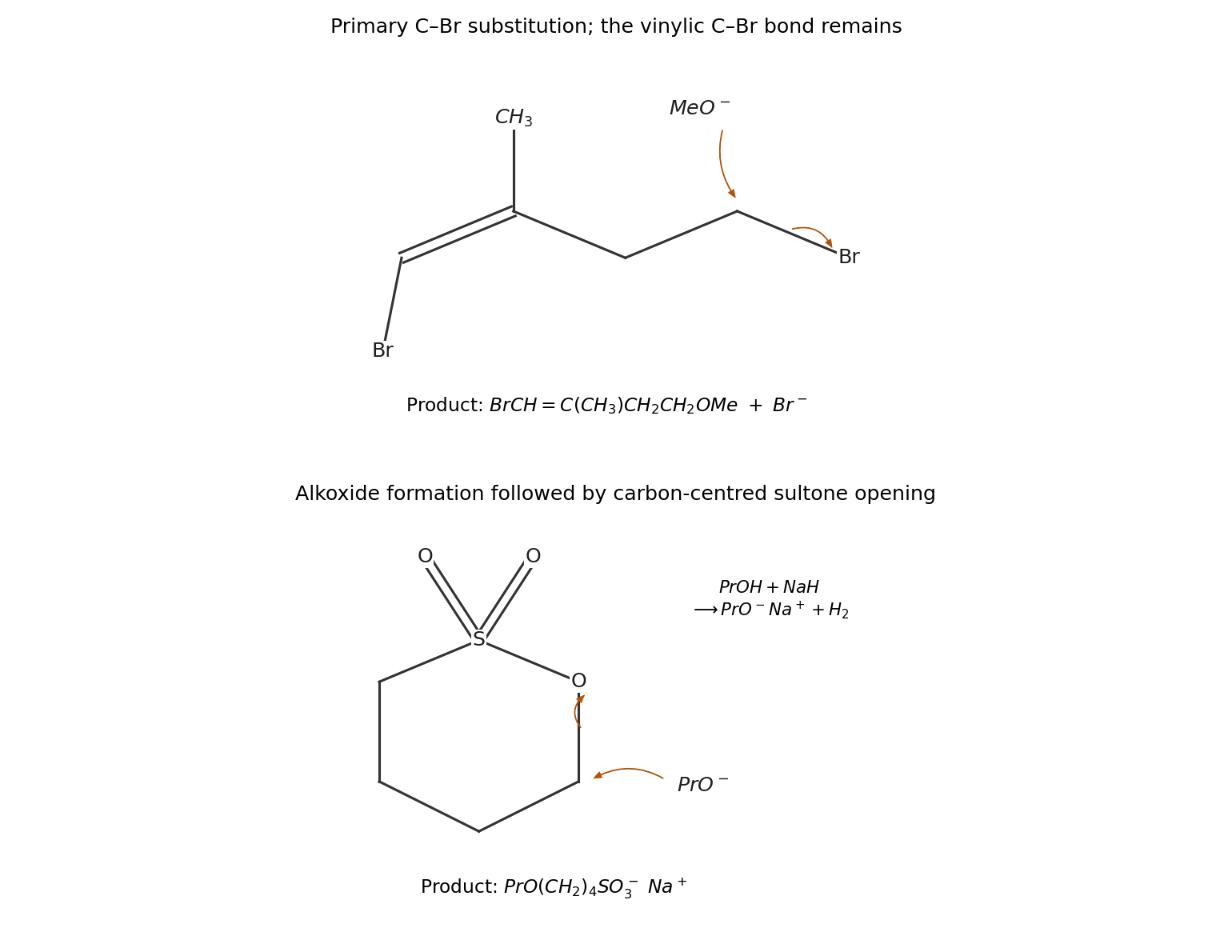
Original electron-pair arrows for selective primary-carbon substitution and propoxide opening of the four-carbon sultone
. Details. 
Aqueous base selectively converts the methyl ester to a carboxylate, and brief acidification gives the corresponding monoacid while retaining the tert-Butyl ester. At the methyl-ester end, a hydroxide lone pair attacks the acyl carbon and the carbonyl pi pair moves to oxygen. The tetrahedral intermediate collapses as the oxygen anion reforms C=O and the acyl C–OMe bond breaks to methoxide. proton transfer then gives the carboxylate and methanol. carboxylate formation makes the net saponification effectively irreversible under the basic conditions; protonation protonates that carboxylate.
The tert-Butyl ester reacts more slowly under these conditions because its bulky alkoxy group hinders acyl attack, and tert-butoxide is a stronger base and poorer leaving group than methoxide. The selectivity is kinetic, not an assertion that tert-butyl esters can never undergo base hydrolysis. The work-up should be sufficiently mild and brief to avoid the separate acid-labile pathway.
Anhydrous trifluoroacetic acid instead removes the tert-butyl group, leaving the methyl ester. protonation activates the ester; in a useful reactive protonation form the alkoxy oxygen bears the proton. The O–C(tert-butyl) bond then cleaves with its electron pair going to oxygen, producing the carboxylic acid and a tert-butyl-cation-like fragment. Loss of a methyl proton gives 2-methylpropene and regenerates the acid catalyst. Carbonyl-oxygen protonation and charge delocalization can precede cleavage; drawing alkoxy-oxygen protonation is a transparent way of tracking the bonds broken. The key distinction is alkyl–oxygen cleavage here versus acyl–oxygen cleavage in the base reaction. Methyl-cation formation is strongly unfavourable, and without water ordinary acid-catalysed methyl-ester hydrolysis is not available. No water is required to account for the tert-butyl deprotection or its alkene by-product.
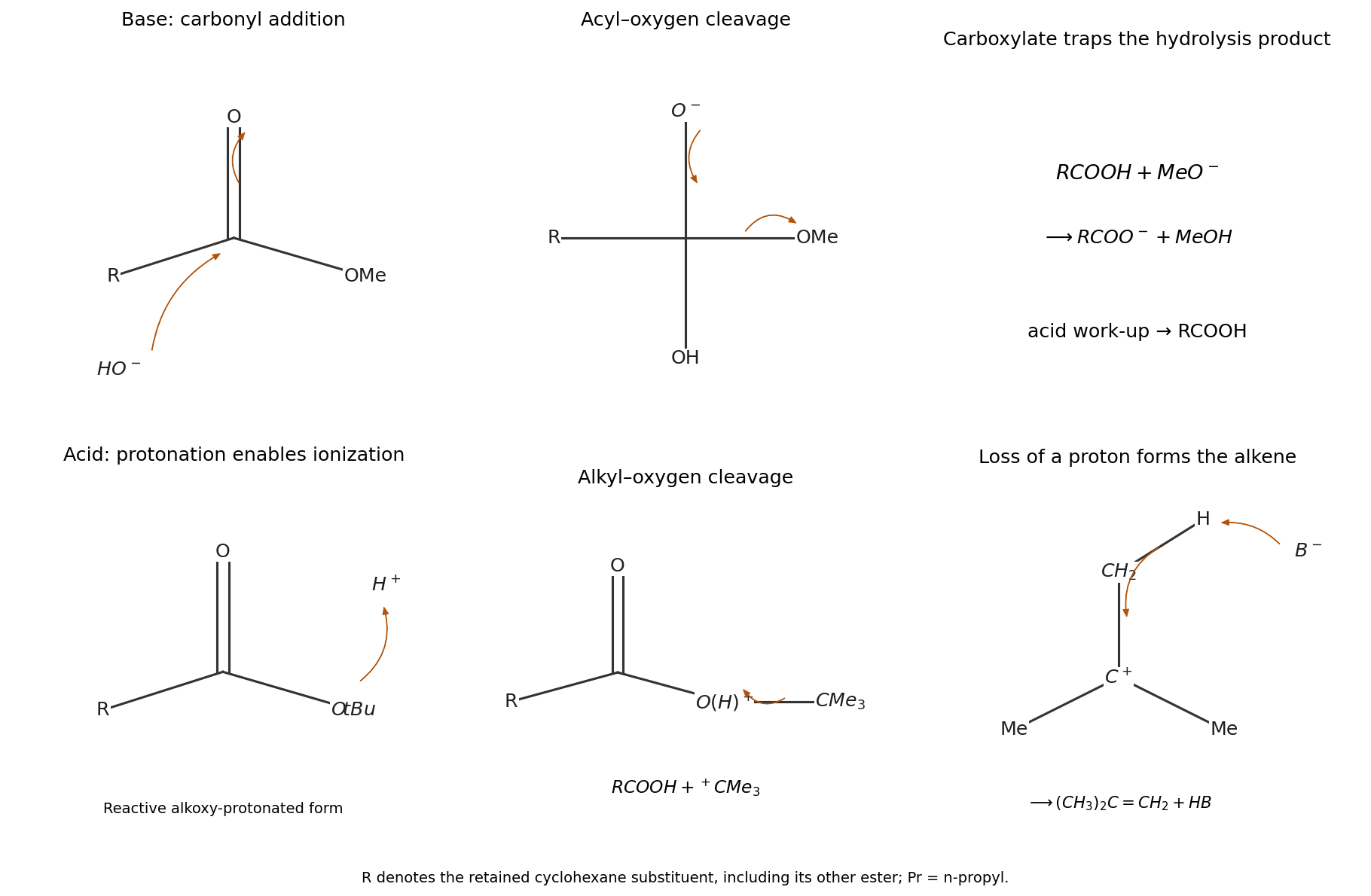
Original mechanisms contrasting tetrahedral acyl substitution with acid-promoted tert-butyl alkyl–oxygen cleavage
. Details. 
Build the phenethyl grignard reagent, use one portion to make a phenethyl-substituted ester, and add two further equivalents to that ester. Write ; the target is , so all three carbon substituents must be phenethyl, not benzyl.
hydroboration followed by oxidation of styrene gives : use in a suitable ether, followed by alkaline hydrogen peroxide. The Anti-Markovnikov addition regiochemistry is essential; acid-catalysed Markovnikov addition of water would give the wrong alcohol. Convert the primary alcohol to with phosphorus tribromide, then form with magnesium in dry ether. The organomagnesium reagent must be prepared and used without a protic solvent.
carboxylate one portion with carbon dioxide and acidify to obtain , then esterify with ethanol under acid catalysis to give . Treat the isolated ester with at least two equivalents of another portion of and then perform an aqueous acidic work-up:The first addition to the ester gives a ketone after ethoxide elimination; the second addition gives the tertiary alkoxide. Work-up supplies its OH proton. The extra central carbon comes from carbon dioxide, and each original styrene contributes one intact eight-carbon phenethyl unit. The resulting carbon count is , matching the target skeleton.
Let be Gibbs free energy, enthalpy and thermodynamic temperature for a fixed amount and composition of material, with the derivative taken at constant pressure. Apply the Gibbs–Helmholtz equation to the standard molar reaction quantities, obtained by summing product minus reactant contributions with their stoichiometric coefficients:Define as the dimensionless thermodynamic equilibrium constant expressed using activities in specified standard states. Since , where is the molar gas constant,If the reaction enthalpy is constant over the interval, integration givesThis is the requested Van't Hoff equation. For an exothermic reaction, increasing temperature decreases . Although the name “isochore” is often used in this context, the displayed enthalpy form follows from standard Gibbs energies and the stated constant-pressure Gibbs–Helmholtz identity; the analogous ideal-gas concentration form involves internal energy when the temperature dependence of standard concentration is retained.
The two remaining partial pressures sum to bar. Their ratio therefore gives bar and bar. With the ideal-gas activity approximation and bar,The equilibrium constant is dimensionless: pressures enter as ratios to the standard pressure. Blindly substituting pressures in pascals into an unnormalized expression would give a different, incorrect thermodynamic .
The standard reaction enthalpy is per mole of reaction as written, because the elements are in their reference states. ThusThis calculation uses the supplied constant-enthalpy simplification. At 200 bar, an accurate thermodynamic treatment would use chemical fugacities rather than ideal partial pressures; no chemical fugacity coefficients are supplied. The iron catalyst changes the approach to equilibrium, not its thermodynamic value.
Using the equilibrium constant calculated without premature rounding,Then givesThe sign agrees with the reduction in gas stoichiometric amount. The standard reaction entropy is not the absolute entropy of ammonia: its stoichiometric coefficient is two. ThereforeThis is an absolute standard molar entropy inferred within the paper's thermodynamic approximations, not a claim that elemental gases have zero absolute entropy. Only their standard enthalpies of formation are zero in this calculation.
For a reversible temperature change at constant pressure and fixed composition, and . HenceWith , termwise integration yieldsThe last sign follows from integrating , not . Every term has units ; the logarithm has a dimensionless argument. Inserting 800 K gives an entropy increase of , and thereforeThe standard pressure remains fixed during this integration; the 200-bar equilibrium mixture is not the standard state. Differentiating the integrated expression recovers , providing a check on all five terms. Using the ammonia heat-capacity polynomial here does not retroactively replace the explicitly requested constant-reaction-enthalpy approximation in the preceding equilibrium calculation.
The products lie below the reactants, while the transition state lies above both. On an energy-versus-reaction-coordinate plot, the forward activation energy is the vertical separation , not the difference between product and reactant energies. For an exothermic elementary path, , and the reverse barrier is .
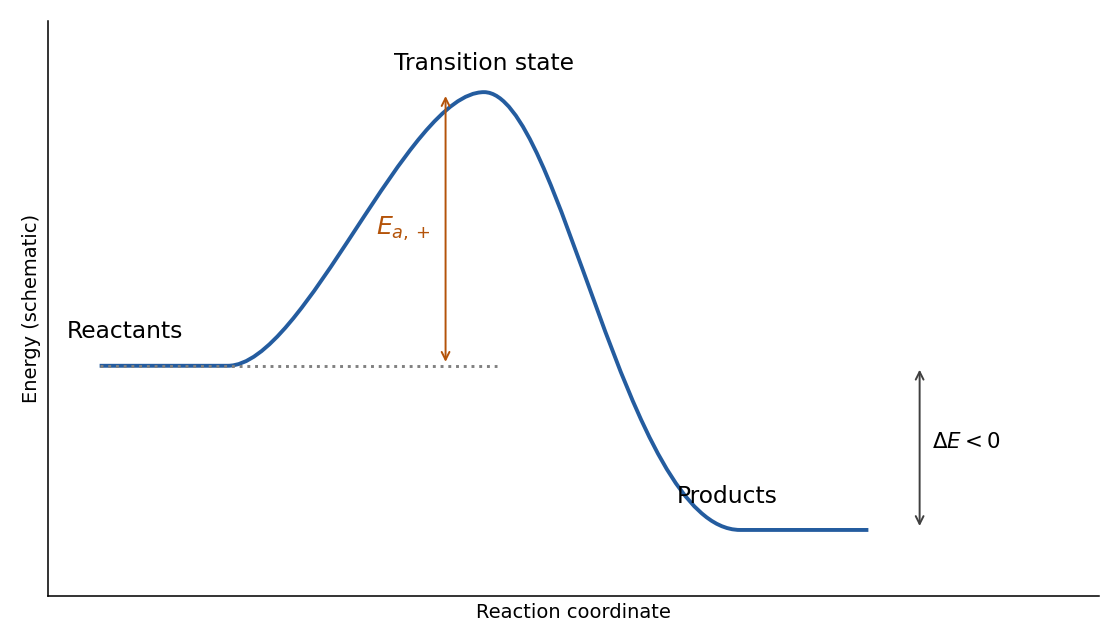
Original schematic exothermic energy profile with reactant, product, transition-state and forward-barrier labels
. Details. 
The Arrhenius equation isThe exponential gives the strongly temperature-dependent energetic factor. For a simple bimolecular collision picture, collects the encounter frequency per reactant concentration and the fraction of encounters with a suitable orientation and other dynamical requirements. Thus a collision is not automatically a successful reaction even when its energy is sufficient.
has the same units as , which depend on the rate law; it is not always a frequency in . More generally it is an effective prefactor containing statistical and dynamical contributions rather than a literal universal collision count. Treating it as temperature independent is the approximation requested here.
Rearrange the Arrhenius relation using the molar activation energy and the molar gas constant:The exponent is dimensionless. There is no Avogadro factor in it because both and are expressed per mole; the molecular concentration convention only determines the units of the prefactor.
For forward and reverse elementary reactions at equilibrium, the two rates are equal. Both directions have two reactant particles and use the same concentration convention, so the conversion factors cancel and . ThereforeFor molar rather than molecular number concentration, the bimolecular rate constant is multiplied by the Avogadro constant:Only one factor is needed: converting the two concentration factors contributes , while converting the production rate from molecules to moles removes one factor.
Step 1 is initiation; steps 2 and 3 are propagation; step 4 is termination. Initiation dissociates a chlorine molecule into two chlorine free radicals. Each propagation step consumes one free radical and creates another, carrying the chain forward without destroying its free radical carrier overall. Termination removes two chlorine free radicals by recombination.
The inert collision partner accepts or supplies energy as needed and is regenerated. It is not a free radical chain carrier or a net reagent. Adding the two propagation steps cancels the hydrogen and chlorine free radicals and gives one complete conversion of hydrogen plus chlorine to two molecules of hydrogen chloride.
The reverse elementary rate constant is extraordinarily small at 298 K. Its reaction would require hydrogen chloride and a chlorine free radical to produce a hydrogen free radical and chlorine, reversing a highly exothermic propagation step. The value found above makes this channel negligible for the intended reacting mixture compared with forward propagation.
A large equilibrium constant alone does not permit a reverse reaction to be ignored under every conceivable composition: if forward reactants were exhausted, concentration ratios would matter. The simplification applies during the forward chain-reaction regime specified, rather than constituting a universal statement about all late-time or imposed reverse conditions.
Apply the steady-state approximation in chemical kinetics to the hydrogen and chlorine free radicals. After a short initiation transient their formation and consumption can balance while the stable reactants continue to be depleted and hydrogen chloride accumulates. Accordingly set and .
This does not mean the free radicals are absent or that the whole mixture is at equilibrium. hydrogen and chlorine molecules and the hydrogen chloride product generally cannot all be assigned steady concentrations over appreciable conversion. The inert-body concentration can be treated as an imposed or slowly varying bath quantity; it is not an intermediate to which a free radical balance must be applied.
Let be the event rate for step , soThe free radical balances, including the factors of two for initiation and termination, areThus and , givingBoth propagation events form hydrogen chloride, soThe orders are one in hydrogen, one half in chlorine and three halves overall, with when the observed rate is HCl formation. If the rate is instead defined as the stoichiometrically normalized reaction rate, half that formation rate, the prefactor lacks the factor two. The bath concentration cancels because the same M-assisted initiation and recombination control the free radical pool. The result does not require ; different free radical concentrations make their steady fluxes equal. For molar concentration, has units .
Using bonds broken minus bonds formed, the enthalpies per mole of elementary events areUnder the steady-state approximation in chemical kinetics, initiation and termination have equal event rates, so their enthalpy contributions cancel. The two propagation steps also have equal flux, and their combined enthalpy is per overall reaction producing two moles of HCl. Step 3 dominates the heat release; the small endothermic contribution of step 2 only slightly offsets it.
An insulated vessel cannot remove this released energy as heat, so its temperature rises as reaction proceeds. In a rigid vessel the precise energy balance uses reaction internal energy and constant-volume heat capacities, whereas a constant-pressure adiabatic balance uses enthalpy; the strong exothermic conclusion is the same. Warming changes the rate constants, and activated initiation and propagation can accelerate, producing positive thermal feedback and potentially a rapid temperature rise. A numerical final temperature or a claim of an inevitable explosion is not justified without composition, heat capacities and heat-loss information. The initially assumed 298-K rate constants cannot remain fixed throughout an appreciable adiabatic temperature rise.
The large drop from carbon to silicon is the main trend; the smaller reversals at Ge and Pb reflect changes in shielding and valence-electron binding. Allen electronegativity is based on the mean binding energy of valence electrons in free ground-state atoms, rather than an arbitrary charge-transfer count. Moving to larger principal shells generally makes the valence electrons more diffuse and more shielded, reducing their attraction to the nucleus. carbon's compact second-shell valence orbitals therefore give particularly high electronegativity.
The intervening filled 3d shell shields imperfectly, increasing effective nuclear attraction in germanium relative to a simple smooth extrapolation from silicon. This helps explain Ge being slightly above Si rather than below it. Increased size then lowers Sn relative to Ge. The filled inner d and f shells and relativistic stabilization of lead's 6s electrons modify the next step; contraction and stronger binding of the 6s contribution help Pb lie slightly above Sn. The small reversals should not obscure the much larger C-to-Si change. The spectroscopic definition includes both occupied s and p valence contributions, so the relativistic s effect can influence the Allen average even though not every electron participates equally in every bond.[ref]
Electronegativity is the average one-electron energy of the valence-shell electrons in ground-state free atoms by Leland C. Allen. Definition of the valence-shell spectroscopic average
The valence configurations are , , and . Their full closed-shell cores are respectively , , and . The filled 4f and 5d subshells of lead are not the outer valence configuration requested.
carbon uses strong 2s/2p-derived covalent bonding, whereas retention or involvement of the low-energy Pb 6s pair distinguishes the two lead oxides. In CO, carbon has an approximately triple-bonded description with one carbon lone pair; the latter has substantial 2s character, while the sigma and two pi bonding combinations involve the valence shell, particularly carbon 2p orbitals for the pi bonds. In CO, carbon is formally in oxidation state +4 and its four valence electrons participate in two strongly covalent C=O double-bond frameworks. A localized account uses sp hybrids for sigma bonding and two p orbitals for the pi systems. oxidation states are bookkeeping devices here: neither molecule contains a bare C or C ion.
In PbO, the Pb(II) description removes or employs mainly the two 6p electrons, retaining a relatively low-energy 6s pair. In PbO, the Pb(IV) description additionally involves those two 6s electrons. The stabilization and poor availability of that pair underlie the inert-pair effect and the relative preference for Pb(II) chemistry. “Inert” does not mean that the 6s electrons have zero influence on bonding or shape: mixing with oxygen states and empty Pb states can make the Pb(II) lone pair stereochemically active. The more ionic formal electron counts in the lead oxides and the covalent molecular-orbital description of the carbon oxides are complementary models, not literal assignments of individual electrons to immutable atomic orbitals.[ref]
CO and CO are discrete molecules, whereas the other oxides gain stability from extended bonding or ionic lattices. carbon's compact 2p orbitals overlap effectively with oxygen 2p orbitals, allowing strong multiple bonds that satisfy the valence requirements within small molecules. Intermolecular forces between CO or CO molecules are much weaker than those internal bonds, so low condensation temperatures and gaseous states at room conditions are unsurprising. CO is nonpolar overall but still has London dispersion forces and interactions between electric quadrupoles; “nonpolar” does not mean no attraction.
For larger Group 14 atoms, overlap with oxygen 2p orbitals is less effective for strong localized multiple bonding. SiO instead forms an extended network of SiO tetrahedra with each oxygen bridging two silicon atoms. Breaking or melting the network involves much more than separating intact SiO molecules. The Si–O electronegativity difference is , so these are strongly polar covalent bonds rather than evidence for a molecular solid.
For Pb–O the difference is , and ionic Pb/O or Pb/O descriptions provide useful starting points, with appreciable covalent contributions. PbO has layered structures with asymmetric oxygen coordination consistent with a stereochemically active 6s pair. A common PbO structure is rutile-like, with PbO octahedra linked through oxygen. Extended lattice interactions account for their solid states.[ref]
https://doi.org/10.1103/PhysRevLett.107.246402. Geometry and Electronic Structure: rutile PbO2, six-coordinate Pb and three-coordinate O
The similar Si–O and Pb–O electronegativity differences show why a single difference threshold cannot determine the entire bonding type, coordination number or structure.A suitable representative structure is a three-dimensional network of corner-sharing CO tetrahedra, with C–O single bonds. Each carbon is four-coordinate; every bridging oxygen is bonded to two carbons. Sharing four oxygens between two tetrahedra gives oxygens per carbon, so the network retains empirical formula CO without containing separate O=C=O molecules.
High pressure favours a compact, highly coordinated network through its smaller molar volume: at fixed temperature, increasing pressure changes relative Gibbs energies according to . Heating helps overcome the large reconstructive barrier to breaking and redistributing molecular pi bonding and establishing an extended single-bond network. It should not be argued that high temperature by itself favours the lower-entropy network. Nor is merely freezing molecular CO sufficient: dry ice remains a molecular solid.
The sketch shows connectivity and local tetrahedral coordination, not a unique predicted crystal structure. Real amorphous carbonia need not have perfect periodic order or exclusively one coordination environment. The original carbonia experiments combined high-pressure preparation with infrared, Raman and diffraction evidence for loss of molecular character and formation of an amorphous network.[ref]
Amorphous silica-like carbon dioxide by Mario Santoro and others. Abstract: spectroscopy and diffraction evidence for amorphous nonmolecular CO2
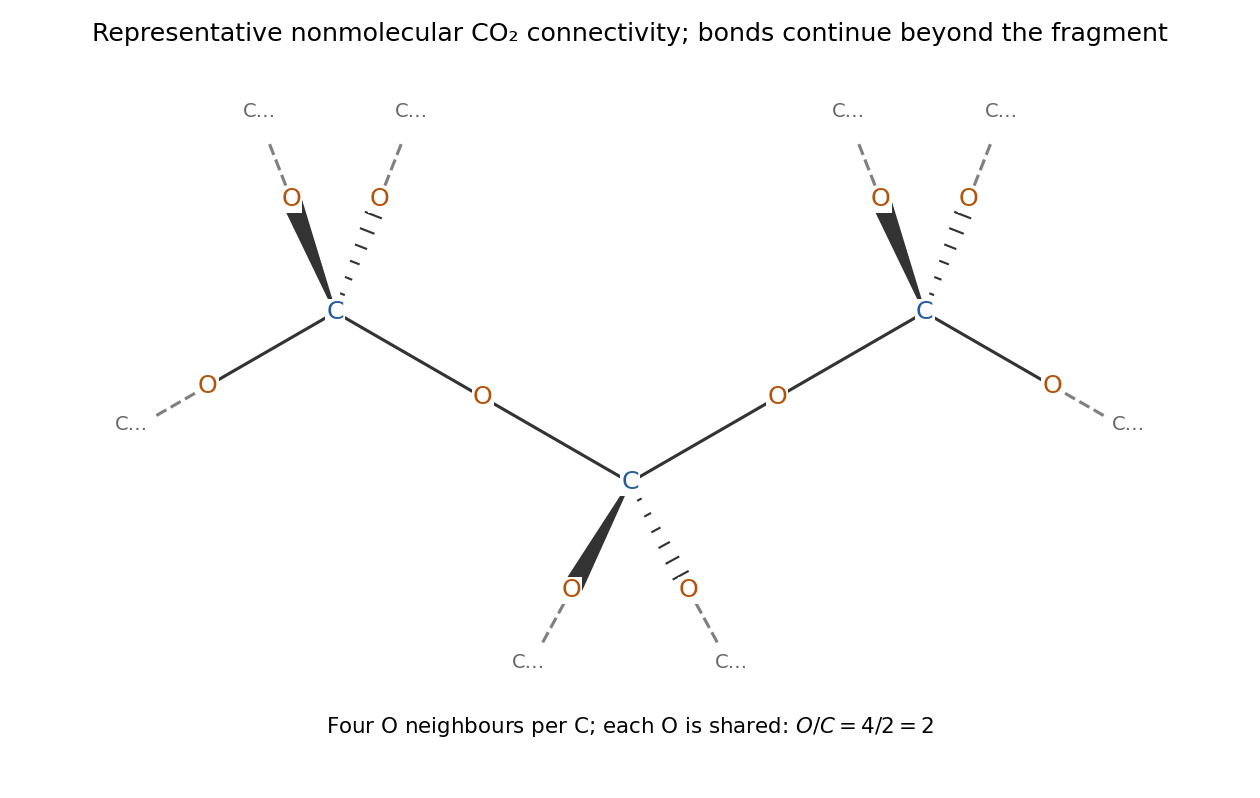
Original representative corner-sharing tetrahedral CO2 network fragment; terminal bonds continue into the solid
. Details. 
Amine nitrogen binds the carbon end of CO; Mg binds through oxygen. The polarized C=O bonds make carbon electrophilic and oxygen electron rich. An amine nitrogen lone pair therefore donates toward carbon, potentially giving a carbamate-like adduct after proton transfer. The hard Lewis acid Mg accepts an oxygen lone pair, either from coordinated CO or from an oxygen of a captured carbamate species. Simply reversing these assignments because nitrogen and oxygen both have lone pairs would put two electron-pair donors together without accounting for the electrophilic site.
The local binding pattern does not by itself determine the full proton-transfer state or whether cooperative chains form; those depend on the framework and amine arrangement. A documented diamine-appended framework shows cooperative carbon-dioxide insertion and ammonium carbamate chain formation, illustrating one possible implementation.[ref]
To regenerate the material, lower the CO chemical potential using reduced pressure or a CO-free purge, and, where binding is exothermic, heat the framework to favour desorption. The temperature must remain compatible with framework stability. This reverses adsorption or reversible chemisorption; it does not require permanently destroying the metal–organic framework.
Articles by others on the same topic
There are currently no matching articles.