The diagnostic infrared spectroscopy absorptions are the conjugated ester carbonyl near and the alkene stretch near . Reasonable approximate ranges are – and –, respectively. Conjugated system lowers the carbonyl stretching spectroscopic wavenumber relative to an unconjugated ester.
The ester C–O stretches and strong C–F stretches lie mainly in the – region. Vinylic C–H stretching is just above , and saturated C–H stretching is about –. There is no hydroxy group to give a broad O–H band.
The assignments are : ppm, H, doublet of quartets; : ppm, H, doublet of quartets; : ppm, H, quartet; : ppm, H, triplet. The chemical shift of a multiplet is its centre, rather than its most downfield line.
Each vinylic proton has scalar spin-spin coupling to the other vinylic proton and to three equivalent spin- fluorine nuclei. The first interaction produces a doublet, and the second a quartet: eight lines overall, partly interleaved for . The two chemical shifts differ because the vinylic sites have different substituents.
The ethoxy protons are deshielded by oxygen and split into a quartet by the three methyl protons. The methyl protons are split into a triplet by the two equivalent methylene protons. The relative NMR signal integrals are .
Use the NMR coupling constant conversion . At , separating the overlapping quartets givesThe doublet separation independently gives . For , the two quartets are and ppm; simply taking adjacent lines in their combined ordering would mix different scalar spin-spin couplings.
The methylene quartet gives an average adjacent spacing ppm, or . Thus its printed rounded positions agree with the methyl-derived value to about ; quote the ethyl NMR coupling constant as approximately –. The large vinylic value supports the trans arrangement. The arrows below join the interacting nuclei; each arrow to represents the same interaction with each equivalent fluorine nucleus.
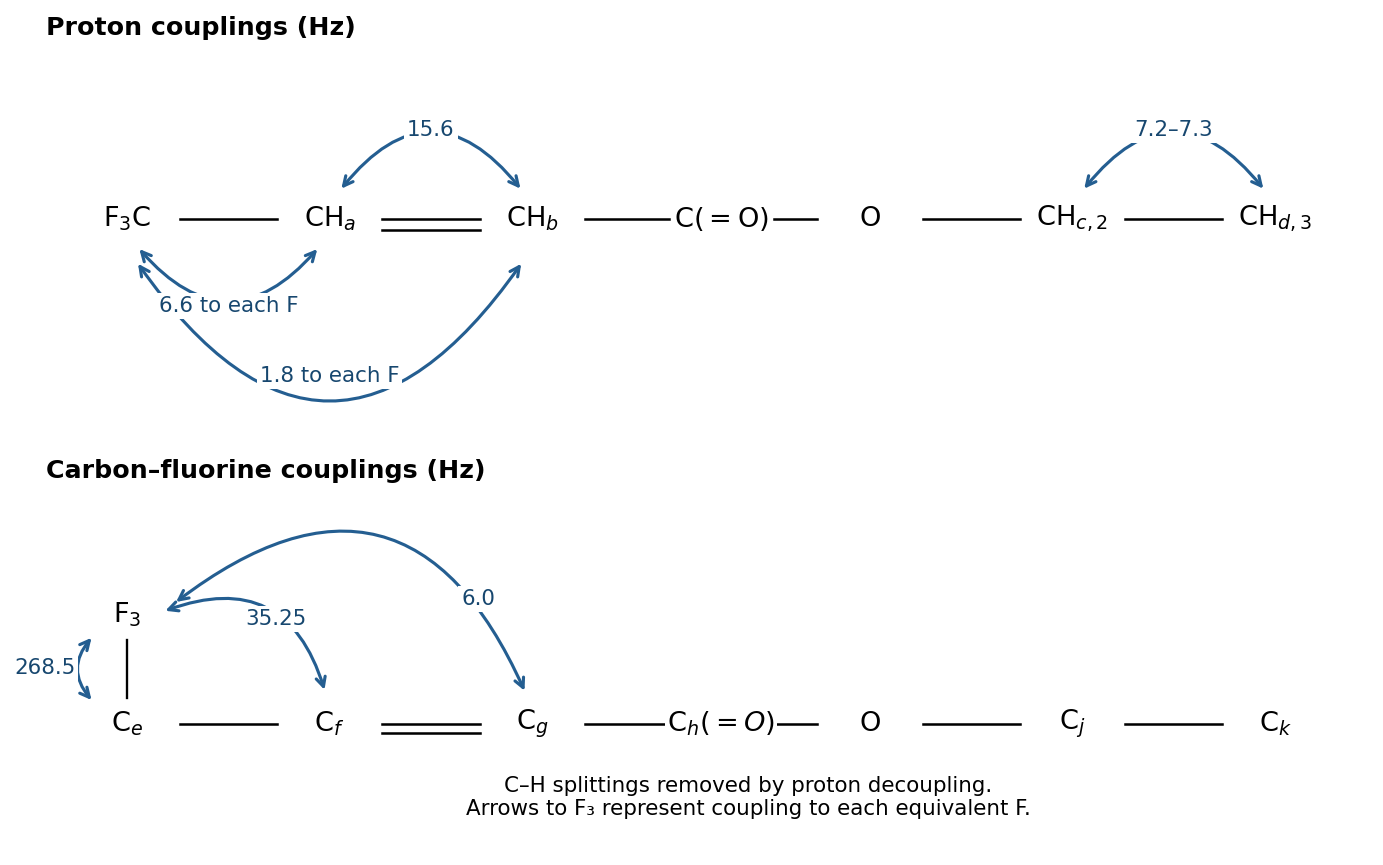
Calculated scalar spin-spin couplings for the vinylic, ethyl and trifluoromethyl sites
. Details. 
The six carbon environments are assigned as follows, with chemical shifts at the centres of the fluorine-split multiplets:The supplied carbon-13 spectrum is interpreted as proton-decoupled NMR, as indicated by its unsplit ethoxy signals. Proton decoupling removes C–H splitting but leaves C–F scalar spin-spin coupling. Three equivalent spin- fluorine nuclei give each resolved quartet its intensity pattern. The carbonyl's much smaller four-bond C–F interaction is unresolved in the plotted spectrum; “singlet” describes what is observed, rather than proving an exactly zero interaction.
The wide quartet is centred at ppm. The other two centres are and ppm. The signal near ppm is the deuterated chloroform solvent, not another carbon of the analyte. The structure labels skip : the ethoxy methylene is .
At a carbon-13 resonance frequency of , the three resolved NMR coupling constants areEach is the spacing of adjacent lines within its own quartet. The lower panel of the original coupling diagram in 1(b)(ii) marks the corresponding carbon–fluorine interactions. The bond superscripts count bonds along the connecting path; they are not additional numerical factors multiplying .
One fluorine-19 NMR resonance, integrating to three equivalent fluorine nuclei, appears as a doublet of doublets with and . This predicts four principal lines of equal intensity, from coupling to and , respectively. Relative to the unknown resonance centre, their offsets are and .
Equivalent fluorine nuclei do not split one another. This prediction assumes ordinary proton-coupled acquisition; proton decoupling would collapse these four principal lines to a singlet. The proton and carbon spectra do not determine the numerical fluorine chemical shift. Weak natural-abundance carbon-13 satellites could accompany the principal pattern.
Articles by others on the same topic
There are currently no matching articles.