End-on overlap produces and molecular orbitals; side-on overlap produces and molecular orbitals. Matching signs of the facing atomic orbital lobes give constructive interference and a bonding molecular orbital. Opposite signs give destructive interference and an additional nodal plane between the atomic nuclei in the antibonding molecular orbital.
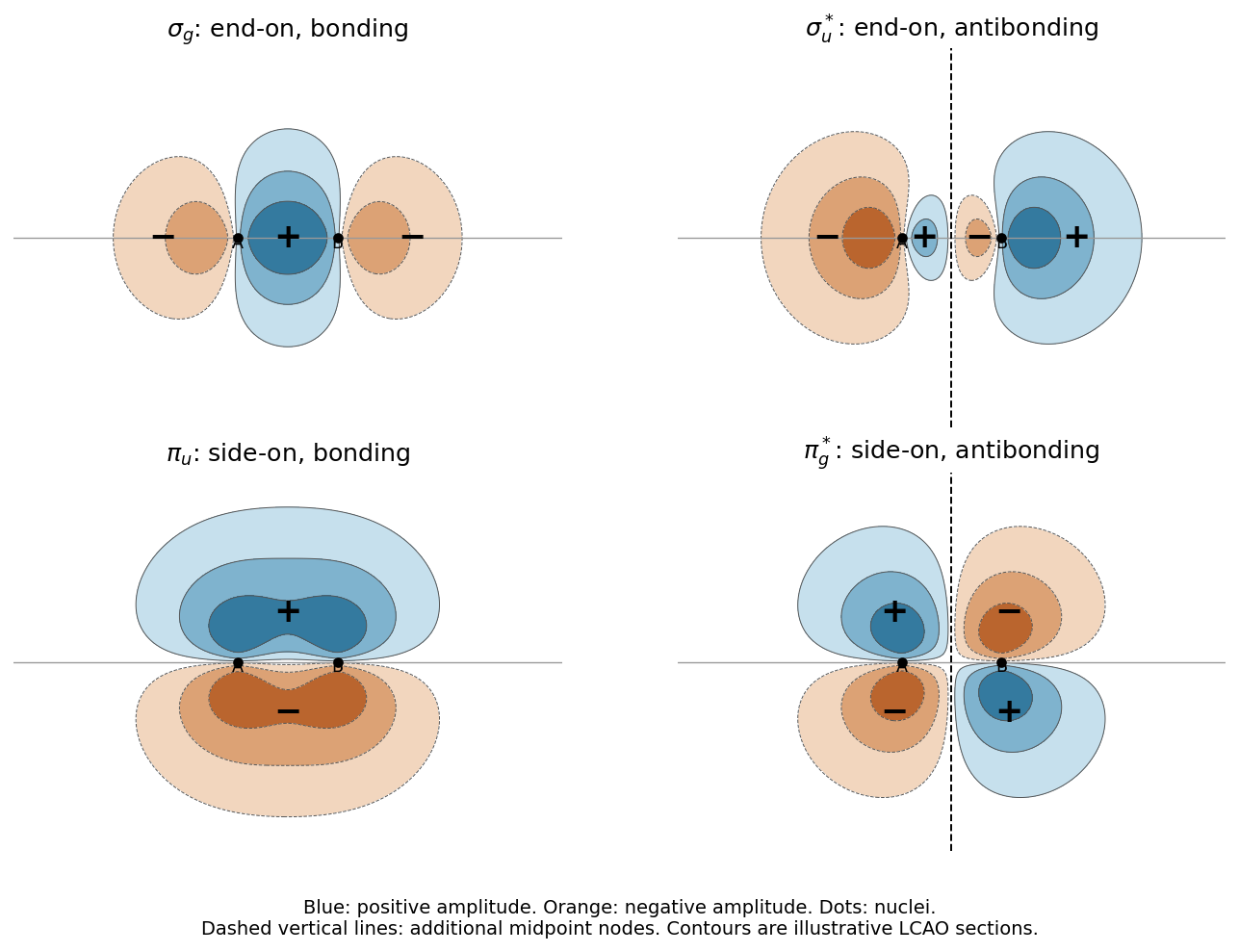

Take the internuclear direction as , and define both atomic functions as positive on their own right-hand side. Up to wavefunction normalization, the combinations areThe minus sign in the bonding combination follows from this common-axis quantum phase convention: the facing lobes of the two unmodified functions have opposite signs. It does not make that combination antibonding. Every molecular orbital also has a nodal plane containing the internuclear axis; the additional midpoint node distinguishes from .
The labels apply when the molecule has an inversion centre, as a homonuclear diatomic molecule does. The label means , and means , with the origin at that centre. In a heteronuclear diatomic molecule, inversion exchanges different atomic nuclei and these are generally not valid symmetry labels.
For the p-derived combinations above,Inversion both exchanges the two centres and changes the sign of each individual p atomic orbital. Applying both operations to each sum or difference gives these labels. The star denotes antibonding molecular orbitals, independently of parity: a bonding molecular orbital need not always be .
Articles by others on the same topic
There are currently no matching articles.