For a hydrogen-like ion, the Coulomb potential is stronger by the nuclear atomic number , and the energy levels scale as :Here is the number of protons in the atomic nucleus; the ion has exactly one electron, so its net electric charge is . The zero of energy is a separated stationary electron and atomic nucleus at infinite distance. This is the nonrelativistic hydrogenic approximation using the supplied ; a more precise isotope-specific result also corrects the reduced mass.
The lowest two energy levels have and . For carbon, , even though the ion's net charge is :Increasing raises the energy toward zero; the most negative value is the ground-state energy.
An emitted photon has positive energyFor spontaneous emission into , the conservation of energy equation isConsequentlyThe principal quantum number must be an integer, so the transition is . Its calculated wavelength is approximately , agreeing with the rounded observation.
End-on overlap produces and molecular orbitals; side-on overlap produces and molecular orbitals. Matching signs of the facing atomic orbital lobes give constructive interference and a bonding molecular orbital. Opposite signs give destructive interference and an additional nodal plane between the atomic nuclei in the antibonding molecular orbital.
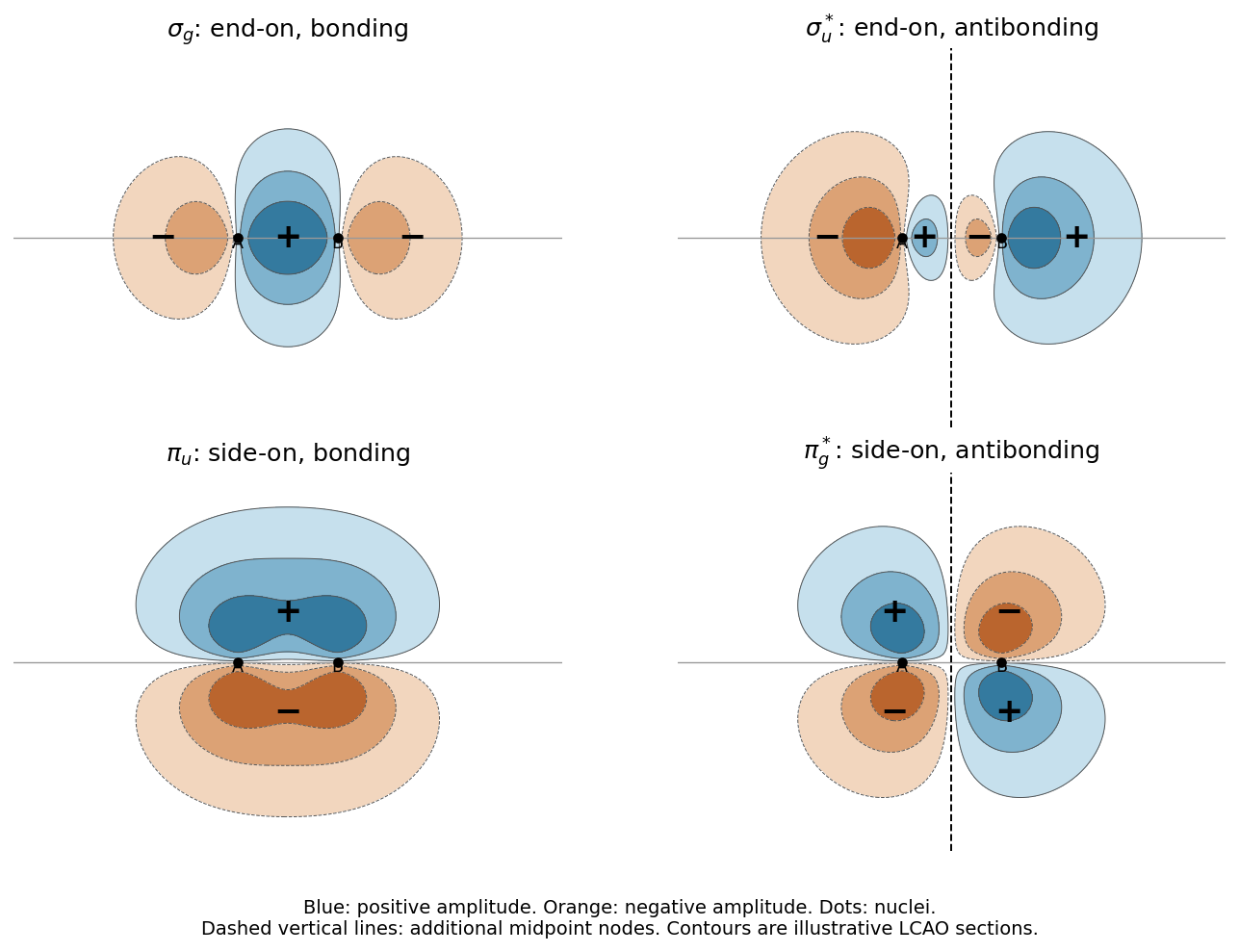

Take the internuclear direction as , and define both atomic functions as positive on their own right-hand side. Up to wavefunction normalization, the combinations areThe minus sign in the bonding combination follows from this common-axis quantum phase convention: the facing lobes of the two unmodified functions have opposite signs. It does not make that combination antibonding. Every molecular orbital also has a nodal plane containing the internuclear axis; the additional midpoint node distinguishes from .
The labels apply when the molecule has an inversion centre, as a homonuclear diatomic molecule does. The label means , and means , with the origin at that centre. In a heteronuclear diatomic molecule, inversion exchanges different atomic nuclei and these are generally not valid symmetry labels.
For the p-derived combinations above,Inversion both exchanges the two centres and changes the sign of each individual p atomic orbital. Applying both operations to each sum or difference gives these labels. The star denotes antibonding molecular orbitals, independently of parity: a bonding molecular orbital need not always be .
One consistent localized orbital hybridization description uses the Lewis structuresFor methyldiazonium, take C as and both N atoms as . For diazomethane, the double-bond resonance contributor suggests C as , central N as , and terminal N as . The central N uses two opposite hybrids for the linear C–N–N sigma bond framework. In the localized double-bond picture, terminal N uses one hybrid for its sigma bond, two for lone pairs, and its remaining p atomic orbital for a pi bond.
These labels specify an approximate bonding construction, not uniquely measurable atomic properties. An alternative representation takes terminal N as , with one lone pair and one p lone pair; the latter can participate in the delocalized C–N–N system. It describes the same resonance more explicitly. Neither construction requires an unpaired electron or a bent central N.
There are valence electrons, all paired, so diazomethane exhibits diamagnetism. A localized orbital occupancy consistent with the double-bond construction in 2(c)(i) isHere mean central and terminal. Each listed occupied spatial orbital contains two electrons of opposite spin. The central N's two p atomic orbitals are perpendicular, so they can support the two perpendicular pi bonds. No central-N lone pair is left over: its positive formal charge accompanies four bonding pairs in this Lewis structure.
Allowing resonance mixes a terminal-N lone pair into the C–N–N orbitals. In the alternative terminal- basis, the same electron count is four occupied orbitals ( electrons), one terminal- lone pair (), one perpendicular N–N orbital (), and two occupied orbitals of a three-centre C–N–N system (). The -electron count and the paired ground state survive this change of description; the localized picture does not assert two perfectly isolated double bonds.
On carbon protonation, the C–N bond length increases and the N–N bond length decreases. Forming the fourth C sigma bond changes the carbon from approximately planar to tetrahedral , removing its effective C–N pi bonding. The product is described by : C–N becomes predominantly single and N–N predominantly triple. The resonance of the unprotonated species makes its actual bond orders intermediate rather than exact integers.
Articles by others on the same topic
There are currently no matching articles.