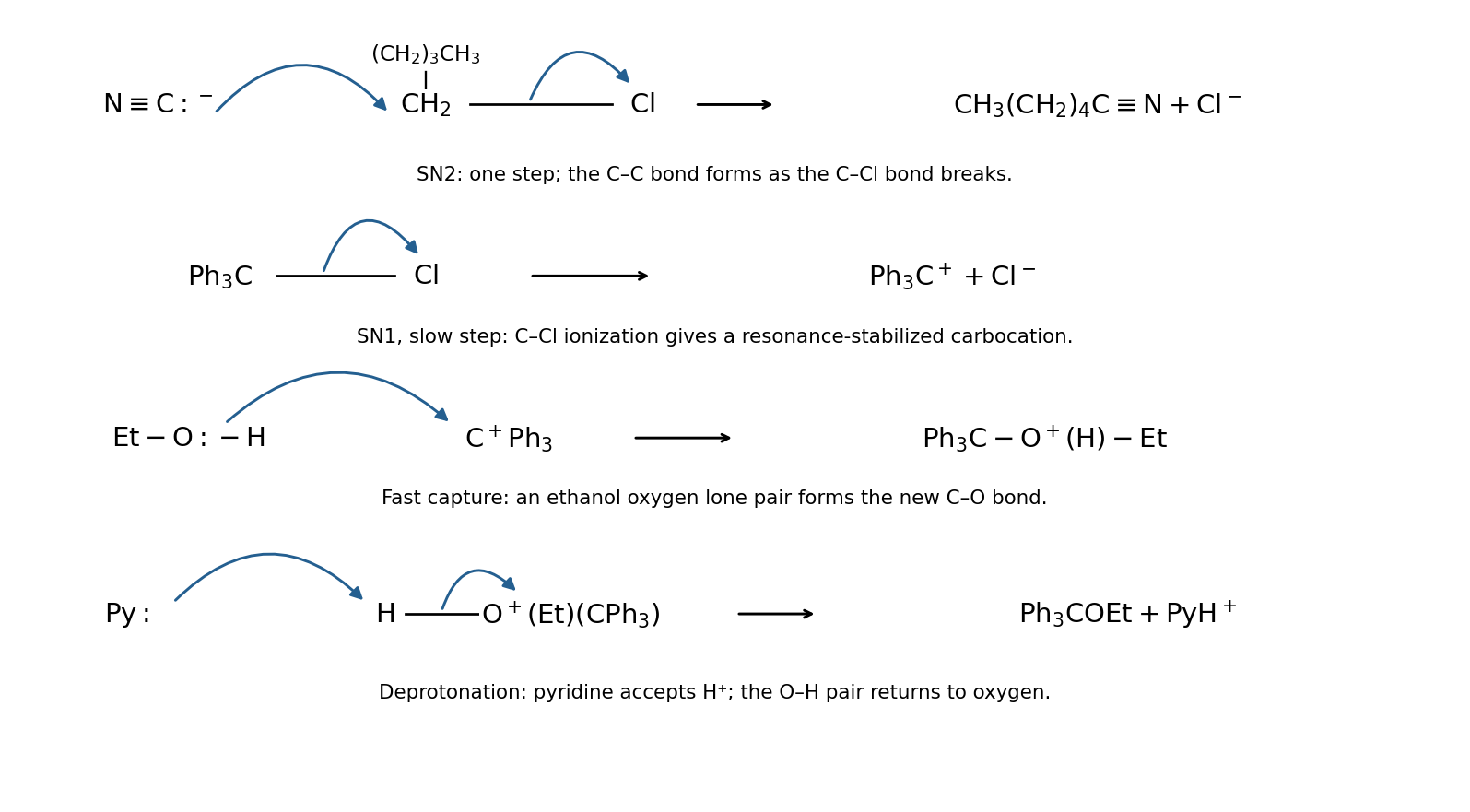
The products are hexanenitrile, , and ethyl triphenylmethyl ether, . The nitrile carbon comes from cyanide, so replacing chloride in the five-carbon chain gives a six-carbon product.
For the primary chloride, the carbon-end lone pair of attacks the carbon carrying Cl from the back side while the C–Cl bond pair moves onto Cl. The single concerted nucleophilic substitution step forms the C–C bond and releases . Attack through the carbon end gives the nitrile, not an isocyanide.

Articles by others on the same topic
There are currently no matching articles.