The products are hexanenitrile, , and ethyl triphenylmethyl ether, . The nitrile carbon comes from cyanide, so replacing chloride in the five-carbon chain gives a six-carbon product.
For the primary chloride, the carbon-end lone pair of attacks the carbon carrying Cl from the back side while the C–Cl bond pair moves onto Cl. The single concerted nucleophilic substitution step forms the C–C bond and releases . Attack through the carbon end gives the nitrile, not an isocyanide.
For the triphenylmethyl chloride, the C–Cl bond first undergoes heterolysis to and . An ethanol oxygen lone pair then attacks the carbocation, giving . Finally pyridine accepts that O–H proton, with the O–H bond pair returning to oxygen, giving the neutral ether and pyridinium chloride.
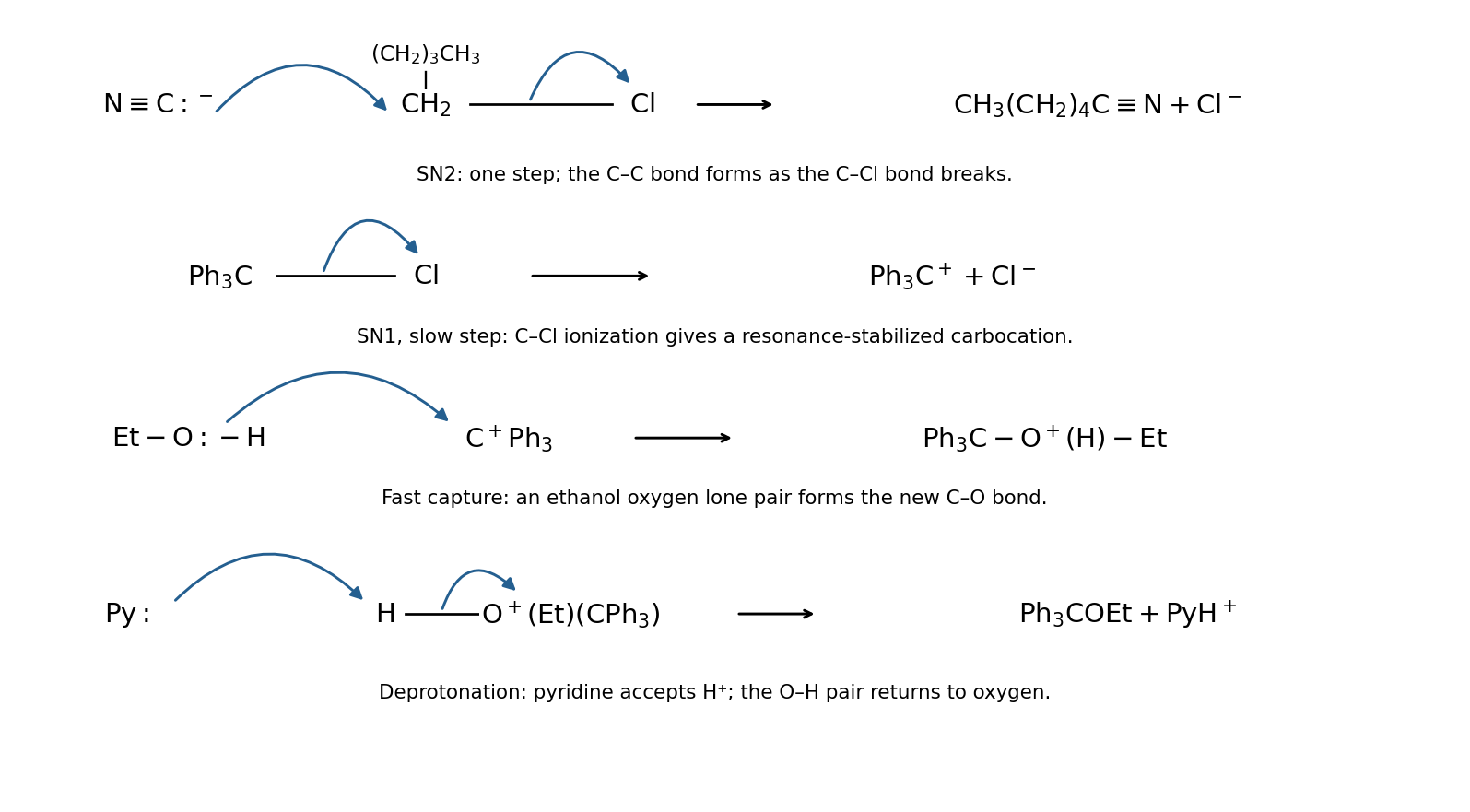

The primary chloride undergoes an SN2 reaction; the triphenylmethyl chloride undergoes an SN1 reaction. The primary site is accessible to back-side attack, whereas three phenyl groups make back-side attack at the triphenylmethyl site extremely hindered and stabilize its carbocation through resonance.
For the SN2 reaction, a suitable transition state isThe entering C and leaving Cl lie on opposite sides of the reacting carbon, with partial C–C and C–Cl bonds. The total charge is . This transition state is not a discrete reaction intermediate.
For the SN1 reaction, the approximately planar carbocation is a genuine reaction intermediate. Assuming its formation by C–Cl heterolysis is rate determining and trapping is rapid,Thus the limiting rate law is independent of ethanol concentration. The successive attack and proton transfer occur after the slow ionization; a cation-stabilizing environment and efficient trapping underpin this idealized SN1 description.
Articles by others on the same topic
There are currently no matching articles.