The products are hexanenitrile, , and ethyl triphenylmethyl ether, . The nitrile carbon comes from cyanide, so replacing chloride in the five-carbon chain gives a six-carbon product.
For the primary chloride, the carbon-end lone pair of attacks the carbon carrying Cl from the back side while the C–Cl bond pair moves onto Cl. The single concerted nucleophilic substitution step forms the C–C bond and releases . Attack through the carbon end gives the nitrile, not an isocyanide.
For the triphenylmethyl chloride, the C–Cl bond first undergoes heterolysis to and . An ethanol oxygen lone pair then attacks the carbocation, giving . Finally pyridine accepts that O–H proton, with the O–H bond pair returning to oxygen, giving the neutral ether and pyridinium chloride.
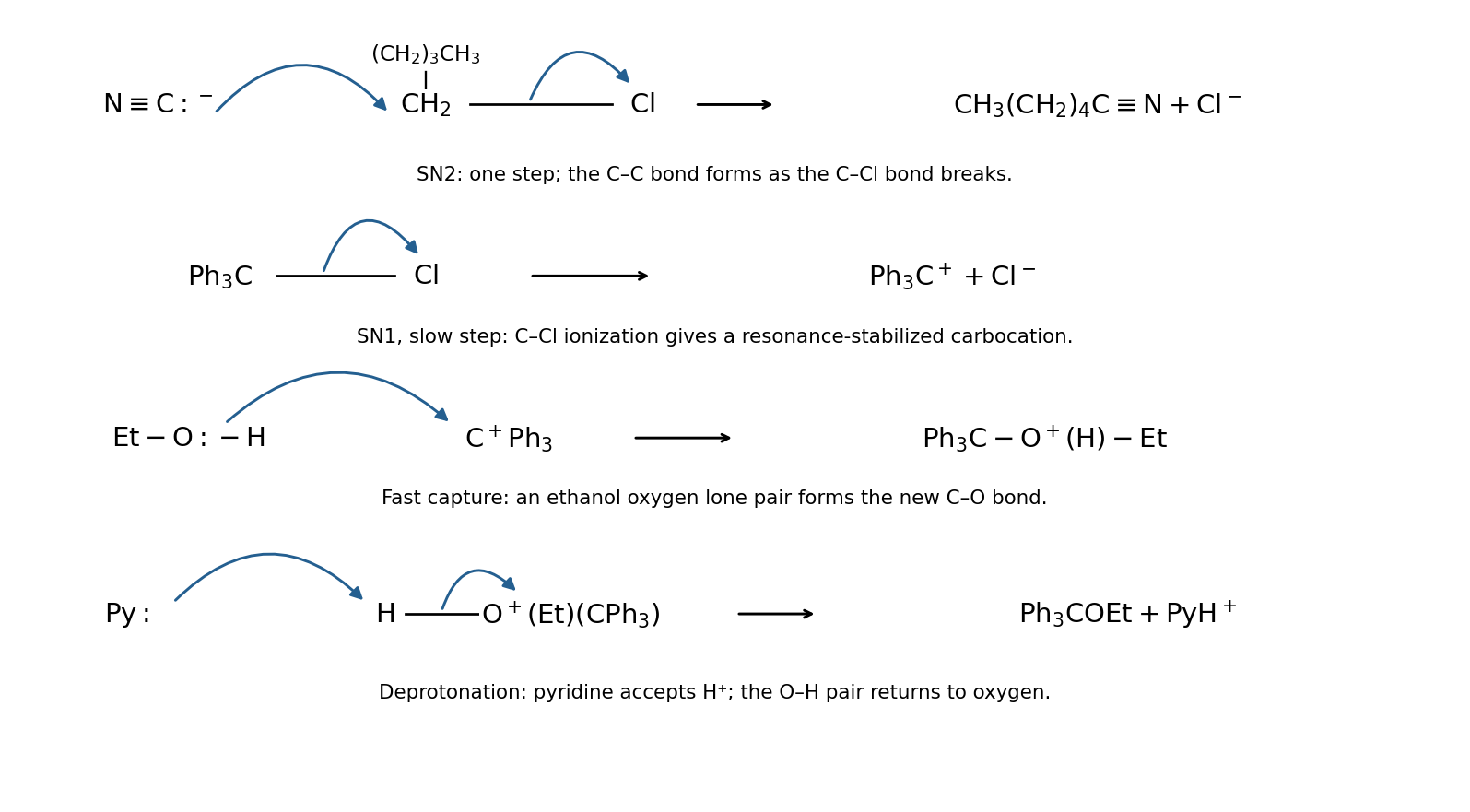
The primary chloride undergoes an SN2 reaction; the triphenylmethyl chloride undergoes an SN1 reaction. The primary site is accessible to back-side attack, whereas three phenyl groups make back-side attack at the triphenylmethyl site extremely hindered and stabilize its carbocation through resonance.
For the SN2 reaction, a suitable transition state isThe entering C and leaving Cl lie on opposite sides of the reacting carbon, with partial C–C and C–Cl bonds. The total charge is . This transition state is not a discrete reaction intermediate.
For the SN1 reaction, the approximately planar carbocation is a genuine reaction intermediate. Assuming its formation by C–Cl heterolysis is rate determining and trapping is rapid,Thus the limiting rate law is independent of ethanol concentration. The successive attack and proton transfer occur after the slow ionization; a cation-stabilizing environment and efficient trapping underpin this idealized SN1 description.
B is 4-hydroxy-1-methylpyrrolidin-2-one; C is 1-methylpyrrolidin-3-ol. Their ring connectivities are shown below. Each ring remains five membered; the attached N-methyl group is retained.
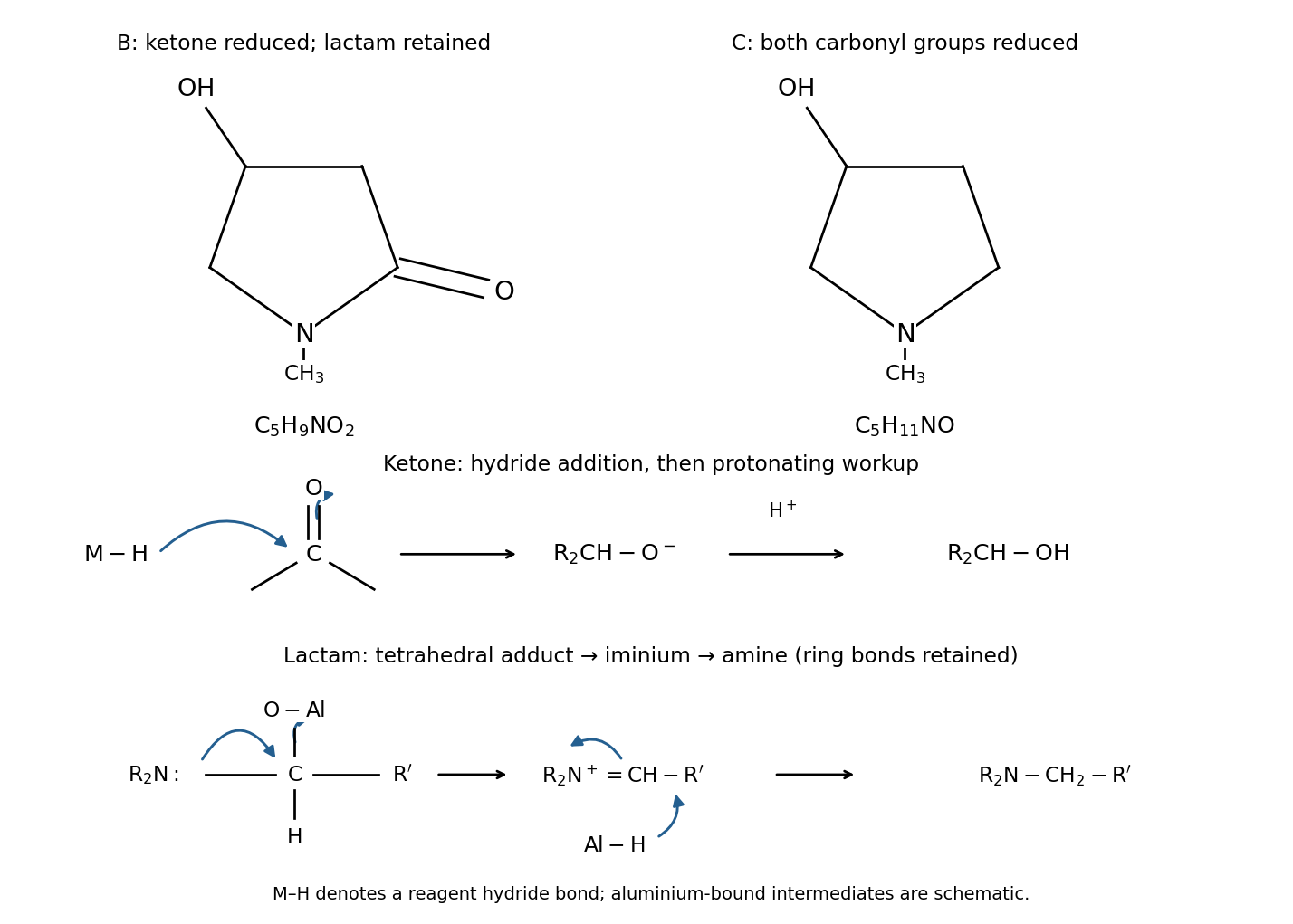


For B, a B–H bond of sodium borohydride supplies a hydride equivalent to the ketone carbonyl carbon, and the carbonyl pair moves to oxygen. This gives an alkoxide, whose protonation during the reaction or workup gives the secondary alcohol. The lactam carbonyl remains. Converting one to adds two H atoms and gives .
For C, lithium aluminium hydride reduces that ketone in the same net way and also reduces the lactam. Coordination of the amide oxygen to aluminium assists hydride attack at its carbonyl carbon, giving a tetrahedral intermediate. The N lone pair then forms a C=N bond while the C–O bond breaks to an aluminium-bound oxygen group. A resulting iminium ion accepts a second hydride at carbon, yielding the cyclic tertiary amine. Aqueous workup protonates the ketone-derived alkoxide.
The lactam conversion replaces by ; its oxygen is removed rather than retained as another alcohol. Together with ketone reduction, the net change is , giving . No stereochemistry is specified: the new alcohol stereocentre is formed as a racemic mixture in an achiral environment.
Sodium borohydride is chemoselective for the ketone; lithium aluminium hydride reduces both the ketone and the lactam. In an amide, donation of the N lone pair into the carbonyl system reduces the carbonyl carbon's electrophilicity. It is therefore substantially less susceptible to the milder hydride donor.
Lithium aluminium hydride supplies more strongly reducing hydride equivalents, and the strong affinity of aluminium for oxygen assists removal of the amide oxygen through the iminium pathway. This difference explains both the unchanged lactam carbonyl in B and the absence of that oxygen in C. Both reactions are interpreted after the usual protonating workup.
D is , and E is . D results from transesterification; E results from acid-catalysed acetal hydrolysis.
For D, methoxide attacks the ester carbonyl carbon and moves the carbonyl pair to oxygen. Collapse of the tetrahedral reaction intermediate reforms C=O and expels ethoxide. Proton transfer with the methanol solvent regenerates methoxide. Excess methanol favours replacement of the ethyl ester by a methyl ester; the dimethyl acetal survives these basic conditions.
For E, protonate one acetal oxygen, then break its C–O bond with the pair going to oxygen, releasing methanol and forming an oxocarbenium ion. Water attacks that carbon. Deprotonation gives a hemiacetal; protonation of its remaining methoxy oxygen permits loss of a second methanol. The hydroxyl oxygen's lone pair forms C=O during this loss, and deprotonation gives the aldehyde, regenerating the acid catalyst.
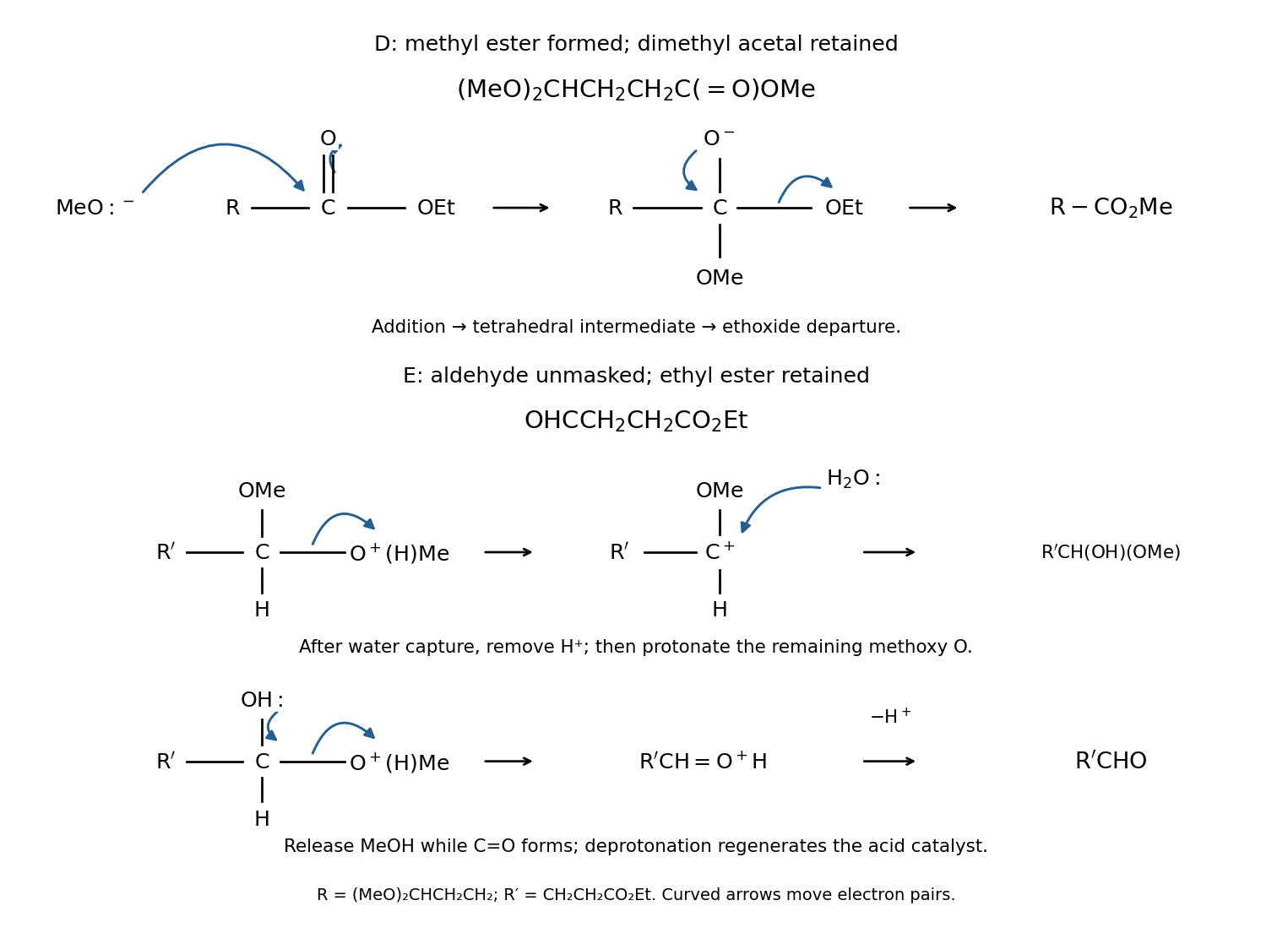
Original products and electron-flow steps for transesterification and acid-catalysed acetal hydrolysis
. Details. 
The spectroscopy is consistent with these products. D has one ester carbonyl near and six carbon-13 NMR environments: acetal CH, two distinct chain sites, carbonyl, ester , and the two equivalent acetal groups. Thus seven carbon atoms give six resonances. E has separate ester and aldehyde carbonyl bands, approximately and , and six distinct carbon atoms: two carbonyls, two chain methylenes and the two ethyl carbons.
Basic methanol exchanges the ester alkoxy group while retaining the acetal; dilute aqueous acid removes the acetal while retaining the ethyl ester on the stated reaction timescale. An acetal lacks an electrophilic carbonyl and is stable to ordinary base: expelling methoxide directly would require a poor leaving group. The ester can instead undergo nucleophilic acyl substitution through a carbonyl-derived tetrahedral intermediate.
Under acid, protonating an acetal oxygen converts an alkoxy substituent into departing methanol, and the resulting oxocarbenium is stabilized by its remaining oxygen. Water then drives acetal hydrolysis toward the aldehyde. Ester hydrolysis is also possible under acid, but is slower under the conditions implied by the product data. The retained ethyl group and six distinct carbon-13 NMR environments support E rather than the carboxylic acid that prolonged hydrolysis could produce.
Articles by others on the same topic
There are currently no matching articles.